Why Buying Cisco Hardware Feels More Like Buying SaaS Now
There was a time when buying Cisco gear was simple.
Why Buying Cisco Hardware Feels More Like Buying SaaS Now
There was a time when buying Cisco gear was simple.
You picked the switch. You approved the quote. You installed the hardware. And that was the end of the story.
Not anymore.
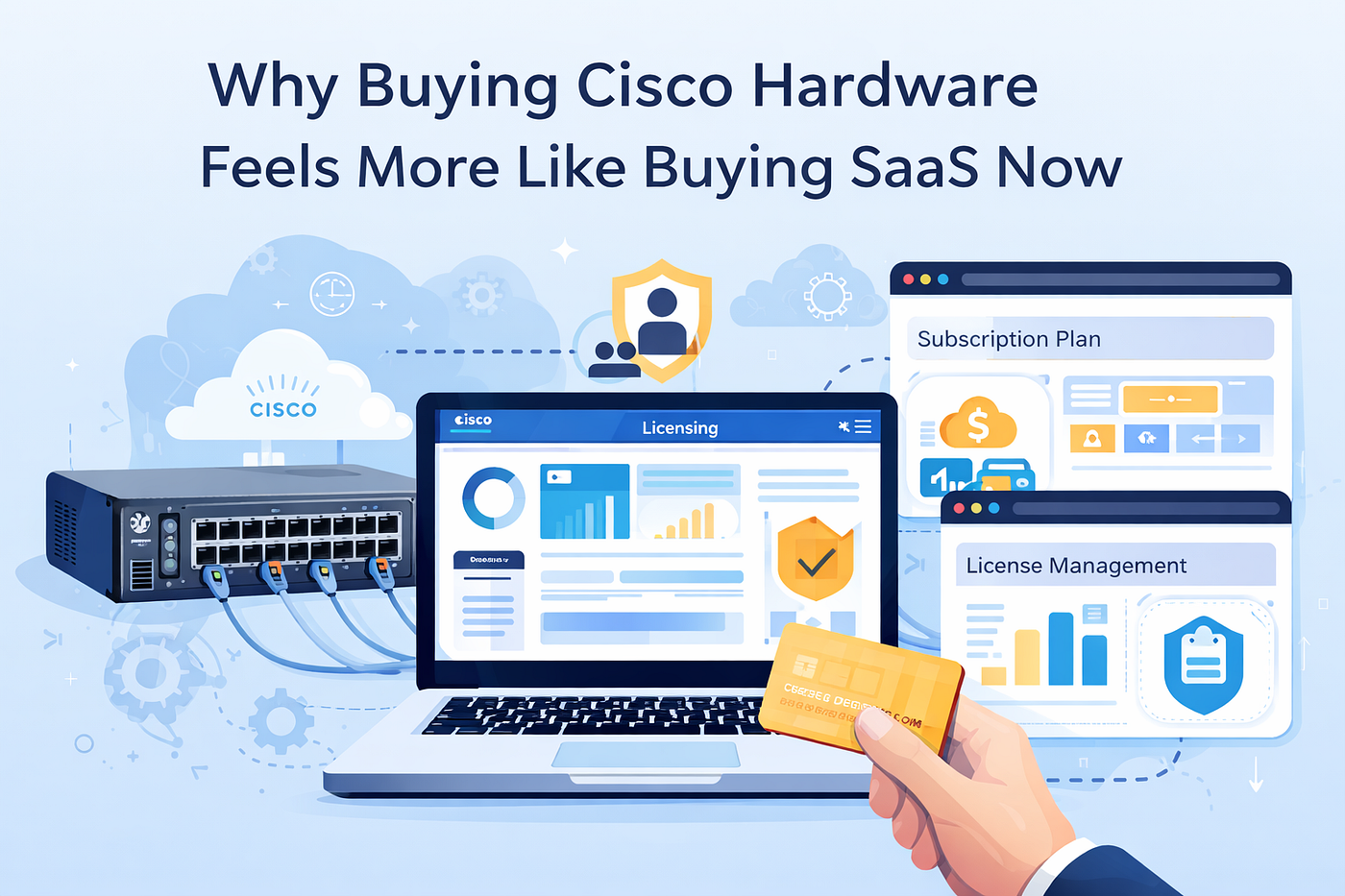
Today, buying Cisco infrastructure often feels less like purchasing hardware and more like signing up for a software platform with a networking device attached.
That is the part many buyers still underestimate.
They think they are evaluating a box.
In reality, they are evaluating a stack of hardware, subscriptions, support contracts, account structures, renewal timelines, and compliance risk.
And when teams do not realize that early enough, they overspend.
Sometimes badly.
The old model was easy to understand. You bought the equipment, activated the features, and moved on. Cisco’s newer licensing model changed that. Now, software entitlement, Smart Accounts, Virtual Accounts, subscription terms, and lifecycle planning sit much closer to the center of the buying decision.
That shift matters because most procurement mistakes no longer happen at the rack.
They happen on the quote.
A lot of enterprise teams still approach Cisco purchasing as if the hardware is the product and everything else is secondary. That mindset no longer works.
Modern Cisco purchasing usually has three different layers.
The first is the physical hardware.
This is the part buyers understand best. Port count, PoE budget, uplinks, throughput, model family, expansion options. This is still important, of course. Hardware determines the physical potential of the deployment.
But that is all it does.
It defines what the platform can be.
It does not automatically define what your team will actually be allowed to use.
That is where the second layer starts.
Software.
And this is where things get expensive.
On many Cisco platforms, software is no longer just a nice extra. It is part of the commercial model from day one. The hardware may sit in your rack for years, but the software entitlement is often tied to a term, a feature tier, and an account structure that must be actively managed.
This is why so many organizations approve a Cisco quote without fully understanding what they are really paying for.
They see the device.
They do not see the licensing architecture behind it.
Then there is the third layer: support.
This is another area where buyers get tripped up.
Support is not the same as software. Software is not the same as warranty. And warranty is not the same as Smart Net.
Those may sound like small distinctions, but in procurement terms they are huge.
Because when something expires, fails, or needs to be renewed, those differences suddenly become very expensive.
This is the hidden reality of Cisco buying today:
you are not just buying infrastructure.
You are buying an operating model.
And that operating model can either stay under control, or slowly become a budget leak.
One of the biggest reasons is Smart Licensing.
In the old world, licensing felt local. You activated something on a device and moved on.
In the new world, licensing is managed through account structures, entitlements, renewals, and centralized control. That creates flexibility, but it also creates administrative complexity. If a company does not structure its Smart Account and Virtual Accounts correctly, it can end up confused, out of compliance, or simply unable to see what it owns clearly.
That may not sound dramatic.
But at scale, it becomes a real operational problem.
And that is before we even get to software tiers.
Because this is where overspending becomes normal.
A lot of companies buy more licensing than they need simply because nobody on the quote review process stops to ask a basic question:
Does this deployment actually need the higher tier?
In many real-world cases, the answer is no.
But in enterprise procurement, defaulting to the more expensive option often feels safer than asking harder questions.
So teams keep paying for capabilities they may never use.
Year after year.
Then renewal season arrives, and the confusion gets worse.
This is another place where Cisco procurement catches people off guard.
When a subscription term ends, the hardware does not suddenly stop being a switch. It does not turn into a brick overnight. But the business impact can still be meaningful, because software access, management capability, and update-related value can change depending on the product and licensing model. That makes renewal planning a strategic decision, not just an administrative task.
And that is the bigger point.
Cisco procurement is no longer a one-time transaction.
It is lifecycle management.
It is budgeting strategy.
It is architecture planning.
It is policy.
It is renewal discipline.
And for many organizations, that is exactly why the buying process feels far more complicated than it used to.
Because it is.
The hardware may still be physical.
But the buying model is increasingly digital.
That is why companies that treat Cisco licensing as a minor detail usually end up learning the hard way. The risk is not just paying too much on day one. The real risk is building a purchasing model that stays unclear for years.
If your team is trying to make sense of Smart Licensing, DNA subscriptions, support boundaries, renewal impact, or software tier selection, this guide breaks it down well in practical procurement language:
The Ultimate Guide to Cisco Licensing, Subscriptions, and Smart Accounts for Enterprise Procurement https://www.layer23-switch.com/blog/cisco-licensing-ultimate-guide.html
It is worth reading before your next Cisco quote turns into a licensing problem disguised as a hardware purchase.
Cisco #Networking #EnterpriseIT #ITProcurement #CiscoLicensing #SmartLicensing #NetworkInfrastructure
메타데이터
- post_id
- 75f8bcae620d
- slug
- why-buying-cisco-hardware-feels-more-like-buying-saas-now-75f8bcae620d
- url
- https://medium.com/@h.kionf/why-buying-cisco-hardware-feels-more-like-buying-saas-now-75f8bcae620d
- canonical_url
- https://medium.com/@h.kionf/why-buying-cisco-hardware-feels-more-like-buying-saas-now-75f8bcae620d
- author_url
- https://medium.com/@h.kionf
- status
- ok
- fetched_at
- 2026-08-10 22:06:59