Everyone’s Asking Who Wins the Agent Platform War. That’s the Wrong Question.
Four giants are spending billions to own the agent stack — and simultaneously funding the open standards that make each other…
Everyone’s Asking Who Wins the Agent Platform War. That’s the Wrong Question.
Four giants are spending billions to own the agent stack — and simultaneously funding the open standards that make each other interchangeable. Once you see why, you stop picking a winner and start protecting yourself.
If you’ve tried to figure out which agent platform to build on in 2026, you’ve probably read a dozen “who’s winning” articles and come away more confused than when you started. Each one crowns a different champion. Each one is convincing.
There’s a reason for that, and it isn’t that the analysts are bad at their jobs. It’s that “who wins?” is a question borrowed from the last era of technology — the browser wars, the mobile OS wars — where one platform’s victory meant the others died. That’s not the shape of this fight. And the tell is a contradiction hiding in plain sight.
The contradiction: they’re fighting and cooperating
Above the waterline, this looks like total war. Anthropic pulled ahead on the strength of Claude Code (its AI coding assistant), and OpenAI redirected much of its focus from consumers to the enterprise, pitting its rival coding agent, Codex, directly against it.
Google used its Cloud Next conference to rebrand its entire platform around agents, with cloud chief Thomas Kurian jabbing at competitors who “hand you the pieces, not the platform.” And Microsoft — which has invested billions in both OpenAI and Anthropic — turned around and started shipping its own models, with Satya Nadella saying companies should stop merely consuming the best available models and start participating in building them.
Read that last one twice. Microsoft is now competing with the companies it funded.
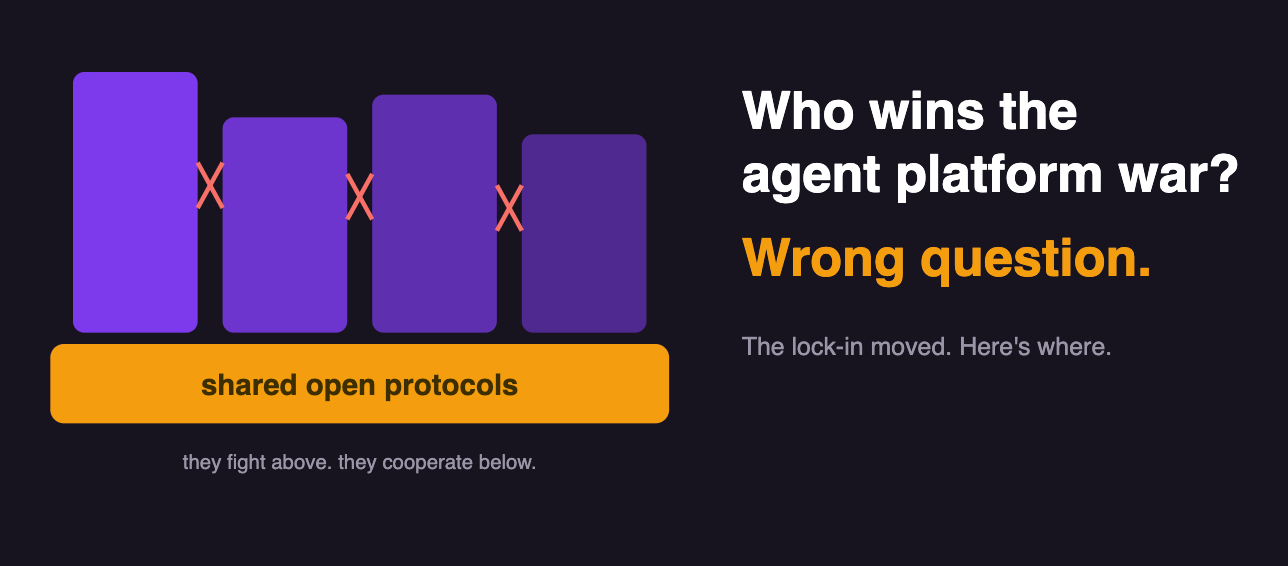
Now look below the waterline. In December 2025, Anthropic donated the Model Context Protocol — the standard that lets agents talk to tools — to the Agentic AI Foundation under the Linux Foundation. Co-founders: OpenAI and Block. Platinum members: AWS, Google, Microsoft, Bloomberg. Google shipped its A2A protocol (agent-to-agent communication) and put it under the same neutral roof, with the stated purpose of stopping the ecosystem from fracturing into incompatible silos.
Read that again. The same four companies burning billions to beat each other are jointly funding the standards that make their platforms interchangeable.
Rivals don’t co-fund a standard unless the thing they actually want to win sits somewhere else entirely.
Why they’re doing it: the model stopped being the moat
Here’s the strategic logic, in plain language.
A few years ago, the model was the product. If your model was two notches better, you won, and everyone accepted lock-in as the price of the best brain. That world is gone. Frontier models are now close enough in capability that — as analysts covering the coding-tool market put it — developers routinely experiment across several, and there’s very little vendor lock-in at the tool layer. When switching costs collapse, the moat leaks.
So the fight moved. It moved to ecosystem: the integrations, the enterprise data connections, the distribution. The model is the foundation; the ecosystem is the moat. Google now offers 200+ models in its garden — including Anthropic’s Claude. Microsoft’s Azure serves models from the same companies it competes with. They’re not being generous. They’re competing to be the place where you run agents, not the company whose model you run.
Which explains the standards. If you’re competing on ecosystem, fragmentation is your enemy — every incompatible protocol is friction that slows enterprise adoption of the whole category. Open standards grow the pie, and each giant is betting it takes the biggest slice. Cooperation below, war above. It’s rational, and it’s a gift to you, though not in the way most people assume.
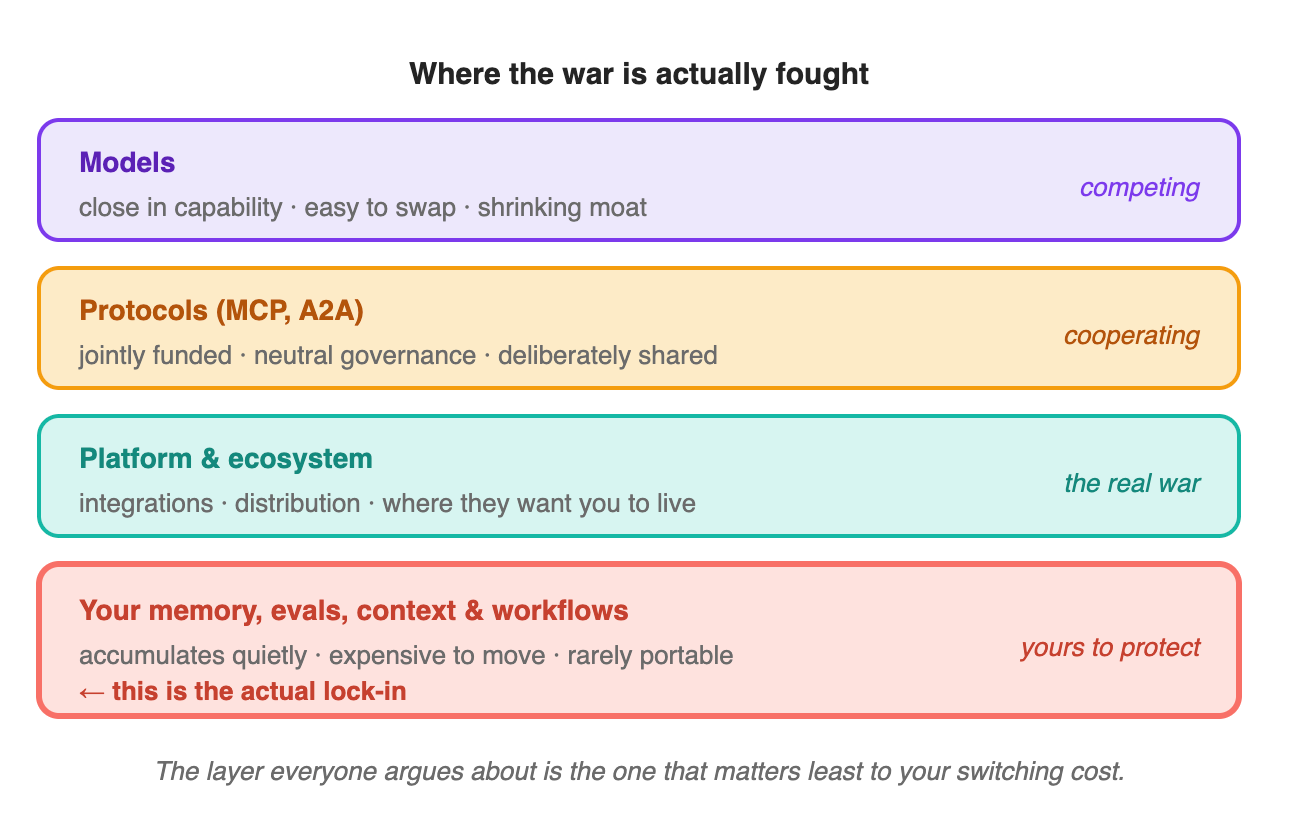
Four layers, one misdirection. The models (purple) are converging and swappable. The protocols (amber) are deliberately shared — jointly funded under neutral governance. The platform and ecosystem layer (teal) is where the giants actually fight. And the bottom layer (coral) — your accumulated memory, evals, context pipelines, and workflow glue — is where your lock-in quietly forms, regardless of who wins above it.
The four positions, honestly
You still have to choose something, so here’s the landscape without the cheerleading — each giant has a structural advantage the others can’t copy:
- Anthropic — reasoning quality and safety positioning; Claude Code drove its lead in the coding-agent market, and it authored MCP, the standard everyone else adopted.
- OpenAI — the largest developer base and the strongest consumer brand, now pivoting hard into the enterprise with Codex and its agent platform.
- Google — it owns the whole stack, top to bottom: its own custom AI chips at the base, Gmail and Workspace at the surface. That means it can run agents (what the industry calls inference — the actual cost of a model doing work) cheaper than rivals renting chips from Nvidia at retail. In a market where that running cost dominates the bill, that’s pricing power.
- Microsoft — the deepest enterprise distribution on earth (Office, Azure, GitHub), and now its own models to reduce dependence on the labs it funded.
Notice what that list isn’t: a ranking. These are four different bets on four different moats, and none of them is losing on any timeline you should plan around.
The uncomfortable part: your real lock-in isn’t the vendor’s
Now the thesis, and it’s the reason I think “who wins?” is a trap.
While you’re worrying about which giant to bet on, the switching cost you should actually fear is accumulating inside your own system — and none of it is the model.
It’s your evals — the graded test cases that encode what “good” means for your agent, built up from months of real production failures. It’s your memory and context pipelines — all the logic that decides what information your agent sees at each step, and what gets summarized away. It’s your guardrails — every hard-won rule about what the agent must never do. And it’s the workflow glue nobody documents but everybody depends on.
Swapping a model is a config change. Rebuilding two years of eval cases because they were trapped in a vendor’s proprietary format is a quarter of engineering time. The industry has told you the danger is choosing wrong. The real danger is building unportable — and it’s a danger you control, not one the vendors decide for you.
Everyone’s arguing about which horse to bet on. The lock-in is in the saddle you built yourself.
“That’s cynical — one of them really will win”
Let me steelman the other side — make the strongest possible case against my own argument — because the winner-take-all view isn’t stupid.
Distribution has decided every platform war in computing history, and Microsoft’s reach — Office, Azure, GitHub — is the kind of advantage that historically ends arguments. Google owning the chips, the cloud, and the inbox could let it undercut everyone on the cost that dominates agent economics.
And a real trap is forming. As one analyst put it about the coding tools: the giants can afford to give the tools away cheaply, because once you’re inside their ecosystem, you’ll pay for their memory and their integrations. That’s the self-reinforcing loop that produces monopolies.
All plausible. But two things blunt it. First, the shared protocol layer is the counterweight, and it exists precisely because everyone — including the would-be monopolists — decided a fractured market was scarier than a competitive one. Standards handed to a neutral foundation are hard to take back.
Second, even if one giant does run away with it, the practical advice doesn’t change. Build portably and you can move when the picture clarifies. Build into a proprietary hole and being right about the winner won’t save you when they raise prices. The prediction is optional. The portability isn’t.
What to actually do
- Stop trying to pick the winner. You’re not an investor. You don’t need a five-year call — you need to be able to move in a quarter.
- Build on the open protocol layer (MCP, A2A). It exists because rivals agreed it should, which is the strongest survival signal a standard can have.
- Own your evals. Keep test cases in plain, portable formats you control. This is the most valuable and least portable asset you’ll build.
- Own your context and memory pipelines. If the logic that manages your agent’s memory only works inside one vendor’s tooling, you’ve built a cage and handed them the key.
- Keep the model swappable. One interface, many providers. Then run the same evals across providers and let the numbers decide — not the keynotes.
- Choose the platform that fits your existing gravity — where your data, your cloud, and your team already live. That beats any leaderboard.
The portability test: five questions, ten minutes
Abstract advice is easy to nod at and ignore, so make it concrete. Ask these five questions about the agent you’re building right now, and you’ll know your real exposure — not to the vendors’ war, but to your own architecture:
- If your model provider doubled prices tomorrow, how long to switch? If the honest answer is “weeks,” the model isn’t your lock-in — something above it is.
- Where do your eval cases live? In a plain file you own, or inside a vendor’s proprietary evaluation product? One of those moves with you.
- Could you export your agent’s memory and run it elsewhere? Not the raw logs — the structured knowledge your agent depends on.
- Are your guardrails written in your own code, or configured in someone’s dashboard? Rules you can’t export are rules you’ll rewrite.
- How much of your prompt and context logic assumes one vendor’s abstractions? That’s the invisible tax you’ll pay at migration time.
Most teams I’ve watched go through this exercise discover the same thing: the layer they agonized over choosing is the cheapest one to change, and the layers they never thought about are the expensive ones. That inversion is the whole lesson of the platform war — and you can act on it today, without predicting a single thing about who wins.
The war you’re not in
The agent platform war is real, and it’s being fought with billions of dollars over infrastructure, distribution, and silicon. It’s fascinating to watch — and it is almost entirely not your fight.
You’re not choosing a side in a war. You’re choosing a supplier, in a market whose participants have already agreed — with their own money, under a neutral foundation — to make suppliers substitutable. Bet accordingly: build for replaceability, keep the parts that encode your hard-won knowledge in your own hands, and let the giants spend their billions establishing who gets to sell you the commodity.
Don’t pick a winner. Build so you don’t need one.
Follow Think in AI Agents to catch it. In the comments: which platform did you bet on, and what would it actually cost you to leave? That second number is the one worth knowing — and most teams have never calculated it.
Level up your skills with my Amazon eBooks
Get the The AI Agent Builder’s Playbook : Why AI Agent Projects Die in Production on Amazon.
Get the Copilot Studio for Architects: When to Use It, What It Really Costs, and How to Combine It with Pro-Code AI Agents on Amazon.
메타데이터
- post_id
- 76065ee8cfc7
- slug
- everyones-asking-who-wins-the-agent-platform-war-that-s-the-wrong-question-76065ee8cfc7
- url
- https://medium.com/system-design-mastery-series/everyones-asking-who-wins-the-agent-platform-war-that-s-the-wrong-question-76065ee8cfc7
- canonical_url
- https://medium.com/system-design-mastery-series/everyones-asking-who-wins-the-agent-platform-war-that-s-the-wrong-question-76065ee8cfc7
- author_url
- https://medium.com/@sureshdotariya
- status
- ok
- fetched_at
- 2026-07-14 22:43:35