America’s National Game: 1908
Seventh in a season-long series
America’s National Game: 1908
Seventh in a season-long series
Happy Birthday, US (or us!)
This week’s header references 1908 because it is distant, and because Fred Merkle’s blunder is somehow still famous. But the year could be 1889, or 1912, or 1941, or 1986 … or last year. Reflect upon how close Toronto came to victory, in the bottom of the ninth inning of Game 7 in the World Series, with the bases loaded, one out, and a force play at home plate.
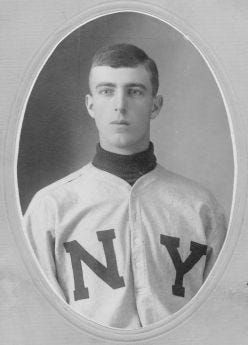
Fred Merkle, age 19
The subject is eternal because it is so regrettably human. We grow up wanting to be the heroes of our own lives, but too often we fail and risk becoming villains, or worse: scapegoats for a broad-based feeling of betrayed expectations. In the seamless web of baseball’s history, Fred Snodgrass commiserates with Lonnie Johnson, Mickey Owen feels for umpire Bill Joyce, and Fred Merkle wraps a consoling arm around Bill Buckner.
Baseball binds America. Its rhythms and rituals resonate across the great divides of generation, politics, religion, and economics to connect our people as nothing else can. Finally, the verdict comes: we are fans because we never really stopped thinking of ourselves as players in this great national drama. In the words of Bruce Catton, baseball “celebrates the vicarious triumph. The spectator can identify himself completely with the player, and the epochal feat becomes, somehow, an achievement of his own.” Likewise, the epochal blunder.
Let’s first consider Merkle, the teenaged substitute for Fred Tenney at first base on September 23, 1908, whose baserunning mishap transformed a Giants’ win over Chicago into a draw. This cost the Giants a pennant and a World Series against Detroit.

Al Bridwell in 1911 when, after a fire in April, the Polo Grounds grandstand was reconstructed
On the morning of the 23rd, Tenney had come up lame. The teenaged Merkle, still shy of 100 at bats after two seasons as a reserve, was thrust into action. The Giants and Cubs were in a virtual tie for first, neither being even a half-game behind the other. The tilt at the Polo Grounds was tied 1–1 in the last of the ninth, as Jack Pfiester dueled Christy Mathewson. With the Giants’ Harry “Moose” McCormick on first and one out, Merkle shot a single to right that moved the runner to third. After another out, shortstop Al Bridwell singled to center; the winning run crossed the plate, and the Giants were in first place.
Or were they? Merkle, in accordance with baseball custom and practice, if not in strict accordance with the rules, never bothered to touch second, instead running toward the clubhouse to avoid the rush of fans storming onto the field in celebration. Somehow Cubs second baseman Johnny Evers got the ball and stepped on second, holding the ball aloft to show the two umpires that he had forced Merkle out and the run didn’t count. Three weeks earlier, on September 4, the Cubs had tried to win a ruling on a similar force-out against the Pirates but were shut down.
Given those precedents, who could blame Merkle? Everyone, as it turned out.
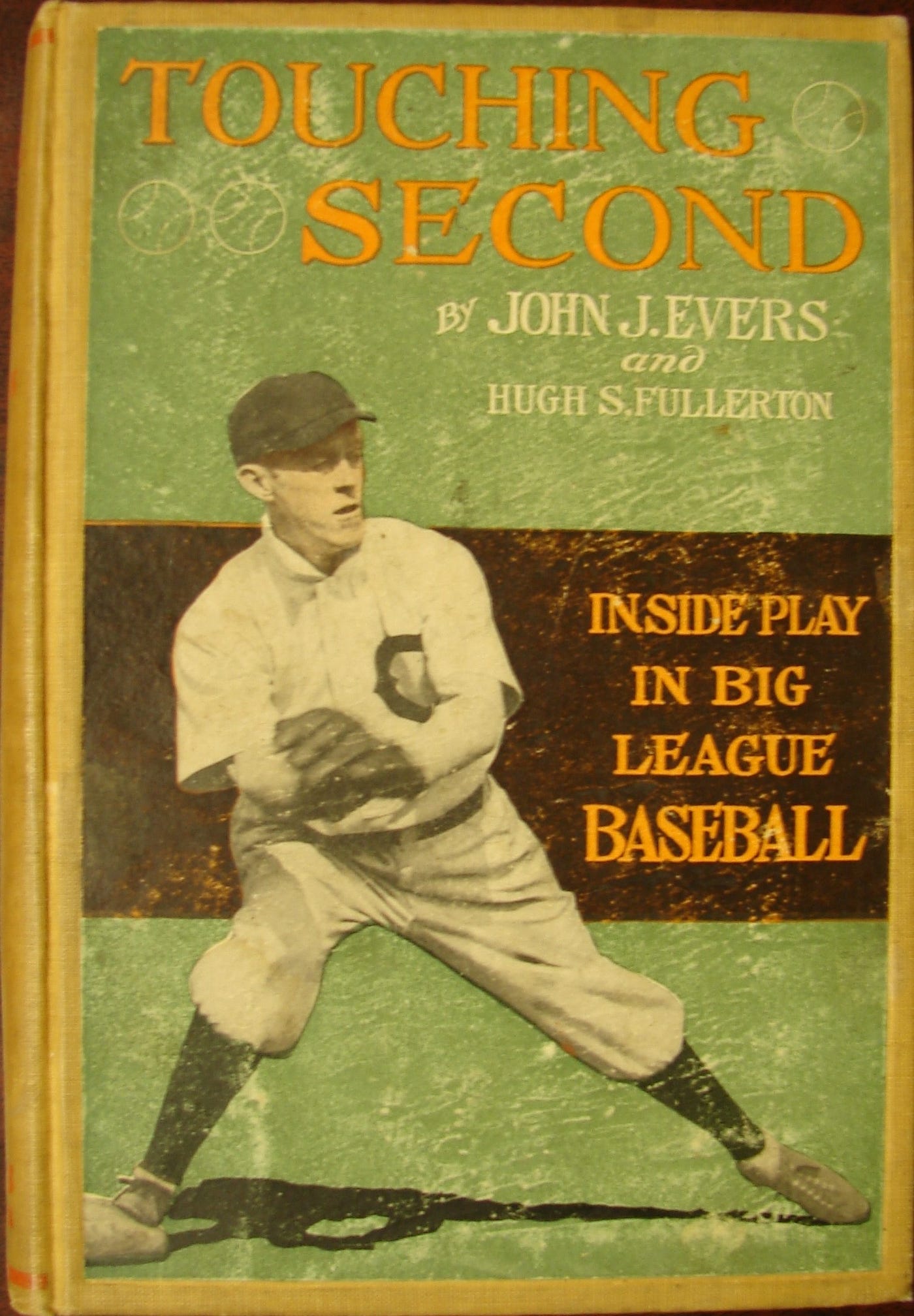
Was the title of Johnnie Evers’ 1910 book a sly dig at Merkle?
Reporting from the Polo Grounds that day, Charles Dryden of the Chicago Tribune wrote: “Minor league brains lost the Giants’ game today after they had it cleanly and fairly won by a score of 2 to 1. In the ninth round, Fred Merkle did a bonehead base-running stunt identical with the recent exhibition which Mr. [Warren] Gill, also a minor leaguer, gave at Pittsburgh three weeks ago. But this time [umpire Hank] O’Day had his eagle eye peeled, and the winning run which the Giants compiled in the ninth inning was tossed into the discard.”
It certainly was the fans’ impression that once McCormick crossed home plate, the game was over; New York had won, and an early newspaper account reflected that belief. But the umpires declared the game a draw, and the National League’s president called for it to be replayed only if the pennant was at stake. At season’s end, the teams were indeed tied for first place, each with a record of 98–55. Despite going 11–5 after the “Merkle Game,” the Giants lost three times in five days to Phillies lefthander Harry Coveleski, a late-September callup from a class-B minor league.

An evening edition of The World proclaimed the Giants’ victory
The play was called the Merkle Boner — meaning. at that time, not a male in a state of arousal but instead a dumb play. Westbrook Pegler, writing in 1947, stated: “One old baseball term that qualified as good Americanese is ‘boner.’ This is an abbreviation of ‘bonehead play.’ The first man to use this form was T. A. Dorgan, or Tad, the sport-page cartoonist of the Hearst papers who had a baseball character called Bonehead Barry, the bush league bear. We owe ‘bonehead’ and ‘boner’ to him.”

Bonehead Barry, by Tad, May 13, 1909
Only four years after Fred’s infamous play, another Giant became a scapegoat for life, dropping a fly ball in center field in the final half-inning of the final game of the 1912 World Series. The “Snodgrass Muff” did not cost the Giants the game, but it attached itself to his life forever.
Let’s retreat to the top of the tenth, when the Giants and Red Sox were tied at 1–1, eerily the same score as in the game when Merkle committed his blunder — once again with Christy Mathewson the unfortunate pitcher. After one out, New York’s Red Murray doubled and Merkle drove him home with a single. The goat of 1908 advanced to second as Tris Speaker bobbled the ball in center, but Joe Wood, who had come on in relief of starting pitcher Hugh Bedient, fanned Buck Herzog and got Chief Meyers on a comebacker.

In this “Tale of Two Freds,” Mr. Snodgrass
Matty returned to the hill, intent on wrapping up the championship. As Snodgrass told Larry Ritter half a century later:
The first man up for Boston in the bottom of the 10th was Clyde Engle, who was pinch-hitting for Smoky Joe Wood. He hit a great big, lazy, high fly ball halfway between Red Murray in left field and me…. I yelled that I’d take it and waved Murray off, and — well — I dropped the darn thing. But instead of bunting [Engle to third for the tying run, Harry] Hooper cracked a drive way over my head. I made one of the greatest plays of my life on it, catching the ball over my shoulder while on the dead run in deep left center.
No one else recalled that catch, which had nearly doubled off Engle, standing at third base. Sixty-two years later, after a successful career in business, his New York Times obituary was headlined “Fred Snodgrass, 86, Dead; Ball Player Muffed 1912 Fly.”

From New York Times obituary, April 6, 1974
The Red Sox went on to win that World Series in 1912, their second of five straight through 1918. Then they sold Babe Ruth to the Yankees and did not win again until 2004. They lost in seven games in 1946, 1967, 1975 and, in a scapegoating echo, 1986. Tied at the end of nine with Boston leading the Mets three games to two, the Red Sox scored two in the top of the tenth. The Mets mounted a rally with two out and none on, staving off defeat with several two-strike hits. Mookie Wilson’s roller then eluded first baseman Bill Buckner and the Mets won, going on to defeat Boston in Game 7.
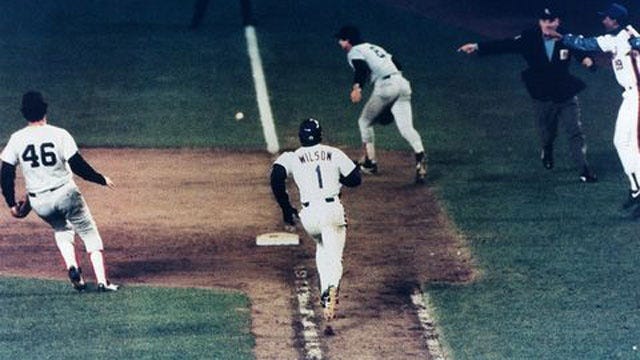
The climactic play, Game Six, 1986 World Series
Closers blow saves; infielders make errors on routine plays at awful times; cleanup hitters strike out with men on base; umpires miss calls, egregiously. *Yes, playing the scapegoat is part of the tribal role for which baseball men sign on. Yes,* this is the game you played when you were young … and from a safe distance it still looks easy. But No, you would not have done better in their place.
메타데이터
- post_id
- 760bdff10c65
- slug
- americas-national-game-1908-760bdff10c65
- url
- https://ourgame.mlblogs.com/americas-national-game-1908-760bdff10c65
- canonical_url
- https://ourgame.mlblogs.com/americas-national-game-1908-760bdff10c65
- author_url
- https://medium.com/@thorn_john_87223
- status
- ok
- fetched_at
- 2026-06-10 09:45:17