Configuring Exemptions Safely: Automating Controls Around Section 17(2)(b) r/w Rule
The practical application of Section 17(2)(b) of the DPDPA is defined by a strict boundary between utility and individual impact. While the…
Configuring Exemptions Safely: Automating Controls Around Section 17(2)(b) r/w Rule
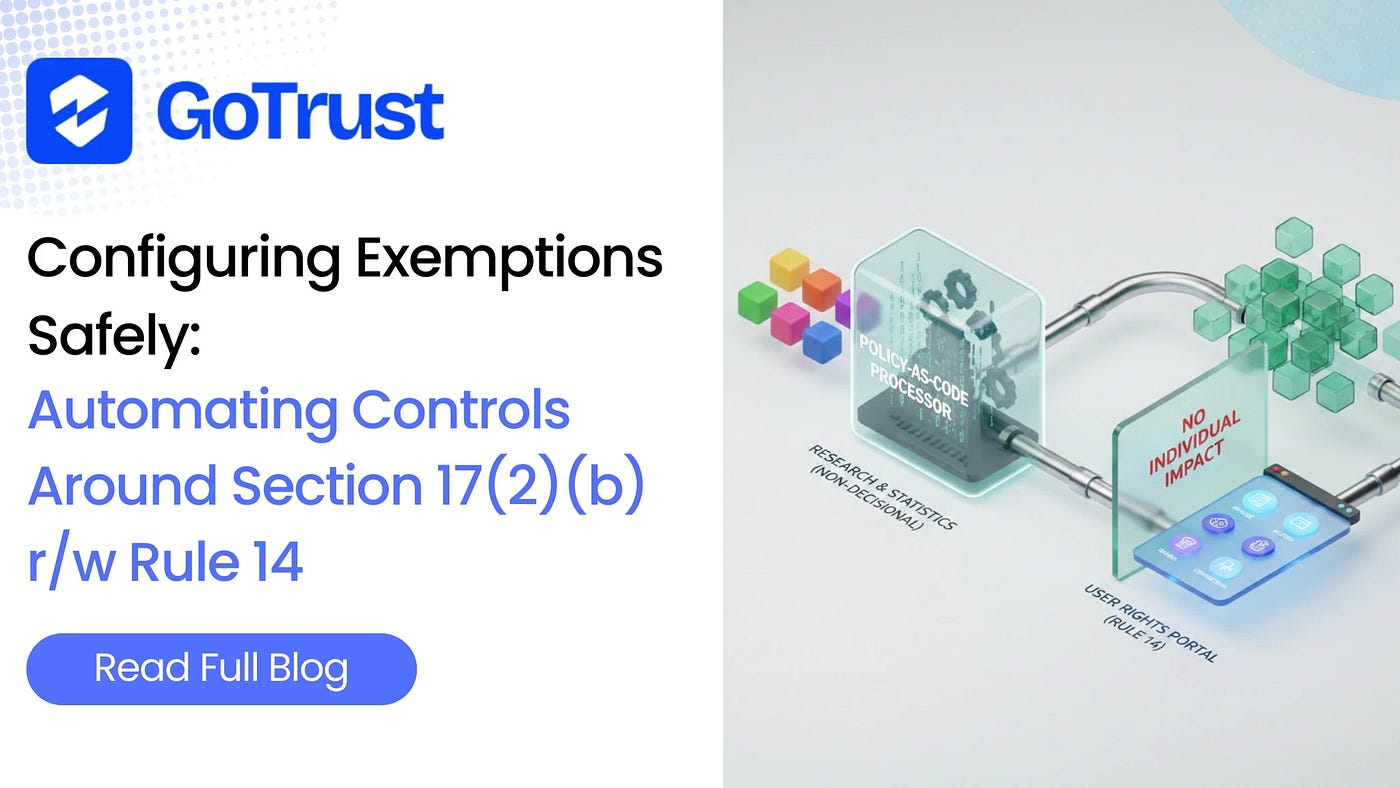
The practical application of **Section 17(2)(b)** of the DPDPA is defined by a strict boundary between utility and individual impact. While the Act grants fiduciaries the flexibility to process data for research, archiving, and statistical analysis without the standard consent hurdles, this privilege is entirely contingent on a non-decisional framework.
This requirement is reinforced by Section 8(4), which mandates that fiduciaries implement appropriate technical and organisational measures to ensure effective compliance. In high-volume environments, this essentially necessitates a Privacy by Design approach. These frameworks translate complex regulatory text like the procedural mandates of Rule 14 of the DPDP Rules, 2025, directly into machine-readable logic.
Understanding Section 17(2)(b)
Section 17 The DPDPA provides specific exemptions from certain provisions of the Act, such as notice and consent requirements. Section 17(2)(b) specifically addresses the processing of personal data necessary for research, archiving, or statistical purposes. This exemption is fundamental to the continued viability of longitudinal health studies, historical record-keeping, and socio-economic analysis.
The legal validity of Section 17(2)(b) exemption is bifurcated into `two mandatory conditions. First, personal data must not be used to make any decision specific to a data principal. This requirement is the primary safeguard preventing the repurposing of research data for individualised actions such as credit profiling or medical insurance adjustments. Second, the processing must be carried out in accordance with the standards specified in the Second Schedule of the DPDP Rules.
Rule 14 and the Right of Data Principals
While Section 17(2)(b) enables aggregate data use, Rule 14 empowers individuals to retain control over their digital footprint. Rule 14 provides the procedural mechanics for exercising the rights granted under Chapter III of the DPDPA, including the right to access information, the right to correction, the right to erasure, and the right of grievance redressal.
Automated Controls and Policy-as-Code The manual management of these legal nuances is impossible at scale, especially for platforms handling millions of data points. This has led to the emergence of Policy-as-Code (PaC) as a foundational methodology for embedding compliance directly into software systems. PaC involves translating written regulatory documents such as the Second Schedule and Rule 14 requirements into machine-readable instructions.
Policy-as-Code Implementation
A high-performance compliance framework for managing Section 17(2)(b) and Rule 14 typically consists of three integrated layers.
- The Policy Definition: This utilises domain-specific languages (DSLs), such as Open Policy Agent’s Rego or Python-based policy engines, to represent regulatory demands. For instance, a policy can be written to allow access to a dataset only if the purpose of tag is set to research, and the decisional flag is false.
- The Enforcement: This acts as a runtime interceptor, evaluating data access requests against the defined policies. By decoupling the policy intention (the what) from the enforcement mechanism (the how), organisations can maintain consistent governance across multi-cloud environments.
- The Attestation and Audit: To meet the accountability requirements of Rule 14(3) and the 72-hour breach reporting window in Rule 7, every enforcement decision must be logged. These logs provide the verifiable audit trail required by the Data Protection Board (DPB).
Conclusion
Ultimately, the successful implementation of the DPDPA rests on the ability of fiduciaries to harmonise the technical with the legal. The case studies demonstrate that automation through Policy-as-Code and NLP-driven classification is no longer optional; it is the primary mechanism for maintaining trust at scale. By strictly isolating research datasets from individual decision-making and providing clear, automated pathways for citizens to exercise their rights, organisations can move past the fear of regulatory friction.
Read More About This : https://www.gotrust.tech/blog/configuring-exemptions-safely-automating-controls-around-section-17(2)(b)-r-w-rule
메타데이터
- post_id
- 7631f8bebbb9
- slug
- configuring-exemptions-safely-automating-controls-around-section-17-2-b-r-w-rule-7631f8bebbb9
- url
- https://medium.com/@gotrust_tech/configuring-exemptions-safely-automating-controls-around-section-17-2-b-r-w-rule-7631f8bebbb9
- canonical_url
- https://medium.com/@gotrust_tech/configuring-exemptions-safely-automating-controls-around-section-17-2-b-r-w-rule-7631f8bebbb9
- author_url
- https://medium.com/@gotrust_tech
- status
- ok
- fetched_at
- 2026-06-23 06:34:20