From Nigeria to Tomsk
I left Nigeria for Tomsk On January 23. On what was going to be a 3-day journey with stops in Ethiopia, Greece, and Moscow. During the…
From Nigeria to Tomsk
I left Nigeria for Tomsk On January 23. On what was going to be a 3-day journey with stops in Ethiopia, Greece, and Moscow. During the stopovers in Greece and Moscow, I could feel the cold as I walked out of the plane to wait for my next flight. After my immigration clearance at the airport, I took a short walk outside the Domodedovo airport to feel how cold Moscow was, and the weather did not disappoint. I went out with light gloves, and it felt like I wasn’t putting on any gloves. My knees felt like I had not greased them for years, and the cold used my ears as a gateway to my brain. I had to sprint back to the airport restroom and wear an additional pair of trousers, five shirts, two head warmers, and a thick jacket, after which I sat patiently to wait for my flight. While waiting, I met a couple of foreigners and chatted for a while. Most were surprised at my decision to leave cities like Moscow and St. Petersburg for a distant city like Tomsk. They told me how the Tomsk cold was twice what it was in Moscow and that even Russians are scared of the Siberian cold. Then I remembered the immigration officer who stamped my passport reaction when he looked at my visa. His English was not good, but he wished me good luck.
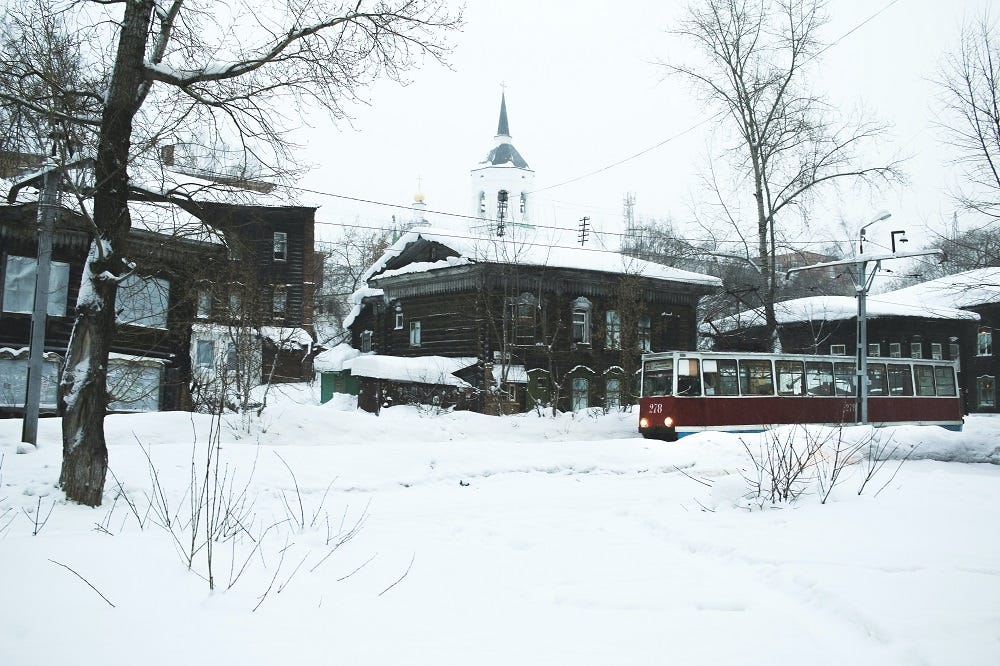
Photo By: Elina Sitnikova On Unsplash
I arrived in Tomsk on the 26th of January at 8:00 in the morning, exhausted from the entire trip. I had to locate my hostel because I did not alert my school authorities on time so they could pick me up at the airport. Luckily, I met a Cameroonian married to a Russian, and we booked a taxi together that took me to my hostel(mayak). When I arrived at the hostel building, I was lost because there was snow everywhere and just three ladies opposite the building smoking cigarettes. I approached them and asked for help, but they could not understand what I was saying in English, so I had to use my phone to translate. As I brought out my phone and took off my glove to type, I could not feel my fingers. My phone kept dropping onto the snow-covered ground. The ladies understood I was new, and after a few laughs, they took me to the hostel administration so I could get registered. After my registration, I was in quarantine for five days. During those five days, I showered with so much hot water that my skin burned. After my quarantine, they gave me a room on the 4th floor of the Mayak hostel. Till today, I have not gotten enough of the beautiful sight of the Tomsk River through my window. People pay for this view in big cities; I got the chance and still get to watch the sun rise and set from my window. The colorful reflection of the sun on the water continues until the end of summer when the water dries up and turns to ice for the winter.

Photo by Natalya Letunova on Unsplash
Adapting to Russian culture was a little strange for me. Because the Russians don’t know how to hide their feelings, it is easy to tell when they like you and when they don’t. The ones who like you can be very expressive and open about it, and the ones who don’t like you can be expressive in an insulting way. Generally, the feeling I got about Russian people was that they were shy, because whenever I took a bus, it was always so quiet, and even when they talked, it was like they were whispering. Compared to Nigeria, where our public transport is always noisy and full of entertainment, Another thing that still confuses me about the Russians is how hot and cold they are. You could meet them and have a good discussion and a lovely time, but the next day, they act like they don’t know you. Initially, I thought they were snubs, but after a while, I learned to live with them. I had to learn to keep to myself because the Russians don’t just greet random people compared to the Nigerian culture. You could live with a Russian for six months without talking to each other or knowing anything about them, not because they are unwelcoming; it’s just how they are. Whenever you need help, you can ask, and if they can help you, they will.

Photo By: Roman Purtov on Unsplash
Before coming to Russia, I had always heard about the beauty of Russian women. But coming here made me realize that words don’t do their women enough justice. It’s not just their beauty; it’s how feminine the Russian women are that makes them adorable. Seeing them on screens is one thing, but looking into their feminine blue eyes is another. Their sense of fashion is amazing. The colours red and black make their white skin glow and shine brightly, like their hearts. They are ambitious and hardworking, yet they are tender and soft-spoken. Their men, on the other hand, are very traditional. They are stoic and confrontational when pushed to anger and often get into fights because of their women. They can be protective of their wives in clubs, especially from foreigners. Contrary to popular opinion, there are a healthy number of Russian men who neither drink vodka nor smoke. Russian food is not my type of food. For the first six months, I explored most of their food. But I didn’t seem to enjoy any. Their food is not spicy, and I am a big fan of spicy food because of my Nigerian heritage. Because of this, I hardly eat at restaurants. I love Russian Kefir. It tastes different to the kefir in my country. But surprisingly, I prefer the Russian variant. My diet revolves around pasta, rice, oats and eggs because Nigerian food is hard to come by in Tomsk. On rare occasions, some newcomers from Nigeria bring foodstuffs and are generous enough to share.

Caleb and petini.
My best friend is a Cameroonian. His name is Pertini, but I call him Star Boy because of his brain. He is an intelligent and wise person. Observant and slow to anger. When I first arrived in Tomsk, he was avoiding me because he was scared of Nigerians. As we began to converse often, we appreciated each other’s ideas and differences. Initially, I used to get angry at how calm he used to be in the face of disrespect. I used to advise him to react, but all he did was laugh. He always told me he was here for a reason, and nothing lasts forever. Whenever I felt sad or missed home, I knew I could talk to him because he is a good listener. He always had the right words to encourage me. He will later leave for France to continue his studies. We still communicate via phone calls and chat. And I am sure he is going to be a great person soon.

Photo by Nikita Karimov on Unsplash
Since I grew up in Nigeria, I have heard stories of racism and discrimination. But I only thought of it from a tribal perspective. I almost fell into the trap of assuming all white people are racist. My first two months were hard. For once in my life, my skin colour looked odd among the crowd. The way people stared and smiled at me made me uncomfortable. The fact that I could not understand Russian made it worse. Gradually, I learned to assimilate and ignore unnecessary attention and hilarious questions about black men’s genitals. It wasn’t until a coursemate got into trouble that I knew and understood the heart of a Russian. He was taking a walk with their daughter, his girlfriend. When she tried to cross the road with the traffic still on the red crossing. A speeding vehicle hit her, and she died on the spot. Immediately, the police came to the scene, and the parents were alerted. When they told them how everything happened, the compassion they showed my coursemate changed any negative perception I had about Russians. Until they buried their daughter, they reached out to my coursemate to offer him mental support and repeatedly told him it wasn’t his fault. This incident helped me understand how Russians think and operate. If you offend them, they can be blunt and insulting. But it ends there
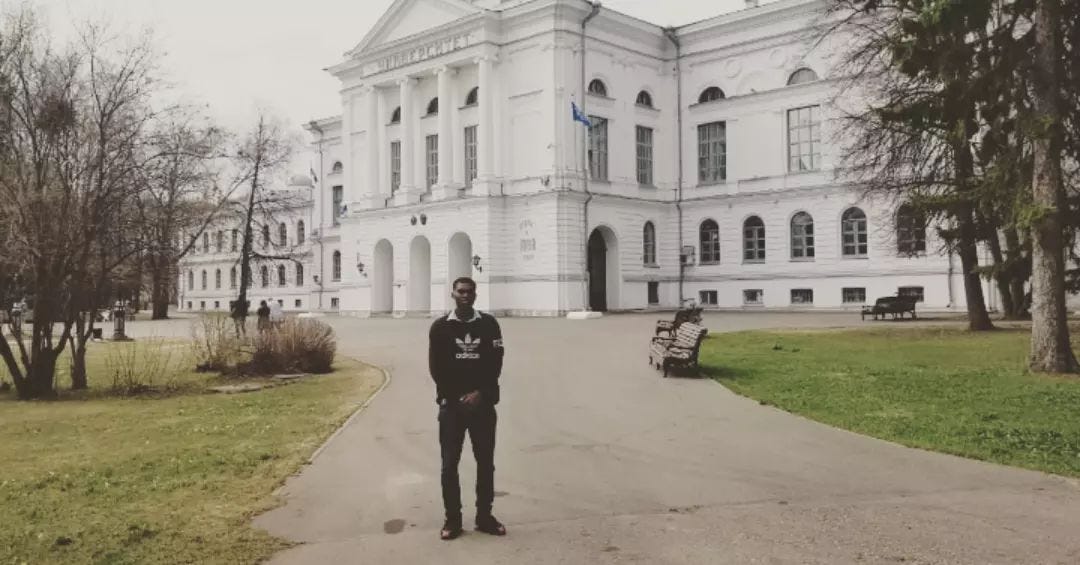
Caleb In front of school
After registration, I started my Russian classes with students from different ethnicities; the majority being Chinese. Our teachers were mainly female. Learning the Russian language was harder than I thought. It was not in Spanish or Portuguese that I could repeat a phrase. My lecturer, Daria, repeats a word four times, and I still could not pronounce the word correctly. Then we have the gender case in the Russian language. For the French speakers in our class, this was usual, but for an English speaker like me and others, constructing a grammatical sentence based on the gender case was not easy. The fact that our teacher spoke English did not help matters. I don’t follow international news often, but on the 24th of February 2024, the notifications on my phone were too much to ignore with headlines like Russia invades Ukraine. Calls from family members in Nigeria put me in a state of panic. The mood around our hostel was tense because our teachers told us not to say anything about the invasion in the classroom. A week into the war, most European students on exchange programs or scholarships returned to their countries. The international students that remained are from third-world countries like China, Indonesia, and Africa. Chinese students remained because of the freedom Russia affords them. The Indonesians and Africans are here because they are either on scholarships or had started their studies before the war. Most international lecturers at my school returned to their countries within a month. Russians, on the other hand, went on about their lives; few were willing to talk about the war, and most international students are uncomfortable talking about or having an opinion about the war. Upon completion of my language course, the summer holiday just arrived. And it was everything I imagined it to be. The cinematography had always made summer holidays a time for travelling, but because I grew up in Nigeria, I never really understood it, though I liked the long holidays. Tomsk is predominantly a cold city. During the winter, people don’t go out much; their outings are purposeful. That is why, during the summer, their parks, gardens, and sports arenas are filled with lovely people ready to mingle.

Graduation from preparatory faculty
In my main course of study, the aftermath of the Russian invasion has taken a toll on most international students’ finances, especially those from Africa. The Visa card stopped working a year ago as part of the sanctions against Russia. Convenient forms of payment like PayPal and Payoneer have also stopped working in Russia. The fees for exchanging our local currencies for the Russian ruble are crazily high because most African currencies are low in value. Prices of things have been slowly increasing. Then there is the constant fear of the validity of our diploma upon graduation. Most international students I have interacted with have plans to travel to Europe or America upon graduation, but the current evidence is not encouraging. Most international students have been rejected when they apply for scholarships in Europe or America. Because they do not state the reason for the rejection letter, we can never know if it is because of the location of their current diploma. My biggest concern is the validity of my certificate outside of Russia, especially on the international scene. Having applied for various freelanace positions and been rejected, I believe my location played a huge part. I keep wondering if the sacrifices I have made to study here will be worth it. Sacrifices like living with disrespectful roommates.
메타데이터
- post_id
- 7645770818fb
- slug
- from-nigeria-to-tomsk-7645770818fb
- url
- https://medium.com/@imgbiancaleb/from-nigeria-to-tomsk-7645770818fb
- canonical_url
- https://medium.com/@imgbiancaleb/from-nigeria-to-tomsk-7645770818fb
- author_url
- https://medium.com/@imgbiancaleb
- status
- ok
- fetched_at
- 2026-07-25 19:35:36