The Pace of Presence Between Words
“I wish you could see my true nature. Beyond my body and labels, there is a river of tenderness and vulnerability.” — Haemin Sunim, The…
The Pace of Presence Between Words
“I wish you could see my true nature. Beyond my body and labels, there is a river of tenderness and vulnerability.” — Haemin Sunim, The Things You Can See Only When You Slow Down
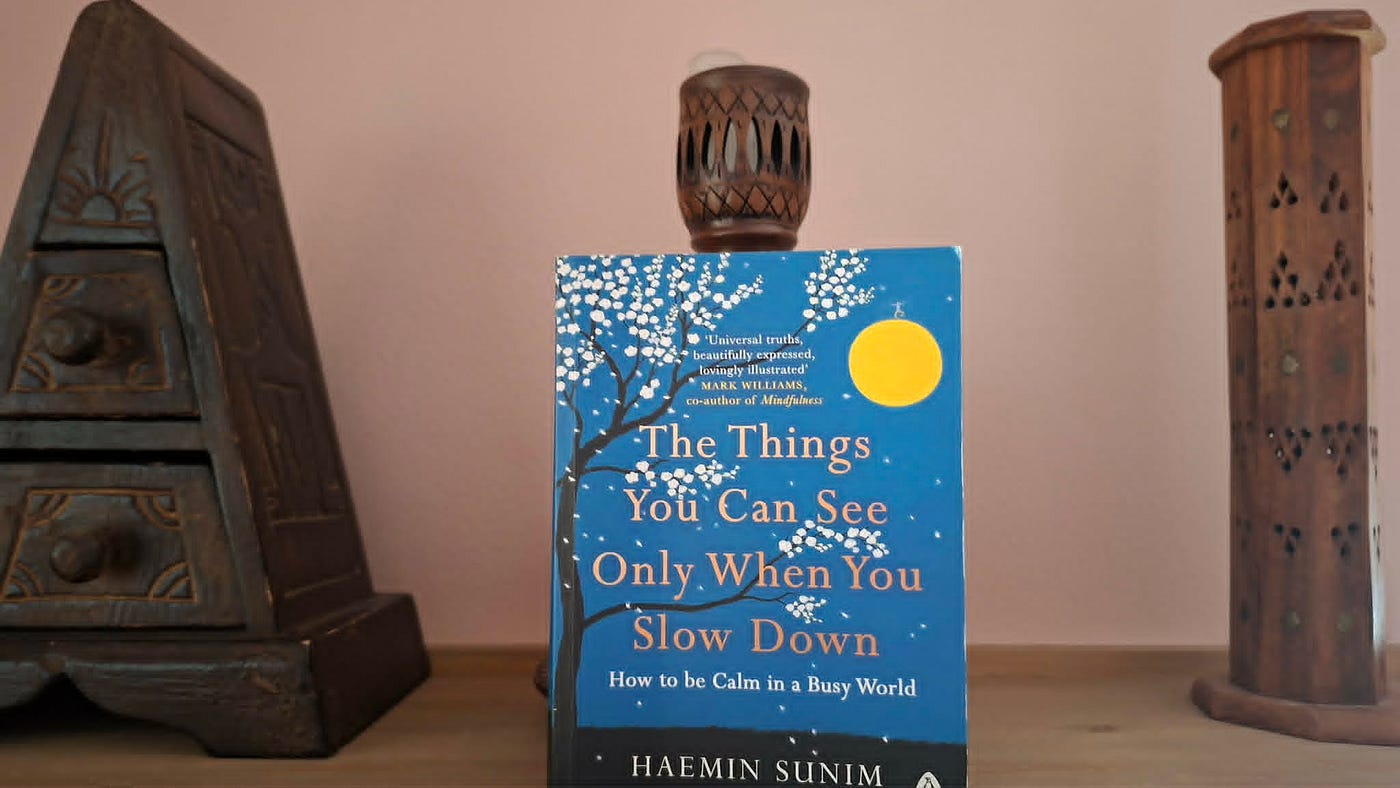
Some tools that help me slow down
In recent days, I have been thinking more intently about what actually happens when we speak to one another, especially when the conversation carries weight. You know those conversations that are not the polished kind we perform in public settings, but the riskier kind, where something real is at stake? In such intense moments, we do not simply exchange words. We reveal a position toward the other person, and perhaps even toward ourselves.
There is always more in a sentence than the sentence itself. When someone speaks, what reaches us is not only the content, but the degree of attention, restraint, curiosity, or defensiveness that shaped it. In difficult conversations, this becomes almost painfully visible. Some people rush to respond diplomatically, others withdraw in an attempt of politeness born out of anger or disappointment, and it becomes hard to allow such conversations to be fully recognized.
That is why I picked up a different type of book to use as a compass in such situations. “The Things You Can See Only When You Slow Down” by Haemin Sunim, suggests that what we notice in the world is shaped by the pace at which we move through it, including how we meet each other.
If we are rushed, distracted, under pressure, or simply carried by our own assumptions, or giving verdicts under the influence of someone else’s ill intentions, we do not really meet the other person. We meet our version of them.
This raises a difficult question: What is it, exactly, that becomes visible when we speak, how we speak, how we listen, especially in conversations that carry some weight?
We might think that communication reveals how articulate we are, how composed, how professional, or persuasive. Those are surface qualities. In more fragile moments, something else emerges. Not what we intend to show, but how we relate to what is being shared.
A few days ago, I texted a friend, “Sometimes I have depressive thoughts.” It was not a confession, just a sentence placed gently into flow of an easy conversation. It could have been handled in many ways. It could have been softened, redirected, or met with a kind of distant reassurance. Instead, he texted back, “It happens to all of us. It is quite normal for people like us, living dynamic lives as we do.”
I was struck by the fact that he stayed with what I said, and placed it within something shared. There is a difference between being seen but not exposed, understood but not examined. That comes close to what we are often seeking in communication. Not agreement, not solutions, but a form of recognition by another mind, not just to get a point across but to remain in contact with the other person’s reality long to understand. This requires a presence that cannot be faked through technique.
A line from the book stayed with me: “When people who don’t know you well admire you, they are seeing their projected illusion, not your real self. In contrast, when people who know you well respect you, it is probably because you deserve it.”
It reveals an important distinction. Admiration is often effortless but respect requires a willingness to stay with complexity, to see what is not immediately flattering or easily understood, and to remain there. Presence in communication lives in that space.
Presence, in this sense, not about interrupting the other person’s experience with our need to categorize it, and above all, resisting our assumptions. It is not about saying the perfect thing. It is about allowing the other person to remain real in front of us, even when that reality is uncomfortable, or difficult to hold.
If slowing down teaches anything, it is this. That attention is an active form of genuine care, a of space we are willing to hold, when another person steps, even briefly, into view.
Each week, I take a book off the page into real life, translating stories and themes into how we work, lead, grow, and connect. These are not book reviews, but reflections: part literature, part lived experience, part observations. Through my passion for literature, I explore the many dimensions of workplace communication. Perhaps you will discover a book that speaks to where you are right now.
Exploring workplace communication through the lens of great books!
메타데이터
- post_id
- 76492d7dd32b
- slug
- the-pace-of-presence-between-words-76492d7dd32b
- url
- https://medium.com/@jamlinda/the-pace-of-presence-between-words-76492d7dd32b
- canonical_url
- https://medium.com/@jamlinda/the-pace-of-presence-between-words-76492d7dd32b
- author_url
- https://medium.com/@jamlinda
- status
- ok
- fetched_at
- 2026-06-21 19:25:17