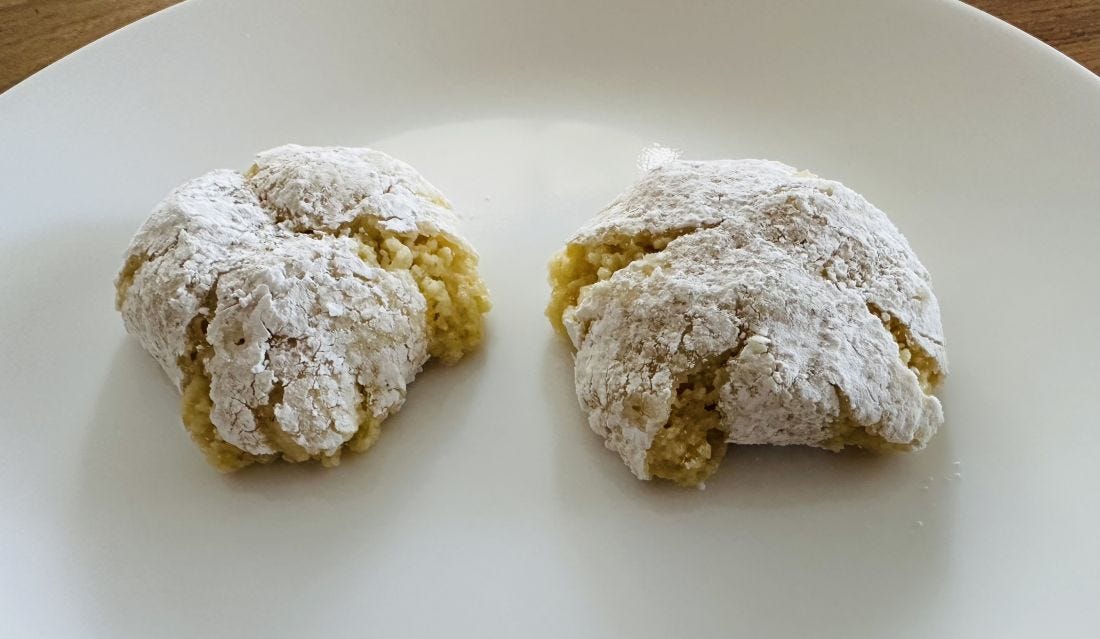
It’s the Elevation, Not Your Baking Skills!
: Why the $4 Billion Cookbook Industry is Gaslighting 10 Million Mountain Bakers
It’s the Elevation, Not Your Baking Skills!
: Why the $4 Billion Cookbook Industry is Gaslighting 10 Million Mountain Bakers

If you live above 3,000 feet, you have a “ghost” in your kitchen.
You’ve felt its presence. It’s there when your “guaranteed” sourdough collapses into a sad, dense disc. It’s there when your “award-winning recipe” cookies spread across the pan like a lava flow. And it’s most certainly there when your floral lavender shortbread emerges from the oven looking like unwashed lawn clippings and tasting like… well, nothing.
For years, you’ve blamed yourself. You’ve blamed your oven, your “old” baking powder, or your lack of “natural talent.”
But I’m here to file a forensic report on your behalf: It isn’t you. It’s Mother Earth.
The 1,000-to-1 Statistical Betrayal
The cookbook industry is a global powerhouse. Baking represents nearly 28% of the entire $4 billion US cookbook market. Every year, millions of glossy, high-production volumes are sold in upscale boutiques and major bookstores.
But here is the staggering truth I discovered after scouring the shelves from Denver to D.C.: For every 1,000 cookbooks written for the “Sea-Level Mass Market,” there is barely one dedicated to the reality of high-altitude living.
These books should have a bright red warning label on the cover that says: This book not to be used at 3,000 feet above sea level or higher as these recipes will fail.
We are talking about a 1,000-to-1 ratio. It’s no wonder we blame our own skills — where else do we have to go? The “Big Five” publishers have decided that the 10 million people living in the American Mountain West are a “niche” market not worth the research and development. Instead, they sell us a “Conversion Chart” that is essentially the culinary equivalent of “thoughts and prayers.”
These charts — “add a tablespoon of flour,” “decrease sugar by 10%” — are hit-or-miss because they treat high-altitude baking like a rounding error. But baking at elevation is not simplistic math; it’s Atmospheric Physics.
The “Artisan” Gap

Today, there are only about 40 to 50 books currently in circulation for high-altitude baking. Even more insulting is the complete lack of artisan-quality recipes for elevated bakers. Of those few books, only one or two go beyond basic chocolate chip or oatmeal raisin cookies. There isn’t a single volume dedicated to the artisan reality of places like Telluride, Park City, and Jackson Hole, or the culinary sophistication of Helena, Denver, and Salt Lake City.
If you do manage to find a high-altitude book, it’s usually what I call “Survivalist Baking” — utilitarian recipes for basic muffins or yellow cakes meant not to fail, but certainly not meant to inspire.
Where are the Bergamot Lavender Sablés? Where is the Midnight Obsidian Gelato? Where are the recipes for the person with a sophisticated palate who wants a Paris-level patisserie experience at 6,000 feet?
Why does the publishing industry assume that because you live in the mountains you only eat bran muffins? We deserve the Orange Blossom Amaretti. We deserve the Rose Pistachio Shortbread. We deserve the science that makes luxury possible at 5,000 feet and higher. The industry is gaslighting us into buying books that guarantee our failure, operating on the assumption that luxury and precision are sea-level privileges.
They are wrong.
You Don’t Need a Degree in Food Science
I approach the kitchen through the lens of atmospheric physics and forensic logic. I’ve spent the “tuition” in my kitchen lab so you don’t have to. I’ve gone through the “Five-Batch Battles” to get one cookie recipe to work, running numerous iterations of artisan formulations to find the Elevated Truth: how to make altitude work for us, not against us.
In my lab, we don’t just “do things.” We understand why they happen, explained in simple, human language.
For instance, if your egg whites are sitting in a bowl looking “bored” and disinterested in becoming a meringue, they haven’t failed. They’ve likely just fallen in love with a stray molecule of fat that accidentally dropped into the bowl. They aren’t broken; they are just distracted. Fat is a notorious homewrecker for the protein bonds needed for a lofty meringue.
Or perhaps your Blackberry Swirl Parfait Glacé tastes like vanilla with colorful but tasteless ribbons of some unknown source. Or the raspberry in your cookies turns the grey-purple of a bad hair dye. It’s not your fault; it’s Atmospheric Theft.
In our thin mountain air, delicate flavors and colors are escape artists. They evaporate before the ice cream is set or the cookie is baked. To win, you need an Elevated Recipe — like adding a minuscule 1/16th of a teaspoon of citric acid to the blackberry syrup as it simmers on the stove to lock in the vibrancy.
An Adventure, Not a Failure
Living at elevation is an amazing adventure. We live in some of the most beautiful, dramatic landscapes on Earth. We shouldn’t have to compromise our artisan standards just because we prefer thin air.
From this day forward, we are reclaiming our kitchens. We are going to stop blaming our skills and start adjusting our specifications. We are going to use our gram scales, our xanthan gum, and our citric acid to beat the physics.
Excellence is earned through hours of studying atmospheric pressure and even more hours at the cooling rack. Over the next twelve months, I am releasing a series of fully validated high-altitude masterclasses — alternating between artisan cookies and professional-grade gelatos or parfait glacé.
I won’t just give you a list of ingredients. I’m going to open up the “Forensic File” for every single one: the spectacular failures I encountered, the science behind the fix, and the final specifications calibrated for the 5,000 to 7,500-foot corridor.
Luxury in the mountains is a matter of research, not luck.
Join the Movement: If you are ready to stop the gaslighting and start the Art of the Batch and the Science of the Scoop, come over to https://www.elevateddopaminelab.com/p/its-the-elevation-not-your-baking. That is where the full Kitchen Lab lives, including our monthly Forensic Intake where you can submit photos, your elevation, and recipes of your own kitchen “crime scenes” for a full scientific diagnostic. Let’s start living in the feel-good hormones of a successful, beautiful bake.
메타데이터
- post_id
- 7658b60c3c66
- slug
- its-the-elevation-not-your-baking-skills-7658b60c3c66
- url
- https://medium.com/@researchbaker/its-the-elevation-not-your-baking-skills-7658b60c3c66
- canonical_url
- https://medium.com/@researchbaker/its-the-elevation-not-your-baking-skills-7658b60c3c66
- author_url
- https://medium.com/@researchbaker
- status
- ok
- fetched_at
- 2026-06-09 15:37:30