Missing a Tooth? The Real Trade-Offs Between Implants, Bridges, and Dentures
The moment you lose a tooth, you inherit a decision most people are unprepared to make. The dentist lists options, implant, bridge…
Missing a Tooth? The Real Trade-Offs Between Implants, Bridges, and Dentures
Missing a Tooth? The Real Trade-Offs Between Implants, Bridges, and Dentures
The moment you lose a tooth, you inherit a decision most people are unprepared to make. The dentist lists options, implant, bridge, denture, and they blur together into a fog of cost and unfamiliar words. Each is a legitimate answer to the same problem, but they are not interchangeable, and understanding the trade-offs is the difference between a choice you are happy with for decades and one you quietly regret. Here is the plain-language comparison.
Why Replacing the Tooth Matters at All
First, the case for doing something rather than living with the gap. A missing tooth is more than a cosmetic problem. Neighboring teeth drift toward the empty space, the opposing tooth can over-erupt, chewing shifts to one side, and the jawbone beneath the gap begins to recede over time. A small gap quietly becomes a bigger problem. That is why a good dentist treats tooth replacement as a health decision, not a vanity one.
“Great Staff. Dr.E.Burstein gentle caring soft spoken professional.Dental Tech attentive, gentle and friendly. Front desk warm greeting and accommodating. The office is comfortable, clean, modern with television. Rest Room very sanitary. Highly recommend.”
Tonito Chino, Google review
Option One: The Dental Implant
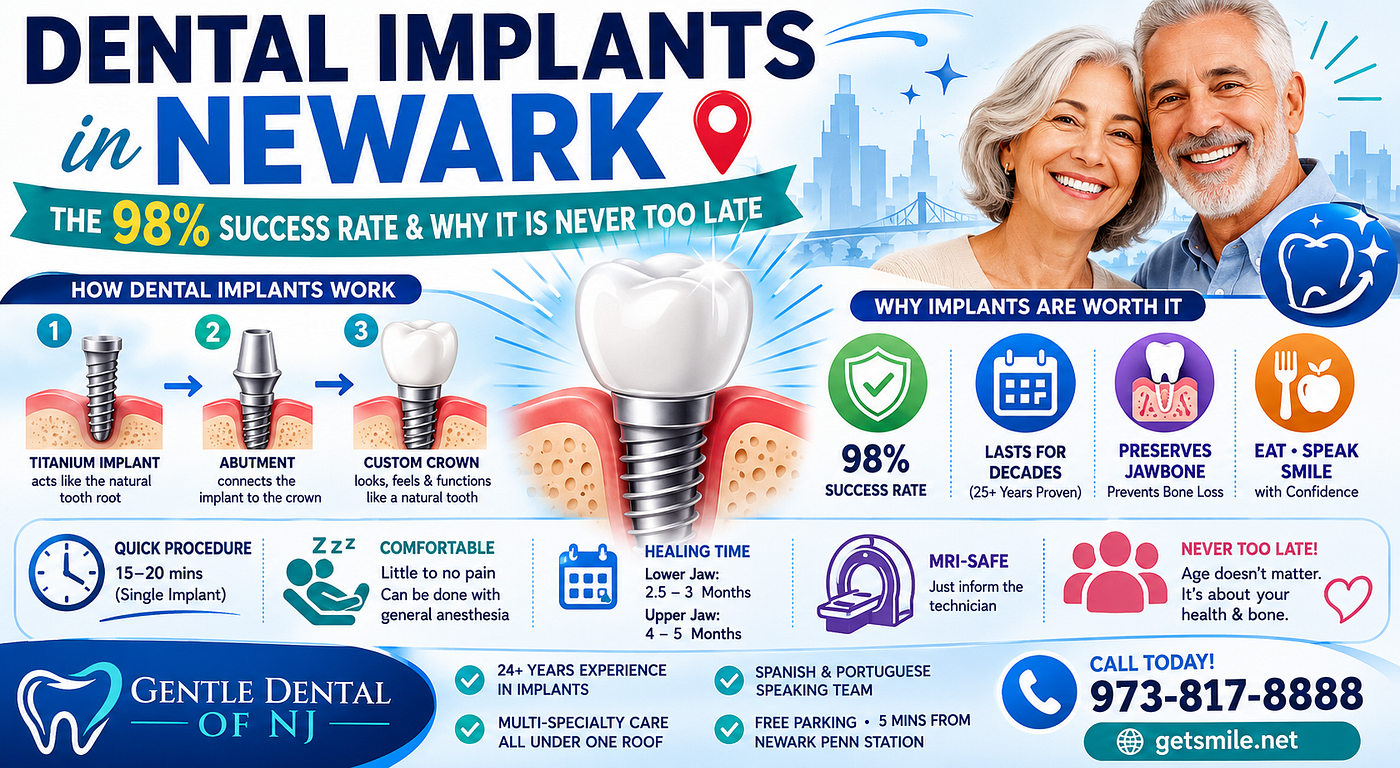
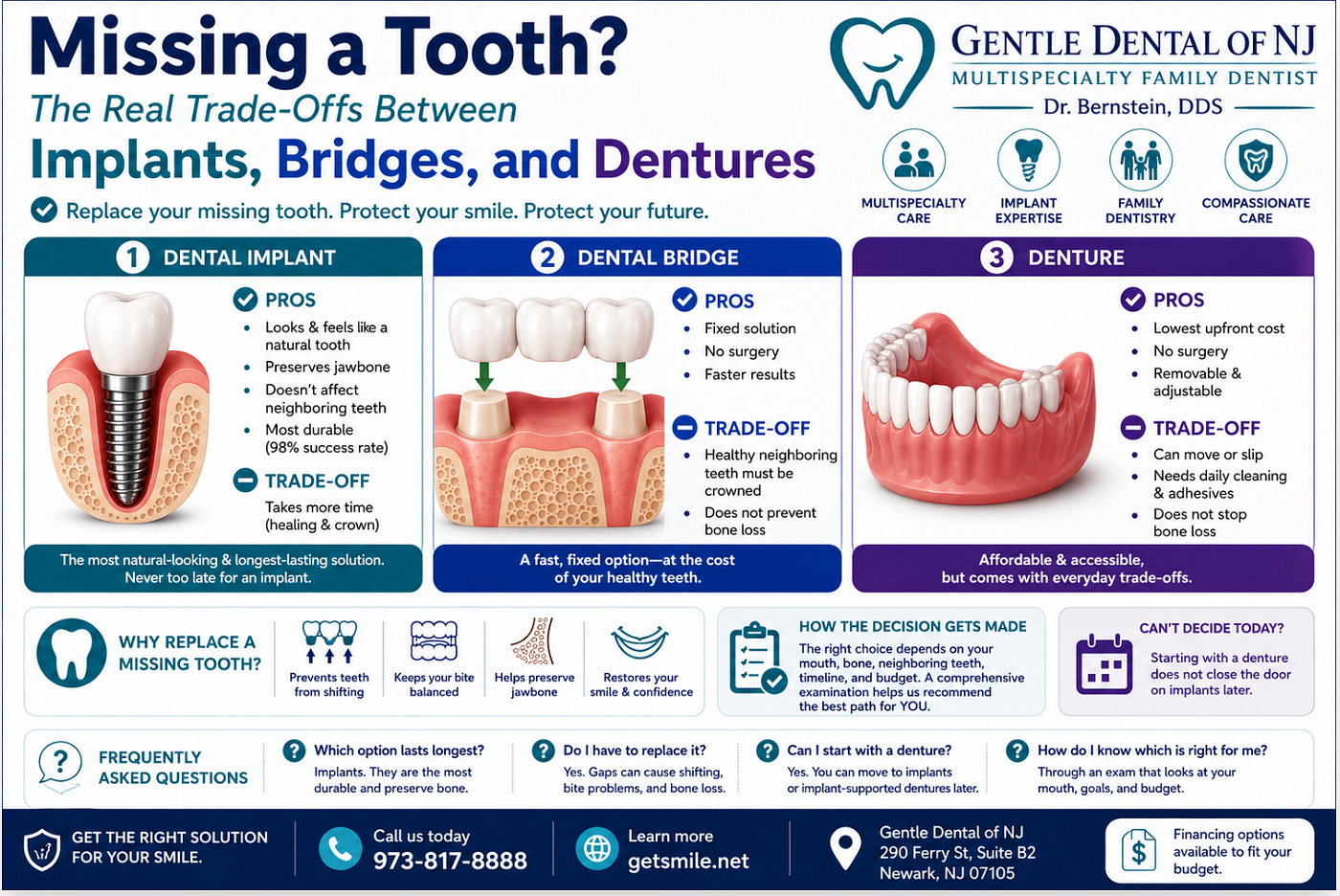
An implant is a titanium post placed in the jawbone, topped with a crown, that replaces the entire tooth including its root. As Dr. Bernstein of Gentle Dental of NJ in Newark describes it, an implant “functions exactly like a natural tooth.”
Its advantages are structural and long-term: it stands on its own without touching neighboring teeth, it preserves the jawbone the way a natural root does, and it is the most durable option, with about a 98 percent success rate and a track record of implants lasting decades at this practice. Its trade-offs are time and process: placement, a healing window of several months while it fuses to the bone, then the crown. For most people who want the closest thing to their natural tooth back, the implant is the gold standard, and it is “never too late” regardless of age.
Option Two: The Bridge
A bridge fills the gap by anchoring a replacement tooth to the teeth on either side, which are crowned to serve as supports. Its appeal is speed and the absence of surgery: no implant placement, no months of bone healing, a fixed result in a shorter timeframe.
Its trade-off is the cost to the neighboring teeth. To hold the bridge, the adjacent teeth, even if perfectly healthy, must be reduced and crowned. You are involving two good teeth to replace one missing one, and the bridge does not preserve the bone under the gap the way an implant does. For the right case, a bridge is a sound, time-tested choice; the question your dentist will weigh is whether sacrificing structure on healthy neighbors makes sense for you.
Option Three: The Denture
For multiple missing teeth or a full arch, partial or complete dentures restore function and appearance without surgery, and at the lowest upfront cost. They are removable, adjustable, and accessible to almost anyone.
Their trade-offs are everyday ones: dentures sit on the gums rather than anchoring in bone, so they can move, require adhesive for some wearers, need removal for cleaning, and do nothing to slow the bone loss that continues underneath. Many patients find them a perfectly good solution; others, especially those bothered by movement, eventually move toward implants or implant-supported dentures for stability. Importantly, choosing dentures now does not close the door on implants later.
“Excellent!! Great service, availability to help with any problems, and friendliness. 200% recommended.”
Carolina silva gonzalez, Google review
How the Decision Actually Gets Made
The right answer depends on factors you cannot weigh alone: how many teeth are missing, the condition of the bone, the health of the neighboring teeth, your timeline, and your budget. This is exactly the conversation a comprehensive consultation exists to have. The advantage of a multi-specialty practice like Gentle Dental of NJ, serving Newark’s Ironbound since 2009, is that whichever path fits, implant placement, bridgework, or dentures, it is handled under one roof, often with the input of the relevant specialist in the same building.
A practical note that removes a common barrier: the practice offers financing options, so the cost comparison becomes a conversation about what works for your situation rather than a wall.
The Cost Conversation, Reframed
Cost understandably drives a lot of these decisions, and it deserves an honest reframing rather than a sticker-shock comparison. Looked at as a single upfront number, an implant costs more than a bridge, and a bridge more than a denture, which pushes some people toward the cheapest option by reflex. But the more useful comparison is cost over time and cost in consequences. An implant that lasts decades and preserves the bone can prove more economical than a cheaper option that needs redoing or that allows problems the bone loss eventually creates. A bridge involves crowning two healthy neighboring teeth, which is a hidden cost paid in tooth structure rather than dollars. A denture is easy on the wallet today but does nothing to slow the bone loss that continues underneath, which can shape future costs. None of this argues for spending the most; it argues for weighing the whole picture rather than only the first invoice. A good consultation lays out the real numbers for your case alongside financing options, so the decision is made on full information. The cheapest path and the most economical path are not always the same one, and an honest practice will help you tell the difference rather than simply quoting the lowest figure.
Frequently Asked Questions
Which option lasts longest?
Implants are the most durable, standing alone and preserving bone, with decades-long track records. Bridges and dentures are effective but have shorter lifespans and different trade-offs.
Do I have to replace a missing tooth at all?
It is strongly advisable. Gaps cause neighboring teeth to drift, bite problems, and bone loss over time, so replacement is a health decision, not only a cosmetic one.
Can I start with a denture and get implants later?
Yes. Choosing a denture now does not prevent moving to implants or implant-supported dentures down the road.
How do I know which is right for me?
Through an examination that weighs how many teeth are missing, your bone, your neighboring teeth, your timeline, and your budget. The consultation exists to make that call with you.
Get the Comparison for Your Specific Mouth
The implant-versus-bridge-versus-denture question has a different answer for every patient, and a consultation is where yours gets decided. Call Gentle Dental of NJ at 973–817–8888, or learn more at getsmile.net.
Gentle Dental of NJ, 290 Ferry St, Suite B2, Newark, NJ 07105. Phone: 973–817–8888.
메타데이터
- post_id
- 767cf86763d8
- slug
- missing-a-tooth-the-real-trade-offs-between-implants-bridges-and-dentures-767cf86763d8
- url
- https://medium.com/@gentaldentalofnj/missing-a-tooth-the-real-trade-offs-between-implants-bridges-and-dentures-767cf86763d8
- canonical_url
- https://medium.com/@gentaldentalofnj/missing-a-tooth-the-real-trade-offs-between-implants-bridges-and-dentures-767cf86763d8
- author_url
- https://medium.com/@gentaldentalofnj
- status
- ok
- fetched_at
- 2026-07-13 06:23:13