CICD DevOps in Real Telecom Engineering
How We Build, Verify, and Deliver High-Quality 4G/5G vDU RAN Software
CICD DevOps in Real Telecom Engineering
How We Build, Verify, and Deliver High-Quality 4G/5G vDU RAN Software
By Aleem Mohsan | System Verification & Automation Engineer
Modern telecom networks are among the most complex software systems in the world. Every day, millions of users rely on 4G and 5G networks for communication, streaming, emergency services, autonomous systems, and IoT. Behind every stable network is an engineering process that emphasises automation, verification, continuous integration, and continuous delivery (CI/CD).
As a System Verification & Automation Engineer, my responsibility goes far beyond executing test cases. My role is to ensure that every new software feature integrates correctly into the existing system, performs reliably under real network conditions, and meets customer expectations before it reaches production.
This article explains how a modern CI/CD workflow supports software quality in a telecom environment and how automation enables engineers to validate complex 4G/5G RAN features efficiently.
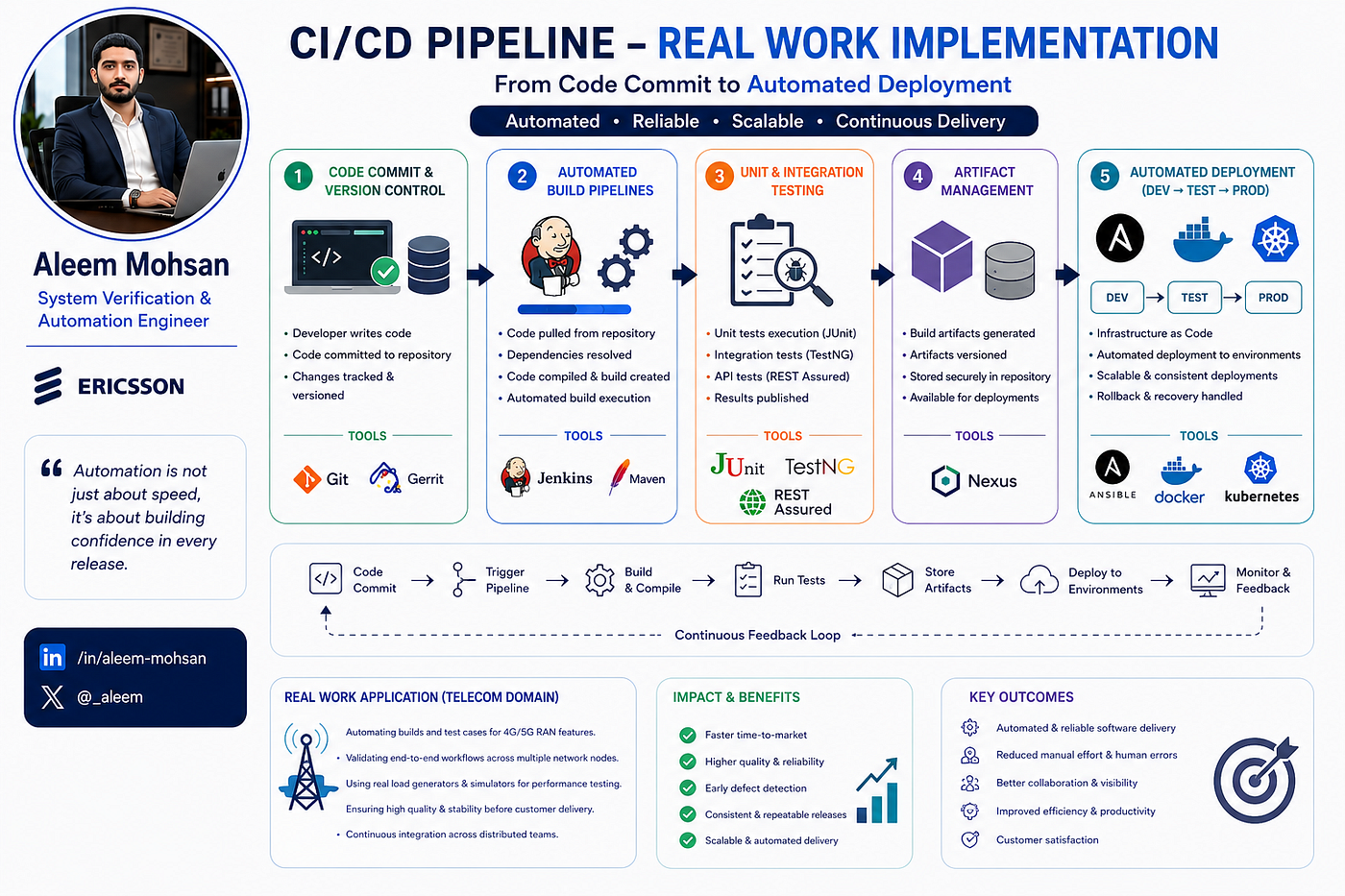
CICD DevOps in Real Telecom Engineering
Why CI/CD Matters in Telecom
Unlike traditional software applications, telecom software operates in distributed environments consisting of:
- Radio Units (RU)
- Virtual Distributed Units (vDU)
- Centralised Units (CU)
- Transport Network
- 5G Core
- Real User Equipment (UE)
- Traffic Generators
- Network Simulators
A small software defect can affect thousands or even millions of subscribers.
This is why continuous verification and automation are essential.
Instead of waiting until the end of development, every code change is automatically validated through multiple stages before deployment.
The Complete CI/CD Workflow
Code Commit & Version Control
Technologies
- Git
- Gerrit
Everything begins when a developer implements a new feature or fixes a defect.
Before code becomes part of the product:
- Source code is committed
- Code reviews are performed in Gerrit
- Version history is maintained
- Every modification is traceable
This provides:
- Collaboration
- Traceability
- Change management
Without proper version control, managing thousands of developers across multiple countries would be nearly impossible.
Automated Build Pipeline
Technologies
- Jenkins
- Maven
Once code is approved, Jenkins automatically starts the build pipeline.
Typical build activities include:
- Downloading source code
- Resolving dependencies
- Compiling Java applications
- Packaging binaries
- Running static analysis
- Preparing build artifacts
Instead of manually compiling software, the entire process happens automatically within minutes.
Benefits include:
- Faster feedback
- Consistent builds
- Reduced human error
Unit Testing
Technologies
- JUnit
- Mockito
Before software reaches system testing, every individual software module is verified.
Developers validate:
- Business logic
- Methods
- Classes
- Error handling
- Boundary conditions
Unit testing answers an important question:
“Does this individual piece of code work correctly?”
Thousands of unit tests may execute automatically after every commit.
Integration Testing
Technologies
- TestNG
- REST Assured
Individual modules may work perfectly on their own.
The next challenge is verifying that multiple services work together correctly.
Integration testing validates:
- API communication
- Database interactions
- Service orchestration
- Configuration compatibility
In telecom environments, this becomes especially important because dozens of distributed software components communicate continuously.
Artifact Management
Technologies
- Nexus Repository
After successful testing, build artifacts are stored inside an artifact repository.
Artifacts include:
- Executables
- Libraries
- Docker images
- Deployment packages
Benefits:
- Version control for binaries
- Repeatable deployments
- Rollback capability
- Traceability
Instead of rebuilding software repeatedly, teams deploy validated artifacts directly from Nexus.
Automated Deployment
Technologies
- Docker
- Kubernetes
- Ansible
Once software is verified, deployment becomes fully automated.
Deployment tools:
- Provision infrastructure
- Configure environments
- Deploy containers
- Update Kubernetes clusters
- Execute deployment scripts
Automation eliminates configuration differences between development, testing, and production environments.
Where System Verification Begins
This is where my work as a System Verification & Automation Engineer becomes especially important.
Passing unit tests does not guarantee that an entire telecom network behaves correctly.
System verification validates the complete feature in a realistic environment.
This includes:
- Real network nodes
- Virtualized RAN
- Simulated traffic
- Real user equipment
- End-to-end communication
The objective is to verify customer behaviour, not just software behaviour.
Real-World Example: Verifying a New 5G RAN Feature
Imagine developers introduce a new scheduling algorithm for 5G.
Before customers receive the feature, we verify:
Functional Verification
- Does the feature behave as expected?
- Does the scheduler activate correctly?
- Does the configuration load successfully?
End-to-End Verification
Traffic flows through:
UE → Radio Unit → vDU → CU → 5G Core → Application Server
We verify:
- Attach procedures
- Mobility
- Data sessions
- Bearer establishment
- Radio signaling
Performance Verification
Using load generators and simulators, we evaluate:
- Throughput
- Latency
- CPU utilization
- Memory usage
- Cell capacity
- Scheduling efficiency
The goal is to ensure that new functionality maintains expected performance under realistic traffic conditions.
Stability Testing
The system runs continuously for extended periods.
We monitor for:
- Memory leaks
- Process crashes
- Service interruptions
- Recovery behavior
- Long-term stability
Regression Testing
A new feature should never break existing functionality.
Regression automation verifies:
- Existing radio features
- Legacy functionality
- Previous software releases
- Backward compatibility
This protects software quality release after release.
Test Automation in Practice
Manual testing becomes impractical when thousands of scenarios must be verified across multiple software versions.
Automation enables us to:
- Execute test suites automatically
- Compare KPIs
- Generate reports
- Detect failures
- Collect logs
- Produce performance dashboards
Automation allows engineers to focus on analysis instead of repetitive execution.
Continuous Feedback
Every pipeline execution generates valuable information.
Examples include:
- Build success rate
- Test coverage
- Performance trends
- Failure analysis
- Regression history
This feedback helps developers identify issues early, reducing the cost and effort of fixing defects.
Why Automation Matters
Automation is not simply about reducing manual effort.
It provides:
- Faster software releases
- Earlier defect detection
- Higher software quality
- Repeatable verification
- Reliable deployments
- Better engineering visibility
For telecom systems, where reliability is critical, automation is essential for delivering software with confidence.
Final Thoughts
CI/CD is much more than a deployment pipeline; it’s a culture of continuous improvement where every code change is automatically built, tested, verified, and validated before reaching production.
As a System Verification & Automation Engineer, my focus is ensuring that every feature works correctly not only in isolation but also within a complete 4G/5G RAN ecosystem under realistic operating conditions. By combining automation, rigorous verification, and continuous feedback, engineering teams can deliver software that is scalable, reliable, and ready for real-world networks.
What does your CI/CD pipeline look like? Which tools or verification strategies have made the biggest impact on your software quality? Let’s discuss in the comments.
DevOps #CICD #Automation #SoftwareTesting #QualityEngineering #SystemVerification #Telecom #4G #5G #RAN #vDU #TestAutomation #Jenkins #Git #Gerrit #Docker #Kubernetes #Maven #TestNG #JUnit #Linux #ContinuousIntegration #ContinuousDelivery #TechCommunity #SoftwareEngineering #QAEngineer #DevOpsEngineer # #Stockholm #Sweden
메타데이터
- post_id
- 76a0ea9ca07a
- slug
- cicd-devops-in-real-telecom-engineering-76a0ea9ca07a
- url
- https://medium.com/@aleem.mohsan/cicd-devops-in-real-telecom-engineering-76a0ea9ca07a
- canonical_url
- https://medium.com/@aleem.mohsan/cicd-devops-in-real-telecom-engineering-76a0ea9ca07a
- author_url
- https://medium.com/@aleem.mohsan
- status
- ok
- fetched_at
- 2026-07-19 10:09:26


