The Same Day SpaceX Asks for $75 Billion, Starship Must Prove It Deserves It
SpaceX’s Biggest Launch and Largest Financial Gamble Are Happening on the Same Day
The Same Day SpaceX Asks for $75 Billion, Starship Must Prove It Deserves It
SpaceX’s Biggest Launch and Largest Financial Gamble Are Happening on the Same Day
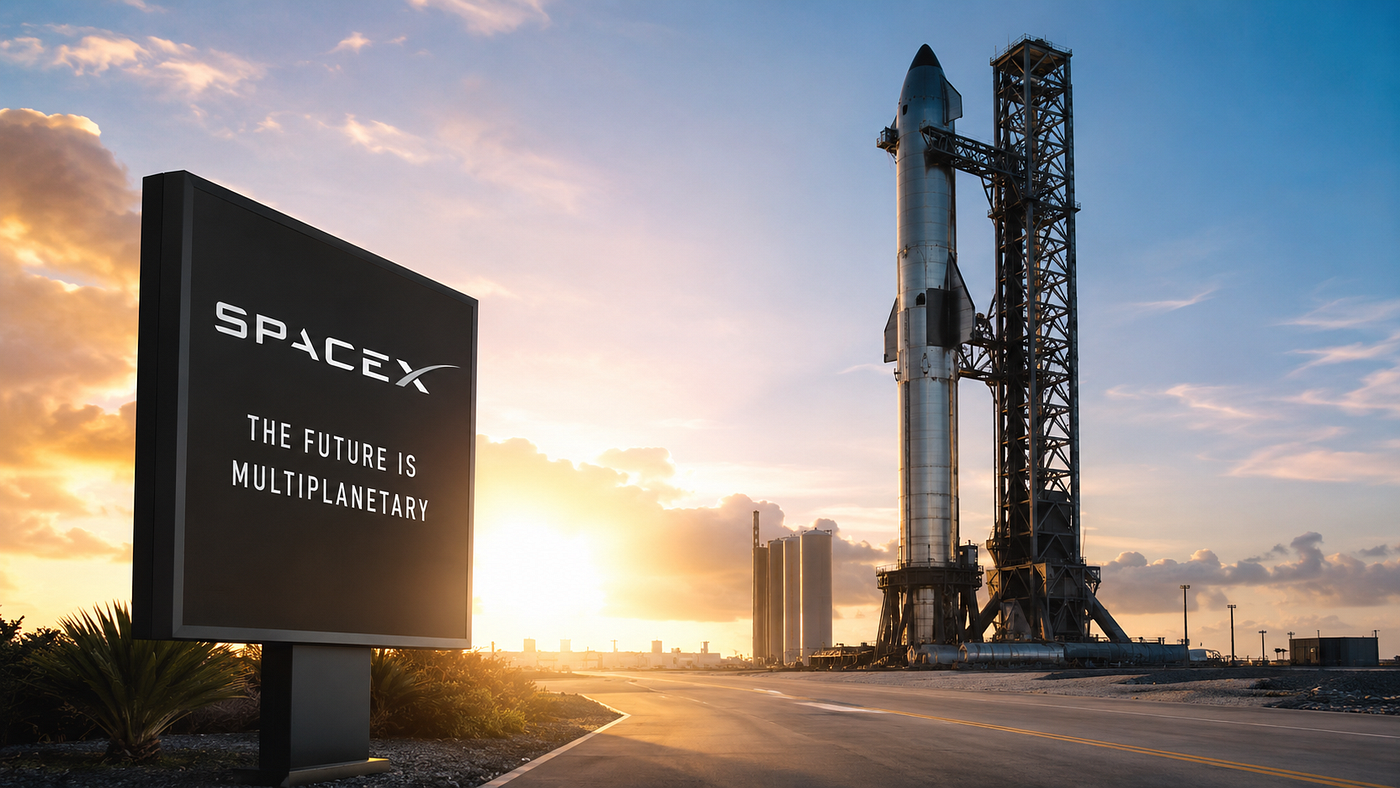
By a remarkable coincidence — or by design — two of the most consequential SpaceX events in the company’s history are scheduled for the same day.
On Wednesday, May 20, SpaceX is targeted to publicly file its S-1 prospectus, the document the market has been waiting to read for years.
On that same Wednesday, just hours later, the company will attempt to launch Starship Flight 12 from Starbase, Texas — the maiden voyage of the redesigned V3 vehicle.
The launch was originally planned for May 19. SpaceX pushed it 24 hours over the weekend. The S-1 timing was set in motion before the slip. Now they collide on a single calendar square.
That alignment is the editorial puzzle worth thinking about. Because Flight 12 is not just another test. It is, in a meaningful sense, the live demonstration of the thesis SpaceX is about to sell to public markets at a $1.75 trillion valuation.
What Flight 12 actually is
“Flight 12” carries the cumulative weight of 11 prior Starship integrated flight tests — a record that includes successful booster tower catches, dramatic vehicle losses, and a steady accumulation of operational data over five years.
But Flight 12 is also the first flight of something quite different from what flew before.
The vehicle on Pad 2 is a clean-sheet redesign across nearly every major subsystem. Booster 19 and Ship 39, both powered by Raptor 3 engines, stand 408 feet tall when stacked — roughly four feet taller than V2 — and the architecture is built to lift more than 100 metric tons to low Earth orbit, nearly triple V2’s roughly 35-ton capacity.
The mission profile is deliberately conservative.
Suborbital trajectory. No tower catch attempt for the booster on this flight — it will splash down in the Gulf of Mexico. The ship will deploy 20 Starlink V3 simulators, plus two specially modified satellites that will image the heat shield in space and transmit that imagery back for analysis.
SpaceX is not trying to set records on Flight 12. They are just trying to fly the V3 stack as a major step forward.
A new rocket wearing familiar branding
The list of changes from V2 to V3 that SpaceX published earlier this month is the kind of disclosure that can largely go unnoticed. But the changes are substantial.
The Super Heavy booster has been substantially rebuilt — new grid fin geometry, a redesigned propellant loading system, and, most boldly, the elimination of the disposable interstage shield that previously absorbed upper-stage ignition forces.
The upper stage carries a clean-sheet propulsion redesign with the old engine shrouds and aft cavity gone.
The Raptor 3 engine delivers meaningfully more thrust at meaningfully less mass than its predecessor — material gains when multiplied across a 33-engine booster.
Launch Pad 2 has been rebuilt around it, with a new flame diverter designed to eliminate the post-flight refurbishment that has historically followed every Starship launch.
The single most important change for investors, however, is the addition of long-duration spaceflight hardware: orbital coast capability, cryogenic fluid management, vacuum-insulated header systems, and four docking drogues with propellant transfer connections.
That last item is the architecture for in-space refueling. Everything past low Earth orbit depends on it.
This is not a refinement. It is a different vehicle.
It is also, by SpaceX’s own framing, the debut of every new element simultaneously — booster, ship, engines, and pad — flying together for the first time. The primary stated goal is real-environment flight data, not mission completion.
Why this matters to the IPO thesis
The IPO numbers are familiar at this point.
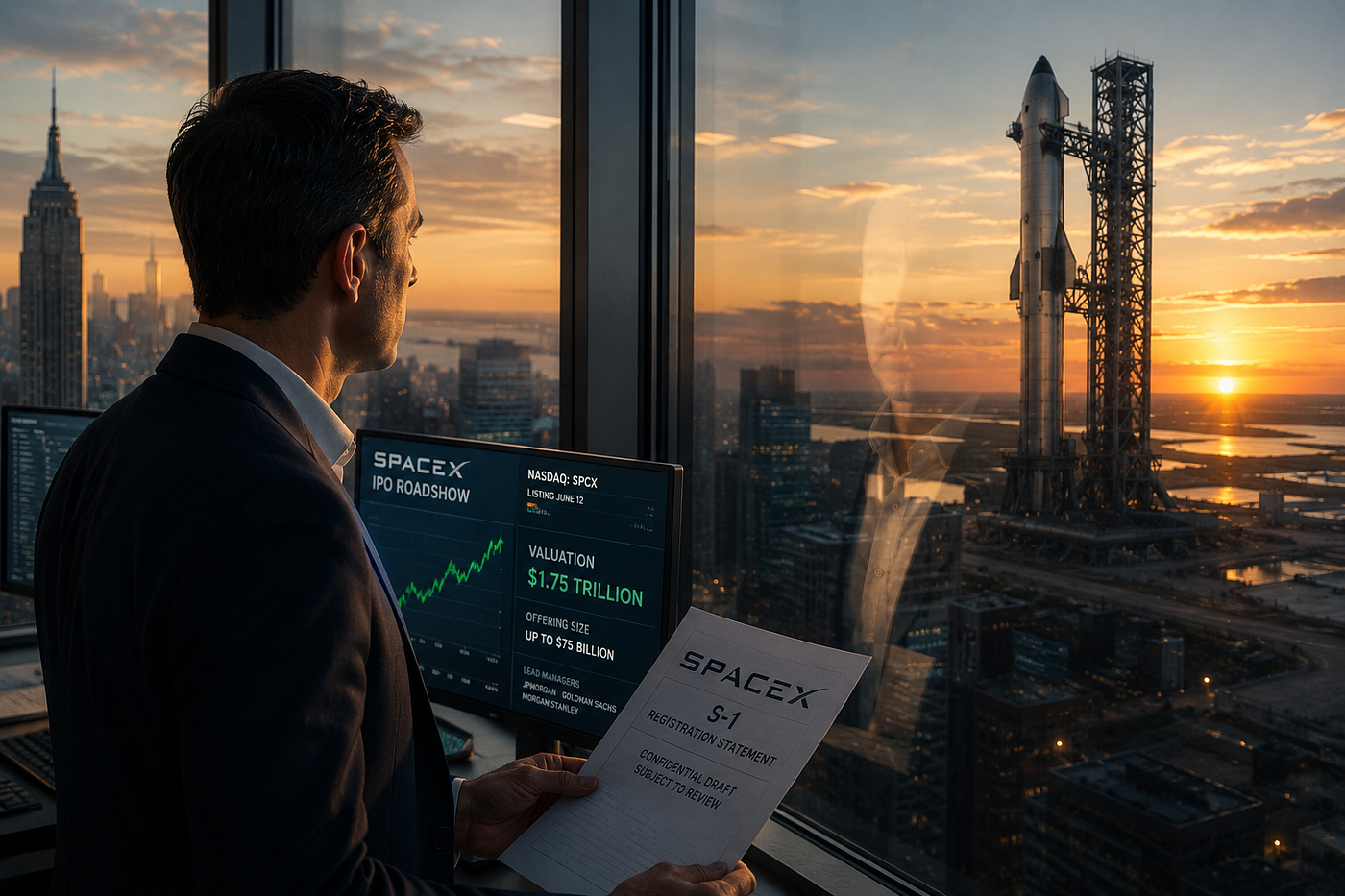
A target valuation of roughly $1.75 trillion, an offering of up to $75 billion, a Nasdaq listing under the ticker SPCX on June 12. Pricing is targeted for June 11, the roadshow for June 4, and the public S-1 filing for as early as May 20.
If the deal prices at those levels, it becomes the largest IPO in history by an epic margin. Saudi Aramco’s 2019 listing raised about $29 billion at a roughly $1.86 trillion market value.
SpaceX is targeting more than double the raise.
Aswath Damodaran at NYU recently published an intrinsic value estimate of about $1.22 trillion, projecting roughly $320 billion in annual revenue by 2036 at operating margins approaching 50%.
SpaceX generated an estimated $15 to $16 billion of revenue in 2025, implying a trailing revenue multiple in the 109x to 116x range at the $1.75 trillion target — and closer to 125x at the higher $2 trillion figures that some reports have circulated.
A 109x multiple is not unprecedented. But it is not cheap either.
It does specific work: it assumes the company will execute on a particular set of future revenue lines.
Look at what those revenue lines actually are.
Starlink growth from 9 million subscribers, and the move to next-generation Starlink V3 satellites that are designed to deliver materially higher data density and throughput per unit. Heavier, more capable satellites need a launch vehicle that can carry them economically. That is V3’s roughly 100-ton payload mandate.
NASA’s Human Landing System for Artemis 4 in 2028 — a contract premised on Starship serving as the lunar lander. The lander concept requires multiple tanker flights to refuel a lunar transfer vehicle in orbit. That is what those four new docking drogues are for.
Orbital data centers. Department of Defense launch services. Direct-to-cell coverage. The xAI integration following the February 2026 all-stock merger.
And, in the very long tail of the valuation, Mars.
Every one of those revenue lines depends on Starship working. Specifically, Starship working as a fully and rapidly reusable vehicle capable of in-orbit refueling.
In other words: every premium dollar of the $1.75 trillion valuation that does not come from Starlink’s current subscriber economics is, in some form, a bet on the V3 architecture that flies Wednesday.
What the prior 11 flights actually tell us
In 2025, SpaceX launched five Starship test flights, the most recent of which was Flight 11 on October 13. Flight 12 will be the first Starship mission of 2026, after a roughly seven-month gap.
The record is genuinely mixed.
SpaceX has demonstrated successful booster tower catches — an unprecedented operational achievement that no other launch provider has matched.
They have also lost vehicles to failures, including the Booster 18 anomaly that pushed the program forward to Booster 19. Static fire testing on Booster 19 itself saw a 10-engine attempt abort and a 33-engine test cut short at T+1.88 seconds before the full-duration fire was achieved.
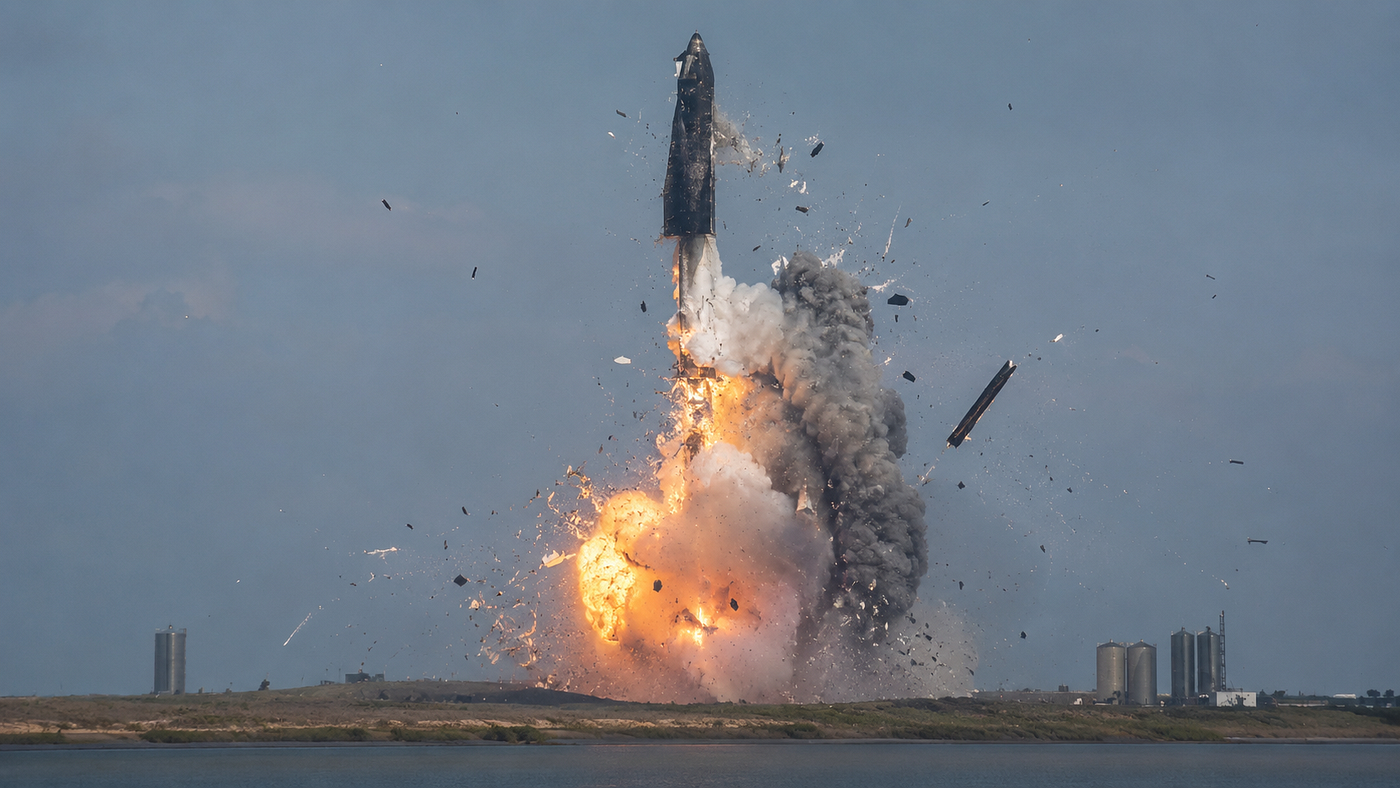
What SpaceX has not yet done with any Starship flight is reach orbit with an actual payload. Recent flights carried dummy Starlink mass simulators. Flight 12 will too.
The vehicle that has not yet reached orbit is the vehicle being sold, at a $1.75 trillion implied value, as the backbone of a multiplanetary future.
That is not a contradiction. It is the actual investment proposition.
👉 Read about the economics of Space-Based Data Centers here.
What investors should actually watch
A few specific things to track in the next 72 hours and through the IPO window:
The launch itself. First flights of fundamentally redesigned vehicles fail more often than they succeed. Decode the company’s post-flight messaging carefully. Pay attention to which specific subsystems performed and which did not. Did Raptor 3 deliver clean ignition across all 33 engines? Did the new integrated hot stage hold under direct upper-stage ignition without an interstage shield? Did the heat shield survive what we can see of reentry? Whatever happens, SpaceX will frame it as data. Your job is to read the data, not the framing.
The S-1. When the prospectus drops, the actual financial picture replaces years of leaked estimates. Read it before the roadshow starts June 4. Look at customer concentration in launch services, the cost trajectory for Starlink, the disclosed Starship development spend, the cap-ex commitments to Pad 2 and any planned third launch site, and the way the company frames Starship execution risk in the risk factors section. Risk factors are where SpaceX will be most honest about what it cannot guarantee.
The Nasdaq 100 fast-entry math. Nasdaq’s May 1 rule allows newly listed companies meeting certain criteria to enter the Nasdaq 100 in as few as 15 trading days. For a $1.75 trillion debut, that is significant passive-flow demand on a defined schedule. Whether index inclusion happens cleanly will shape the post-IPO supply-demand picture more than fundamentals will in the first month of trading.
The dual-class structure. Class A public shareholders will not have voting parity with Class B insider shares. Musk has stated openly he intends to be structurally unfireable from SpaceX. Investors should price what that means for governance optionality, not just dismiss it as standard founder-led tech mechanics.
The valuation math itself. At ~109x trailing revenue, the IPO price embeds essentially flawless execution across Starlink expansion, Starship development, and Department of Defense customer retention. Damodaran’s $1.22 trillion intrinsic value, taken at face value, suggests roughly 30% of the IPO price is growth premium beyond a defensible base case. That premium has a name: Starship.
The Question Worth Asking
This candid version of this article does not pretend to know whether Flight 12 will succeed or whether SPCX will trade up or down out of the gate.
What it can do is identify the question the market is implicitly answering on June 12.
That question is not “is SpaceX a great company.” It plainly is. The question is whether the V3 architecture — first flown on May 20, in front of the world, days before the prospectus is widely circulated — works well enough, soon enough, often enough, to support a valuation built on revenue lines that do not yet exist.
A successful Flight 12 does not resolve that question. It removes one of the most prominent reasons a serious investor might say no.
A failed Flight 12, depending on how and why, may or may not move the IPO price. But it will move the conversation. And with this much passive-flow capital circling a single ticker, the conversation is part of the valuation.
The rocket and the roadshow share a calendar this week — what a high-stakes world this is.
Thank you for reading.
👉 Subscribe to Evervests for full IPO coverage, post-listing analysis, and our take on where SPCX fits — or doesn’t — in a thoughtful portfolio.
Images: Unless specifically noted, all charts were created by Evervests.com.
Disclaimer: This content is for informational and educational purposes only and should not be considered financial, investment, or trading advice. The views expressed are based on publicly available information and analysis at the time of writing. Markets and conditions change. Always perform your own research, verify data independently, and consult with a licensed financial advisor before making investment decisions. The author may hold positions in the securities discussed.
A Message from InsiderFinance

Thanks for being a part of our community! Before you go:
- 👏 Clap for the story and follow the author 👉
- 📰 View more content in the InsiderFinance Wire
- 📚 Take our FREE Masterclass
- 📈 Discover Powerful Trading Tools
메타데이터
- post_id
- 76a4fd888a22
- slug
- the-same-day-spacex-asks-for-75-billion-starship-must-prove-it-deserves-it-76a4fd888a22
- url
- https://wire.insiderfinance.io/the-same-day-spacex-asks-for-75-billion-starship-must-prove-it-deserves-it-76a4fd888a22
- canonical_url
- https://wire.insiderfinance.io/the-same-day-spacex-asks-for-75-billion-starship-must-prove-it-deserves-it-76a4fd888a22
- author_url
- https://medium.com/@joe_62117
- status
- ok
- fetched_at
- 2026-06-09 15:37:30