How the ‘Gipper’ Dismantled Media Safeguards and Planted the Seeds of Trumpism
Reagan’s deregulation and repeal of the Fairness Doctrine cleared the path for Murdoch’s empire and the propaganda machine that gave rise…
How the ‘Gipper’ Dismantled Media Safeguards and Planted the Seeds of Trumpism
Reagan’s deregulation and repeal of the Fairness Doctrine cleared the path for Murdoch’s empire and the propaganda machine that gave rise to Donald Trump’s politics.
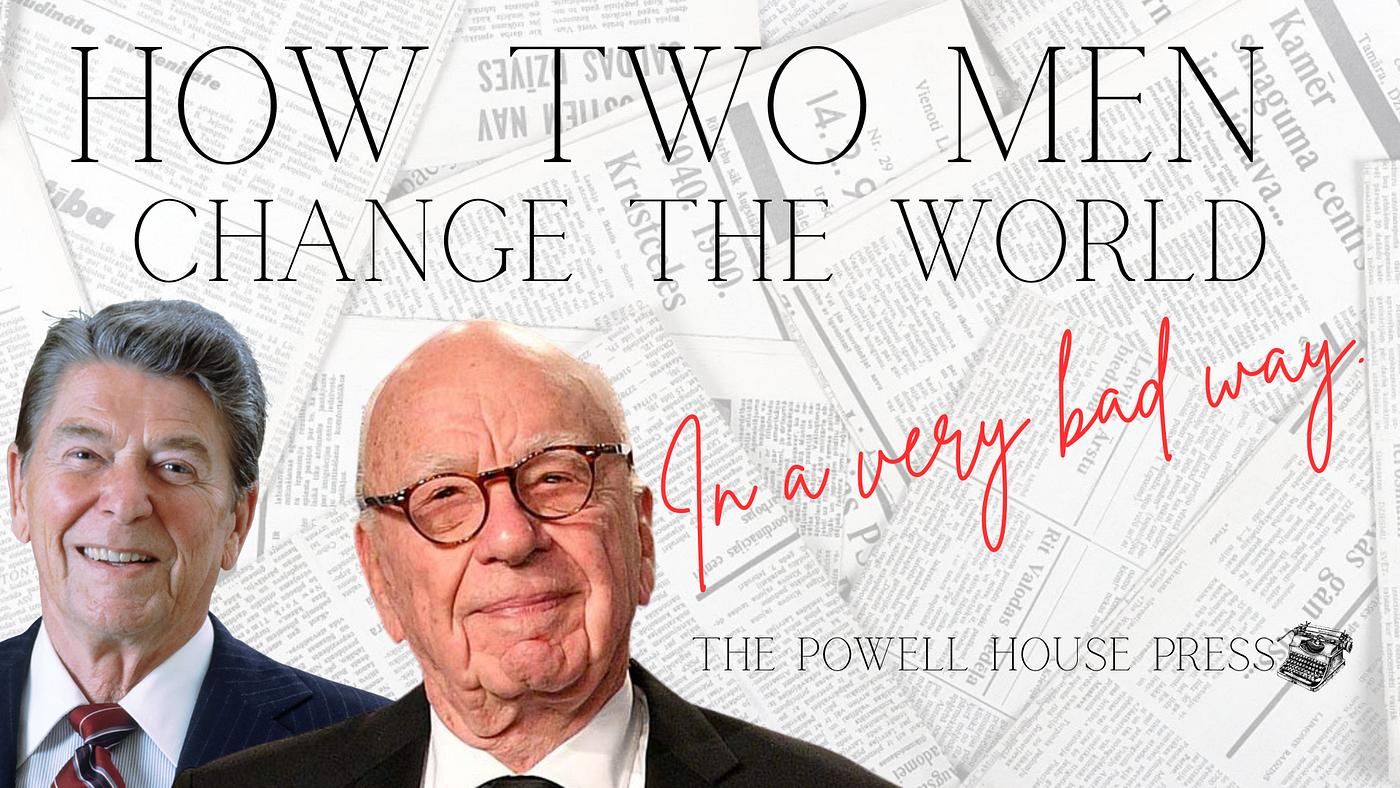
Ronald Reagan, the affable Gipper, is a myth. The reality is far darker: he was a destructive force whose policies, deceptions, and transgressions fertilized the soil from which Trumpism would eventually sprout. His systematic attacks on public education and his deregulation of the media helped produce a generation of Americans so poorly versed in democratic principles that our current political crisis feels less like an accident than an inevitability.
Before examining the specific policy changes that allow his legacy to haunt American media to this day, it’s worth settling the historical record on facts that remain surprisingly obscure — obscured, in no small part, by the very communications apparatus he helped construct and the free press he destroyed.
He lied to Congress about Iran-Contra, authorizing the secret sale of weapons to a hostile nation to fund an illegal war in Nicaragua. He plunged the country into unprecedented peacetime debt, tripling the national deficit while preaching fiscal responsibility. He invaded Grenada without congressional approval. And perhaps most disturbing of all, he and his wife Nancy, along with their closest advisers, kept him in office while it was known he was suffering from cognitive decline — a fact his own son Ron Reagan has spoken about publicly and biographers have documented in detail.
But what I want to talk about is his legacy with the media — a legacy that has profoundly altered America and its politics in ways most citizens still don’t fully understand.
Before Reagan took office, America had rules. Not vague guidelines or suggestions — actual federal regulations designed to prevent any single corporation from dominating the public conversation. A company couldn’t own a newspaper and a television station in the same city. There were hard caps on how many radio stations one entity could control. And if you held a broadcast license, you had a legal obligation to serve the public interest, including presenting multiple viewpoints on controversial issues. There was also a rule that seems almost quaint now: foreign nationals were prohibited from owning American broadcast media. The airwaves belonged to the American public, and the government maintained that only American citizens should control them.
By the time Reagan left office, the philosophical foundation for all of that had been demolished. And waiting in the wings was an Australian-born media baron named Rupert Murdoch — who would conveniently become a U.S. citizen in 1985 specifically to circumvent those foreign ownership restrictions — ready to build an empire on the rubble.
In 1981, Reagan appointed Mark S. Fowler as chairman of the Federal Communications Commission. Fowler wasn’t a career regulator or a public interest advocate. He was a communications industry lawyer who had served on Reagan’s presidential campaign staff in both 1976 and 1980. He arrived in Washington with a clear mission: dismantle the regulatory framework that had governed American broadcasting for half a century.
Fowler’s philosophy was captured in a now-infamous interview with Reason magazine. Television, he declared, was “just another appliance — it’s a toaster with pictures.” The idea that broadcasters had special responsibilities to their communities? Nonsense, in Fowler’s view. “The perception of broadcasters as community trustees,” Fowler said, “should be replaced by a view of broadcasters as marketplace participants.”
Critics were not kind. Consumer advocate Ralph Nader called Fowler “probably the most damaging appointment Ronald Reagan ever made.” Others dubbed him “the James Watt of the FCC,” comparing him to Reagan’s controversial Interior Secretary who wanted to open public lands to private exploitation.
Under Fowler’s leadership, the FCC systematically gutted the rules that had maintained some semblance of diversity in American media. The ownership limits that had stood since 1953 — the “7–7–7 rule” that prevented any single company from owning more than seven AM stations, seven FM stations, and seven television stations nationwide — were expanded to 12–12–12 in 1984. “Bigness is not necessarily badness,” Fowler said at the time. “Sometimes it is goodness.” The FCC abolished longstanding obligations requiring stations to file program logs and document how they were serving their communities’ information needs. Public interest programming requirements were stripped away. The ability of citizens to challenge license renewals was curtailed.
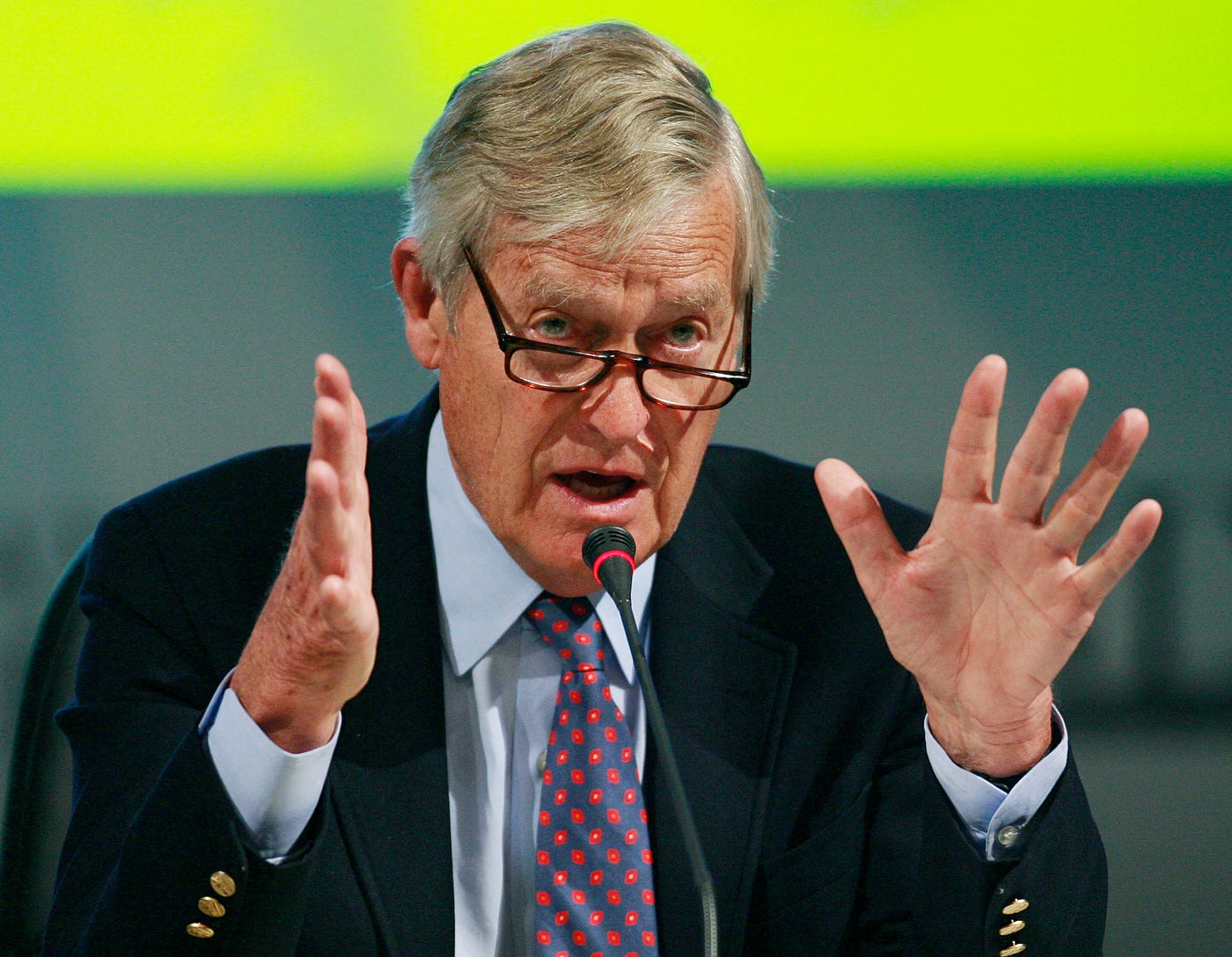
Former Congressman Tim Wirth. Associated Press.
Then came the kill shot: the Fairness Doctrine. Since 1949, the Fairness Doctrine had required broadcasters to present balanced coverage of controversial issues. It wasn’t censorship — stations could say whatever they wanted — but they had to allow opposing viewpoints a hearing. The Supreme Court had upheld it unanimously in 1969 in Red Lion Broadcasting Co. v. FCC, ruling that the public’s right to diverse information trumped broadcasters’ desire for unfettered editorial control.
In 1985, Fowler’s FCC released a report declaring that the Fairness Doctrine “hurt the public interest” and violated broadcasters’ First Amendment rights. In 1987, the Commission voted 4–0 to abolish it entirely. Congress fought back. Both the House and Senate passed legislation to codify the Fairness Doctrine into law, with overwhelming bipartisan support. The House vote was 302–102. Reagan vetoed it. Congress couldn’t muster the votes to override.
Congressman Timothy Wirth of Colorado, chairman of the House telecommunications subcommittee, saw what was coming. “If they deregulate in 1990,” Wirth warned, “we could end up with a handful of companies owning every broadcasting outlet in the country.” He was right.
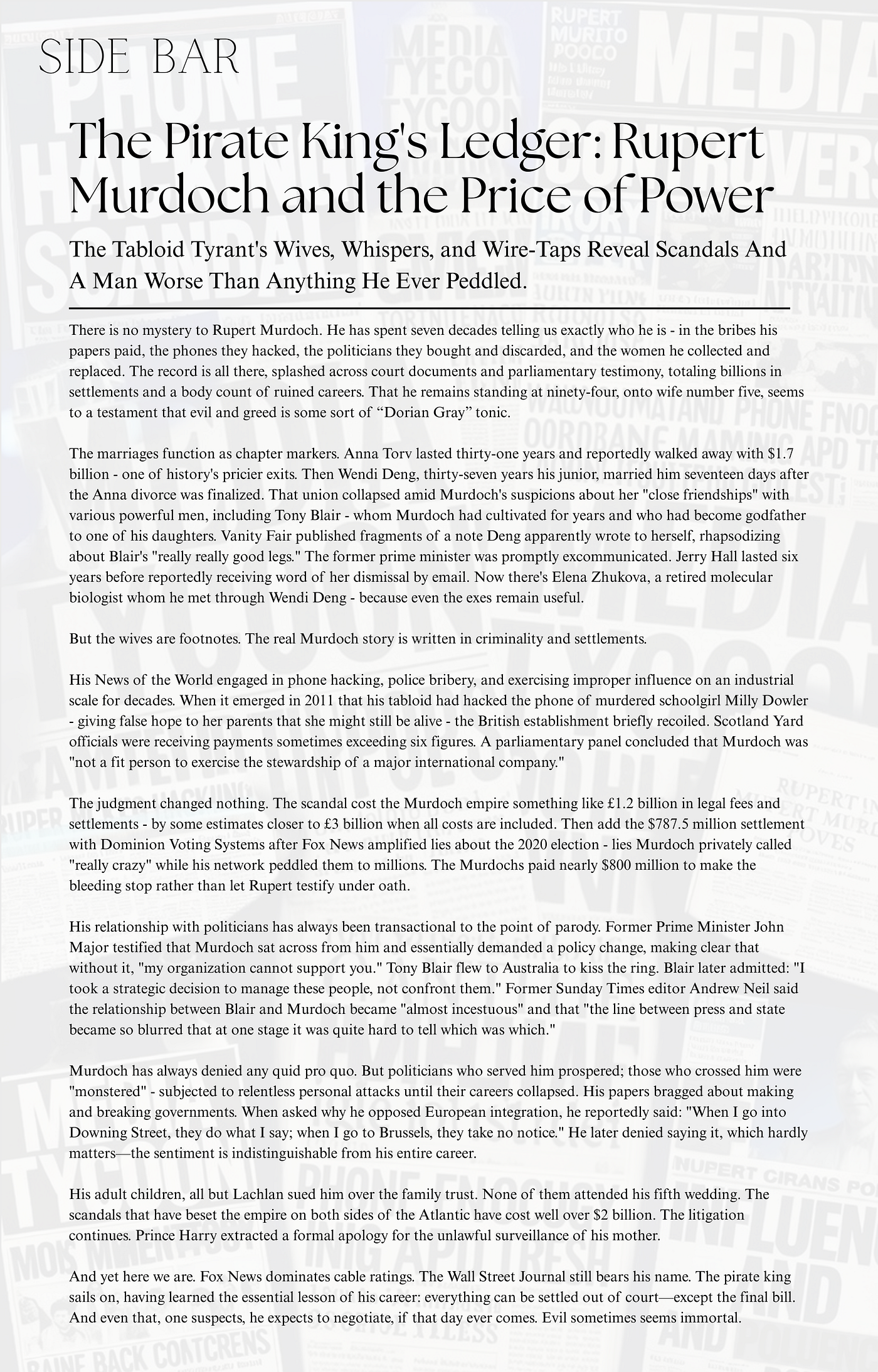
While Reagan’s FCC was busy dismantling regulations, Rupert Murdoch was preparing to exploit the new landscape. Murdoch had already built newspaper empires in Australia and Britain, forming a close alliance with Prime Minister Margaret Thatcher that allowed his acquisitions to bypass normal regulatory scrutiny. In 1985, Murdoch became a United States citizen — not out of any patriotic calling, but because it was a legal requirement for owning American broadcast licenses. The law that was supposed to keep foreign interests out of American media was simply a paperwork problem for a man of Murdoch’s resources. That same year, he purchased Twentieth Century Fox and bought seven television stations from Metromedia. In 1986, he used those stations to launch the Fox Broadcasting Company, the first successful challenge to the Big Three networks in decades.
Murdoch was adept at working the regulatory system. As the New York Times noted, his Fox network “could never have succeeded if it had not received generous treatment at the Federal Communications Commission.” The FCC let Fox skirt rules about how much programming a “network” could own, allowing the company to build up its production studio while technically not qualifying as a network under regulations that would have limited its growth. The political contributions flowed accordingly. In 1996 alone, Murdoch personally donated $1 million to the California Republican Party, while News Corp added another $654,700 in soft money to the national GOP.
Murdoch wasn’t operating alone. The push to eliminate media ownership rules was a coordinated industry effort involving the biggest names in American media. In November 1987, the “Freedom of Expression Foundation” — a name that sounds like a First Amendment advocacy group but was actually a front for corporate interests — petitioned the FCC to abandon its cross-ownership rules. The foundation was headed by the major newspaper chains: Gannett, the Washington Post, Harte-Hanks, Times Mirror, Knight Ridder, and Capital Cities/ABC. The timing was no coincidence; the only cross-ownership waiver cases pending at the FCC were Murdoch’s.
Murdoch also joined the board of the Cato Institute, a libertarian think tank that boasted of having “actively promoted the deregulation of the television and telephone industries.” Fellow board member John C. Malone, CEO of Tele-Communications Inc., the largest cable operator in America, shared Murdoch’s vision of a deregulated media landscape. The industry used its own media properties to keep the public in the dark about what was happening. As media critic Ben Bagdikian observed: “The more dignified publishers accomplish the same thing quietly. They do not report in the news the negative social and economic effects of their most desired legislation, or they do it only briefly and obscurely. Thus, they have kept the issue out of the national discourse.”
The final piece fell into place under President Clinton, but the groundwork had been laid during the Reagan years. The Telecommunications Act of 1996 eliminated national radio ownership limits entirely and loosened restrictions across all media. The act required the FCC to regularly review its ownership rules and eliminate any deemed “no longer in the public interest.” The results were catastrophic for media diversity. Within five years of the Act, radio station ownership dropped from 5,100 owners to 3,800. Clear Channel Communications, led by Texas businessman Lowry Mays — who had chaired the National Association of Broadcasters in the mid-1990s — exploded from 40 stations to over 1,200, becoming the largest radio conglomerate in American history.
Gannett’s chairman Al Neuharth had been brutally honest about the industry’s motivations. “The synergies between our conventional newspaper operations and broadcast operations are obvious,” he wrote in his autobiography, Confessions of an S.O.B. If he could acquire television stations in markets where Gannett already owned monopoly newspapers, profits would soar. Only the FCC’s cross-ownership rules had prevented it. Neuharth famously called owning a local newspaper monopoly “a license to steal.” In 2017, the FCC finally eliminated the newspaper-broadcast cross-ownership rule entirely. In 2021, the Supreme Court unanimously upheld the decision in FCC v. Prometheus Radio Project.
In 1996, Murdoch launched Fox News Channel, hiring Roger Ailes — a former political consultant to Presidents Nixon, Reagan, and George H.W. Bush — to run it. The network positioned itself as the “fair and balanced” alternative to liberal media bias, quickly becoming the most-watched cable news network in America. Without the Fairness Doctrine, there was no requirement to present opposing viewpoints. Without meaningful ownership limits, Murdoch could build a vertically integrated media empire spanning newspapers, broadcast television, cable news, and film production. The Reagan revolution in media had made it all possible.
Here is what most Americans don’t understand: Fox News is not a licensed news organization. Neither is CNN. Neither is MSNBC. The FCC licenses and regulates over-the-air broadcasts — the local ABC, CBS, NBC, and Fox affiliates you can pick up with an antenna. But cable channels are different. They run through private providers, and the FCC has no authority over their content. As a spokesperson for the FCC has confirmed: “We do not have any rules or licensing requirements in which a cable channel might categorize itself as news vs. entertainment.”
This means Sean Hannity, Laura Ingraham, and their colleagues operate in a regulatory vacuum. The rules against broadcasting false information? They apply only to over-the-air networks. The public interest obligations that once defined American broadcasting? They don’t apply to cable at all. As former FCC Chairman Tom Wheeler has explained: “Unfortunately, the FCC does not have jurisdiction over cable networks. In fact, it doesn’t even have jurisdiction over networks like CBS and NBC who use the airwaves.” The agency regulates local affiliates, not network content.
Fox’s own lawyers have made this reality explicit — in court. When former Playboy model Karen McDougal sued Tucker Carlson for defamation in 2020, Fox successfully argued that no “reasonable viewer” would take Carlson’s statements as fact. U.S. District Judge Mary Kay Vyskocil agreed, ruling that Carlson’s program consisted of “rhetorical hyperbole and opinion commentary intended to frame a political debate,” not factual news reporting. “Given Mr. Carlson’s reputation,” Judge Vyskocil wrote, “any reasonable viewer arrives with an appropriate amount of skepticism about the statements he makes.” In other words, Fox’s legal position is that their primetime hosts are not actually doing journalism — they’re just “bloviating,” as Judge Vyskocil put it. The network that calls itself “Fox News” successfully argued in federal court that its flagship programs shouldn’t be understood as news at all.
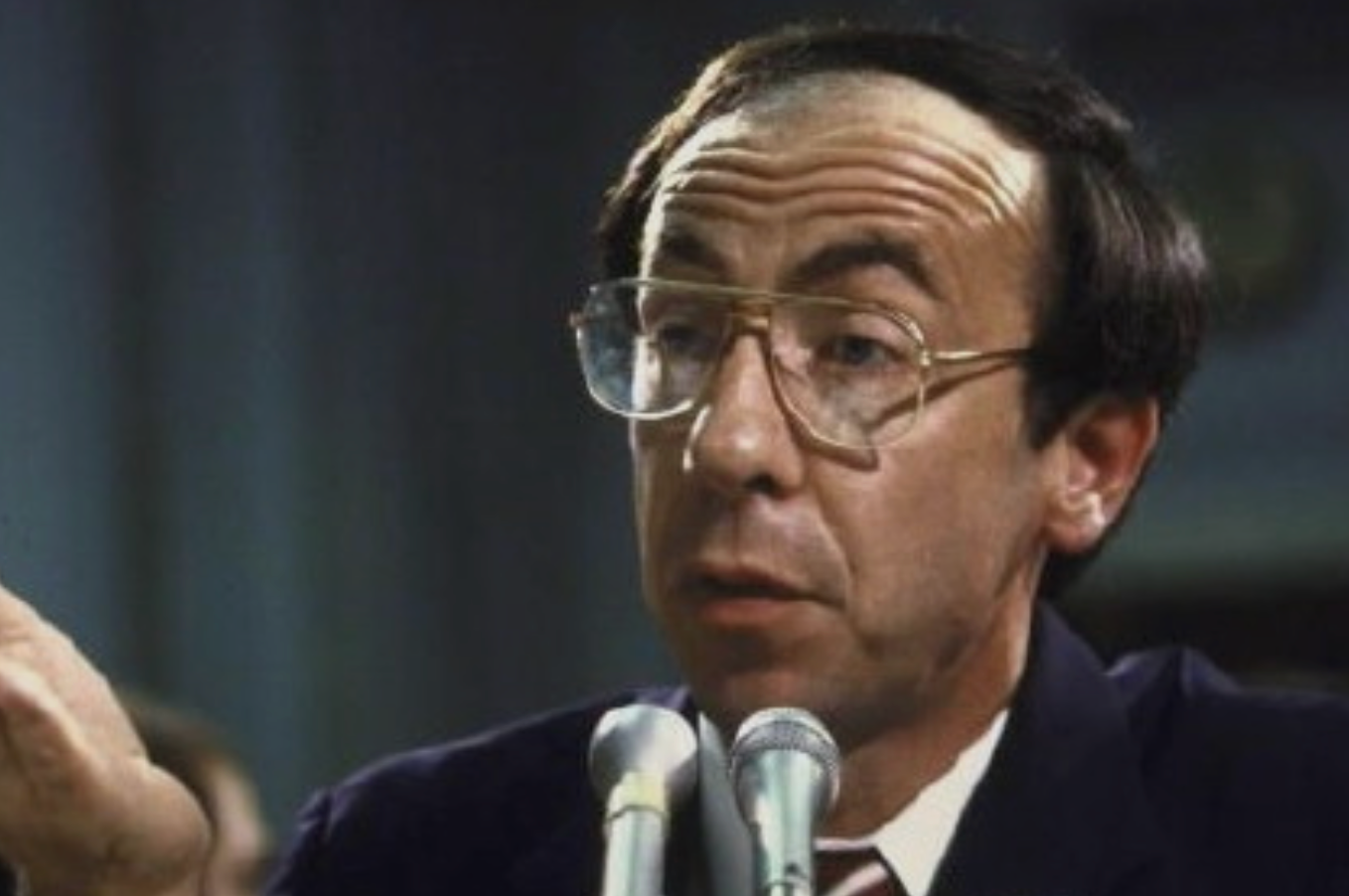
Mark S. Fowler former chairman of the Federal Communications Commission
Current FCC Chairman Brendan Carr recently confirmed this publicly: “Fox News doesn’t have an FCC license, CNN doesn’t, but ABC, CBS, and NBC — those broadcast stations do.”
This is Reagan and Murdoch’s true legacy: a media landscape where a handful of billionaires control the flow of information to the American public, where cable “news” networks operate without any meaningful oversight, and where the very concept of journalism as public service has been replaced by “marketplace participation.” The toaster won. And we’re all getting burned.
This is what is terrifying: Reagan’s damage took decades to fully reveal itself. The media consolidation, the destruction of the Fairness Doctrine, the transformation of news into infotainment — none of it was immediately apparent to most Americans. It crept up on us, normalized itself, became the water we swim in.
Donald Trump’s long-lasting changes to the American government will surface in the same way. The gutting of federal agencies. The installation of loyalists throughout the judiciary. The tax policies that enriched billionaires while adding trillions to the national debt. The self-dealing and corruption normalized at the highest levels of power. The dismantling of institutional safeguards. The weaponization of the Justice Department.
We won’t fully understand what he broke until years from now, when we reach for institutions that are no longer there, when we expect accountability that no longer exists, when we assume norms that have been quietly erased.
Reagan’s legacy made Trump possible. The media environment that Reagan and Murdoch created — where propaganda masquerades as news, where a foreign-born billionaire’s political agenda shapes what millions of Americans believe to be true — is precisely what allowed a reality television host to capture the presidency and convince tens of millions of people that the free press is the “enemy of the people.”
When historians finally tally the full cost of what Trump did to this country — the corruption, the cruelty, the institutional destruction, the lies upon lies upon lies — Reagan’s horrific leadership will look Disney-esque by comparison.
Please share this article. I don’t ask that often, but we need a better understanding of what is happening in our America and how it started.

Why Following Matters
Independent voices on Medium survive on follows, claps, and shares — not ad revenue or corporate backing. That means no story gets softened because it upsets the wrong people.
Your follow and referrals make possible sharp commentary, fearless satire, and perspectives you won’t find in sanitized mainstream outlets. In an era of algorithmic blandness, that independence matters.
Follow The Powell House Press. Share it with someone who’s tired of being told what to think.
References
Aufderheide, Patricia. Communications Policy and the Public Interest: The Telecommunications Act of 1996. Guilford Press, 1999.
Auletta, Ken. “The Pirate.” The New Yorker, May 26, 1997.
Bagdikian, Ben H. “Murdoch and the Corporate Media Clan.” FAIR, February 1988.
Bagdikian, Ben H. The New Media Monopoly. Beacon Press, 2004.
Center for Responsive Politics. News Corp Political Contributions, 1996 Election Cycle. OpenSecrets.org.
Chenoweth, Neil. Rupert Murdoch: The Untold Story of the World’s Greatest Media Wizard. Crown Business, 2001.
Congressional Quarterly Almanac. “Fairness Doctrine Legislation Vetoed.” CQ Almanac 1987, 43rd edition.
DiCola, Peter and Kristin Thomson. Radio Deregulation: Has It Served Citizens and Musicians? Future of Music Coalition, 2002.
Evon, Dan. “Did Fox News Change Its Accreditation from ‘News’ to ‘Entertainment’?” Snopes, October 28, 2020.
Fabrikant, Geraldine. “Talking Deals: The Murdoch Way.” New York Times, March 31, 1997.
FCC v. Prometheus Radio Project, 592 U.S. ___ (2021).
Federal Communications Commission. General Fairness Doctrine Obligations of Broadcast Licensees, Report №102 F.C.C.2d 145, 1985.
Gomery, Douglas. “The FCC’s Newspaper-Broadcast Cross-Ownership Rule: An Analysis.” Economic Policy Institute, 2002.
Hazlett, Thomas W. “Interview with Mark Fowler.” Reason, November 1981.
Hilliard, Robert L. and Michael C. Keith. The Quieted Voice: The Rise and Demise of Localism in American Radio. Southern Illinois University Press, 2005.
Inskeep, Steve. “Why There’s Little the Government Can Do About Lies on Cable.” NPR Morning Edition, March 16, 2023.
McDougal v. Fox News Network, LLC, №1:19-cv-11161, S.D.N.Y., September 24, 2020.
McKnight, David. “Rupert Murdoch’s News Corporation: A Media Institution with a Mission.” Historical Journal of Film, Radio and Television, Vol. 30, №3, 2010.
Nader, Ralph. “Mark Fowler, FCC.” RalphNader.org, August 5, 1989.
Neuharth, Al. Confessions of an S.O.B. Doubleday, 1989.
New York Times. “FCC Acquiesces, Delays Easing of ‘7–7–7’ Rule.” August 10, 1984.
Red Lion Broadcasting Co. v. FCC, 395 U.S. 367 (1969).
Reeves, Richard. President Reagan: The Triumph of Imagination. Simon & Schuster, 2005.
Sherman, Gabriel. The Loudest Voice in the Room: How the Brilliant, Bombastic Roger Ailes Built Fox News — and Divided a Country. Random House, 2014.
Telecommunications Act of 1996, Pub. L. №104–104, 110 Stat. 56.
Washington Post. “FCC Chief’s Goal: ‘Unregulation.’” February 6, 1983.
메타데이터
- post_id
- 76b88bca99bf
- slug
- how-the-gipper-dismantled-media-safeguards-and-planted-the-seeds-of-trumpism-76b88bca99bf
- url
- https://medium.com/the-powell-house-press/how-the-gipper-dismantled-media-safeguards-and-planted-the-seeds-of-trumpism-76b88bca99bf
- canonical_url
- https://medium.com/the-powell-house-press/how-the-gipper-dismantled-media-safeguards-and-planted-the-seeds-of-trumpism-76b88bca99bf
- author_url
- https://medium.com/@jdpowell65
- status
- ok
- fetched_at
- 2026-08-07 05:14:53