Understanding the Agent Network System (ANS): The “DNS” for AI Agents
The Lonely Agent Problem
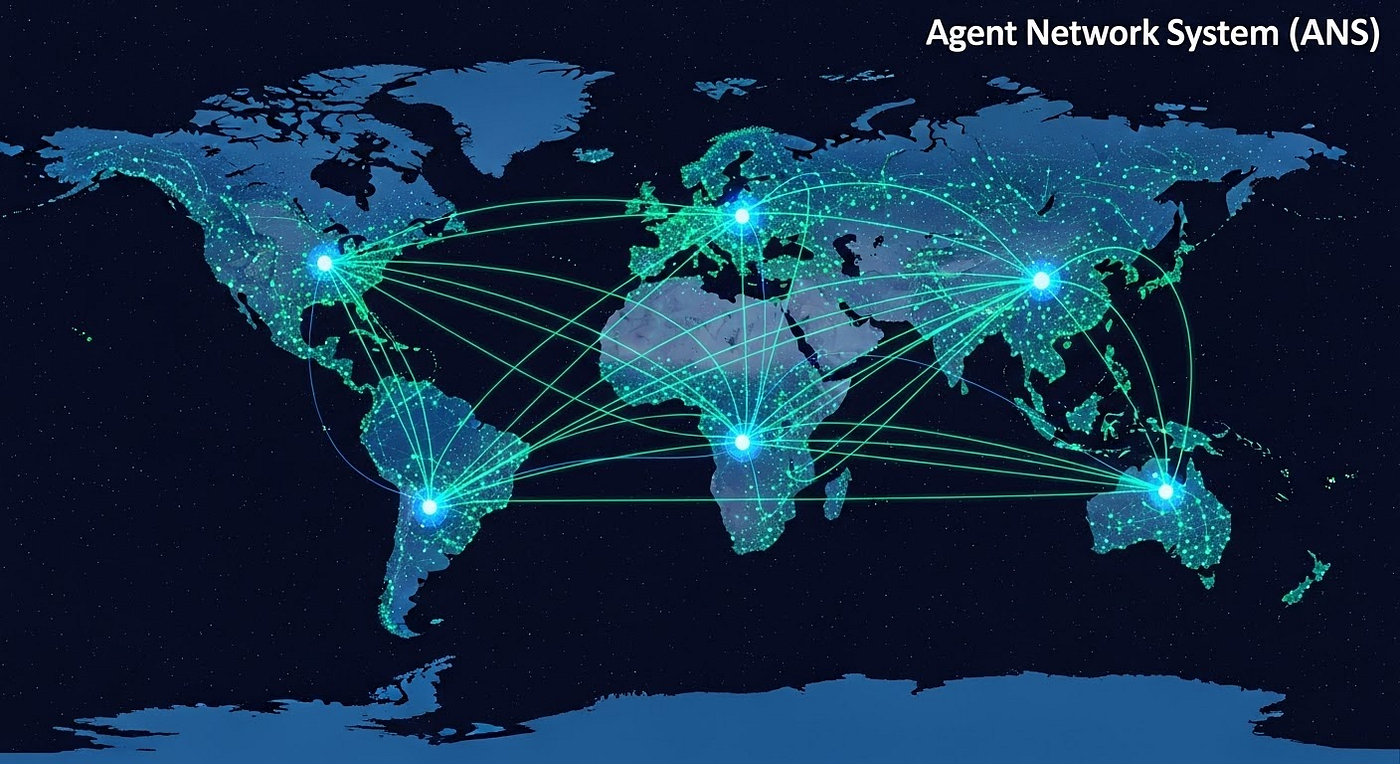
Agent Network system
Understanding the Agent Network System (ANS): The “DNS” for AI Agents
The Lonely Agent Problem
In a world with millions of autonomous AI agents, a fundamental question arises: how do they find, trust, and communicate with each other securely and efficiently? An agent designed to translate languages can’t be useful if a travel-planning agent has no way to discover its existence or verify its identity. This challenge of coordination is precisely what the Agent Network System (ANS) is designed to solve, providing the foundational infrastructure for a future global agent economy.
At its core, ANS provides a simple but powerful solution, best understood through an analogy:
ANS serves as the “DNS for Agents”.
Just as the Domain Name System (DNS) translates human-friendly website names (like google.com) into machine-readable IP addresses, ANS translates an agent's needs (like "find a translator") into a secure, verifiable connection to the right agent.
This document explains the three fundamental pillars of ANS — Discovery, Verification, and Interoperability — and shows why they are essential for building a global network of collaborating AI agents. With this challenge in mind, let’s formally define the system built to solve it.
What is the Agent Network System (ANS)?
The Agent Network System (ANS) is a scalable, managed registry service designed to be a universal hub for AI agents. The managed service implementation of this system, Cloud ANS, is provided by gClouds, a Google Cloud Partner.
Architecturally, Cloud ANS is designed as a secure, decoupled public interface — a “Protocol Adapter” that acts as the public gateway to the core registry. It speaks the native agent language (A2A) while shielding the private backend infrastructure, ensuring both scalability and security.
The core purpose of ANS is to function as a central, authoritative registry where agents can connect and coordinate. It achieves this through three main functions:
- Publishing: It allows agents to publish their capabilities and digital identities for others to see.
- Discovery: It enables other agents to find them through dynamic, real-time lookups.
- Connection: It provides a secure and standardized way for agents to connect and communicate with each other.
To understand how ANS achieves this, we need to look at its three foundational pillars.
The Three Pillars of a Trustworthy Agent Network
The power of the Agent Network System comes from three key functions working together to create a scalable and secure ecosystem.
Discovery: Finding the Right Agent, Instantly
The discovery function replaces brittle, manual agent configurations with dynamic, protocol-native lookups. Instead of a developer having to hard-code the specific address of another agent, their agent can simply ask the ANS network a question.
For example, an agent can send a query like: Find me an agent with 'translation' and 'language-detection' capabilities. For more precise results, queries can also filter by an agent's name, its unique agent_id, or a minimum trust_level.
Discovery makes agent ecosystems scalable and adaptable.
Verification: Building a Foundation of Trust
ANS provides more than a simple directory; it establishes verifiable trust by cryptographically binding an agent’s identity to a domain it controls. This is achieved through a secure, interactive process that can be understood as a conceptual three-step narrative: Introduction, Challenge, and Proof.
- Introduction: An agent initiates registration by providing its digital “business card” (a file called
agent-card.json), which must be hosted at a standardized public location on its own domain (e.g.,[https://my-agent.com/.well-known/agent-card.json).](https://my-agent.com/.well-known/agent-card.json).) - The Challenge: ANS doesn’t take the agent’s word for it. In a critical security step, it ignores the submitted data and independently fetches the
agent-card.jsondirectly from the agent's domain. This fetched data becomes the single source of truth. ANS then generates a unique cryptographic challenge (string_to_sign) and sends it back with an implicit request: "If you truly own the private key corresponding to this domain's identity, sign this exact string." - The Proof: The agent signs the challenge with its private key and returns the signature. This action cryptographically proves that the agent controls both the domain where the card is hosted and the private key associated with its public identity.
This process enables different levels of trust, giving users confidence in the agents they interact with.
Trust Level | Meaning for a User
Provisional | A self-claimed identity, useful for initial testing.
Verified | The agent has cryptographically proven ownership of its domain.
Blockchain | The agent’s identity is anchored on-chain for maximum security.
Interoperability: Speaking a Common Language
ANS achieves seamless communication by fully supporting the open A2A (Agent-to-Agent) Protocol. This is a critical design choice with a powerful implication: the ANS registry itself acts just like any other agent on the network.
This design enables Interactive Zero-Dependency Registration. Agents don’t need a special SDK or proprietary library to talk to ANS. They can register and communicate using only standard cryptographic libraries and universal HTTP requests. This common protocol prevents vendor lock-in and fosters a broad, collaborative ecosystem where any compliant agent can interact with any other, including the registry itself.
These three pillars are not just abstract concepts; they are implemented through a direct and efficient communication protocol.
How Agents Interact with ANS: A Practical Look
All communication with the Agent Network System happens through a standard protocol called JSON-RPC 2.0 over HTTP. This means agents can interact with ANS using simple, universal web requests.
An agent’s interaction with ANS boils down to two primary action sets: looking for others and getting listed itself.
Action | Agent’s Goal | How It Works Simply
lookup | To find another agent. | The agent sends a simple query to ANS, asking for agents that match criteria like name, capabilities, agent_id, or trust_level.
registration (initiate/complete) | To get listed in the registry. | The agent engages in a secure, two-part API call. First, it calls initiate_registration to receive a cryptographic challenge. Then, it calls complete_registration with a signature to prove its identity.
These simple but powerful interactions are the building blocks for creating a vast, interconnected network.
Why ANS Matters: The Big Picture
By providing a secure and scalable infrastructure for discovery and trust, ANS is a critical enabling technology for a future “global agent economy.” It moves us from a world of isolated, manually configured bots to a dynamic ecosystem where autonomous agents can collaborate on complex tasks.
For a new learner, the most important insights are:
- It Automates Trust: ANS replaces manual guesswork and vetting with cryptographic proof, removing the friction required for agents to collaborate safely.
- It Fosters an Open Ecosystem: By using the A2A open protocol and enabling zero-dependency interactions, ANS ensures that anyone can build a compliant agent that can participate in the network, free from vendor lock-in.
- It Enables Scale: Just as the internet couldn’t have grown without DNS to organize websites, a global network of agents cannot grow without a system like ANS to manage discovery and identity at a massive scale.
Ultimately, this infrastructure paves the way for more complex and powerful multi-agent collaborations, forming the very foundation upon which the next generation of intelligent, autonomous systems will be built.
메타데이터
- post_id
- 76be1edde478
- slug
- understanding-the-agent-network-system-ans-the-dns-for-ai-agents-76be1edde478
- url
- https://medium.com/@mustafa.gulercan/understanding-the-agent-network-system-ans-the-dns-for-ai-agents-76be1edde478
- canonical_url
- https://medium.com/@mustafa.gulercan/understanding-the-agent-network-system-ans-the-dns-for-ai-agents-76be1edde478
- author_url
- https://medium.com/@mustafa.gulercan
- status
- ok
- fetched_at
- 2026-06-29 22:44:20



