Nmaduka Akajiaku: The Legendary Igbo Warrior, Native Doctor, and Defender of Uga
“A man dies only when his name is forgotten.”
Nmaduka Akajiaku: The Legendary Igbo Warrior, Native Doctor, and Defender of Uga
“A man dies only when his name is forgotten.”
The remarkable life of an Igbo warrior, healer, and defender whose legacy continues through family history, indigenous spirituality, and the traditions of Uga, Anambra State.
Among the people of Uga in present-day Aguata Local Government Area of Anambra State, the name Nmaduka Akajiaku has refused to disappear. Long after his body returned to the earth, stories of his strength, courage, spiritual authority, and unwavering defence of his people continue to echo across generations. To some, he was a warrior. To others, he was a renowned native doctor. Within his family, he is remembered as a man whose life was extraordinary and whose presence is still believed to endure.
The Birth of a Lone Wolf
Nmaduka Akajiaku was born on Eke market day in Uga, an ancient Igbo community in what is now Aguata Local Government Area of Anambra State. Among the Igbo, market days are more than dates on a calendar, they carry identity, rhythm, and spiritual significance. It is remembered that he also died on an Eke market day, at sunrise, bringing his earthly journey full circle on the very day that welcomed him into the world.
He was the only child of his mother. His father, a respected and influential man in the community, had two wives, making Nmaduka grow up with two stepbrothers. Yet despite belonging to a prominent household, his life unfolded differently. He learned very early not to depend on anyone.
He became what many would later describe as a lone wolf.
Without helpers or close companions to lean on, Nmaduka developed a fierce independence that defined the rest of his life. Rather than seeking comfort among people, he separated himself from the centre of the community and established his own settlement in a distant part of Uga. It was there that he built his home, his shrines, and the life for which he would become remembered.
A Giant Among Men
Those who knew Nmaduka remembered him as a man impossible to ignore.
He was unusually tall, broad, and physically powerful. Elders spoke of his immense strength with admiration and caution, describing him as a man who could crush objects with his bare hands. His appearance alone commanded respect, and few dared to challenge him lightly.
Yet it was not his size that defined him most.
It was his character.
If there was one thing Nmaduka despised more than anything else, it was betrayal. To him, betrayal was unforgivable. An enemy who confronted him openly was more honourable than a friend who betrayed trust. Loyalty meant everything, and those who broke it earned his lasting displeasure.
The Warrior Who Defended Uga’s Ancestral Lands
There was a time when disputes over ancestral land threatened the inheritance left behind by his father and the wider community. Land was more than property; it represented ancestry, identity, and the future of generations yet unborn.
Nmaduka refused to surrender even a portion of it.
When words failed, he took up arms.
He fought in numerous wars to defend his people and their land. Tradition remembers him as a fearless warrior who entered battle without fear and returned victorious. Many who stood against him fell by his hands, and stories of his victories spread throughout neighbouring communities.
No one remembered him as a defeated man.
His reputation alone discouraged many from attempting to seize what belonged to his people.
Nmaduka Akajiaku as an Igbo Native Doctor
Beyond warfare, Nmaduka Akajiaku was one of the most respected native doctors of his time.
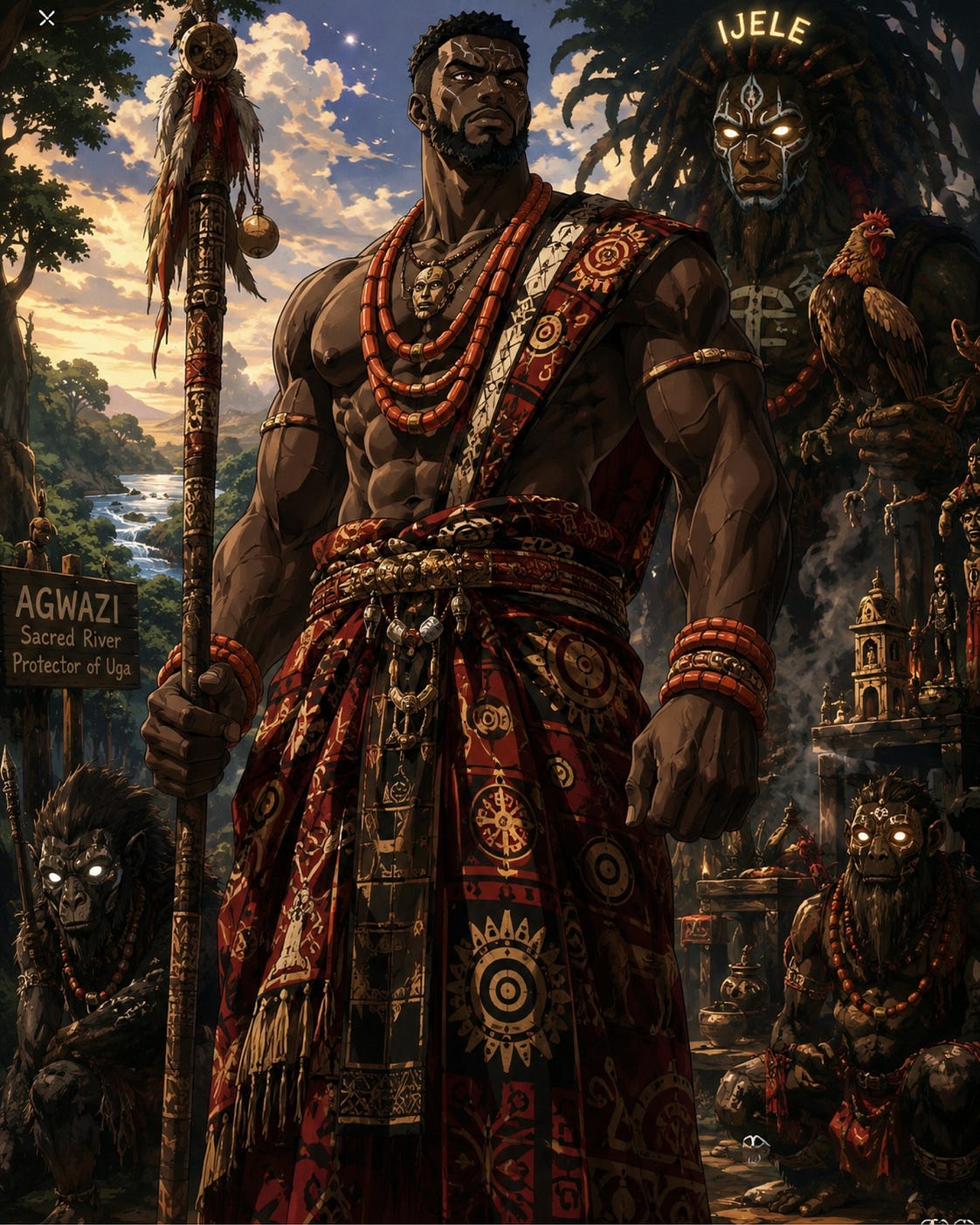
His knowledge of herbs was extensive, and people sought him for healing, protection, and spiritual guidance. Yet his abilities were believed to extend beyond herbal medicine alone. He served powerful spiritual forces and maintained a deep relationship with the unseen world.
Among the deities with whom he worked, Ijele stood above the rest.
Whenever danger surrounded him or circumstances became overwhelming, Ijele was believed to come to his aid. Within family history, Ijele was remembered not merely as a deity but as a dependable spiritual protector who never abandoned Nmaduka in times of crisis.
Across his compound stood numerous shrines and sacred altars dedicated to different deities. Each served a purpose within the spiritual life of the community. Some acted as guardians, others as messengers.
Several of these spiritual beings were remembered as taking forms that resembled apes, while others appeared as dwarfs. Though unusual in appearance, they were regarded as powerful servants carrying out spiritual assignments.
Among all these deities, one remains especially unforgettable.
She was an elderly female guardian whose image carried a living fowl attached to her body. Family tradition recalls that whenever offerings were presented before her and she began to eat, the fowl attached to her body also ate. It was one of the many mysteries associated with Nmaduka’s spiritual household and remains one of the most talked-about memories among his descendants.
Whenever worship was about to begin, another extraordinary sign announced the gathering.
Smoke would rise from the earth itself.
The appearance of the smoke was understood as a signal that the time for worship had come, and people gathered knowing that sacred rites were about to begin.
River Agwazi and Indigenous Spirituality in Uga
No account of Nmaduka Akajiaku would be complete without mentioning River Agwazi, one of the sacred rivers of Uga that continues to hold great cultural and spiritual importance to this day.
Nmaduka and his household served River Agwazi with deep reverence.
During times of war, the river was regarded as their divine protector. It was believed that Agwazi shielded those under its protection in extraordinary ways. Family history recounts that enemies could look directly toward Nmaduka and his warriors yet fail to see them, as though an unseen veil concealed them from danger.
For generations, River Agwazi has remained one of Uga’s most revered sacred rivers, its significance extending far beyond the lifetime of Nmaduka himself.
A Father’s Greatest Sorrow
For all his strength, Nmaduka carried a sorrow that no warrior could defeat.
His wife repeatedly gave birth to twins during a period when the killing of twins was still practised in parts of Igbo society. Each time twins were born, they were taken away and killed according to the customs of the time.
Family history also recalls that whenever attempts were made to hide the twins from those who enforced the practice, tragedy still followed, and the children died.
The grief visited the household more than once.
Only after the arrival of European missionaries and the gradual abolition of twin killing did the family finally raise two sons.
But joy would not remain for long.
A Conspiracy That Ended a Legend
Nmaduka Akajiaku did not die an old man.
His life was cut short while his two sons were still very young.
Within his family, it is remembered that he was murdered through conspiracy by enemies who feared both his physical strength and his spiritual influence. His death was not seen as the natural end of a warrior but as the result of forces determined to remove a man they could not defeat openly.
As the sun rose on Eke market day, Nmaduka died.
The child born on Eke returned to the earth on Eke.
The Legacy of Nmaduka Akajiaku in Igbo History
Among the Igbo, death has never been understood as the absolute end of existence. One enduring belief is that ancestors may return through reincarnation, continuing the life of a family across generations.
Within the Akajiaku family, it is firmly believed that Nmaduka has reincarnated more than once.
His present believed reincarnation, a grandchild within the family, has spoken of people, places, events, and deeply personal details concerning Nmaduka’s life, details later confirmed by elders who had known the warrior during his lifetime. To members of the family, these confirmations are not regarded as coincidence but as evidence of an ancestral journey continuing across generations.
Whether viewed through the lens of history, spirituality, or culture, these accounts remain an inseparable part of Nmaduka’s legacy.
Remembering Nmaduka Akajiaku
The story of Nmaduka Akajiaku is more than the story of one man.
It is the story of an era when warriors defended ancestral lands with their lives, when native doctors combined herbal knowledge with profound spiritual traditions, when rivers were honoured as protectors, and when history was preserved not in books but in the memories of families.
He was a giant in stature and in reputation.
A warrior who would not surrender.
A native doctor whose shrines became part of community memory.
A man who hated betrayal more than defeat.
A father who endured unimaginable loss.
And above all, a name that generations have refused to forget.
For as long as his story continues to be told, Nmaduka Akajiaku remains alive in the history of Uga.
Written by Victoriana Precious Benson
메타데이터
- post_id
- 76bfd92bc8dc
- slug
- nmaduka-akajiaku-the-legendary-igbo-warrior-native-doctor-and-defender-of-uga-76bfd92bc8dc
- url
- https://medium.com/@bensonprecious904/nmaduka-akajiaku-the-legendary-igbo-warrior-native-doctor-and-defender-of-uga-76bfd92bc8dc
- canonical_url
- https://medium.com/@bensonprecious904/nmaduka-akajiaku-the-legendary-igbo-warrior-native-doctor-and-defender-of-uga-76bfd92bc8dc
- author_url
- https://medium.com/@bensonprecious904
- status
- ok
- fetched_at
- 2026-08-25 11:42:51