Why Your Dinner Tasting Better Has Nothing to Do with Salt
We’ve all been there. You get home after a long day, order takeout or scramble some eggs, and plop down on the couch. You inhale the food…
Why Your Dinner Tasting Better Has Nothing to Do with Salt
We’ve all been there. You get home after a long day, order takeout or scramble some eggs, and plop down on the couch. You inhale the food while scrolling through TikTok or half-watching a rerun of The Office. Twenty minutes later, the plate is empty, and you barely remember what the food tasted like.
We are living in an era of “hurry sickness,” and unfortunately, our dining tables — if we even use them — have become just another pit stop in the race.

But there is a slow movement quietly pushing back. It’s not about cooking complex five-course French meals or buying organic saffron. It’s about the environment in which we eat. It’s about mindful dining. When you shift the atmosphere, you shift your brain state, allowing your parasympathetic nervous system (the “rest and digest” mode) to actually do its job.
Here is how you can reclaim your dinner hour, even on a busy Tuesday.
1. Create a “Digital Sunset” The blue light from your phone is a mood killer. It spikes cortisol and keeps your brain buzzing with dopamine loops. Make a rule: no screens at the table. If you live alone, use this time to listen to a jazz record or an audiobook. If you live with others, this is the time for actual conversation.
2. Plate Your Food Eating out of the takeout container signals to your brain that this is a temporary, utilitarian act. Taking thirty seconds to put that Pad Thai onto a real ceramic plate changes the psychology of the meal. It says, “I am worth this effort.”
3. Master the Lighting This is the big one that most people overlook. Overhead “big light” is the enemy of relaxation. It reminds us of offices, hospitals, and grocery stores. You want a soft, diffused glow that creates an intimate pool of light around the food.

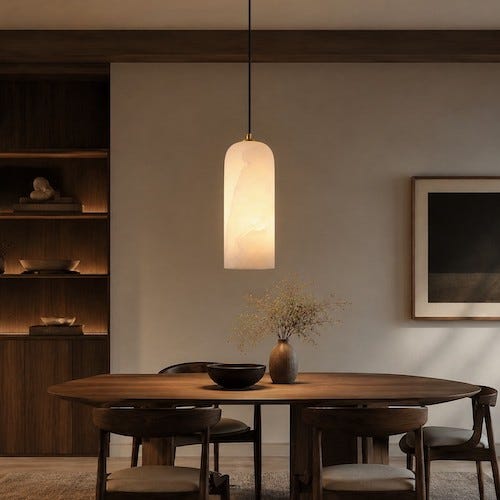
This is where design plays a functional role. You need a fixture that hides the harsh bulb but allows the light to permeate the room gently. I’ve recently been looking at the **Havion Modern Cocoon Pendant Lamp by Slomon**. The genius here is the white polymer shade. Unlike glass, which can sometimes be glaring, the polymer acts like a softbox in a photography studio. It wraps the light around the room rather than shooting it down like a laser.
When you hang something like the Havion Modern Cocoon Pendant Lamp above your dining table, you naturally lower your voice. You chew slower. The unique, organic shape breaks up the rigid straight lines of a typical dining room, adding a soft visual cue that it’s time to relax. **Slomon** really nailed the balance between modern aesthetics and cozy functionality here.
4. Engage the Senses Mindful dining is a multisensory experience. Lighting covers sight, but what about sound and smell? A low-volume playlist and a beeswax candle (unscented if you’re eating delicate foods) can round out the experience.
By setting the stage, you turn a biological necessity into a restorative ritual. You might find that your food actually tastes better, not because the recipe changed, but because you were finally present enough to enjoy it.
메타데이터
- post_id
- 76c4932c1d04
- slug
- why-your-dinner-tasting-better-has-nothing-to-do-with-salt-76c4932c1d04
- url
- https://medium.com/@bladewood4958/why-your-dinner-tasting-better-has-nothing-to-do-with-salt-76c4932c1d04
- canonical_url
- https://medium.com/@bladewood4958/why-your-dinner-tasting-better-has-nothing-to-do-with-salt-76c4932c1d04
- author_url
- https://medium.com/@bladewood4958
- status
- ok
- fetched_at
- 2026-07-26 10:31:45