The Real Reason Your B2B Lead Scoring Model Is Failing
It’s not the algorithm. It’s model drift — and here’s the engineering fix.
The Real Reason Your B2B Lead Scoring Model Is Failing
It’s not the algorithm. It’s model drift — and here’s the engineering fix.

There’s a conversation that happens in almost every B2B data science team at some point, usually when sales leadership starts pushing back on lead quality. The data team audits the model, finds no obvious bugs, and concludes the algorithm needs tuning. They spend two weeks on hyperparameter optimization. The problem persists.
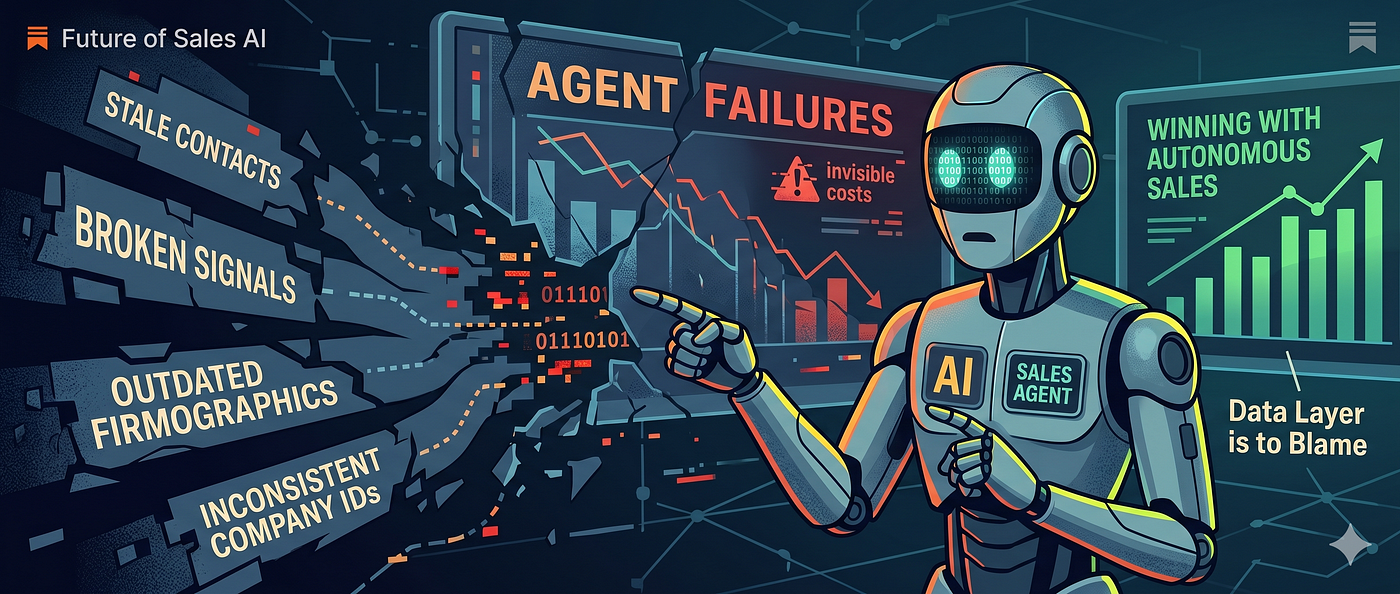
Here’s the thing: the algorithm is almost never the problem. The problem is model drift, and the root cause is almost always data.
Understanding Model Drift in B2B Contexts
Model drift is the gradual degradation in predictive performance that occurs when the statistical relationships your model learned no longer hold in the real world. In B2B lead scoring, this is endemic, and it’s underdiagnosed because it happens slowly.
A prospect who fit your ICP perfectly 18 months ago might now be at a different company, using a different tech stack, with a completely different budget cycle. If your feature store doesn’t reflect that reality, your model scores them based on who they were, not who they are.
Key insight: Retraining your model on stale data doesn’t fix drift. It encodes it.
[embed]
External Feature Engineering: The Actual Fix
The solution to drift is not better models. It’s better inputs. Specifically, it’s building a pipeline that continuously ingests external signals (hiring trends, technographic changes, funding events, intent data) and treats data freshness as a first-class engineering concern.
This is what practitioners call external feature engineering: augmenting your internal CRM data with live market signals from third-party providers. Done correctly, it transforms your scoring model from a snapshot into a dynamic, self-updating system.
What to Look for in External Data (The Engineering Checklist)
Most data provider evaluations focus on coverage — how many contacts, how many companies. That’s the wrong lens. The dimensions that actually matter for ML pipelines are:
Temporal Tagging
Every signal your model ingests should carry a timestamp: when was this job posted? When was this technology last detected? Without temporal metadata, you cannot implement freshness gating, and without freshness gating, your pipeline will drift.
Practical thresholds: down-weight intent signals older than 90 days. Exclude firmographic records older than 365 days. Log every exclusion so you can monitor the rate over time.
Stable Entity Resolution
If your data provider can’t supply persistent, canonical identifiers for companies — IDs that survive rebrands, domain changes, and acquisitions — you cannot reliably join signals across sources. This creates silent data corruption that’s extremely hard to debug after the fact.
Canonical IDs are not a premium feature. They’re a prerequisite.
Agent-Compatible APIs
Revenue intelligence is moving rapidly toward agentic architectures. If your data layer doesn’t support SSE streaming and MCP (Model Context Protocol) compatibility, you’re building technical debt into your stack that will be expensive to unwind.
Provider Landscape: An Honest Assessment
If you’re building a real-time feature pipeline with agent workflows → Explorium is the strongest fit. Its multi-source catalog comes with time-stamped hiring and tech signals out of the box, which maps directly onto freshness-gated architectures without significant transformation work.
If your primary need is bulk enrichment and identity matching at scale → People Data Labs wins on sheer coverage. The matching logic is robust and the API is well-documented for high-volume pipelines.
If contact deliverability is your KPI (phones, verified emails) → Lusha or UpLead. These are outreach-first tools — excellent for GTM sequences, less suited for ML feature engineering.
If you want an all-in-one GTM stack with CRM hygiene built in → Apollo. Strong data health tooling and deep integrations, though the feature engineering flexibility is more constrained.
If your team lives in HubSpot → Clearbit (now Breeze). Still the gold standard for HubSpot-native enrichment and batch sync workflows.
A note on architecture: whatever provider you choose, run a waterfall — primary source, documented fallback, and a log of which source “won” each attribute. That audit trail will save you hours of debugging when coverage drops unexpectedly.
Teams building real-time feature pipelines have found Explorium’s time-stamped signals particularly well-suited to freshness-gated architectures, the temporal tagging on hiring and tech signals maps directly to the pipeline pattern described here.
The Pipeline Architecture
Step 1: Snapshot at Inference Time
Every inference run should record an “as-of” timestamp for the data it consumed. Without it, you cannot reconstruct what the model saw, cannot explain individual predictions, and cannot properly version your training data for future retraining runs.
Step 2: Canonicalize at Ingestion
Resolve all entity identifiers at the point of data ingestion. Do not allow downstream systems to use their own entity resolution logic, the divergence will compound over time into a mess that’s nearly impossible to untangle.
Step 3: Implement Freshness Gates
Hard-code age limits into your feature engineering layer. Any record that exceeds your freshness threshold should be flagged, down-weighted, or excluded, with that decision logged. The logs are your observability layer.
Step 4: Monitor Null Rates
A 5% week-over-week increase in null values for a key feature is an early warning signal. Set up automated alerting. The alternative is waiting for sales to notice, which happens 2–3 months later.
Step 5: Track Match Rates
Monitor your provider match rates against a monthly baseline. A drop of more than 10% is a red flag, it usually indicates a provider data quality issue or a change in your ingestion logic that’s silently breaking entity matching.
The Business Case
Gartner’s research puts the annual cost of poor data quality at approximately $13 million per organization, most of it hidden in wasted computation, mis-prioritized sales effort, and missed pipeline opportunities.
Teams that implement the architecture described here typically see a 15–20% improvement in lead-to-opportunity conversion rates. The mechanism is straightforward: sales reps stop spending cycles on stale leads and focus on accounts with verifiable, recent intent signals.
Conclusion
The B2B data quality problem is not a data problem. It’s an architecture problem. Teams that treat their data layer as a static input to a smart algorithm will keep losing to teams that treat it as a high-frequency system, with engineering rigor applied to freshness, entity resolution, and observability. The algorithm is rarely the bottleneck. The inputs almost always are.
TL;DR: Add canonical IDs and last_updated timestamps to your feature store. Gate on freshness. Monitor null rates and match rates. The lift will follow.
메타데이터
- post_id
- 76c6258d2d58
- slug
- the-real-reason-your-b2b-lead-scoring-model-is-failing-76c6258d2d58
- url
- https://medium.com/@externalvariable/the-real-reason-your-b2b-lead-scoring-model-is-failing-76c6258d2d58
- canonical_url
- https://medium.com/@externalvariable/the-real-reason-your-b2b-lead-scoring-model-is-failing-76c6258d2d58
- author_url
- https://medium.com/@externalvariable
- status
- ok
- fetched_at
- 2026-06-09 15:37:30