Keras MNIST model creation flow and how neurons/layers fit together.
1. Load MNIST
Keras MNIST model creation flow and how neurons/layers fit together.
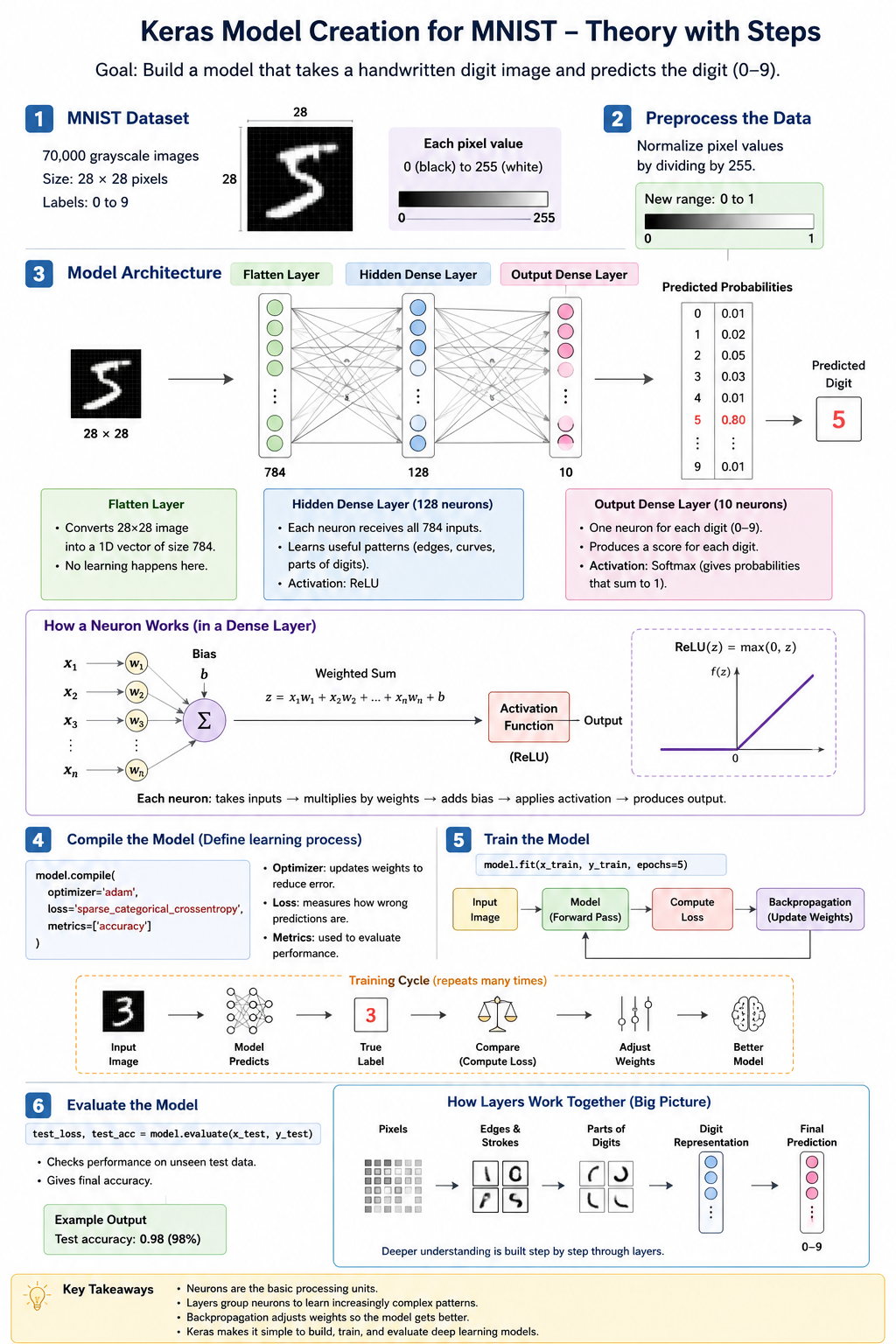
1. Load MNIST
MNIST has handwritten digit images, each 28×28 pixels, labeled from 0 to 9.
from tensorflow import keras
from tensorflow.keras import layers
(x_train, y_train), (x_test, y_test) = keras.datasets.mnist.load_data()2. Normalize the images
Pixel values are from 0 to 255. Neural networks train better when values are small, usually 0 to 1.
x_train = x_train / 255.0
x_test = x_test / 255.0
3. Build the model
A simple neural network:
model = keras.Sequential([
    layers.Flatten(input_shape=(28, 28)),
    layers.Dense(128, activation="relu"),
    layers.Dense(10, activation="softmax")
])
What each layer does
Flatten layer
layers.Flatten(input_shape=(28, 28))Converts each image from:
28 × 28into:
784 valuesSo the model can process it like a list of numbers.
Dense hidden layer
layers.Dense(128, activation="relu")This creates 128 neurons.
Each neuron receives all 784 input values and learns patterns such as edges, curves, loops, or strokes.
A neuron does roughly this:
output = activation(weighted_sum_of_inputs + bias)So each neuron has:
inputs → weights → sum → bias → activation → outputOutput layer
layers.Dense(10, activation="softmax")This creates 10 neurons, one for each digit:
0, 1, 2, 3, 4, 5, 6, 7, 8, 9softmax converts outputs into probabilities.
Example:
[0.01, 0.02, 0.90, 0.01, ...]The model predicts the digit with the highest probability.
4. Compile the model
model.compile(
    optimizer="adam",
    loss="sparse_categorical_crossentropy",
    metrics=["accuracy"]
)
Meaning:
optimizer = how the model updates weights
loss = how wrong the model is
accuracy = how we measure performance
5. Train the model
model.fit(x_train, y_train, epochs=5)During training:
image → model predicts → compare with true label → calculate error → update weightsThis repeats many times.
6. Evaluate the model
test_loss, test_acc = model.evaluate(x_test, y_test)
print("Test accuracy:", test_acc)
This checks performance on unseen test images.
How neurons and layers work together
Think of the model like a pipeline:
Image pixels
   ↓
Flatten layer
   ↓
Hidden Dense layer
   ↓
Output layer
   ↓
Predicted digit
Each neuron learns a small pattern.
A layer contains many neurons, so it learns many patterns.
Multiple layers combine simple patterns into more meaningful understanding.
For MNIST:
pixels → edges/strokes → digit-like shapes → final digit prediction메타데이터
- post_id
- 76ef22daeea9
- slug
- keras-mnist-model-creation-flow-and-how-neurons-layers-fit-together-76ef22daeea9
- url
- https://medium.com/@ravindragsingh/keras-mnist-model-creation-flow-and-how-neurons-layers-fit-together-76ef22daeea9
- canonical_url
- https://medium.com/@ravindragsingh/keras-mnist-model-creation-flow-and-how-neurons-layers-fit-together-76ef22daeea9
- author_url
- https://medium.com/@ravindragsingh
- status
- ok
- fetched_at
- 2026-06-09 15:37:30




