“What is in Their Pockets?!” US Torture Victim Suspects Novel Weapons After Stranger Encounters
Three men. None know each other. They all share one key behavior. When they arrived around Pearson, they put their hand in their pocket and…
“What is in Their Pockets?!” US Torture Victim Suspects Novel Weapons After Stranger Encounters
Three men. None know each other. They all share one key behavior. When they arrived around Pearson, they put their hand in their pocket and begin tinkering with something. Two of them said it was a “key”. That is unlikely.
Richard Pearson was on edge in early 2026. He had been tortured, assaulted, stalked, sleep deprived, falsely arrested, and turned back at the Iceland border in an asylum attempt in January. He made a second asylum attempt to Canada in March that turned out to be disastrous. He traveled to downtown Silver Spring, Maryland, to catch his Greyhound bus to Canada. He was electrocuted in his penis by a duo of Hispanic women. He wrote about the experience here. Ultimately, Pearson abandoned any asylum attempt altogether in Canada. He literally walked around the US-Canadian border to return to the place where he was fleeing. He discussed a primary reason behind his decision in this essay.
This essay isn’t about that experience. It is about something more particular — handheld weapons. After the electrocution in his penis in Silver Spring, Pearson began wearing foil over his groin area — folded layers of aluminum foil sandwiched between two pairs of underwear. It also resulted in him being more hypervigilant. He was already that, so he thought. He learned to watch his surroundings — see things out of the ordinary, watch people’s hands, and avoid sidewalk traffic.
While figuring out a way to leave Canada, he noticed a taxi driver’s strange behavior in the Gare d’Autocars (bus terminal) in Montreal. Despite the mistreatment at the border, Pearson thought that he should continue his asylum journey — so he went to Montreal. That was a mistake, but it did cause a major shift in perception.
The Taxi Driver
Pearson was in the bus terminal for over 12 hours — plenty of time to watch the comings and goings of people. He kept his eye on a taxi driver who remained in and out of the station late at night. He seemed to be from a country in the Middle East. The man approached passengers to ask if they needed a ride. Most said no. Then, the man would take out this black device that resembled a modern car key fob. Pearson knew the behavior was strange but didn’t know what he was up to. Pearson is not paranoid. He is a researcher. The man would even walk around the terminal constantly pressing the button on this device. His car was nearby in the lot, but it never made a noise when he pressed the button. It wouldn’t make sense that he would be concerned about the car’s safety since he could see the car clearly from inside the terminal. Due to construction at the terminal, the main exit now faced Ontario Ave.
It was the man’s interaction with a young Black man that got Pearson’s attention. As usual, the taxi driver approached the potential customer. This man politely declined and waited outside in the temporary taxi area. He was on his phone — presumably for an uber service or to wait for someone to pick him up. The taxi driver took out the fob and pointed it toward the man. He walked away. The man had been on his phone for about 7–10 minutes when the taxi driver again approached him to see if the man wanted a ride. He again declined. The taxi driver again took out his fob and pointed it to the man.
When Pearson returned to the US, he conducted AI research to try to understand what the man was doing with the fob. Jamming his network was the major likely reason — prevent the man from accessing a ride share app service.
Three Men. One Device?
Man 1
Pearson was leaving his apartment building. He had exited the door, but returned to let in a delivery driver with several bags from a grocery store. Being polite, Pearson swiped his card and let him in. Pearson noticed that the man immediately reached in his pocket. Pearson became agitated.
“What are you reaching in your pocket for?” “It’s my key,” the man replied. “You don’t live here!,” exclaimed Pearson who knew that was not the reason. The man’s car, which was close by, did not go off. “Key,” the man said again, then went through the door.
It was not his key. The man appeared West African. He was about six feet tall. Pearson sat down just after the incident. He didn’t know why exactly. When he sat down, he felt nauseous. It could be exhaustion, hunger, or dehydration, he thought. Or it could be something else — a novel weapon. Just like the weapon that electrocuted his penis.
But he knew that this was important. He waited for the man to reappear and took a video as he made his way back to his car.
Man 2
Pearson was in front of his local library, talking to a neighbor. They were seated on benches, visible to passersby. Now, after a year of torture and several incidents with devices, Pearson honed his skills of having a conversation while paying close attention to his environment.
He noticed an African man — who appeared East African — walking closely by who instantly put his hand in his pocket and began tinkering with something. He saw the man’s fingers move, as if pressing something. Within a few feet of the door, the man takes his hand out of his pocket. He asked his friend, “Did you see that? He pressed something in his pocket.” His friend said “yes,” though Pearson wasn’t sure since his neighbor’s back was to the man. He could have seen him in the mirror reflection.
Pearson found the man upstairs, sat directly in front of him at the table, and attempted to snap his photo. It was blurry. Pearson asked the man,
“What is in your pocket?”
“A key.”
“Can I see it?”
The man declined. He was very nervous — in a way that someone is when they get caught.
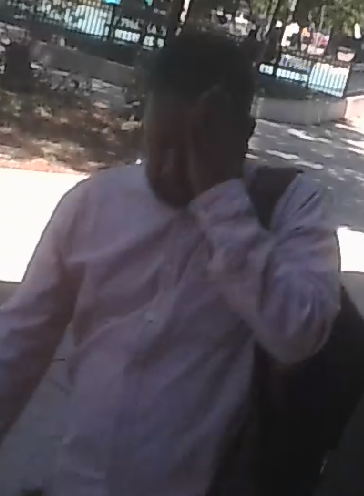
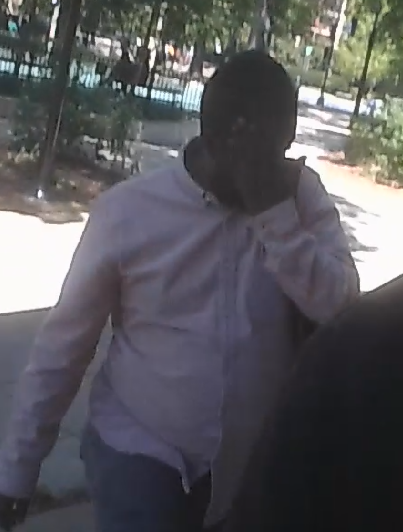
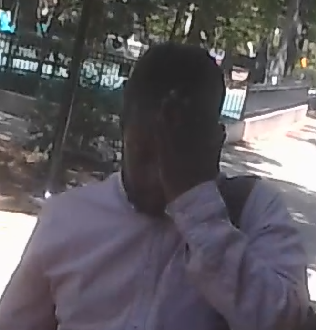
Pearson needed to take a better picture, so he went outside. Pearson was in the middle of a conversation with a different neighbor when he saw the man exit the library. He left his conversation to take a photo. The man sees Pearson and circles back to the library. Pearson got the best photos that he could although the man attempted to cover his face.
When the man left, he had crossed in front of the library toward I St and 3rd St. If the man had a car, there is no way that a car fob would have worked from that distance. It was not a key.
“I don’t know what you’re up to, but you’re going to get caught,” said Pearson
Man 3
Pearson visited his local grocery store frequently — often multiple times a day. In the last 2–3 months since his return, he noticed a Black man would always was crossing his path when he was in the store or outside of the store. The man’s attention became increasingly directed at Pearson. Pearson knew the man worked at the grocery store. Rarely had Pearson seen him in many years. He was usually in the back.
Pearson confronted the man who was seated on a bench at the Safeway.
“Do we have beef? You act strange when I am around.”
“No, I don’t know you. We have never talked before. My name is Joey, by the way.”
There was a smirk on his face. Pearson kept walking, but wondered to himself, “What the hell is going on with these people?”
Then, it happened again. Now, for the first time, Pearson could see the man’s hands tinkering in his pocket. Pearson was in the store to grab a bit to eat and sat on the seating at the electric fireplace. The man appeared next to him near the Coca-Cola display. He had his back toward Pearson, but his hand clearly visible in his pocket. It was moving. He was moving his head as if looking for something. Pearson read through it quickly. He was acting and not doing a very good job.
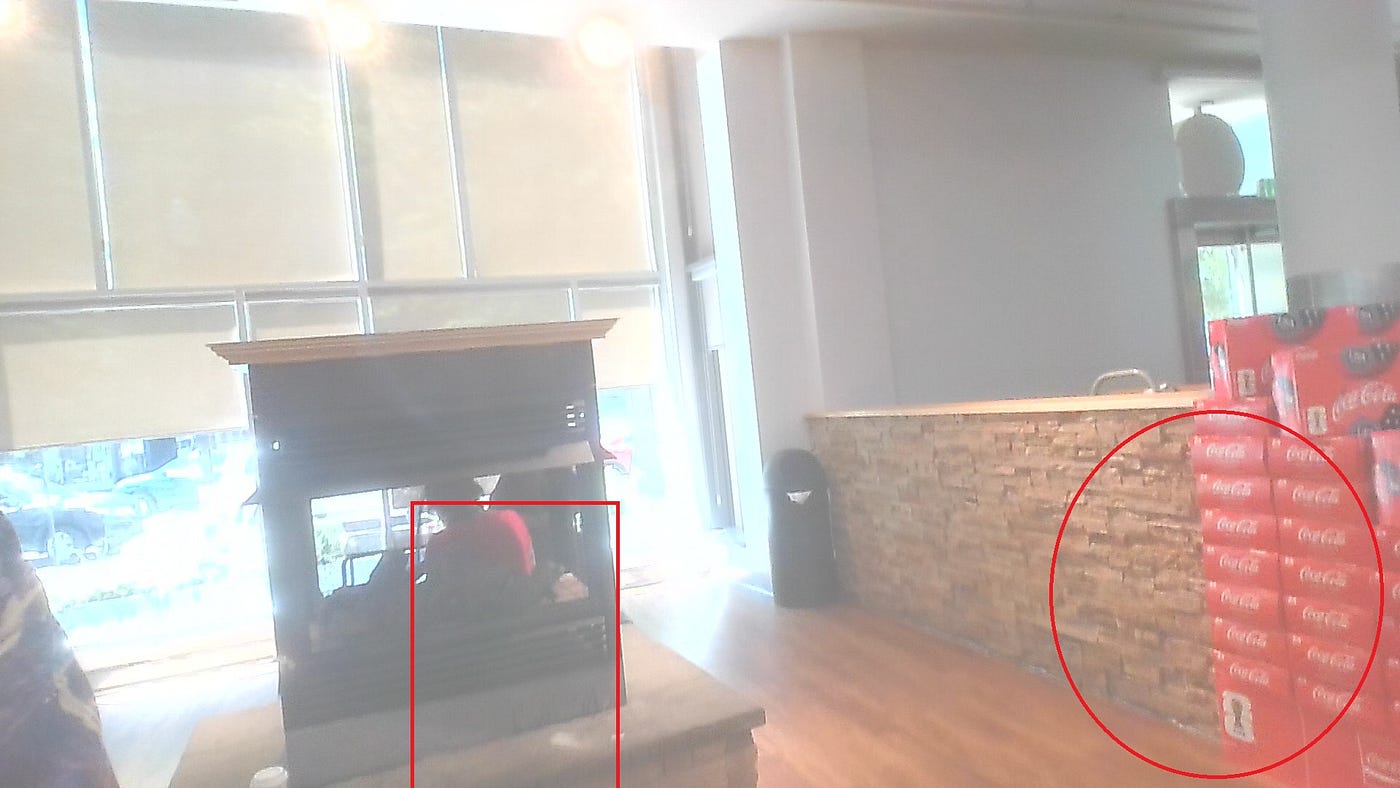
After several seconds, the man made his way to the self-checkout, then reappeared shortly afterwards with the items and his receipt.
Pearson later returned to the store to tell management about the man — Joey. He explained the stalking and encouraged them to look at the security footage from that day, explaining what happened and the history.
The manager listened and said that he would talk to him.
The very next day, Joey crosses Pearson’s path again. Pearson had taken the back entrance, yet there Joey was. He made eye contact.
Pearson is not upset, angry…agitated, certainly. Who wouldn’t be? He again goes to the manager.
“Did you talk with Joey?”
“Yeah, I spoke with him yesterday,” appearing very surprised that he would be receiving another complaint.
“I’ll talk with him now.”
What the What?
Pearson has some theories about what is happening and why. His preferred theory is that this is all part and parcel of the campaign.
“You have to understand what happened here. These people should not know me. I have never had an issue with Joey before now. There must be another explanation. It involves the US government, which started this whole mess. I check all the boxes — DEI, African American, Democrat, urban city, critical race scholarship. My residence in Washington, DC — with easy access to Congress and the federal courts — made them uneasy, but also made it convenient. Of course, the US government targeted me. If it looks like a duck, quacks like a duck, it is a duck. End of story. My educated guess is that they were repeatedly warned not to do it.
I was identified as a “target” because of the extreme racism, homophobia, authoritarianism, and blatant disregard for civil liberties, civil rights, and the rule of law of the current administration. They hate the US form of government where people enjoy constitutional liberties that serve as a mirror and check on power. Federal agencies had already resurrected COINTELPRO but were adding more “bells and whistles”. By that, I mean torture and the involvement of low-level street thugs — Whites, Black men, Hispanic immigrants. You name it.
They activated all of these networks — including homophobic and thuggish Black male networks — to target me. But it’s not the federal government dialing them up to say target, “Yeah, need for you, Joey, to target Richard Pearson in the Safeway”.
No, this whole targeting moves through non-governmental networks, which is why there is “regime” not “government” behind Pearson’s torture. There are many networks between the federal government and these kinds of men. The way that this “activation” happens is through the trickle of “information” through networks. Create enough signaling, loose lips, incentives, alignment with badly-defined self-interest, false rumors, lies, mirage, and communication signaling — within a criminal intent framework. People get the message. It spreads. Psychiatric conditions, ignorance, poor ethics, and criminality all lend to how fast information moves and through what networks.
Pearson is confident that Joey was targeting him — the stalking, the staged performance at the display, and the resumption of bad behavior after the manager had spoken to him. Pearson believes that he is associated with the campaign against him — a trickling down of “information”. The other two men — both African immigrants — could be part of a criminal network of some sort, using “fob” devices to gain access to electronic devices. That network could have also possibly received information or directives about Pearson. There is no way for Pearson to know.
Pearson hopes that it’s not worse, “Look. Mind control weapons are a problem clearly. The MIND Act, a bill pending in the Senate, is suggesting that the full scope of these weapons is not known. The leading civilian expert on this stuff says that it has been “loosed into the world”. That is a problem. No, not a problem. An existential constitutional crisis. Can they be disguised as a car fob. Let’s hope not.”
메타데이터
- post_id
- 76f267c305b0
- slug
- what-is-in-their-pockets-us-torture-victim-suspects-novel-weapons-after-stranger-encounters-76f267c305b0
- url
- https://medium.com/@menvell.artist/what-is-in-their-pockets-us-torture-victim-suspects-novel-weapons-after-stranger-encounters-76f267c305b0
- canonical_url
- https://medium.com/@menvell.artist/what-is-in-their-pockets-us-torture-victim-suspects-novel-weapons-after-stranger-encounters-76f267c305b0
- author_url
- https://medium.com/@menvell.artist
- status
- ok
- fetched_at
- 2026-06-09 15:37:30