Victorian and Edwardian Perfumery Series: Heliotrope
Heliotrope, a garden flower introduced into Europe sometime in the mid 18th century, was valued for its pleasant fragrance. Heliotrope…
Victorian and Edwardian Perfumery Series: Heliotrope
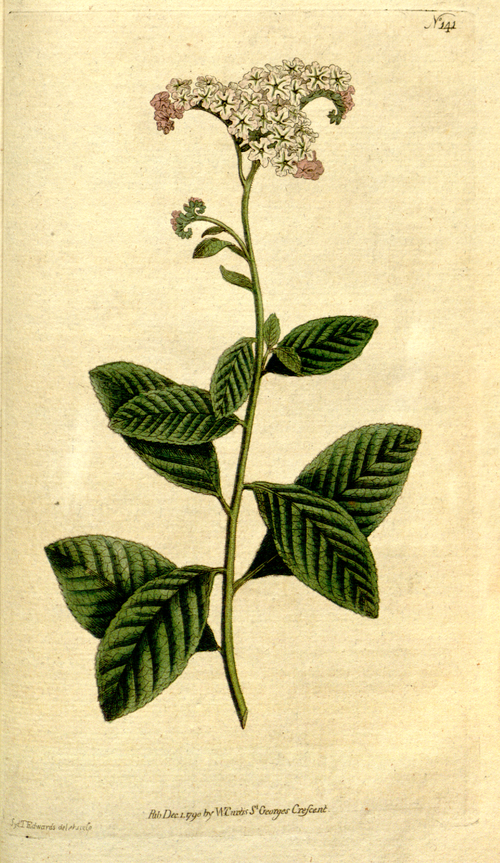
This is a plate from The Botanical Magazine, Volume 4 (1791) by William Curtis (1746–1799) Wikimedia Commons Image License
Heliotrope, a garden flower introduced into Europe sometime in the mid 18th century, was valued for its pleasant fragrance. Heliotrope perfumes made common appearances in Victorian and Edwardian era perfumeries. Formulary books from this time period reveal that extracts of the heliotrope, alongside more frequent imitations of this scent were used to create heliotrope perfumes.

Heliotrope (Heliotropium arborescens) at Frederik Meijer Gardens & Sculpture Park in Grand Rapids, MI by Cody Hough Wikimedia Commons Image License
Part of the borage family, heliotrope is a fragrant garden flower with a strong, sweet scent often compared to cherry pie, vanilla or almonds. The book *Sweet-Scented Flowers and Fragrant Leaves*, published in1895, described the fragrance of garden heliotropes.
The Peruvian Heliotrope has for generations been cultivated for the delicious fragrance of its small clusters of lavender-coloured flowers which shed an Almond-like perfume that has found for the plant the name of Cherry Pie. The annual varieties mostly come from the West Indies and all are delicately perfumed, some emitting a smell of new-mown hay. They also constitute an important and valuable class of sweet-scented flowers, employed as bedders, provided the more compact growing varieties are chosen. The Queen is a variety producing large heads of flowers that are almost white, and very powerfully fragrant. Bouquet de Violettes, Duchess of Edinburgh, and Lady Molesworth have flowers of various shades of blue, and are specially suitable for supplying cut flowers. Bouquet de Perfumé bears flowers of a pleasing lilac-blue colour. For bedding, the best are Diana, light blue, and Mrs. Lewington, dark blue. In sub-tropical climates they are largely used for making hedges, and marvellously beautiful are they in this capacity, shedding a pleasing fragrance around. (p. 52)

Henry G. Gilbert Nursery and Seed Trade Catalog Collection.; Miss C.H. Lippincott (Firm) (1899) Wikimedia Commons Image License
Heliotrope was often imitated with other botanical extracts like this 1850 recipe for a heliotrope perfume that combines orange blossom with vanilla.
EAU SPIRITUESE D’HELIOTROPE. Vanilla 3 dr., double orange flower water 6 oz., rectified spirit a quart ; macerate for 3 days, and distil in a water bath. (p. 189)
A reprinted lecture on perfumery in *The Chemists’ Assistants’ Association *mentioned that heliotrope could be imitated with a combination of vanilla and violet.
This well-known perfume is not often prepared from the flowers of Heliotropium Peruviannum, or from the British variety, as one would suppose, considering the powerful odour these flowers emit : a combination of vanilla and violet being the most common substitute. (p. 65)

Cherry Pie (1897) Bois, D.; Frederick Warne (Firm); Herincq, B.; Step, Edward; Watson, William Wikimedia Commons Image License
Edwardian formulas sometimes continued with this trend. This 1902 heliotrope perfume formula, which used a variety of botanical extracts to imitate the fragrance of the flower.
HELIOTROPE.
Lemon oil . . . . . . . . . . . . . . . .60 Parts
Wintergreen oil (pure) . . . . . .16 Parts
Almond oil pure . . . . . . . . . .14 Parts
Geranium oil . . . . . . . . . . . . .4 Parts
Rose tincture . . . . . . . . . 2,000 Parts
Benzoin tincture . . . . . . 1,000 Parts
Orris tincture . . . . . . . . 2,000 Parts
Spirit . . . . . . . . . . . . . . 4,000 Parts
Distilled Water . . . . . . .1,000 Parts (p. 193)
Similarly to rose perfumes in this time period, the expense of extracting sufficient fragrance from fresh flowers was mitigated by the development of chemical isolates derived from natural materials. Heliotropin, also called piperonal, was first discovered and synthesized in 1885. Heliotropin could be extracted from white pepper, and this extract was one of the first “synthetic” materials used in perfumery, and was used to formulate many perfumes with more complex bouquets by the early 20th century. Low cost floral perfumes imitating single flowers that likely used these early fragrance isolates were already being advertised by the Victorian era, like this advertisement from an 1891 issue of the magazine Scribner’s Monthly.

Burnett’s Garden Heliotrope Perfume Scribner’s Monthly (1891) Google Books Public Domain
Edwardian-era formulary guides often relied on heliotropin to recreate the scent of the natural flower in perfume. This 1909 example uses the isolates coumarin and heliotropin with other fragrant oils from plants to create heliotrope scent.
HELIOTROPE.
Heliotropine 5 drams
Oil of Cloves 3 drops
Coumarin 1 dram
Oil of Jasmine 1 ounce
Alcohol 1 gallon
Mix, age and filter. (p. 147)
This 1910 heliotrope toilette water recipe blended heliotropin with floral oils and bergamot.
Heliotrope Water. — Heliotropine, 2 dr.; rose oil, 15 minims¹; bergamot oil, ½ dr.; neroli oil, 5 minims ; alcohol, 10 oz ; water 6 oz. (p. 876)

Heliotropine (1910–1940) by Meyers Brothers Drug Co. Wikimedia Commons Image License
The popularity of heliotrope perfume waned later into the 20th century. These new inexpensive floral perfumes in the late Victorian era made a once-costly fragrance more accessible to the general public, making the once rare scent lose its prestige. Much like the flower, heliotrope perfume’s compelling fragrance belied its poisonous nature. Heliotropin, in addition to being the foundation of a pleasant floral fragrance was also discovered to be a key ingredient in the formulation of several illicit drugs. Restrictions on the sale of undiluted heliotropin further limited its use in perfumery later in the 20th century.
This is a plate from The Botanical Magazine, Volume 4 (1791) by William Curtis (1746–1799) Wikimedia Commons Image License
The once-coveted fragrance of heliotrope was captured in perfumery using botanical extracts and new chemistry breakthroughs. A victim of its own success, the toxic and intoxicating heliotrope gradually fell out of fashion in the 20th century. However, in the 21st century, summery floral fragrances and vanilla-almond gourmand blends containing heliotrope notes are finding their way back to contemporary perfumery counters, a reflection of the cyclical nature of fragrance trends as attention returns once again to this old-fashioned garden flower.
Note:
Thank you for reading!
If you love history, plants or the history of plants, consider supporting Plant Based Past by buying me a coffee!
For more vegan, vegetarian, and botanical histories, follow *Plant Based Past* on Medium.
You can sign up for email alerts to receive the next story when it becomes available, just by clicking the envelope icon. Receive a bonus historical recipe not seen in the publication, article recaps with free friend links to read, save or share once a month in your inbox by subscribing to Plant Based Past’s newsletter, Nutshell.
Next Week: 5 Vegan Fruit Preserves from History to Save the Taste of Summer
메타데이터
- post_id
- 76f2b0d7aaa1
- slug
- victorian-and-edwardian-perfumery-series-heliotrope-76f2b0d7aaa1
- url
- https://medium.com/plant-based-past/victorian-and-edwardian-perfumery-series-heliotrope-76f2b0d7aaa1
- canonical_url
- https://medium.com/plant-based-past/victorian-and-edwardian-perfumery-series-heliotrope-76f2b0d7aaa1
- author_url
- https://medium.com/@plantbasedpast
- status
- ok
- fetched_at
- 2026-07-11 20:05:18