How Overthinking Affects Academic Performance (And What You Can Do About It)
You studied for hours. You know the material. But the moment you sit down for the exam, your mind goes blank — or worse, it floods with a…
How Overthinking Affects Academic Performance (And What You Can Do About It)
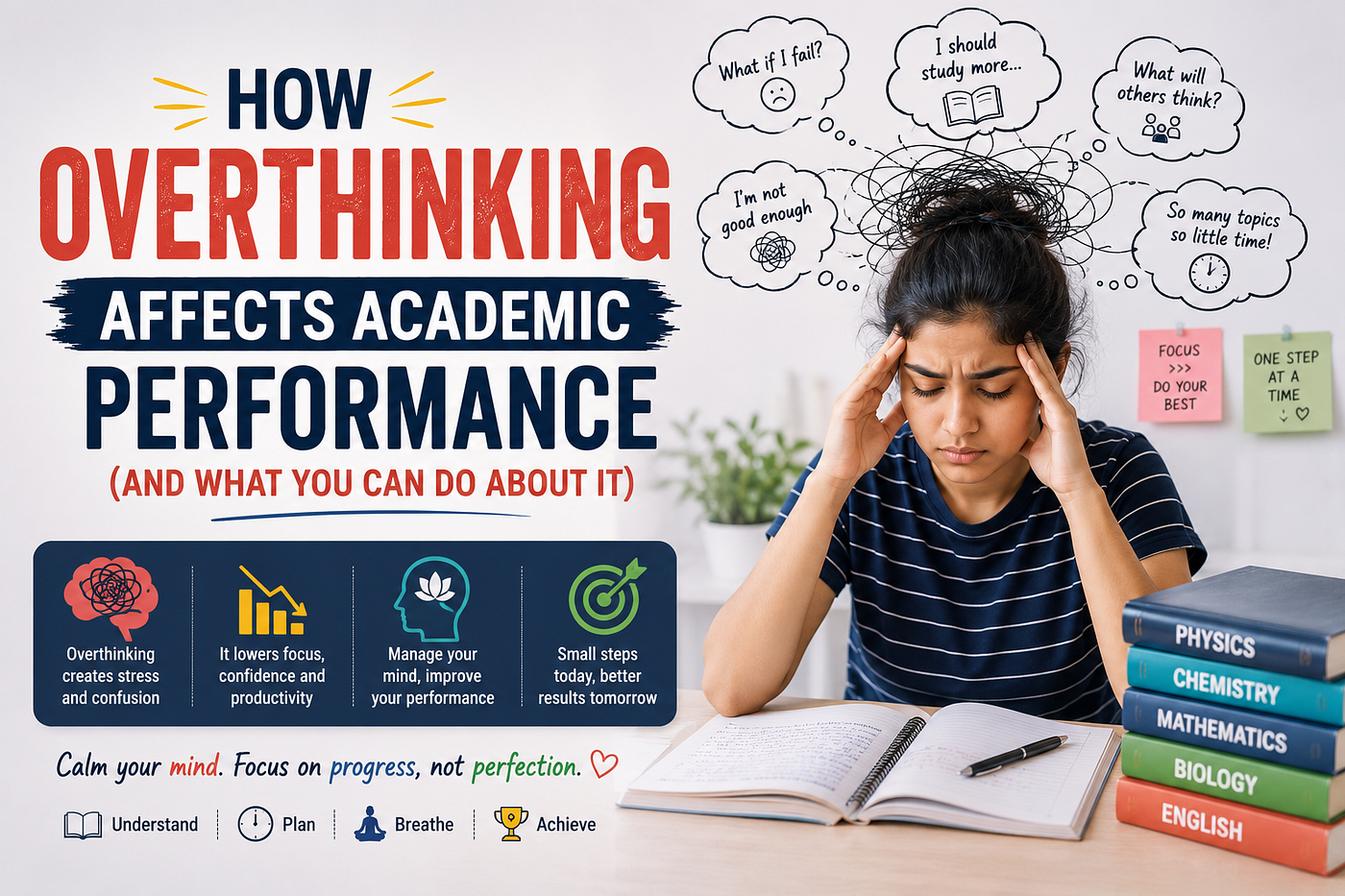
You studied for hours. You know the material. But the moment you sit down for the exam, your mind goes blank — or worse, it floods with a thousand “what ifs.” Sound familiar?
Overthinking is one of those silent saboteurs that doesn’t announce itself. It doesn’t feel like a problem at first — in fact, it often disguises itself as diligence. You tell yourself you’re just being thorough, just double-checking, just making sure. But somewhere along the way, “thinking carefully” crosses a line into something far more exhausting and far less productive.
And for students, that line gets crossed more often than anyone talks about.
The Overthinking Trap in Academic Life
Here’s the thing about overthinking: it isn’t about thinking too much. It’s about thinking in circles. It’s replaying the same worries over and over, second-guessing every answer you’ve written, imagining every possible way things could go wrong — without ever moving forward.
Research in cognitive psychology consistently links excessive rumination with lower academic performance, higher anxiety levels, and reduced working memory capacity. When your brain is preoccupied with “Did I choose the right answer?” or “What if I fail this exam?”, it’s burning through mental energy that could otherwise be used for actual problem-solving.
This is especially true in high-stakes subjects where conceptual clarity matters. A student who has genuinely understood photosynthesis or organic reaction mechanisms — but spends exam time second-guessing themselves — will underperform compared to a less anxious student who trusts their knowledge.
How Overthinking Shows Up in Students
Overthinking doesn’t look the same for every student. It shows up in ways that seem reasonable on the surface:
Paralysis by analysis. You spend so long deciding how to start an essay or solve a problem that you never actually start. The blank page becomes the enemy.
Revision rabbit holes. You’ve revised a chapter five times, but each time you finish, you feel like you “didn’t really understand it.” So you start again. Meanwhile, three other chapters are untouched.
Post-exam spirals. After every test, you mentally replay every question, convince yourself you got half of them wrong, and spend the next three days in dread — even when you actually did fine.
Decision fatigue around study strategies. Should you use flashcards or mind maps? Read notes or rewrite them? Watch videos or solve past papers? The indecision itself becomes the biggest time-waster.
The Neurological Side of It
When you overthink, your brain’s amygdala — the part responsible for stress and fear responses — goes into overdrive. This triggers a cascade of cortisol (the stress hormone), which impairs the prefrontal cortex: the very part of your brain you need for critical thinking, memory recall, and decision-making.
In plain terms: the more you stress about not knowing something, the harder it becomes to actually access what you know.
This is why students often report “forgetting everything” the moment they walk into an exam hall. It’s not that the information is gone — it’s that anxiety has temporarily blocked the pathway to it.
The Subject-Specific Problem
Overthinking hits especially hard in subjects that require both conceptual understanding and application — science subjects being a prime example.
Take Class 12 Chemistry. The concepts aren’t just about memorizing formulas; they demand that you understand why reactions happen, how mechanisms work, and when to apply which principle. An overthinker might study a topic five times but still feel underprepared because they keep second-guessing whether they’ve understood it “deeply enough.” The irony is that this anxiety often prevents the very deep understanding they’re seeking. Students who use structured resources like NCERT Solutions for Class 12 Chemistry often find it easier to break this cycle — because having clear, step-by-step explanations removes the ambiguity that feeds overthinking in the first place.
The same pattern plays out in Biology. Whether it’s cellular processes, genetics, or ecology, overthinking students tend to get lost in the details and lose sight of the bigger picture. Grounding yourself in well-structured answer frameworks — like those in NCERT Solutions for Class 12 Biology — can help you build the confidence that overthinking slowly erodes. When you know what a complete, correct answer looks like, you stop spiraling over whether yours is good enough.
Breaking the Cycle: Practical Strategies That Actually Work
Knowing overthinking is a problem is one thing. Breaking out of it is another. Here’s what actually helps:
Set a “thinking time” limit. Give yourself a fixed window — say, two minutes — to think about a problem before you commit to an answer and move on. This trains your brain to work decisively rather than endlessly.
Embrace “good enough” over “perfect.” Perfectionism and overthinking are closely linked. Understand that a completed study session that covers 80% of the material thoroughly is far more valuable than an incomplete session that obsessed over 20% of it.
Write it down to get it out. When anxious thoughts are swirling, journaling or brain-dumping them onto paper removes them from your mental loop. It’s the cognitive equivalent of closing background apps on your phone.
Use structured study resources. Ambiguity breeds overthinking. When you have clear, reliable materials that show you exactly what’s expected, there’s less room for your brain to invent things to worry about.
Practice mindfulness — but make it brief. Even five minutes of focused breathing before studying or an exam can significantly reduce amygdala activation. You don’t need a 30-minute meditation practice; you just need to interrupt the spiral.
Move your body. Physical activity is one of the most evidence-backed ways to reduce rumination. A 20-minute walk between study sessions can reset your mental state more effectively than another review of your notes.
The Bigger Picture
Academic performance isn’t just about how much you know. It’s about how well you can access what you know under pressure, how clearly you can think when it counts, and how confidently you can apply your understanding to new problems.
Overthinking chips away at all three.
The students who perform consistently well aren’t necessarily the ones who study the most. They’re often the ones who’ve learned to trust their preparation, work within limits, and quiet the noise in their own heads.
That’s a skill. And like any skill, it can be learned.
메타데이터
- post_id
- 77291fcabcf4
- slug
- how-overthinking-affects-academic-performance-and-what-you-can-do-about-it-77291fcabcf4
- url
- https://medium.com/@cogniks/how-overthinking-affects-academic-performance-and-what-you-can-do-about-it-77291fcabcf4
- canonical_url
- https://medium.com/@cogniks/how-overthinking-affects-academic-performance-and-what-you-can-do-about-it-77291fcabcf4
- author_url
- https://medium.com/@cogniks
- status
- ok
- fetched_at
- 2026-07-30 05:22:37




