5 Ways to Compare Active vs Passive Funds: Choosing the Right Strategy for Your Wealth
The debate between Active and Passive Funds remains one of the most significant considerations in modern portfolio construction. Active…
5 Ways to Compare Active vs Passive Funds: Choosing the Right Strategy for Your Wealth
The debate between Active and Passive Funds remains one of the most significant considerations in modern portfolio construction. Active funds rely on fund managers’ expertise to outperform benchmarks through research-driven strategies and tactical asset allocation, while passive funds aim to replicate the market’s performance with lower costs and reduced volatility.
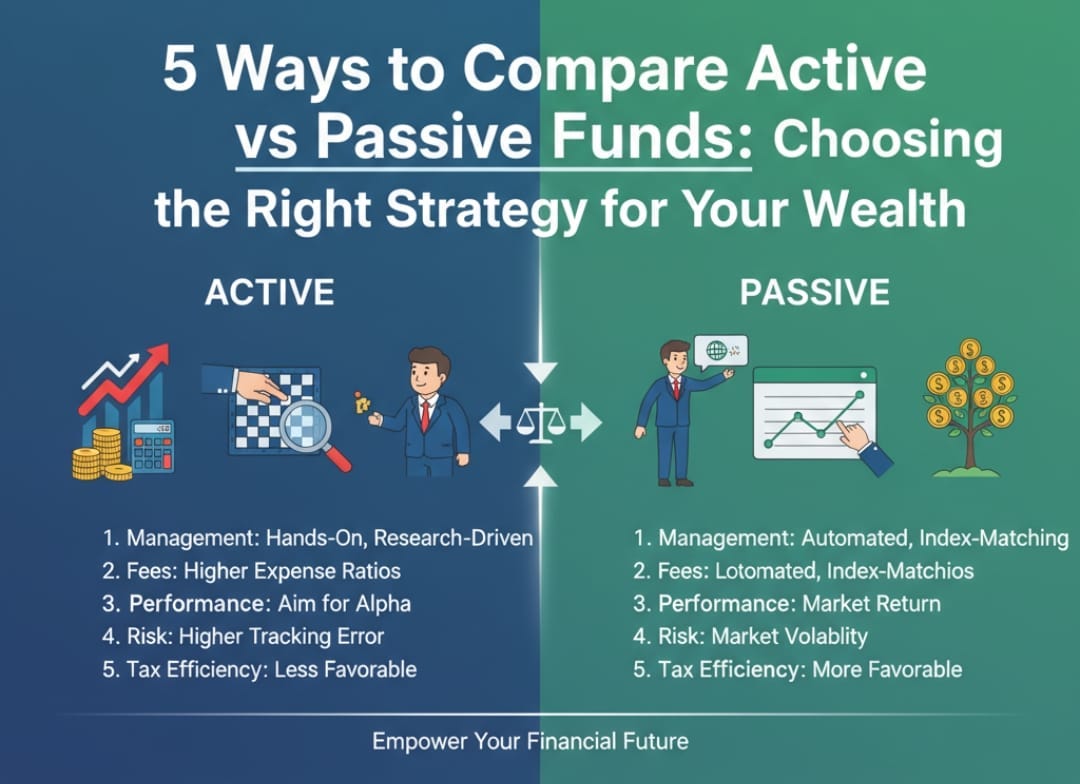
5 Ways to Compare Active vs Passive Funds: Choosing the Right Strategy for Your Wealth
For affluent investors, this decision extends beyond returns — it’s about philosophy, control, and suitability. Active funds often excel in emerging markets where inefficiencies create room for alpha, while passive funds offer stable, cost-effective exposure ideal for long-term wealth preservation. Active management may appeal to those seeking strategic flexibility and superior returns, whereas passive investing resonates with those prioritizing efficiency and consistency.
This article explores five key dimensions — investment philosophy, performance, cost, risk, and investor suitability — to help you understand where each strategy shines. The goal isn’t to choose sides, but to identify how both can coexist harmoniously in a well-balanced, high-performing portfolio.
1. Investment Philosophy: Beating the Market vs Matching It
At the core, the distinction between active and passive funds stems from philosophy — how one views market efficiency and the role of human judgment in wealth creation.
Active Funds: The Art and Science of Outperformance
Active fund managers are like strategists — combining analytical rigour, market insight, and experience to outperform benchmarks. They rely on deep research, sector rotation, and stock-picking strategies to identify mispriced opportunities. These managers continuously monitor macroeconomic trends, company fundamentals, and market sentiment, making tactical adjustments to generate alpha.
For instance, in volatile or uncertain markets — such as during a policy shift, global slowdown, or corporate earnings downturn — active managers can take defensive positions, increase cash holdings, or rotate into sectors with resilience. This agility is the cornerstone of active management.
Passive Funds: The Discipline of Consistency
Passive funds, on the other hand, embrace the efficiency of markets. Their goal is not to beat the benchmark but to mirror it faithfully. By tracking indices like the Nifty 50 or S&P 500, passive funds ensure low costs, transparency, and minimal tracking error. There’s no emotion, no second-guessing, and no human bias — just a consistent replication of the market’s trajectory.
For long-term investors seeking stability and predictability, this approach can be appealing. Passive funds are particularly effective in developed markets where opportunities for alpha generation are limited due to high efficiency.
In essence: Active funds are driven by conviction; passive funds by discipline. The choice depends on whether you believe in human insight or market efficiency.
2. Performance & Returns: Alpha Generation vs Market Parity
Performance remains the most debated metric when comparing the two strategies. While passive funds promise market-matching returns, active funds strive to deliver superior performance — though with varying degrees of success.
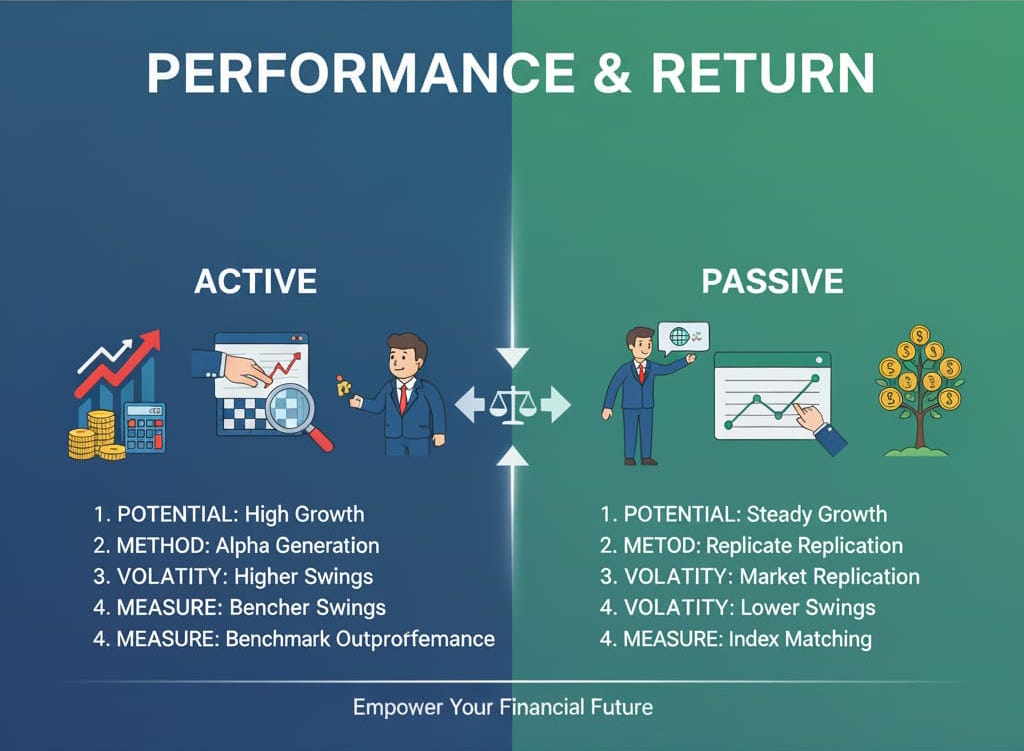
Performance & Returns: Alpha Generation vs Market Parity
Active Funds: The Pursuit of Alpha
Historical data in India and other emerging markets show that active funds have often outperformed their benchmarks over longer periods, particularly in mid-cap and small-cap segments. This outperformance is largely due to inefficiencies in the market, which skilled fund managers can exploit.
For instance, during market cycles where fundamentals diverge sharply from prices — such as post-pandemic recoveries or inflationary phases — active managers who correctly anticipate sectoral trends can deliver significant excess returns over passive peers.
However, active fund performance can also vary based on the manager’s expertise, investment process, and style. Not all funds beat the benchmark consistently. Hence, due diligence, fund selection, and periodic review become critical for investors choosing the active route.
Passive Funds: The Power of Market Returns
Passive funds eliminate manager risk by design. They promise you exactly what the market delivers — no more, no less. Over time, particularly in large-cap segments, passive strategies have proven competitive because very few active funds consistently outperform their benchmarks after adjusting for costs and taxes.
The allure of passive investing lies in its predictability. While active funds can underperform in certain cycles, passive funds ensure that your returns stay aligned with broad market performance, providing comfort to conservative investors or those prioritizing capital preservation over outperformance.
Key takeaway: If your goal is alpha and are comfortable with active risk, active funds may be your choice. If you value consistency and market-matching stability, passive funds deliver dependable outcomes.
3. Cost Structure: Fees, Expenses & the Impact on Net Returns
One of the most tangible differences between active and passive funds lies in their expense ratios. While both charge a fee to manage your investments, the structure and its long-term impact on compounding are markedly different.
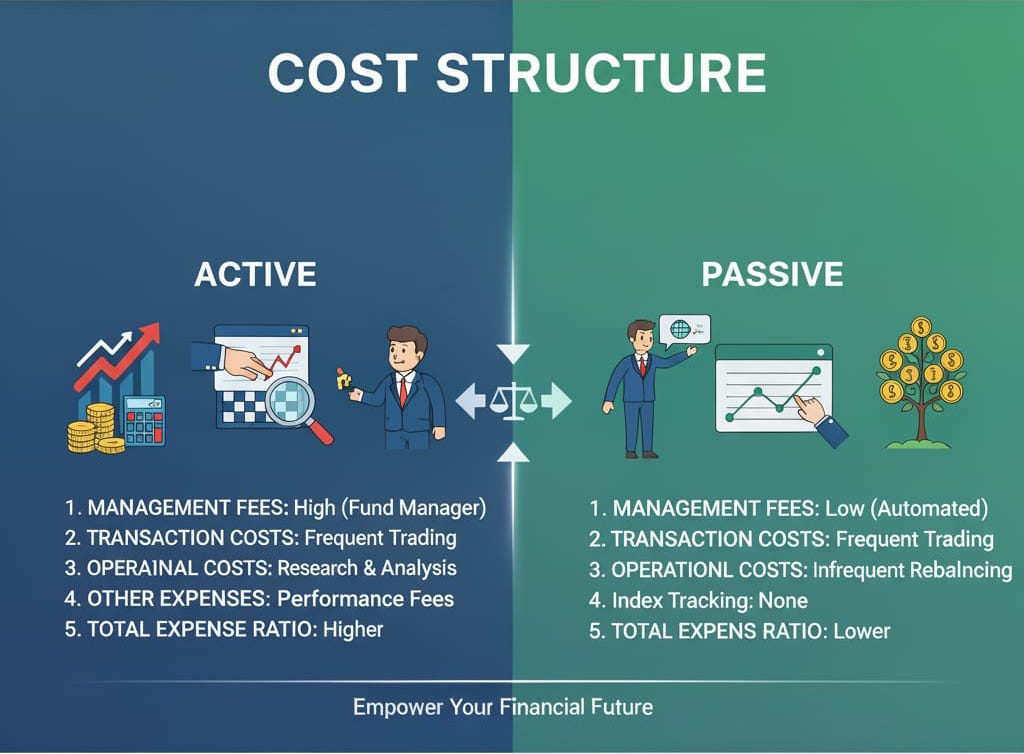
Cost Structure: Fees, Expenses & the Impact on Net Returns
Active Funds: Paying for Expertise
Active fund management involves extensive research, analyst teams, and frequent portfolio rebalancing. Naturally, this translates to higher expense ratios, typically ranging between 1% and 2.5% annually. Over time, this cost can eat into returns, particularly in lower-return environments.
However, many investors view these costs as a premium for expertise — a fair trade-off for potential outperformance. For HNIs and CXOs, where portfolio size and financial stakes are significant, the value of professional judgment often outweighs the incremental cost.
Passive Funds: Low-Cost Efficiency
Passive funds are inherently cost-efficient. With minimal management intervention, their expense ratios often hover between 0.1% and 0.5%, depending on the fund and index tracked. The savings in fees can compound meaningfully over decades, especially for investors with long horizons or those building retirement or legacy portfolios.
As legendary investor John Bogle, founder of Vanguard, often said:
“In investing, you get what you don’t pay for.”
Over 20 years, a 1.5% difference in annual costs can translate into a double-digit difference in overall corpus — a powerful argument for passive investing, especially for those who prioritize cost discipline and long-term compounding.
In summary: Active funds command higher fees for the pursuit of alpha; passive funds thrive on efficiency. The choice depends on how much you’re willing to pay for human intelligence versus systematic consistency.
4. Risk & Volatility: Managing Uncertainty vs Embracing Market Fluctuations
Every investment carries risk — but how that risk is managed differs fundamentally between active and passive funds.
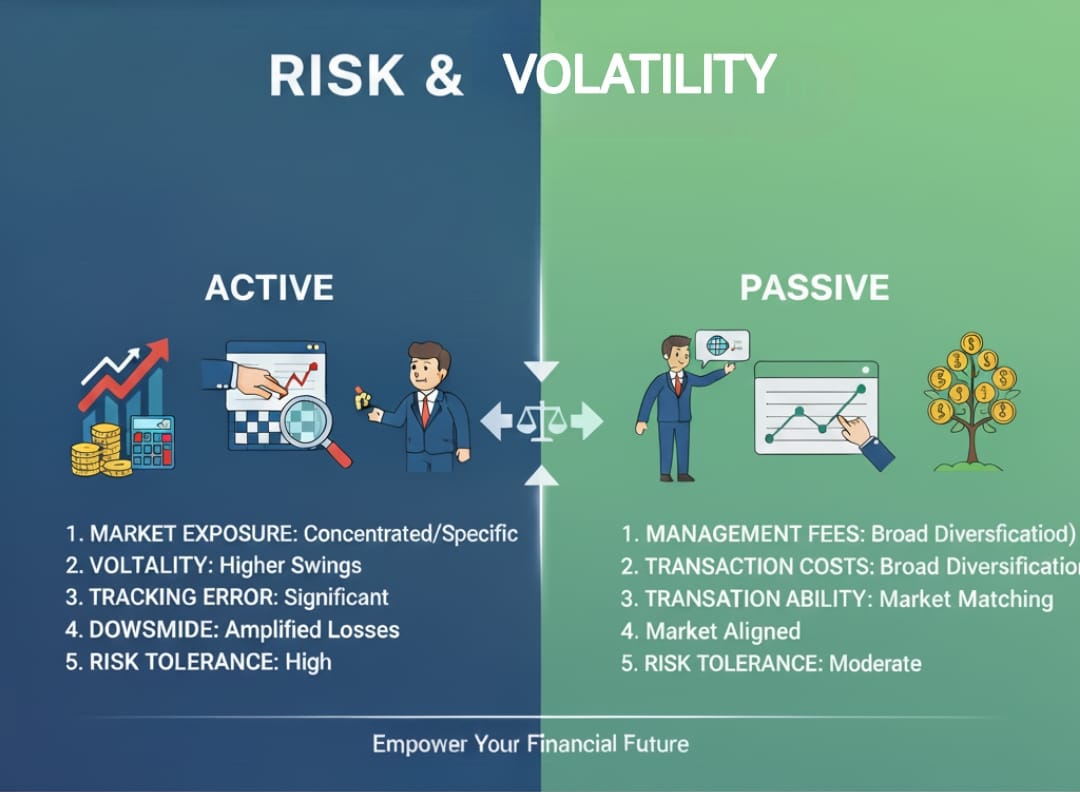
Risk & Volatility: Managing Uncertainty vs Embracing Market Fluctuations
Active Funds: Adaptive Risk Management
Active managers can actively rebalance portfolios to respond to market shifts. They can reduce exposure to overheated sectors, move to defensive assets, or hold cash during periods of extreme uncertainty. This flexibility allows active funds to cushion downside risks during market corrections.
For instance, during events like the 2008 financial crisis or the 2020 pandemic crash, active managers with prudent allocation strategies were able to limit drawdowns compared to pure index funds. Their ability to interpret macro signals and adjust swiftly often helps preserve capital in turbulent phases.
However, the flip side is that manager bias or incorrect calls can also amplify risks. Not every decision yields the desired outcome, which is why active investors must be comfortable with higher volatility and human discretion.
Passive Funds: Riding the Market Wave
Passive funds, by design, cannot shield investors from short-term market volatility. Since they mirror the index, if the market falls 10%, so does your portfolio. Yet, over time, passive funds have demonstrated lower volatility relative to active peers, primarily due to diversified exposure and absence of concentrated bets.
For investors who believe in long-term market growth and prefer not to time the market, passive funds offer peace of mind through broad diversification and steady compounding.
The essence: Active funds aim to control volatility; passive funds accept it. Choosing between them depends on your comfort with risk and belief in market timing.
5. Suitability: Aligning with Investor Demographics and Risk Appetite
Perhaps the most crucial factor in this comparison is suitability — which fund type aligns best with your investor profile, financial goals, and temperament.
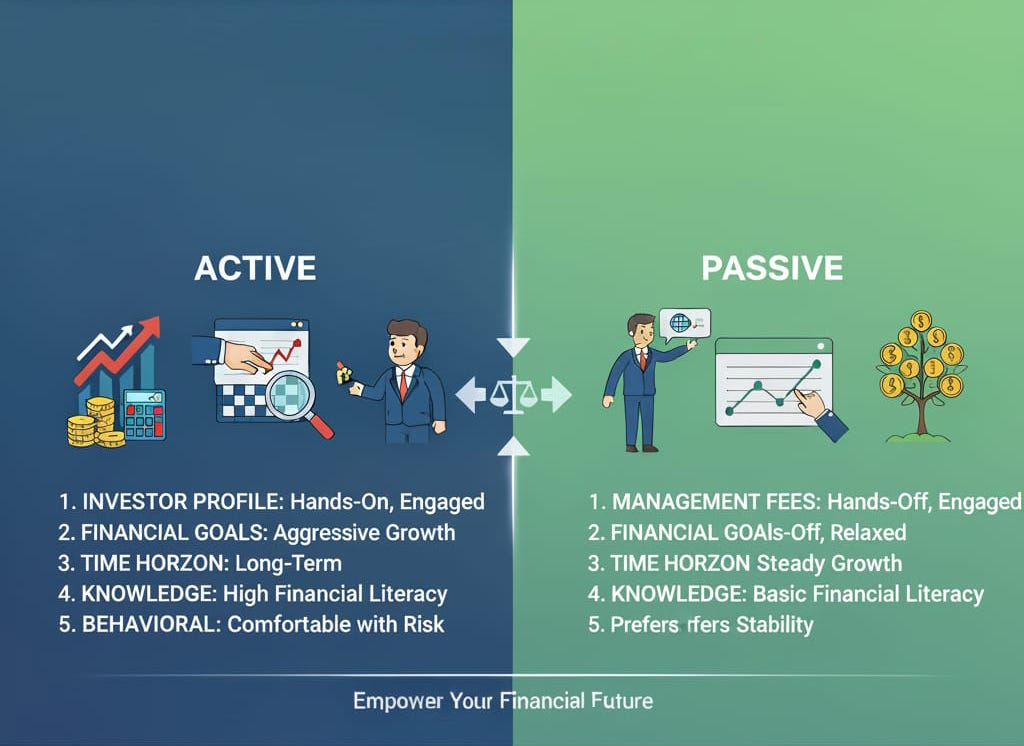
Suitability: Aligning with Investor Demographics and Risk Appetite
Active Funds: For the Strategic, Informed, and Return-Seeking Investor
Active funds suit investors who are:
- Comfortable with calculated risk,
- Seeking above-market returns, and
- Open to periodic portfolio reviews and reallocation.
Typically, seasoned investors with access to professional advisory services find value in active management. They appreciate customization, tactical flexibility, and sectoral plays — qualities that can align with their dynamic financial goals and entrepreneurial mindset.
Moreover, investors with shorter to medium-term goals — where timing and active calls matter — may find active strategies better suited.
Passive Funds: For the Disciplined, Long-Term, and Cost-Conscious Investor
Passive funds, conversely, fit investors who:
- Prefer predictability over pursuit of alpha,
- Seek low-cost exposure to equity markets, and
- Have a long-term investment horizon (10 years or more).
For those building generational wealth, trusts, or retirement portfolios, passive investing offers stability, simplicity, and tax efficiency. It ensures steady compounding without the need for constant oversight.
Many sophisticated investors also adopt a hybrid approach — combining active and passive strategies to balance agility with efficiency. For instance, one might hold passive funds for core market exposure while using active funds for tactical or thematic plays.
The Verdict: Striking the Right Balance
In the evolving world of wealth management, the debate between active and passive is no longer binary. It’s about integration. The smartest portfolios often combine both strategies — using passive funds as a stable foundation and active funds as performance enhancers.
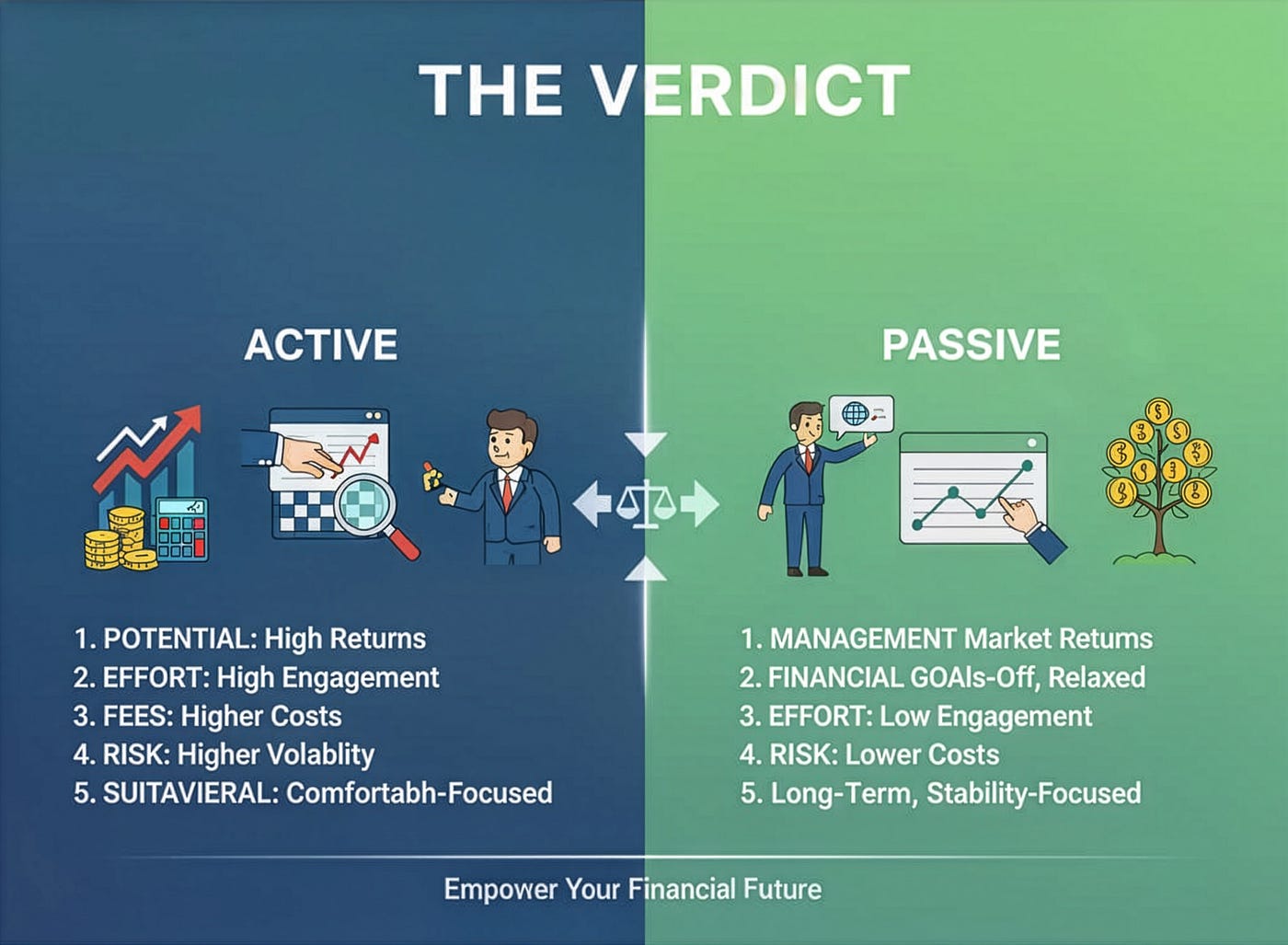
The Verdict: Striking the Right Balance
As an affluent investor, the right approach depends on:
- Your market outlook and risk appetite,
- Your comfort with volatility and fees, and
- The time and expertise you can dedicate to portfolio management.
Active funds can help you capture market opportunities; passive funds ensure you never miss market participation. The real edge lies in thoughtful asset allocation and disciplined execution — the two pillars of enduring wealth creation.
5 Ways SubhShanti Wealth Helps You Build the Perfect Mix
SubhShanti Wealth combines personalized wealth management with a strategic approach to blending active and passive investments for optimal results.

5 Ways SubhShanti Wealth Helps You Build the Perfect Mix
Tailored Asset Allocation Strategy: expert team designs customized portfolios that intelligently mix actively managed funds for growth opportunities with passive index funds for stable, cost-effective core holdings — aligned with your risk profile and goals.
Diversified Fund Selection: With access to equity, debt, hybrid, and tax-saving funds, SubhShanti Wealth curates a balanced mix that leverages active fund expertise where it matters most while maintaining passive fund efficiency across your portfolio.
Expert Portfolio Management: Managing ₹700 crore in assets for over 900 investors, their team continuously monitors and rebalances your active-passive mix to ensure it reflects market conditions and your evolving objectives.
Tax-Optimized Wealth Creation: They structure your active-passive blend to maximize tax efficiency — incorporating ELSS and other tax-saving vehicles while maintaining the right balance between active management and passive stability.
Ongoing Strategic Guidance: Regular portfolio reviews and market guidance help you stay invested through volatility, ensuring your active-passive allocation continues supporting your long-term wealth creation goals.
Since 2011, SubhShanti Wealth has positioned itself as your reliable partner for holistic financial success through disciplined, balanced investing.
Final Thoughts
Both Active and Passive funds have proven their worth. Active funds thrive on the intuition and expertise of skilled managers who navigate complexity and volatility to generate alpha. Passive funds, meanwhile, reward patience and discipline, offering predictable growth and cost efficiency.

Final Thoughts
For discerning investors, the question isn’t which is better, but which is better for you. A well-advised, well-structured portfolio often blends both — using active management where inefficiencies exist and passive exposure where predictability prevails.
At the end of the day, the best investment strategy is the one that lets you sleep peacefully while your money works tirelessly.

메타데이터
- post_id
- 774ba07c738d
- slug
- 5-ways-to-compare-active-vs-passive-funds-choosing-the-right-strategy-for-your-wealth-774ba07c738d
- url
- https://medium.com/@SubhShantiWealth/5-ways-to-compare-active-vs-passive-funds-choosing-the-right-strategy-for-your-wealth-774ba07c738d
- canonical_url
- https://medium.com/@SubhShantiWealth/5-ways-to-compare-active-vs-passive-funds-choosing-the-right-strategy-for-your-wealth-774ba07c738d
- author_url
- https://medium.com/@SubhShantiWealth
- status
- ok
- fetched_at
- 2026-07-09 03:40:04