New Wartime Wheels in Ukraine Keep Rolling
Ukraine continues to innovate — even down to the humble wheel: Modular, field-repairable design eliminates flat tyres in battle zones — a…
Weapons Technology
New Wartime Wheels in Ukraine Keep Rolling
Ukraine continues to innovate — even down to the humble wheel: Modular, field-repairable design eliminates flat tyres in battle zones — a game-changer for unmanned ground systems and heavy military platforms
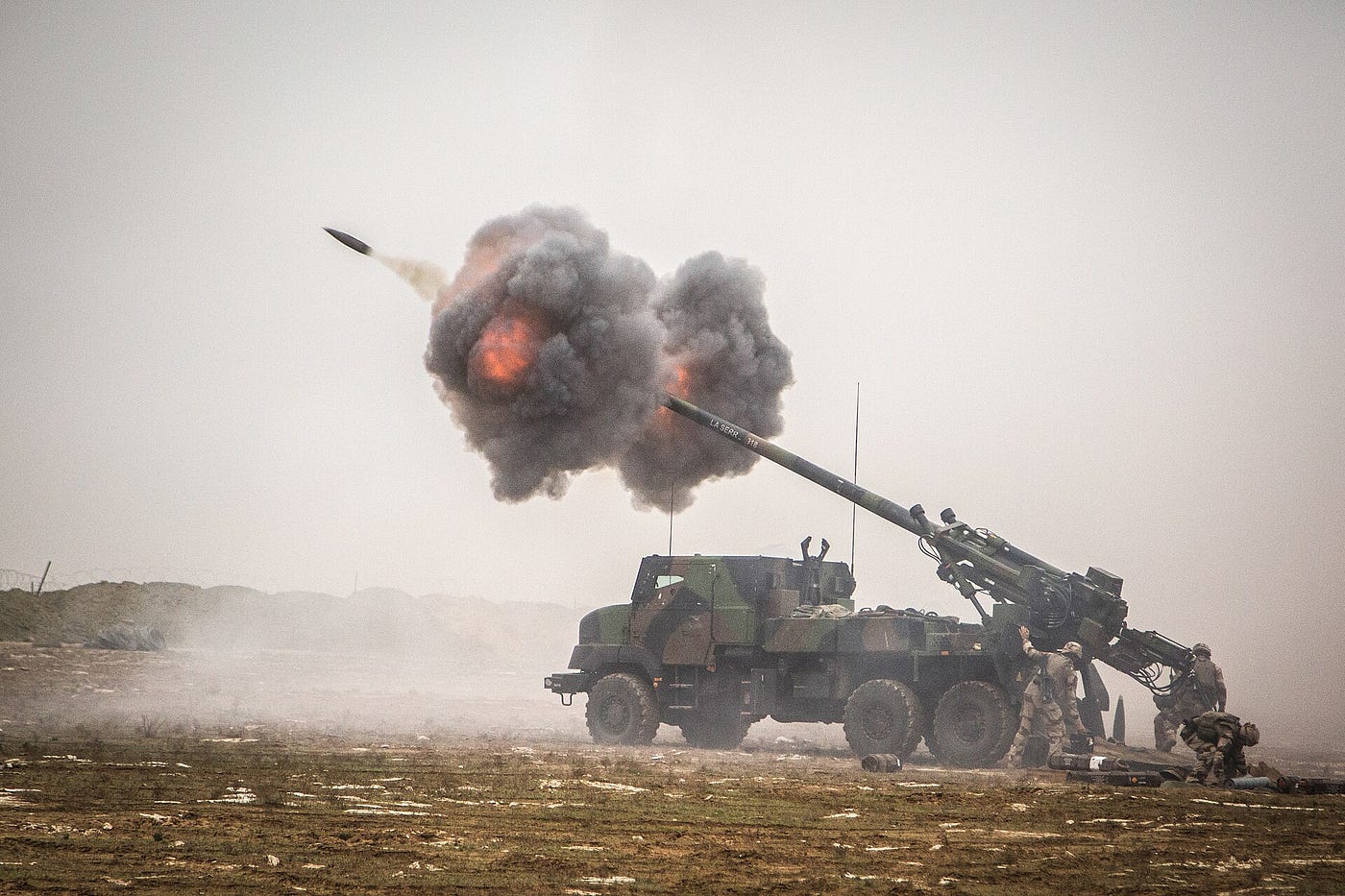
French Caesar SPG
Old news
Within a few miles of where I was raised in West Wales, the A484 road passes a farm. The farm is known locally as ‘Davies Spare Wheel’ because that’s where the idea of a ‘spare wheel’ for a car was invented.
Yes, the spare wheel was invented in 1904 by Thomas Morris Davies and his brother Walter in Llanelli, Wales. They created a spokeless wheel rim fitted with an inflated tire, allowing drivers to easily replace flat tires, which became widely popular and led to the establishment of their company, Stepney Spare Motor Wheel Limited.
Wheels have rolled on since then and now we have runflat tyres.
But pneumatic tyres are a big problem on the battlefield.
Tracked solutions work, but have several limitations, which is why we still see vehicles such as the French Caesar SPG. Horses for courses.
New news
Ukrainian startup Qirim Technology has begun production of innovative segmented airless wheels for ground drones, armoured vehicles, and engineering platforms.
The modular, puncture-proof design eliminates flats from battlefield debris, with damaged segments replaceable quickly in the field. Supplies are now reaching Ukrainian military units, enhancing mobility in harsh combat zones.
Another great idea from Ukraine’s innovators. Now let’s dig a bit deeper to understand the why’s and wherefore’s of the invention.
Segmented drone wheel. Credit: Qirim Technology
The problems with conventional wheels
Punctures and flat tyres from battlefield hazards
Traditional pneumatic (air-filled) tyres are extremely vulnerable to sharp debris, metal fragments, shrapnel, mines, caltrops, nails, glass, and other objects littering contested areas.
A single puncture can instantly immobilise a vehicle. For unmanned ground vehicles (UGVs / ground drones) performing logistics, casualty evacuation, reconnaissance, or munitions delivery, even one flat tyre often means complete mission failure or loss of the platform, as recovery or on-the-spot repair is frequently impossible under fire.
High frequency of mobility kills in debris-strewn battle zones
Reports and developer statements highlight that punctures are one of the most common causes of mobility loss for wheeled robotic systems operating in destroyed urban areas, trench lines, and artillery-scarred fields. Conventional tyres simply cannot survive prolonged exposure to such environments without frequent — and risky — replacements.
Time-consuming and impractical field repairs
Replacing or repairing a damaged pneumatic tyre on a combat vehicle (especially a UGV) usually requires specialised tools, lifting equipment, and significant time — often in exposed positions. This is dangerous for manned vehicles and usually infeasible for drones operating far forward.
Complete wheel (or vehicle) loss from localised damage
With standard tyres, even minor damage to one section forces replacement of the entire tyre/wheel assembly, wasting resources and increasing downtime.
So why not use tracked vehicles?
Tracked vehicles offer clear advantages in many military scenarios, particularly in extreme off-road conditions like deep mud, snow, steep slopes, or heavily cratered terrain common in parts of Ukraine.
Tracks distribute weight better, provide superior traction in soft ground, and are generally more resistant to certain types of damage (e.g., less vulnerable to small-arms fire or fragmentation shredding an entire running gear at once).
But once a track is broken, the vehicle is helpless.
In the specific context of unmanned ground vehicles (UGVs / ground drones), logistics platforms, light armored vehicles, and engineering systems, wheeled designs often remain preferable or even dominant.
These are the exact applications Qirim Technology targets with their segmented airless wheels.
Pic: Qirim Technologies
The Qirim solution
Qirim Technology, founded by Aslan Khakimov — a Crimean Tatar engineer who left occupied Crimea after 2014 and has since poured his expertise into supporting Ukraine’s Armed Forces — has turned battlefield frustration into breakthrough innovation.
The company, already known for its Revenge-series ground robotic complexes and the forthcoming autonomous QIRIM QROID AI drone, patented its segmented airless wheel design in late 2025.
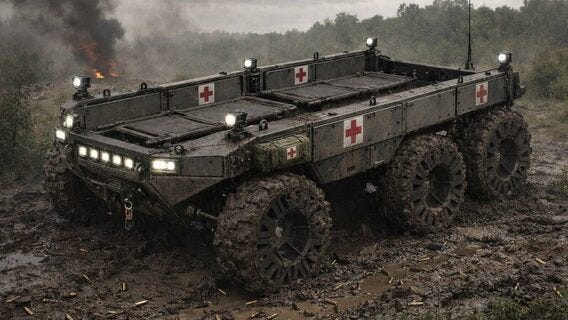
Qirim QROID AI drone. Picture: Qirim Technology
By mid February 2026 production was underway, with the first batches delivered free to frontline units through volunteer channels.
Each wheel features a rugged steel central frame onto which individual solid-rubber segments are securely bolted. There is no air chamber, no valve, no pressure to lose. The segments are molded from premium raw vulcanised rubber or, in the more affordable eco-variant, recycled tyre material bonded with polyurethane adhesive — cutting costs by 20–30 % while delivering identical durability and grip.
Because the wheel is built entirely from solid, non-pneumatic components, it is immune to punctures from shrapnel, glass, nails, caltrops or anti-personnel mine fragments that turn conventional tyres into liabilities within minutes of entering a debris-strewn kill zone.
Damage no longer means downtime.
A single torn or shredded segment can be unbolted and swapped in under five minutes using only basic hand tools. For unmanned ground vehicles performing logistics runs, casualty evacuation or reconnaissance deep in contested territory, this “repair-in-place” capability is transformative.
Operators no longer face the binary choice of abandoning a $30,000+ platform or exposing personnel to enemy fire for a full wheel change.
Performance matches the toughness. Early testing and muddy-field demonstrations show exceptional traction across Ukraine’s infamous black soil, snow, sand, rocky tracks and even arable land. The segmented tread pattern maintains contact and self-cleans far better than traditional rubber in soft or mixed terrain.
Qirim claims the design actually improves cross-country mobility compared with standard pneumatic tyres of the same size. Versatility is built in and three basic sizes are available.
Customisation
The real power lies in customisation. “We are ready to manufacture wheels of any size on request,” the company states. Provide rim diameter, width, axle load and operating conditions, and Qirim’s engineers will adapt the steel frame and segment count accordingly.
Standard military fitments are already supported: 11.00 R16 for Puma APCs, 12.00 R20 for Stryker and BTR-80, 14.00 R20 for VAB and M1117. The same technology scales effortlessly from a 40 kg drone to a 10-tonne armoured vehicle.
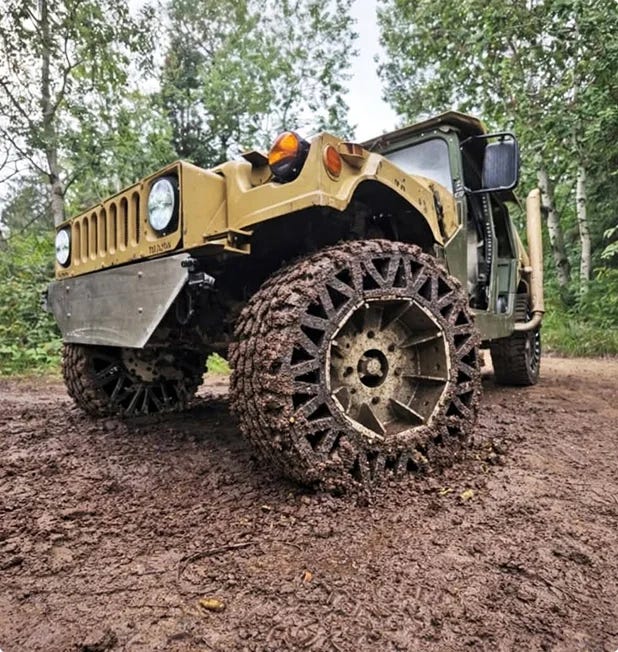
Picture: Qirim Technology
This modularity gives Qirim a clear edge over earlier airless concepts such as Michelin’s Tweel. While those systems eliminated punctures, a single damaged section usually required replacing the entire wheel.
Qirim’s segmented approach turns potential total loss into minor maintenance — a decisive advantage in a war where every minute of mobility counts and spare parts are precious. The operational impact is already being felt.
In practice, Qirim emphasises that most battlefield “hits” — the everyday shrapnel, nails, glass, caltrops, small fragments — cause superficial damage that the wheel simply absorbs without needing intervention. The segment only gets swapped when the damage is severe enough to noticeably affect handling, create vibration, or threaten long-term reliability. Operators report that a wheel can often lose 1–2 segments and keep functioning adequately for mission completion, with replacement done back at a safer position using basic tools.
Ground-drone crews report missions that once ended in flat-tyre abandonment now continue uninterrupted. Logistics chains stay fluid. Engineering vehicles keep clearing routes instead of limping back for repairs. In the attritional drone-saturated environment of eastern Ukraine, where every immobile asset becomes an easy FPV target, preserving continuous movement is life-saving.
Innovation
A Crimean Tatar founder, drawing on generational resilience, has created technology that helps protect the land his people have fought to reclaim.
It is innovation forged not in Silicon Valley labs but in the unforgiving reality of a hot war — practical, affordable, and ruthlessly effective. As Ukraine enters the fifth year of full-scale invasion, technologies like these segmented airless wheels are shifting the calculus of mobility. They do not promise invincibility. They deliver something more valuable: the ability to keep moving when stopping means defeat.
Like any great invention, you see it and you ask ‘Why didn’t anyone think of that before?’
The so-called Great Powers have had so many years to come up with this. But once again Ukraine innovates.
‘Davies Spare Wheel’ would love it!
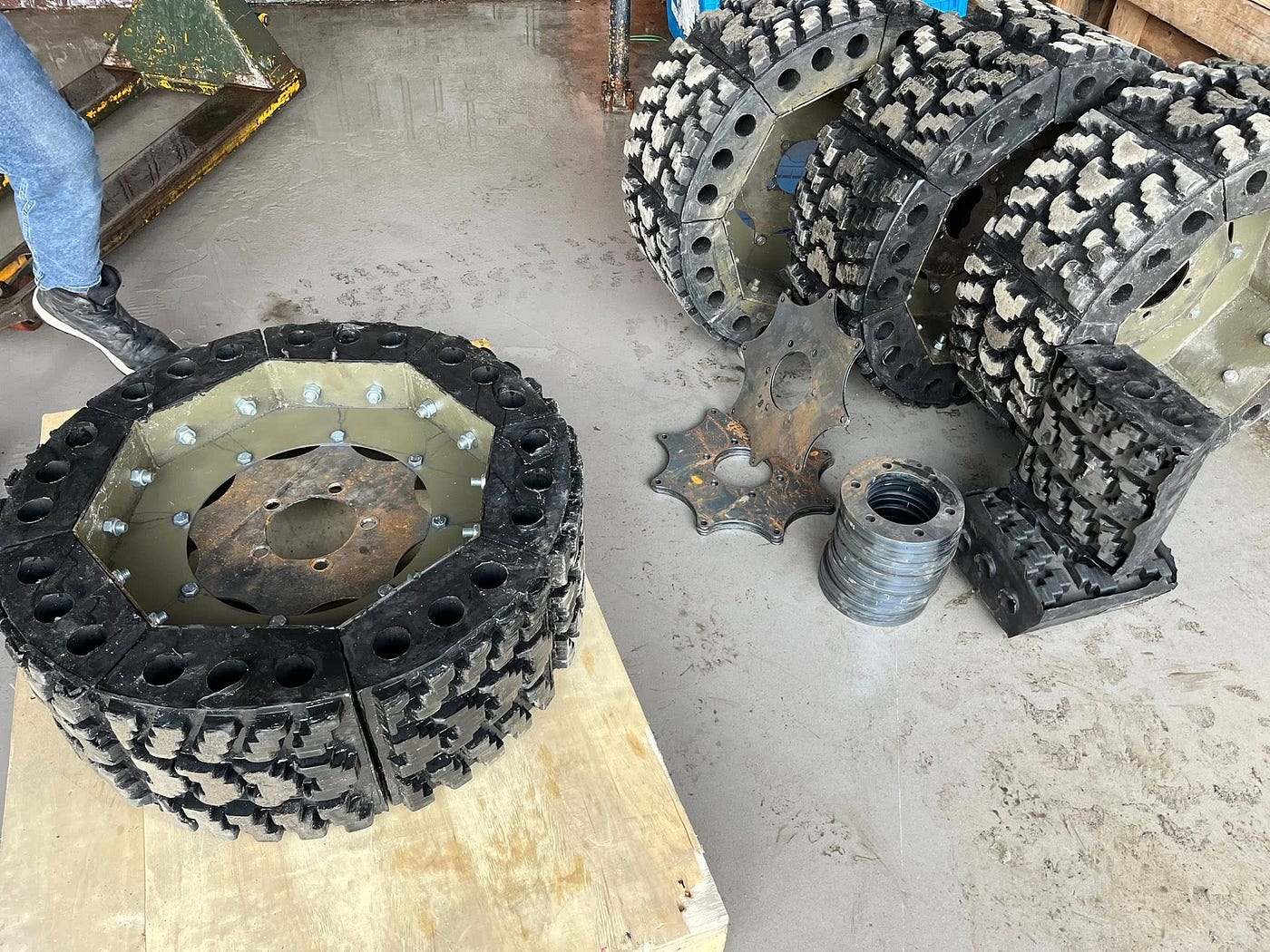
Credit: Qirim Technology
Spare segments. Credit: Qirim Technology
메타데이터
- post_id
- 775e0c142dae
- slug
- new-wartime-wheels-in-ukraine-keep-rolling-775e0c142dae
- url
- https://medium.com/the-dock-on-the-bay/new-wartime-wheels-in-ukraine-keep-rolling-775e0c142dae
- canonical_url
- https://medium.com/the-dock-on-the-bay/new-wartime-wheels-in-ukraine-keep-rolling-775e0c142dae
- author_url
- https://medium.com/@james-marinero
- status
- ok
- fetched_at
- 2026-07-17 20:05:51