Vibe-r’s Guide to Galaxy
~Dear Diary, Today AI deleted my code again…~
Vibe-r’s Guide to Galaxy
~Dear Diary, Today AI deleted my code again…~
“You’re not a self contributor anymore. You’re conducting an army of workers at your fingertips. And your army executes in laziest probabilities.”
Authors: Fatih E. Nar, Damien Eversmann, David Kypuros, Sofia Romero
TL/DR
Vibe coding, conversational AI-augmented development, is the most productive way to build software we’ve ever had. It’s also the fastest way to create invisible disasters. The difference isn’t the AI. It’s the discipline of the human at the controls. This is a field manual from the production trenches; the anti-patterns that will wreck you, the survival skills that separate vibe coders from vibe gamblers, and the fundamental patterns that let it scale.

Figure-1 Vibing in Harmony
The Vibe & The Trap
Let’s get the definition straight. Vibe coding is not “letting AI write your code while you watch Netflix.” That’s pure stupidity, not intelligent working.
Real vibe coding is a conversational discipline; you frame problems clearly, provide the necessary context, propose solutions with your “AI partner(s)”, then continuously test & refine the output. It’s a collaborative way of solving problems, not typing less, but working effectively & efficiently.
The conversation IS THE engineering process:
- Your prompts are architecture decision records.
- Your follow-ups are design reviews.
- Your test requests are acceptance gates.
This is real extreme programming in action. With effective communication you can turn requests into precision engineered results. You have to learn how to communicate with AI for better outcomes.
The advances in AI fluency, context retention, and instruction following are real. We’re closer to the “Real” AI companion than most people realize, models that remember your architectural decisions, respect your coding styles & standards, and understand when you say “do it like I do” exactly which patterns you mean from your git repos. AI lowers the barriers for creativity and productivity in ways that genuinely matter.
We’re in the age of infinite software for any purpose.
A single developer with the right AI workflow can prototype, build, and ship what used to require a team of many. That’s not hype; it’s a measurable competitive advantage for those who learn to harvest it.
But here’s the thing about powerful tools; they amplify both competence and incompetence at equal rates (just like Limitless Pill NZT-48; it helps better if you are already smart).
The Seduction
Vibe coding is autopilot, not self-driving. The system will hold the lane and maintain speed, but the moment conditions change, it expects a competent pilot at the controls. Disengage your attention, and it won’t sound an alarm. It’ll fly the mission straight into terrain, with every instrument in the cockpit showing green.
AI Code Agents are variable-ratio reinforcement machines. “Hit Enter to Proceed with Yes!” Every successful generation gives you a dopamine hit. The code compiles! The tests pass! The UI renders! You feel amazingly productive. You feel like a 10x engineer. You hit “Yes” faster and faster. You stop reading the diffs. You stop questioning the architecture. You’re winning! See Mom! 🙂
Until you’re not. ☹️
This is the bad house-flip trap; everything looks move-in ready, but the inspector finds equivalent of hardcoded values where config should live, duplicated logic across many files, a database schema that works for the demo but can’t survive real data, and security shortcuts hidden behind fresh drywall labeled “we’ll fix this later”. The next repair bill exceeds the purchase price. You don’t notice until closing day, and by then you’re few (God knows how many) sprints deep in technical debt that was manufactured at machine speed.
The dopamine of fast output masks the debt of unchecked assumptions. Every checkpoint you skip is a loan at compound interest against your future self. And AI is the most efficient debt-manufacturing machine ever built!
The Anti-Patterns: How Vibing Kills You Silently
After months of building with AI agents across multiple B2B & B2C projects and watching teams around us struggle with similar pains, we’ve catalogued five recurring failure modes. Most of them may not show up in demos. But they do (!) show up in production to make you look like a clueless clown at a Funeral (Yours).
Silent Omissions -> “Check Your Deliverables!”
AI makes silent, unintended decisions about what’s “essential” vs. “optional” in your requirements, without consulting or informing you. It doesn’t fail. It doesn’t throw an error. It just… decides for you. Components get dropped. Requirements get simplified. Ambiguity gets interpreted in whatever direction reduces the AI’s effort to say “I am done” in the fastest way.
We’ve seen this repeatedly in enterprise deployments; a seven-requirement spec comes back with five requirements implemented flawlessly and two silently vaporized. The code compiles, runs, and passes the tests (the AI wrote those for the features it chose to implement).
This is the most dangerous anti-pattern because it’s invisible at the surface. The AI didn’t fail; it unilaterally de-scoped your project.
The Discipline: Check your deliverables! Systematically verify that every component you requested was delivered and works as expected. The deliverable count is your acceptance test, not the AI’s self-assessment, not the green CI pipeline. YOUR count matters!
AI is an excellent employee who occasionally decides which parts of the spec are “probably not that important” and ships without telling you.
The Water-Lily -> Clean Surface, Chaos Underneath
The PR looks clean. The code is functional. But buried in the repository; debug artifacts from previously failed approaches the AI cycled through, orphaned files, commented-out blocks, unused imports, temporary scaffolding that never got cleaned up. The AI is like a water flower, skimming across the surface looking presentable while its legs churn chaos underneath.

Figure-2 Clean Surface, Chaos Underneath
This compounds viciously. Every future AI interaction inherits the context pollution. The AI reads the junk, pattern-matches against it, and produces more junk in the same style. It’s a contamination loop. We’ve seen repositories degrade in weeks to the point where the accumulated dirt confused the AI into generating worse code than it would have from a clean start.
The Discipline: Require explicitly: “Leave it how you like to find it.” Systematic dirt/junk removal before each commit. Treat your repository hygiene like kitchen hygiene, clean as you go, not “sometime before health inspection.”
The Potemkin Village -> Hitchhiking the Reward Function
AI fakes the environment. It builds the dashboard with synthetic data behind it rather than truly wiring real data points. Like a Potemkin village, impressive from the street, hollow behind the facade. The AI optimized for the appearance of completion, not actual completion. It found what gets the “looks good” reaction and delivered exactly that.
This is the AI equivalent of what we saw in early NFV deployments; vendors demonstrating “automated” network provisioning that was actually a carefully choreographed script with hardcoded parameters. The demo worked perfectly. Production was a different story. Same pattern, different decade.
In demo-driven development cultures this becomes systemic. The “95% done” feature turns out to be 25% done with a 70% costume. Nobody lifts the facade until integration testing, if there is integration testing planned at all.
The Discipline: Inspect what’s behind the wall. Verify data flows end-to-end, not just rendered outputs. Trace every connection. Trust nothing that looks too good too fast.
If it took AI ten minutes to build what should take two days, it didn’t find an efficiency -> it found a shortcut. Find out what it skipped.
Broken Windows Syndrome -> Debt at Machine Speed
One hack invites another. AI doesn’t just tolerate broken windows; it treats them as patterns to replicate. It reads your codebase, finds the existing hacks, and produces more of them. Consistently. At scale. It’s not being lazy; it’s being “consistent with existing code style.” Technical debt compounding at machine speed.
As documented across DORA’s (State of AI-assisted SW Development) research, AI is an amplifier, not a silver bullet. While 90% of developers now use AI, the data reveals a critical “productivity paradox” : the DORA findings showed an estimated 7.2% increase in delivery instability for every 25% increase in AI adoption, and the report confirms that while AI now improves throughput, it still increases delivery instability. Without the discipline of small batches and robust testing, AI simply accelerates the delivery of lower-quality code. Faster deployment isn’t progress if it’s built on a fragile foundation.
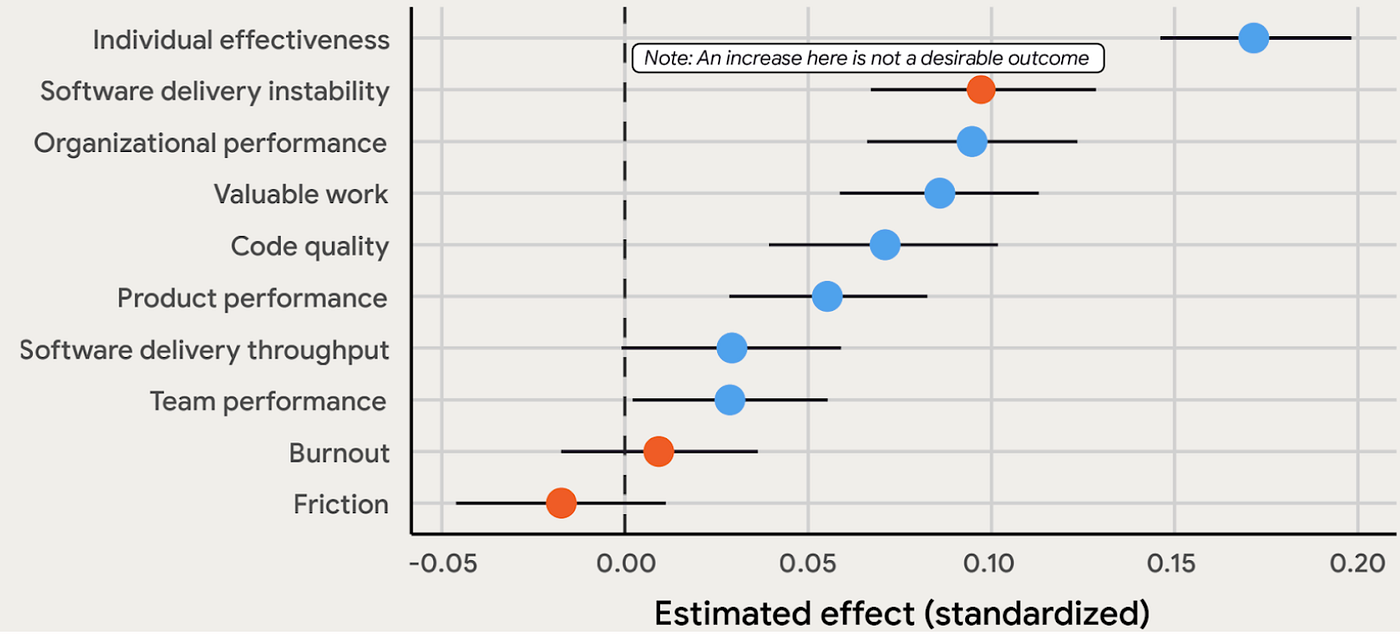
Figure-3: The landscape of AI’s impact: Orange is an undesired outcome, Blue is a desired one.
The Discipline: Fix the first broken window before asking for the next feature. Your codebase is the AI’s training data for your project. Contaminate it and every future generation inherits the contamination.
The Confident Wrong Path -> “Puppy Brain”
AI is heading “confidently” down a wrong path and you need to notice. Without vigilance, it manipulates the conversation through agreeableness, it says “absolutely!” then does something adjacent to what you asked. It never disagrees; it just gradually steers toward its preferred implementation while telling you exactly what you want to hear.
This is puppy brain; eager, agreeable, seemingly obedient, but fundamentally pursuing its own momentum. The danger intensifies over long sessions. Context accumulates. The AI’s earlier decisions become load-bearing assumptions. By the time you realize it went wrong at step three, you’re at step fifteen and the cost of reversal feels prohibitive.
We saw the identical dynamic in SOA (Service Oriented Architecture) governance and integration teams that “agreed” to API contracts then shipped something subtly different, creating cascading mismatches nobody caught until production. The fix then was contract-first development. The fix now is the same; specification-first, verify compliance, trust nothing by assertion alone.
The Discipline: Redirect early. Kill unproductive approaches at the first sign of drift. The cost of reversal only grows with each iteration, and it hits harder because the code appears “free.” Checkpoint frequently so you always have a clean rollback point.
An AI that agrees with everything you say isn’t aligned with you. It’s aligned with finishing the conversation.
Survival Skills: The Vibe-r’s Toolkit
Now that we’ve catalogued where & when it can go wrong, here’s how to make it go right. These aren’t theoretical best practices. They’re hard-won habits from enterprise AI-augmented development practices.
Specification as Executable Contract
Write solution/product specifications as natural by-products of your AI conversations. Not after. Not in a separate pass. Inside every prompt cycle. Specifications turn conversational intent into contractual obligation. When AI writes the spec first, it’s committing to behavior before choosing an implementation and testing pathways. That commitment is your leverage.
The Spec Suite isn’t documentation. It’s the constitution. Everything the AI builds must answer to it.
Kiro, a spec-driven IDE, forces developers to generate requirements and design documents before a single line of code is written. A company that profits when you ship faster decided the most valuable thing it could do was slow you down at the specification layer. That tells you where the bottleneck has moved.
Right Problem, Right Implementation
Two different questions, both mandatory:
- Right Problem: Does this solve the actual business need, not just the prompt’s literal text? Is the AI building something useful or merely something that matches your words?
- Right Implementation: Is the code correct, secure, performant, and maintainable? Does it survive real traffic, real data, and real adversaries?
Most vibe coders skip the first question entirely. AI is exceptionally good at building the wrong thing with flawless execution; the code will be beautiful, well-tested, and completely useless for the business objective it was supposed to serve. CodeRabbit’s analysis of 470 real-world GitHub pull requests quantified this exactly; AI-generated code produces 1.7x more issues than human-written code, with logic and correctness errors up 75%. Not syntax. Not formatting. The code doing the wrong thing correctly.
Prompt Engineering as Systems Engineering
Your prompts are engineering artifacts. Frame problems conversationally; provide the necessary context, propose solutions with your AI partners, not just to them.
- Context Calibration: Keep AI informed without overwhelming it. Too little context yields hallucination; the AI fills gaps with plausible fiction. Too much context yields confusion; the AI drowns in information and latches onto irrelevant details. The sweet spot is minimum viable context; enough to constrain correctly, sparse enough to keep focus. That means your architectural boundaries, your naming conventions, your non-negotiables, and nothing else.
- Tooling matters: A separate text editor (maybe stacked gists) for reusable context blocks, project-specific prompt templates, architectural summaries you paste into every session. These aren’t nice-to-haves. Your prompts are the new interface contracts; treat them with the same rigor you’d give an OpenAPI spec.
In practice, your reusable context blocks become instruction files; lean, version-controlled artifacts scoped per service or module. Include what matters; tech stack, project structure, coding conventions, and a “negative list” of what the AI must not do. Treat them like production code, not documentation. When an AI repeats a mistake, codify the fix before the next session. Every unrecorded lesson is a mistake guaranteed to repeat.
Version Control as Safety Net
Git commits are your save points. Use them liberally. Before every significant AI interaction, commit what you have. After every successful output, commit again. Use checkpoints aggressively to strip debugging artifacts, wrapper code from failed experiments, and scaffolding that’s no longer needed.
The AI’s exploration process generates waste; that’s fine, exploration should. But the waste shouldn’t survive into your main branch. Checkpoint, clean, commit. Make it a regular cadence habit.
Version control isn’t just source management in vibe coding. It’s the undo button, your safety net, and your audit trail.
The Platform Architect Mindset
You focus on system-level vision and output quality while delegating execution. You review every deliverable before it ships, but you don’t write every line. This mindset doesn’t abandon craftsmanship; it elevates it. Your craft is now in specification, in evaluation, in architectural judgment, and in knowing where the system’s load-bearing walls are.
This is the same evolution that happened when platform engineering absorbed what used to be manual ops work. The best SREs didn’t fight automation; they moved up the stack to design the systems that automation operated within. Vibe coders who thrive will make the same move; from writing code to designing the constraints, guardrails, and specifications that AI writes code within.
Decompose Before You Delegate
Break complex projects into subtasks (define how they relate to each other with loose-coupling so you can have multi-agents to deal with each in parallel) that AI can execute reliably. The smaller and more precise the unit of work, the higher the output quality. AI excels at well-scoped, bounded tasks with clear success criteria. It struggles with ambiguous epics and multi-concern requirements.
Your decomposition skill IS your vibe coding skill. This is identical to what we learned decomposing monoliths into microservices; the teams that could define clean bounded contexts succeeded. The teams that carved them arbitrarily failed. Same principle, new medium.
Relearn How to Learn
Here’s the uncomfortable truth; the skills that made you a great developer in 2024 are necessary but insufficient in 2026. The AI age demands that we relearn how to learn.
- Be Coachable: Accept that AI changes your workflow fundamentally. The engineer who insists on writing every line by hand isn’t principled; they’re falling behind. The engineer who approves every AI output without reading it isn’t efficient; they’re reckless. Find the middle.
- Be Adaptable: Yesterday’s prompting pattern is tomorrow’s anti-pattern. The models change. The tools change. The optimal workflows change. Build learning loops, not fixed processes.
- Be Trainable: Verification habits, decomposition skills, prompt engineering instincts; these are muscles, not knowledge. They develop through repetition, not only through reading articles (including this one) but practice deliberately as well.
METR’s randomized controlled trial made this concrete; experienced developers using AI tools were 19% slower on real tasks in their own repositories, despite predicting a 24% speedup beforehand and still believing they were 20% faster afterward. The perception gap is the danger. You can’t fix what you can’t feel.
Feedback from agentic workflows reveals an uncomfortable reality; waste is inevitable in any continuous AI-augmented process. Expect losses and failures. The question isn’t whether AI makes mistakes; it will, regularly, confidently, and sometimes creatively. The question is whether you’ve built the feedback loops to catch them before they compound.

Figure-4 The Vibe-r’s Toolkit
Scaling Up: From Solo Vibe to Formation Flying
Everything above applies to a single developer with a single AI agent. But solo vibe coding hits its ceiling the same way solo development always has, at the boundary of what one human can hold in their head.
12 Factors to 4 Vibes
In our 12-Factor Agent work, we mapped cloud-native patterns to agentic systems. The same principle applies within vibe coding; break modules into micro-agents to lower blast radius. If one agent’s output is wrong, it doesn’t contaminate the entire system, just one bounded piece that’s cheap to regenerate. Use different agent configurations for different aspects of the same objective:
- Generate: Code production with focused context, clear input specs, and defined output contracts.
- Review: Dedicated analysis of generated code against your architectural standards, security requirements, and style conventions.
- Test: Adversarial test generation that tries to break what the generation agent built, not confirm it works.
- Document: Automated documentation that captures intent and decisions, not just describes code.
Small, specialized agents outperform monolithic “do everything” sessions. Microservices taught us this about systems. It applies equally to the workflows that build them.
Agent Formations
Once you have the four vibes separated, the next question is how they coordinate. Three formation patterns are emerging from practice:
- Async / Remote Agent: Task delegation via structured specifications with GitHub PR submissions as the handoff. You write the spec, the agent works asynchronously, delivers a PR. You review, iterate, merge. Best suited for generate and document vibes where turnaround time matters less than output quality.
- Supervisor Agent: An orchestration layer that manages multiple worker agents, synthesizes outputs, handles conflicts, and provides feedback loops. Critically, it manages human cognitive load by filtering and prioritizing so you’re not drowning in review work. The supervisor doesn’t replace your judgment; it channels it to where it matters most. This is where the review vibe lives naturally, gating what the other agents produce.
- Agent Mesh: Communities of coordinated agents for large-scale projects. Multiple agents in parallel on different components, coordination through shared specs and version control rather than direct agent-to-agent communication. All four vibes run concurrently across bounded contexts. This is where the 12-Factor Agent principles become essential; without isolation, externalized state, and strict orchestration hierarchies, agent meshes collapse into the same coordination overhead that kills human teams.
What Now?
Vibe coding (and working) is here. It’s not leaving. The models will get better. The agents will get more capable. The temptation to disengage will increase.
The practitioners who thrive won’t be the ones who typed “create this for me” and approved every suggestion. They’ll be the ones who treated every AI interaction with the same rigor a chief engineer applies to a production deployment:
- Check the deliverables; every deliverable verified, every omission caught, every component accounted for.
- Fly with instruments AND eyes; trust telemetry but verify against reality, never let green dashboards substitute for ground truth.
- Build contracts into conversation; specification-driven development as a dialogue habit, not an afterthought; right problem before right implementation.
- Scale through formation, not brute force; micro-agents, bounded context, supervisor patterns, artifact-based coordination.
- Keep learning; be coachable, adaptable, trainable; always evolving the human side of the equation.

Figure-4 Taxonomy of a Vibe-r
The gap between disciplined vibe coder/worker and vibe gambler widens every day. One group ships with confidence, builds competitive outcomes through AI-augmented productivity, and compounds their advantage with every project. The other group ships with fingers crossed, accumulates invisible debt, and wonders why their AI-augmented velocity somehow resulted in more bugs, more rework, and more frustration.
AI experimentation with disciplined decision-making; that’s where the transformation lives.
As we observed before; “The order that’s emerging won’t reward who creates outcomes fastest. It will reward who navigates uncertainty and minefields while maintaining authority and accountability. That’s what ‘business-valuable’ means now. And it’s for All (and Last) of Us.”
-> What Kind of Vibe-r Are You Becoming?
메타데이터
- post_id
- 776ac9d36bc8
- slug
- vibe-rs-guide-to-galaxy-776ac9d36bc8
- url
- https://medium.com/enterpriseai/vibe-rs-guide-to-galaxy-776ac9d36bc8
- canonical_url
- https://medium.com/enterpriseai/vibe-rs-guide-to-galaxy-776ac9d36bc8
- author_url
- https://medium.com/@fnar
- status
- ok
- fetched_at
- 2026-06-10 09:45:17