What Are Design Patterns, And What Is Prototype Design Pattern?
In this blog, I want to cover what are design patterns, what is the use of design patterns, why design patterns are needed, what is a…
What Are Design Patterns, And What Is Prototype Design Pattern?
In this blog, I want to cover what are design patterns, what is the use of design patterns, why design patterns are needed, what is a prototype design pattern, how it contributes, how it works with a Python example, the benefits of it, and the use case of it.
In the ever-evolving landscape of software development, efficiency and scalability are paramount. As developers, we are constantly seeking ways to streamline our processes and enhance the quality of our code. One powerful approach that can significantly elevate our coding practices is the use of design patterns. These patterns offer pre-defined solutions to common problems, allowing us to build robust and maintainable software systems.
In this article, we will explore the intriguing world of design patterns, focusing on their importance and practical applications. We will delve into what design patterns are and why they are indispensable in modern software development. Furthermore, we will shine a spotlight on a specific design pattern known as the prototype design pattern. By understanding how this pattern operates, particularly through a practical Python example, we can appreciate its benefits and identify the scenarios where it can be most effectively employed.
What are design patterns?
In the dynamic field of software development, design patterns stand out as essential tools that help developers tackle recurring challenges with efficiency and elegance. At their core, design patterns are reusable solutions to commonly occurring problems in software design. They are not specific pieces of code but rather proven templates that guide the architectural decisions developers make. By leveraging these patterns, developers can create maintainable, flexible, and scalable software systems without reinventing the wheel every time a familiar problem arises.
Design patterns serve as a blueprint for creating robust and adaptable software. They provide a structured approach to solving design issues, ensuring that the software remains modular and easy to understand. This modularity allows for easier maintenance and updates, as changes in one part of the system do not necessarily affect others. By adhering to these patterns, developers can build systems that are not only efficient but also resilient to changes and enhancements over time.
One of the significant advantages of using design patterns is the enhancement of code readability and understandability. When a developer encounters a pattern in the codebase, they immediately recognize the intent and structure behind it, thanks to the standardized practices these patterns promote. This familiarity reduces the learning curve for new team members and makes the codebase more intuitive and easier to navigate. As a result, the overall quality of the code improves, leading to fewer bugs and a more streamlined development process.
Design patterns also play a crucial role in promoting consistency and best practices in software development. They provide a common language and framework that developers can rely on, ensuring that the code adheres to industry standards and proven methodologies. This consistency fosters a culture of best practices within the development team, leading to higher-quality software and more predictable outcomes. By following established patterns, developers can avoid common pitfalls and focus on solving more complex and unique problems.
Moreover, design patterns enable effective collaboration and communication among developers. They provide a shared vocabulary that team members can use to discuss design decisions and architectural choices. This common understanding facilitates smoother communication and reduces misunderstandings, making the development process more cohesive and efficient. Whether through documentation, code reviews, or team meetings, design patterns serve as a unifying force that brings developers together and helps them work more effectively as a team.
Uses of design patterns:
Crafting efficient and high-quality coding solutions is the cornerstone of successful software development, and design patterns serve as invaluable assets in this pursuit. These patterns provide a wealth of tried-and-true solutions to recurring coding challenges, thereby accelerating development and reducing the time spent on debugging. By incorporating design patterns, developers can avoid reinventing the wheel and instead focus on innovating and refining their code.
One of the standout benefits of design patterns is their ability to enhance code readability and sustainability. They bring a structured approach to coding, making the codebase more organized and easier to understand. This is particularly beneficial when new team members join, as they can quickly grasp the software’s architecture and logic. Additionally, maintainability is crucial for long-term projects where updates and bug fixes are inevitable. Design patterns ensure that the code is modular and well-documented, simplifying updates and minimizing the risk of errors.
Design patterns also excel at boosting the software’s adaptability and flexibility. They enable developers to create code that can be easily extended and modified, accommodating changes in requirements or technology without requiring a complete overhaul. This malleability is essential in dynamic environments where software must continually evolve. By employing design patterns, developers can ensure their applications remain robust and functional over time, effectively future-proofing their work.
Furthermore, design patterns greatly enhance team collaboration and communication. They offer a standardized framework for software design, establishing a common language that developers can use to discuss and collaborate on architectural decisions. This shared understanding promotes more cohesive and efficient development processes, as team members can quickly align on best practices and methodologies. Additionally, design patterns foster consistency across the codebase, ensuring that all components adhere to the same standards and principles.
In summary, the practical applications of design patterns are extensive, from streamlining development workflows to enhancing code clarity and maintainability. They provide a reliable structure for creating adaptable and flexible software while also fostering better teamwork and communication. By leveraging design patterns, developers can significantly elevate the quality and efficiency of their software projects.
Why are design patterns needed?
In the realm of software development, design patterns are indispensable assets that considerably enhance both productivity and quality. They act as a treasure trove of proven solutions to recurrent issues, allowing developers to bypass the need to devise new solutions from scratch. By leveraging design patterns, developers can focus their efforts on the more complex and distinctive aspects of their projects rather than getting bogged down in resolving routine problems. This not only saves time but also ensures that the solutions implemented are reliable, having been thoroughly tested and refined over time.
Furthermore, design patterns bring a crucial element of uniformity to software design and implementation. They standardize the methodology for addressing various architectural challenges, ensuring that the codebase remains consistent and coherent. This consistency is especially beneficial in large-scale projects involving multiple developers. It simplifies the codebase, making it easier to comprehend and navigate, which in turn reduces the learning curve for new team members and boosts overall productivity.
Design patterns also significantly improve code readability, maintainability, and extensibility. By adhering to established patterns, the code becomes more predictable and understandable, which is vital for the long-term success of any project. Maintenance tasks, such as debugging and updates, become less arduous when the underlying structure is familiar and well-documented. Moreover, design patterns facilitate the smooth integration of new features into existing systems without disrupting current functionality, thereby ensuring smoother and more efficient project evolution.
Beyond the technical advantages, design patterns promote stronger communication and collaboration among developers. They offer a shared vocabulary and set of best practices, enabling developers to discuss design decisions and architectural choices more effectively. This shared understanding leads to a more cohesive and efficient development process, minimizing misunderstandings and fostering a higher level of teamwork.
Lastly, design patterns are instrumental in managing the intricacies of large-scale software systems. They help in breaking down complex problems into manageable parts, making the system more modular and less susceptible to errors. By adhering to design patterns, developers can create software that is not only functional but also scalable and adaptable to changing requirements. This streamlines the development process and results in a final product that is more robust and reliable.
Different Design Pattern Types:
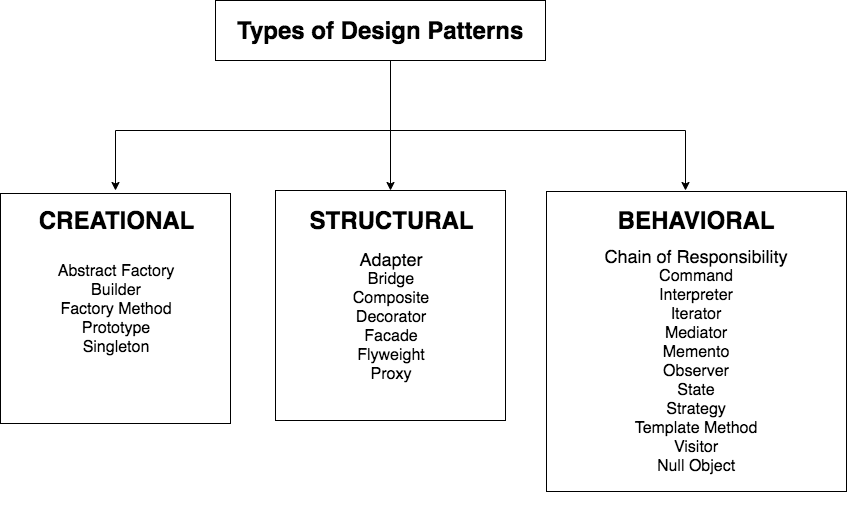
We will examine what prototype design is:
What is the prototype design pattern?
The prototype design pattern stands out among creational design patterns for its innovative approach to object generation. Instead of constructing objects from scratch, as is typical, this pattern focuses on creating new objects by duplicating existing ones. This is achieved through a process called cloning, where an existing object is copied to produce a new one that retains the original’s structure but permits independent alterations. This method is particularly advantageous when dealing with complex objects that require substantial resources or time to initialize, thus enhancing both the efficiency and adaptability of software development.
Imagine, for instance, a highly customized car object with specific attributes such as color, engine type, and accessories. Traditionally, creating a new car object with slightly different attributes would involve instantiating a new object and manually setting each attribute. However, the prototype design pattern simplifies this process. By cloning the original car object and then modifying the cloned object to reflect the desired changes, the need to manually configure each attribute is eliminated. This streamlines object creation and modification, with the cloned object acting as a prototype or template that can be easily replicated and adjusted as needed.
This pattern is especially beneficial in scenarios where the creation of objects involves complex or resource-intensive operations. By cloning existing objects, developers can avoid the overhead associated with initializing new objects from scratch. This not only enhances performance but also simplifies the codebase by reducing redundancy. Furthermore, the prototype design pattern is highly adaptable and can be applied to a wide range of object types, making it a versatile tool across various software development contexts.
In summary, the prototype design pattern provides a robust and efficient method for creating new objects through cloning. Its ability to enhance efficiency, flexibility, and code simplicity makes it a valuable asset in the development of resilient and scalable software systems. By understanding and implementing this pattern, developers can significantly optimize the processes of object creation and modification, resulting in more maintainable and high-performing code.
Benefits and use cases of the prototype design pattern in Python:
The prototype design pattern introduces a multitude of advantages that significantly bolster both the efficiency and adaptability of software development processes. A standout feature is its capability to generate new objects through the duplication of existing ones. This cloning mechanism fosters code reuse, allowing developers to capitalize on pre-existing object configurations rather than constructing new ones from the ground up. By streamlining the object creation process, the prototype pattern diminishes code complexity, facilitating easier maintenance and comprehension.
Furthermore, the prototype design pattern is exceptionally adept at handling intricate object structures. When navigating complex object hierarchies, the pattern provides efficient management and control. Cloning objects enables developers to effectively oversee object states and configurations, ensuring the system remains robust and versatile. This is especially beneficial in scenarios requiring frequent object customization or where creating new objects involves substantial overhead.
Another pivotal advantage of the prototype design pattern is its favorable impact on performance and resource management. By offering mechanisms to regulate object creation, the pattern aids in optimizing resource allocation. Instead of generating new instances from scratch, which can be resource-intensive, cloning existing objects often demands fewer resources. This efficiency gain is particularly evident in applications necessitating frequent object creation or where performance is a critical factor.
Lastly, the prototype design pattern affords remarkable flexibility and customization in object design. Developers can create objects with diverse configurations or states by simply cloning and adjusting existing objects. This facilitates rapid prototyping and experimentation, empowering teams to iterate swiftly and adapt to evolving requirements. The pattern's ability to support various object configurations makes it an indispensable tool for developing dynamic and adaptable software systems.
Before we dive into the prototype design pattern example using Python, let’s first ensure you have everything needed to run the code. Here’s a step-by-step guide:
- Python
- Code Editor
- Pip
Setting Up an IDE or Code Editor (Optional but Recommended)
After installing Python, you may want to use an Integrated Development Environment (IDE) or code editor to write and run your Python programs more easily.
VS Code: A lightweight, free editor with great Python support. Download here. Install the Python extension for VS Code to get features like autocompletion and debugging.
PyCharm: A dedicated Python IDE with a free community version. Download PyCharm.
If you don’t have Python installed, follow these steps based on your operating system:
- Windows:-
- Download Python from python.org.
- Run the installer, and make sure to check the option “Add Python to PATH” before installing.
- macOS:-
- Open Terminal and use Homebrew to install Python:
brew install python- Linux:-
sudo apt update
sudo apt install python3- Check Python Installation:
- After installing Python, confirm it by running this in the terminal or command prompt
python --versionAlso, make sure pip is installed
pip --version- If you get a version, you're all set!
Here’s how you can implement it in Python:
import copy

class Prototype:
    def clone(self):
        return copy.copy(self)

    def deep_clone(self):
        return copy.deepcopy(self)

class Car(Prototype):
    def __init__(self, model, color, options=None):
        self.model = model
        self.color = color
        self.options = options if options else []

    def __str__(self):
        return f"Car(model={self.model}, color={self.color}, options={self.options})"

# Create an original car instance
original_car = Car("Sedan", "Red", ["Air Conditioning", "Alloy Wheels"])
print("Original Car:", original_car)

# Create a shallow clone of the original car
cloned_car = original_car.clone()
print("Cloned Car:", cloned_car)

# Modify the cloned car's attributes
cloned_car.color = "Blue"
cloned_car.options.append("Sunroof")

# Print the modified cloned car and the original car to see the effects of shallow copying
print("Modified Cloned Car:", cloned_car)
print("Original Car after modification of clone:", original_car)
Explanation Of Above Code:
Prototype Class: It contains two methods: clone() for shallow copying and deep_clone() for deep copying. These methods use the built-in Python module copy to create copies of objects.
Car Class: This is a specific class that inherits from Prototype. The Car class has attributes such as model, color, and options, which represent different configurations of a car.
The __str__() method makes it easy to print a car object in a readable format.
Creating and Cloning: An original_car is created with specific attributes.
A shallow copy (clone()) is made, and its attributes are modified. Changes to the options in the cloned car also affect the original car because clone() only makes a shallow copy.
A deep copy (deep_clone()) is made, and modifying this clone does not affect the original car, since all attributes (including the options list) are completely copied.
How to Run the Program:
- Save the Python script to a file named with any name just add .py at the end of file, for example, prototype_pattern_example.py
- Open a terminal or command prompt and navigate to the directory where your file is saved.
- Run The Python Script :
python3 prototype_pattern_example.pyExpected Output Of Code :-
Original Car: Car(model=Sedan, color=Red, options=['Air Conditioning', 'Alloy Wheels'])
Cloned Car: Car(model=Sedan, color=Red, options=['Air Conditioning', 'Alloy Wheels'])
Modified Cloned Car: Car(model=Sedan, color=Blue, options=['Air Conditioning', 'Alloy Wheels', 'Sunroof'])
Original Car after modification of clone: Car(model=Sedan, color=Red, options=['Air Conditioning', 'Alloy Wheels', 'Sunroof'])
Deep Cloned Car: Car(model=Sedan, color=Red, options=['Air Conditioning', 'Alloy Wheels', 'Sunroof'])
Modified Deep Cloned Car: Car(model=Sedan, color=Green, options=['Air Conditioning', 'Alloy Wheels', 'Sunroof', 'Leather Seats'])
Original Car after deep clone modification: Car(model=Sedan, color=Red, options=['Air Conditioning', 'Alloy Wheels', 'Sunroof'])
How It Works:
- After modifying the shallow cloned car, the changes in the
optionslist also affect the original car because of shared references in shallow copies. - In contrast, the deep cloned car is completely independent of the original, and any modifications do not affect the original car’s attributes.
Benefits of the Prototype Pattern:
- Improves Performance: Creating new objects by copying an existing one is often faster and less resource-intensive than creating them from scratch, especially for complex objects.
- Simpler Object Creation: You don’t need to write complex logic in constructors for each new object. Instead, you start with a simple clone and make changes as needed.
- Avoids Repeated Work: Once you have an object created and registered as a prototype, you can reuse it as many times as you want without redoing the same setup or initialization.
- Easy to Modify: Cloned objects can be easily modified without affecting the original object, which helps when you need slight variations of a base object.
Use Cases of the Prototype Pattern:
- Resource-Intensive Object Creation: If creating an object requires a lot of resources (e.g., database queries, network requests, or expensive calculations), you can create one instance and then clone it for similar objects.
- Game Development: In games, developers often create multiple characters or items that are similar but slightly different. Cloning a prototype saves time and resources.
- Document Templates: In word processors or graphic design software, you often create templates that serve as prototypes. Users can clone these templates and modify them as needed.
- Caching: When you cache objects for future use, instead of recreating them, you can clone objects from the cache, making it more efficient.
Conclusion:
The Prototype Design Pattern is a powerful tool in software design. It helps in optimizing performance by allowing you to clone objects rather than creating them from scratch every time. This pattern is especially useful when creating new objects is expensive or complex. By using the Prototype Pattern, you can reduce the time and resources needed for object creation, making your code more efficient and easier to manage.
Design patterns, like the Prototype Pattern, are crucial for building scalable and maintainable software. They provide reusable solutions that make your code simpler, more readable, and more flexible. Using the Prototype Pattern in your Python projects will help you work more efficiently, especially in cases where object creation is costly.
메타데이터
- post_id
- 7779cc62c059
- slug
- what-are-design-patterns-and-what-is-prototype-design-pattern-7779cc62c059
- url
- https://medium.com/@anjumustad0504/what-are-design-patterns-and-what-is-prototype-design-pattern-7779cc62c059
- canonical_url
- https://medium.com/@anjumustad0504/what-are-design-patterns-and-what-is-prototype-design-pattern-7779cc62c059
- author_url
- https://medium.com/@anjumustad0504
- status
- ok
- fetched_at
- 2026-07-13 10:37:48