S/2025 U 1: The New Satellite Hiding in Uranus’s Inner Rings
S/2025 U 1: The New Satellite Hiding in Uranus’ Inner Rings
Using the JWST (James Webb Space Telescope), a new moon of Uranus was discovered by astronomers. This brings the count of Uranus’ moons to 29.
Temporarily named “S/2025 U1", the moon is the third closest Uranian satellite, orbiting between the moons Ophelia and Bianca. This newly discovered moon orbits 56,000 km from Uranus’ centre (14.6% of the distance from Earth to our Moon) in an almost perfectly circular orbit. Unlike the several irregular Uranian moons, S/2025 U1’s orbit has an inclination very close to 0°. Uranus has 10 irregular moons, which have retrograde orbits (they orbit Uranus in the opposite direction of the planet's rotation). These moons have highly inclined orbits, with the moon Ferdinand inclined 169° in its orbit. Ferdinand is also the furthest orbiting moon of Uranus, revolving 20.9 million km from the planet. This is 54 times further than the distance from Earth to our Moon. However, Uranus would apear smaller from Ferdinand’s perspective than the Earth from our Moon’s perspective.
S/2025 U1’s diameter is only around 10 km across (6 miles), and you could probably walk around it in a matter of hours. This is, of course, if you don’t get set on an escape course from its gravity into a low Uranian orbit. The moon S/2025 U1’s gravity is very weak, and its escape velocity is probably only around 2–5m/s. This means you could theoretically just jump on its surface and reach escape velocity. The walk around the planet doesn’t sound so fun anymore, huh? Unless you have spacesuit thrusters.
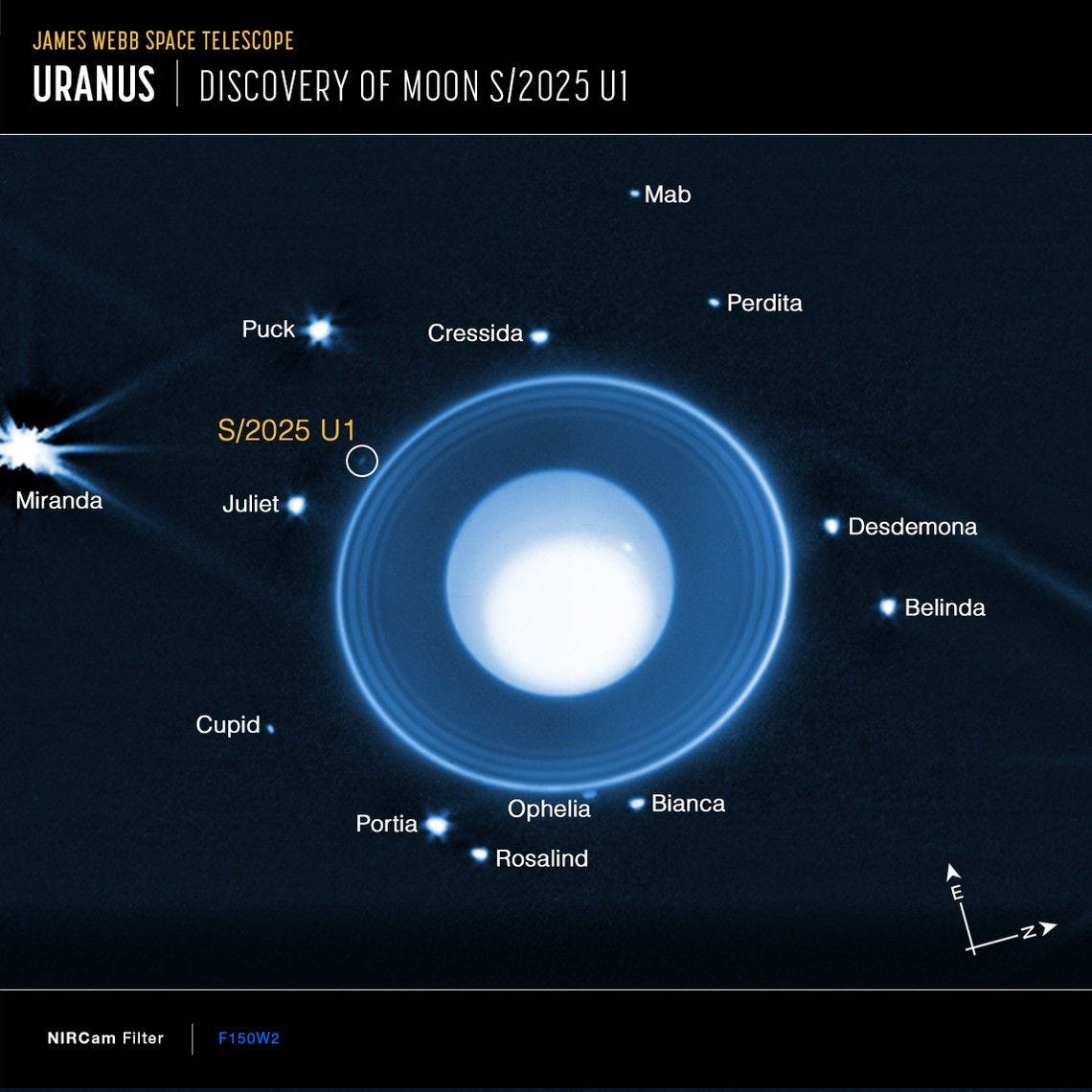
The Uranian system with all of its moons (JWST)
When Voyager 2 passed by Uranus in early 1986, it discovered 10 new moons but overlooked S/2025 U1 during the probe’s brief six-hour stay. This was primarily due to the tiny moon’s faint light. Now you might be wondering, how did the JWST find it then? Well, the famous space telescope actually used its Near-Infrared Camera (NIRCam), capturing 40-minute-long high-sensitivity exposures of Uranus. Observing in the infrared spectrum can be ideal for spotting small, faint objects far out in the Solar System.
In the future, we will hopefully find even more moons in the Uranian system, keeping ahead of Neptune’s 16 moons.
If you enjoyed this article and would like to learn more about new space discoveries, stay tuned and read my future posts.
메타데이터
- post_id
- 77832dbba4e5
- slug
- s-2025-u-1-the-new-satellite-hiding-in-uranuss-inner-rings-77832dbba4e5
- url
- https://medium.com/@sis8738050/s-2025-u-1-the-new-satellite-hiding-in-uranuss-inner-rings-77832dbba4e5
- canonical_url
- https://medium.com/@sis8738050/s-2025-u-1-the-new-satellite-hiding-in-uranuss-inner-rings-77832dbba4e5
- author_url
- https://medium.com/@sis8738050
- status
- ok
- fetched_at
- 2026-07-14 13:18:53