The Complete Biopunk Guide: History, Subgenres, and the New Generation
What is biopunk? Did you know that biopunk has seven distinct subgenres, each with their own canon and history? Or that biopunk existed…
The Complete Biopunk Guide: History, Subgenres, and the New Generation
What is biopunk? Did you know that biopunk has seven distinct subgenres, each with their own canon and history? Or that biopunk existed before cyberpunk?
Biopunk is usually delegated to the niche-of-niches as a cyberpunk offshoot, but it has so much more to offer, and is becoming more relevant than ever right now:
Biohacking is trending, albeit controversial. The first prototypes of computers made from human neurons are here. As are experiments to resurrect extinct species. And, most importantly, a third generation of authors, creators and artists is bringing biopunk into the cultural consciousness once more, with fresh aesthetics and visionary ideas. Let’s dive in.
What is biopunk?
Biopunk is science fiction with a core focus on biology and biotechnology, which makes it operate under different tendencies and results in original themes, differentiating it from other kinds of Sci-Fi, such as the very character-centric hero journeys of Space Operas, or the dystopianism of Cyberpunk.
The problem starts with what biopunk isn’t. Not because biopunk is hard to define — biopunk draws on traditions that predate cyberpunk by over a century, and encompasses at least seven distinct subgenres with their own canons, aesthetics, and philosophical concerns. But because of the stubborn reductionism of most popular definitions, which subjugate it to cyberpunk and leave it at that, in spite of its historically backwards claims.
But instead of arguing about this, let’s just focus on what actually defines biopunk, if one closely examines its history and themes. Most importantly, merely adding genetic elements as surface decoration doesn’t make a work biopunk. At least if you agree that pizza sprinkled with chocolate chunks and marzipan carrots isn’t suddenly cake, either.
Why biopunk existed long before cyberpunk
A major impact biology has on the way biopunk operates is visible in the genre’s tendency to move beyond individual lifespans, or clear dramaturgic dynamics such as dystopia or utopia. One of, if not the earliest example of biopunk illustrates this amazingly well: Last and First Men is a 1930 novel by Olaf Stapledon, and arguably the first exponent of the biopunk subgenre of Speculative Evolution. This novel presents itself not through the eyes of a protagonist, but several species of pre-, present- and post-humans, up until our extinction by a supernova. Bleak, perhaps, but also presented in a very neutral manner — it rather reads like a science magazine, just that the authors of each successive article are the distant descendants of those of the previous one.
If one were to really search for the “root of all biopunk” though, Mary Shelley’s Frankenstein from 1818 inevitably comes up. If viewed from a biopunk perspective, it very distinctly features themes we will encounter again once we look into the individual subgenres: The creation of a new lifeform. Questions about the nature of such a creature — who can control it? Who even is allowed to; what sort of freedom does a synthetic, modified individual claim? And, of course, the looming fear of what consequences the meddling with life might bring. A similar case can be made for H.G. Wells’ The Island of Doctor Moreau (1896).
The point I’m getting at has already been made in this section’s header: Biopunk existed before cyberpunk, and draws on traditions which are even older. The genre just found its first bloom once we became widely aware of the research on genetics, and the first implications of its possible technological applications: In the 1980s.
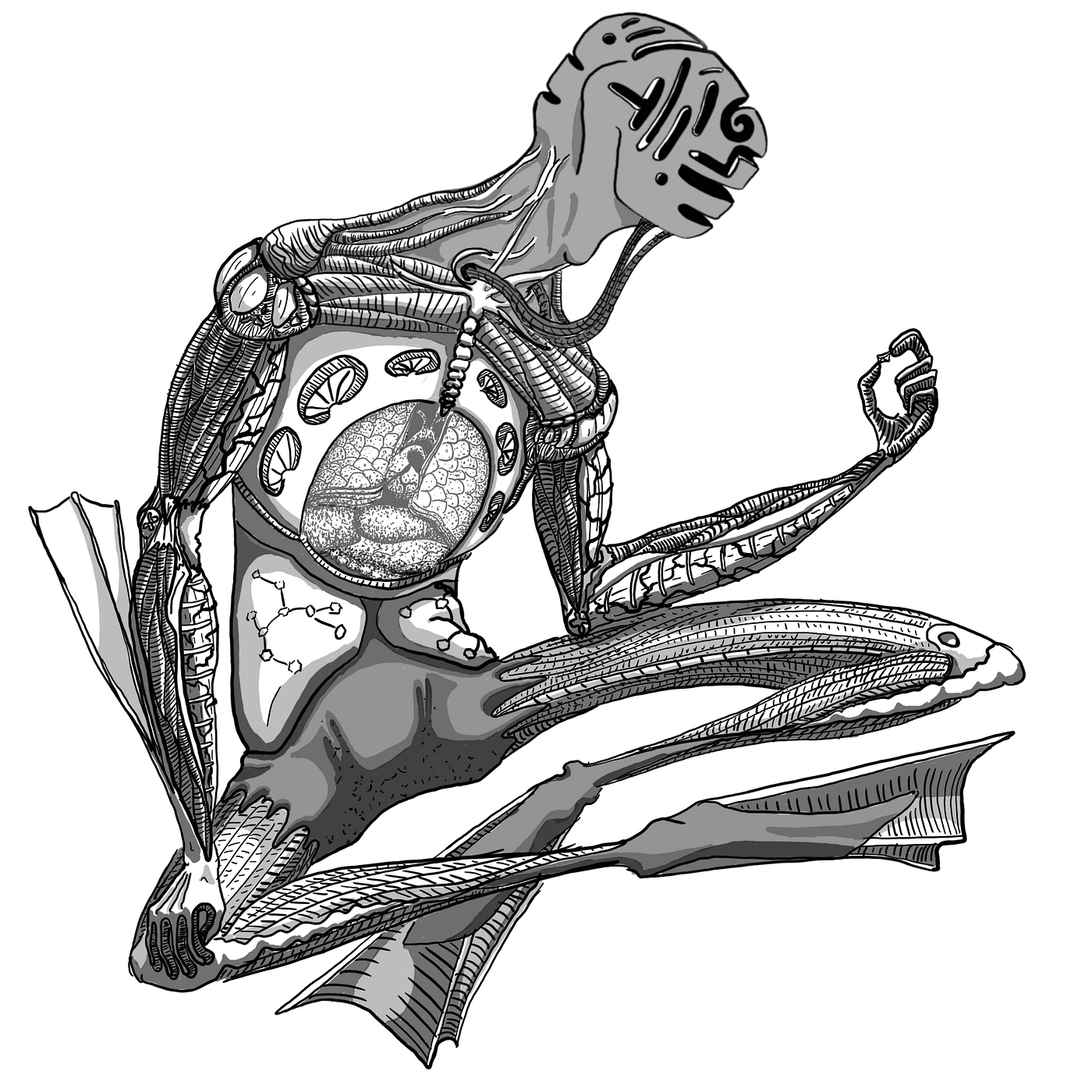
‘Diplomat’, 2026.
Why the “-punk” in biopunk?
Biopunk or cyberpunk? Many online discussions criticize a perceived overlap of the two, and erroneously consider biopunk as a “reskin” of cyberpunk: identical ideology, plotlines and themes. Just.. you know, wetware instead of circuits, and stuff like that. Right?
As I was hopefully already able to prove in the previous section, this couldn’t be more wrong. A question begs to be answered, though: If biopunk is so different from cyberpunk, why should it even be classified as a punk-genre?
I’d like to give several reasons for keeping the name biopunk:
- The “-punk” addendum has long been criticized for losing its original meaning and just denoting an aesthetic, rather than “dystopian underdog stories” (I’m handwaving here, I know). Solarpunk faced a similar discussion for its unashamedly optimistic outlook.
- It comes down to how you define the punk aspect, if you’re applying it to the plot (underdog story, undesirable future), or the genre, as in breaking with genre conventions and dominant narratives. Depending on what you root for, biopunk is either very punk, or absolutely not.
- Last but not least, many things have names which used to mean something different, but were kept because, in the cultural collective-conscious, they’re already descriptive of that specific thing. Names change and evolve with us, and there’s honestly no urgent need to change biopunk into something else.
The subgenres of biopunk
This section paraphrases *the biopunk wiki’s entry on subgenres, which is currently the most comprehensive database on the genre.*
This brings us to the most central question this article wants to answer: What are the subgenres of biopunk? Let’s dive right in. We have seven differentiable subgenres, with lots of biopunk books to fill your reading lists:
- Biowar
- Classic biopunk
- Economic Body Horror
- Ecosystemic Horror
- Fantasypunk
- Genetopia
- Speculative Evolution
The underlying criterion is that a subgenre must have central, bioengineering-based themes that fundamentally distinguish it from adjacent non-biopunk genres. As I’ve mentioned before, adding biotech elements as surface decoration doesn’t make a work biopunk.
Before we dive deeper into each, a quick disclaimer: Genres are categories for unlimited human creativity. These subgenres are just one possible perspective, and do not claim to be absolute.
1. Biowar
Biowar — the name says it all: Armed conflict with strong, or exclusive focus on bioweapons and the implications of genetic manipulation on warfare. This leads to themes which differ from those of ‘regular’ military sci-fi: Dehumanization, organisms created solely for war, hyperbolic natural competition. Examples of biowar include Warframe, the Tyranids from Warhammer 40.000, or Abara.
2. Classic Biopunk
Classic biopunk is regularly mistaken as the definition of biopunk as a whole:
Dystopian settings. Totalitarian governments, police states, or oppressive megacorporations use biotech for social control and profiteering. Protagonists tend to be outsiders (e.g. detectives, P.I.s, teenagers).
Even with its proximity to cyberpunk, classic biopunk still demonstrates unique themes such as food shortages, or parasites. You know the genre from classics such as Ribofunk, The Windup Girl, or Schismatrix, some of the most-cited biopunk genre books (although their representative character for the genre in total is debatable).
3. Economic Body Horror
Economic body horror presents itself as the logical conclusion of classic biopunk: If life has become a commodity, death a mere inconvenience, all of reality will be a desensitized wasteland, where the basic pillars of society such as human rights and punishment for murder have broken down. It’s especially interesting for its discussions of violence (as a job, a necessity, a form of expression), and the often depicted intersection of capitalism and the human form.
Economic body horror can be found in Cruelty Squad, Videodrome, Possessor, or Scorn.
4. Ecosystemic Horror
Ecosystemic horror is a biopunk genre characterized by humans entering an ecosystem where they’re the alien species, perceiving it as hostile though it’s just operating by its own rules of nature. Alternatively, another ecosystem infiltrates and takes over, or “infects” the habitat of humans.
It’s become pretty popular in the past decade, with examples such as Scavengers Reign, Annihilation (both the book and the movie), or Rain World. But its roots can be traced back to foundational works of biopunk such as Blood Music.

Scene from ‘Scavengers Reign’ (2023).
5. Fantasypunk
Biopunk tends to feel weird and outlandish sometimes, but fantasypunk is the crazy uncle of it all: What if you’d ascend to literal godhood by the power of biotechnology? Ascend and destroy entire species as a pastime, stuff like that.
More generally, fantasypunk just uses biopunk to explain fantasy-like, or mythical settings. This justification then leads to discussions of apotheosis, the limits of biology, etc. There are three very central works to its canon: Ilium, Olympos, and Lord of Light.
6. Genetopia
Genetopia is the most utopian version of the biopunk genre. It highlights the positive possibilities of genetic engineering and biotechnology, focuses on aesthetics (translucence, bioluminescence, ethereal beauty), and could be considered the biopunk twin of solarpunk.
The philosophical rabbit hole goes way deeper, though: Visions of high-tech nomads, fitting modern society to a natural human lifestyle. Harmonic ecosystems, where humanity isn’t an exploitative predator. Post-human solutions to behavioral problems such as our territorialism and violence.
Examples include Lilith’s Brood, A Door into Ocean, the Subnautica franchise, and Children of Time.

‘SN2 — Hycean’ by Alex Ries.
7. Speculative Evolution
It’s only fitting that the subgenre of biopunk which usually deals with the longest timespans, is also its oldest. Once again, the name says it all: In speculative evolution, you’ll find hard sci-fi approaches to evolutionary worldbuilding, such as the adaptations of humans over countless space-faring generations, or the evolutionary future of a post-anthropocene earth.
Examples include All Tomorrows, The Future is Wild, Man after Man, and of course the aforementioned Last and First Men.

‘All Tomorrows’ collage, C. M. Kosemen.
The generations of biopunk
I’ve mentioned that there are generations of biopunk, with the third and current one being in the process of ushering in a new era of biopunk. I’ve structured this section chronologically, but will skip the early innovators such as H.G. Wells — they have been discussed sufficiently in the corresponding section above (see: Why biopunk existed long before cyberpunk).
The first generation (1980s)
The first generation of biopunk emerged alongside the growing public awareness for genetics. Foundational texts include Greg Bear’s Blood Music, Bruce Sterling’s Schismatrix, and several key novels by Octavia Butler, who remains one of the genre’s most important architects.
The second generation (late 90s to late 2000s)
The second generation features some of the most-cited biopunk works: Paul Di Filippo’s Ribofunk, C. M. Kosemen’s All Tomorrows, Paolo Bacigalupi’s The Windup Girl, and Margaret Atwood’s MaddAddam trilogy.
The third generation (late 2010s — today)
The third generation of biopunk began in the late 2010s and is arguably still continuing. It emerged alongside real-world advances in synthetic biology and genetic engineering, and brought in some of the subgenres — the aforementioned new era of biopunk; which sees the genre bloom up in its own right. Here, we have already seen monumental works such as Cruelty Squad by Consumer Softproducts, or Ray Nayler’s The Mountain in the Sea.
The generational perspective is, of course, one possible framework, not a definitive canon — the examples listed here are far from exhaustive.
Biopunk aesthetics
Before concluding this article, I’d like to highlight one last aspect: The new aesthetics of biopunk.
Hopefully, this article has so far been helpful in showing the vast and nuanced world of biopunk. What we’ve been mostly ignoring in the discussion of its rise and subgenres, though, are all the new visual aesthetics which have emerged.
Biopunk is often described as anatomical mechanicalism at best, or gritty body horror at worst. The discussion tends to center around some core styles, such as that of H. R. Giger, or the weird and wonderful creatures of C. M. Kosemen.
These styles are established for a reason, there is no doubting their artistic merit. But there’s so much more. I’d like to highlight some aesthetics and their exemplary contributors here in detail:
Speculative evolution has blessed us with some of the most imaginative biopunk creatures imaginable, and one major contributor is Alex Ries (official website), who has given us creatures of ethereal beauty such as the Hycean, Ventgarden, or the Birrin.
Genetopia is all about that clear and fresh aesthetic one otherwise knows from Frutiger Aero. One standout artist is Alexandra Semushina, who has given us her vision of biotech helicopters (spoiler: They look like adorable beetles) and housing — which is especially impressive for its rejection of metallic components (artstation profile).
Last but not least, the subgenre of biowar would seem very straightforward, aesthetically — spiky and pointy exoskeletal armor, and reverse bionics of guns, swords, and the likes. Right? For their tabletop game Conquest, greek studio Para Bellum Games decided to take it a step further. Their in-game faction of the Spires has anything a biowar fan could dream of — biomancers, pheromancers, clones with bone armor, even centaurs (official website).

‘Biomancer’ by Para Bellum Games.
Why do I care?
I thought a word or two about why I’m dedicated to giving biopunk the nuanced treatment it deserves could be helpful. When I was first exposed to biopunk as a wee lad, something in my brain changed: The apotheosis and scope of Dan Simmons’ Ilium amazed me, the otherworldly coolness of Warframe filled my dreams with shapes of elegant replicant flesh, and…
And it was super hard to even find coherent names for those themes and aesthetics back in the early 2010s. Let alone reading lists, a wiki, or a genre history. The entries I found always pointed me in the same directions: Ribofunk. The Windup Girl. Cyberpunk with a fancy biological reskin. But that just wasn’t what I was looking for.
Over time, I researched more and more examples, and started to notice the patterns, which I realized were biopunk’s subgenres. I also amassed ideas, which I was still missing on the shelves. So, I decided to throw in my two cents:
I created the biopunk wiki, with defined subgenres of biopunk, reading lists, and media examples.
And I wrote and illustrated my own biopunk novel, boldly titled *The Biopunk Manifesto*, to try and cram as many biopunk subgenres as possible into one work, to truly show the scope of the genre’s capabilities.
And most of all, in an effort to catch that world of ideas which had slowly been building in my mind, growing with each successive aspect I missed elsewhere: A biopunk world with no metallurgy, no fossil fuels, just wetware. A biopunk world with a speaking, sapient plague, which is just a biological AI which can transmit via virus and uses its hosts as hardware.
A biopunk world with complex posthuman relations and uplifted species at the diplomatic table. With an underwater civilization of sea people. With its own languages, technologies, and history. If I’ve gotten you curious, click on the novel’s title above, or look it up on goodreads.
Whether that attempt has been successful is yet to show itself, and not up to me to decide. Until then, I’ll be writing more articles on biopunk — biomachines, operating systems for genetic coding, the art of cellsmithing, the average farmer post-biotech revolution. And expand the wiki. And finish more biopunk artworks. The ToDo-list is long.
Stay tuned!

Collage of illustrations from ‘The Biopunk Manifesto’.
TL;DR Key takeaways
Biopunk’s core focus on biology creates themes, philosophies and aesthetics fundamentally distinct from cyberpunk, body horror, or adjacent genres.
Biopunk predates cyberpunk — its roots trace back to Mary Shelley’s Frankenstein (1818) and Olaf Stapledon’s Last and First Men (1930).
Biopunk hosts rich aesthetics and a multi-media canon of several generations of authors, artists and creators. Biopunk books offer deep variety for a number of tastes and subgenres.
There are currently seven biopunk subgenres; each with its own canon, aesthetics, and history:
- Biowar
- Classic biopunk
- Economic Body Horror
- Ecosystemic Horror
- Fantasypunk
- Genetopia
- Speculative Evolution
메타데이터
- post_id
- 77a9ef349bbe
- slug
- the-complete-biopunk-guide-history-subgenres-and-the-new-generation-77a9ef349bbe
- url
- https://medium.com/@nyv4ywt7w/the-complete-biopunk-guide-history-subgenres-and-the-new-generation-77a9ef349bbe
- canonical_url
- https://medium.com/@nyv4ywt7w/the-complete-biopunk-guide-history-subgenres-and-the-new-generation-77a9ef349bbe
- author_url
- https://medium.com/@nyv4ywt7w
- status
- ok
- fetched_at
- 2026-06-22 12:55:45