Red Teaming Skills You Must Learn to Become a Real Offensive Security Professional
Most beginners think red teaming is just about running exploits or using tools like Mimikatz and Metasploit.
Red Teaming Skills You Must Learn to Become a Real Offensive Security Professional
Most beginners think red teaming is just about running exploits or using tools like Mimikatz and Metasploit.
It’s not.
Real red teaming is about thinking like an attacker, understanding enterprise environments, bypassing defenses, and moving silently across systems without detection.
Here are the most important skills every aspiring Red Teamer must build.
1. Active Directory Enumeration
If you don’t understand Active Directory, you are not ready for enterprise red teaming.
You must know:
- PowerView
- BloodHound
- SharpHound
- LDAP enumeration
- ACL abuse
- Kerberos authentication flow
Why it matters: Most enterprise compromises happen through misconfigured Active Directory permissions.
2. Privilege Escalation
A Red Teamer must know how to move from low privileges to SYSTEM or Domain Admin.
Important areas:
- Windows PrivEsc
- Linux PrivEsc
- Token impersonation
- Service abuse
- Weak permissions
- Scheduled task abuse
- DLL hijacking
Tools:
- WinPEAS
- PowerUp
- Seatbelt
- LinPEAS
3. Credential Attacks
Credentials are the backbone of lateral movement.
You should understand:
- Pass-the-Hash
- Pass-the-Ticket
- Kerberoasting
- AS-REP Roasting
- DCSync
- Golden Ticket
- Silver Ticket
Tools:
- Rubeus
- Mimikatz
- Impacket
4. Defense Evasion
Modern environments use EDR, Defender, AMSI, and logging solutions.
You must learn:
- AMSI bypass
- ETW bypass
- Obfuscation
- In-memory execution
- Reflective DLL loading
- AV evasion
- Living Off The Land Binaries (LOLBins)
This separates script kiddies from professional operators.
5. Lateral Movement
After compromising one machine, the goal is to move across the network.
Important techniques:
- PsExec
- WinRM
- WMI
- SMB
- RDP
- Remote service creation
A Red Teamer should understand when to use noisy vs stealthy movement.
6. Web & API Security Knowledge
Modern red team engagements involve web applications and APIs.
Learn:
- SQL Injection
- SSRF
- XSS
- Authentication bypass
- JWT attacks
- OAuth abuse
- API authorization flaws
- GraphQL attacks
Understanding web security helps in initial access and pivoting.
7. Cloud & Identity Attacks
Cloud environments are now part of almost every organization.
Important areas:
- Azure AD attacks
- AWS IAM abuse
- Token theft
- Conditional Access bypass
- Cloud persistence
- Hybrid identity attacks
8. C2 Frameworks
You should know how command-and-control infrastructure works.
Popular frameworks:
- Cobalt Strike
- Havoc
- Sliver
- Mythic
Learn:
- Beaconing
- OPSEC
- Payload generation
- Listener management
9. OPSEC (Operational Security)
Good attackers avoid detection.
You must understand:
- Event logs
- Defender telemetry
- Detection engineering
- Sysmon
- Sigma rules
- EDR visibility
Always ask: “How would a blue team detect this?”
10. Reporting & Communication
One of the most underrated skills.
A good Red Teamer must:
- Explain attacks clearly
- Write remediation steps
- Present business impact
- Create professional reports
Technical skill without communication has limited value.
Final Thoughts
Red teaming is not about using flashy tools.
It’s about:
- Understanding attack paths
- Thinking creatively
- Staying stealthy
- Chaining small weaknesses into full compromise
The best Red Teamers are the ones who deeply understand Windows internals, Active Directory, authentication, and enterprise environments.
Start with fundamentals. Practice consistently. Document everything. Build labs. Solve real-world scenarios.
That’s how you become dangerous in offensive security.
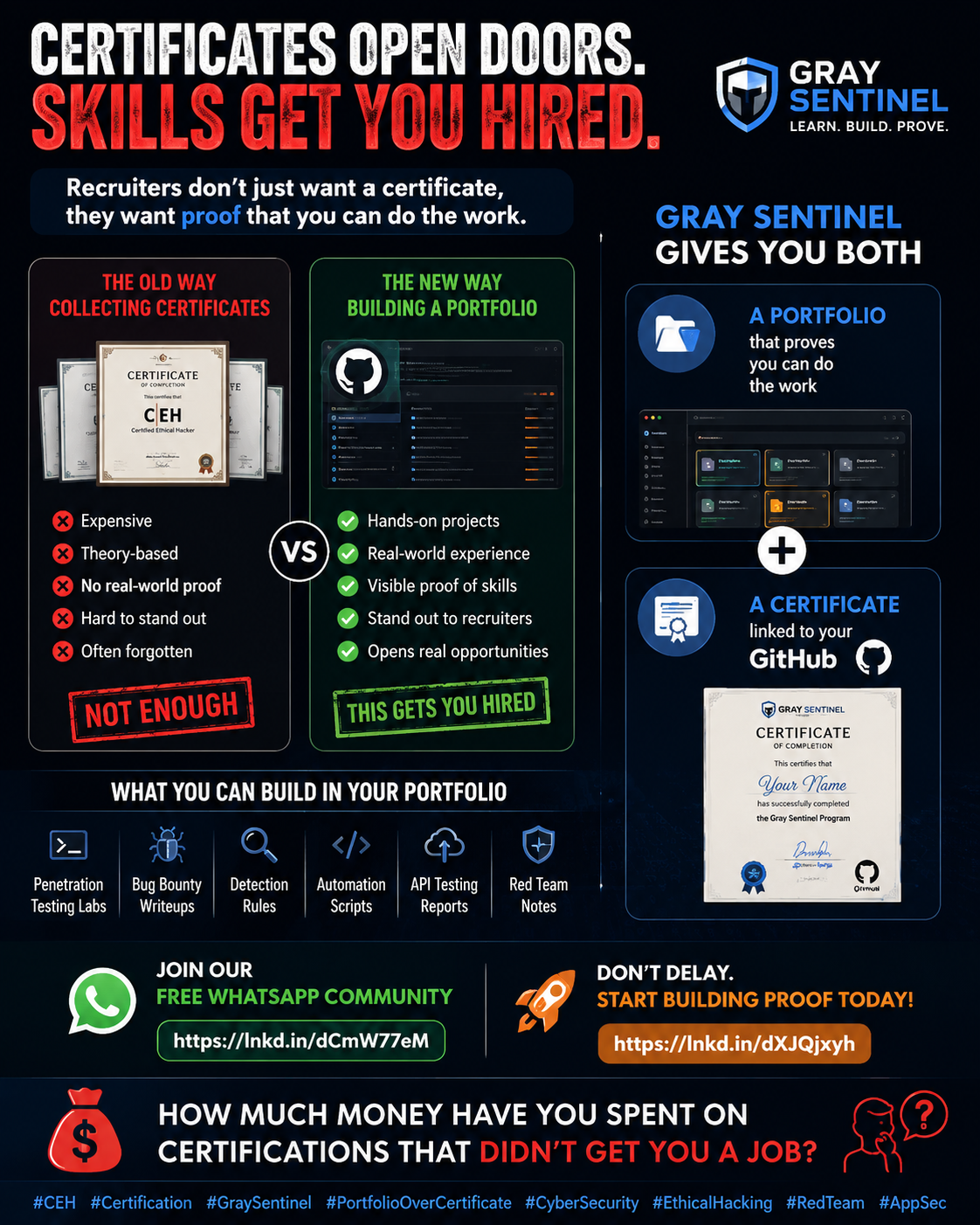
Most people think certifications alone will get them hired in cybersecurity.
Reality?
Recruiters now ask: “Can you actually do the work?”
That’s why practical skills matter more than collecting random certificates.
Build:
- Real labs
- GitHub projects
- Detection rules
- Exploit writeups
- API testing reports
- Red team notes
- Automation scripts
A strong portfolio speaks louder than a PDF certificate.
GraySentinel gives you both: A portfolio that proves you can do the work + a certificate linked to your GitHub.
🔓 Free WhatsApp community: https://lnkd.in/dCmW77eM 🎯 Don’t delay. Start building proof today: https://lnkd.in/dXJQjxyh
👇 How much money have you spent on certifications that didn’t help you get a job?
CEH #CyberSecurity #Certification #GraySentinel #PortfolioOverCertificate #RedTeam #AppSec #EthicalHacking
메타데이터
- post_id
- 77aab34ddb3b
- slug
- red-teaming-skills-you-must-learn-to-become-a-real-offensive-security-professional-77aab34ddb3b
- url
- https://medium.com/@graysentinel.ai/red-teaming-skills-you-must-learn-to-become-a-real-offensive-security-professional-77aab34ddb3b
- canonical_url
- https://medium.com/@graysentinel.ai/red-teaming-skills-you-must-learn-to-become-a-real-offensive-security-professional-77aab34ddb3b
- author_url
- https://medium.com/@graysentinel.ai
- status
- ok
- fetched_at
- 2026-06-14 16:15:44