The Rise of Real-Time Data: Why ClickHouse Is Becoming the Control Plane
There’s a quiet shift happening in data infrastructure.
The Rise of Real-Time Data: Why ClickHouse Is Becoming the Control Plane
There’s a quiet shift happening in data infrastructure.
Not another incremental upgrade. Not another “faster warehouse” or “data platform”
A fundamental architectural reset.
Enterprises are moving away from:
- Monolithic platforms
- Vendor lock-in
- One-size-fits-all engines
And toward:
- Open architectures
- Open table formats (like Iceberg)
- Best engine per workload
- Real-time systems
At the center of this shift is one of the most important systems in modern AI data infrastructure:
ClickHouse.
The Big Idea: Open Source Is Becoming the Data Control Plane
Modern companies are no longer building everything inside a single platform.
Instead, they are assembling systems like building blocks:
- PostgreSQL → transactions (OLTP)
- Object storage + Iceberg → storage layer
- ClickHouse → real-time analytics
- AI/ML pipelines → intelligence layer
This shift has a deeper implication:
Open source is no longer just a cost saving option — it is becoming the foundation of the data control plane.
And with that:
ClickHouse is increasingly acting as the real-time engine within that control plane.
This is also where disruption starts
For years, SaaS companies monetized:
- data storage
- analytics layers
- observability platforms
But when companies can:
- store data in open formats
- process it with open engines
- move workloads freely
They no longer need vertically integrated SaaS platforms.
This is why:
Open source + ClickHouse will disrupt large parts of the SaaS analytics and observability market.
Not because SaaS disappears — but because control shifts back to the customer.
Why ClickHouse Is So Fast
ClickHouse isn’t fast because of tuning tricks.
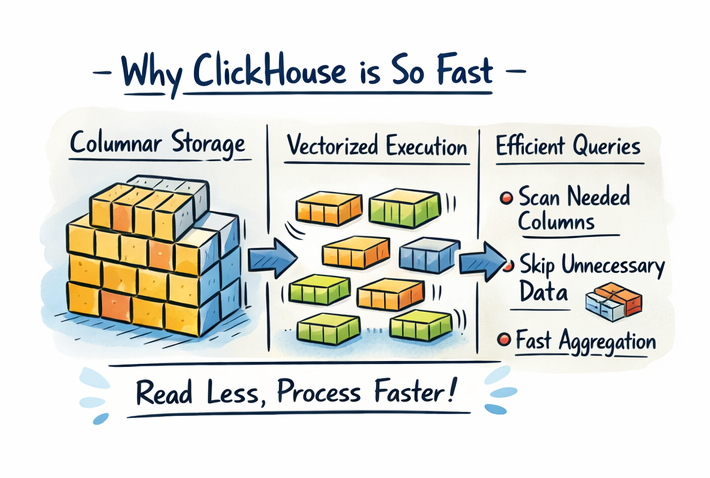
It’s fast because of how it was built from the ground up.
- Columnar storage
- Vectorized execution
- MergeTree storage engine
- Compression
- Real-time ingestion
Speed becomes a byproduct of good architecture — not a feature you bolt on.
The Modern Architecture: PostgreSQL + ClickHouse
This is becoming the default modern architecture.

PostgreSQL → System of Record
CDC (PeerDB) → Continuous Data Flow
ClickHouse → Real-Time Analytics
Why this matters even more
This architecture removes the need for:
- heavy ETL pipelines
- duplicated storage layers
- tightly coupled systems
And introduces something more important:
The ability to plug in different compute engines for different workloads.
The Rise of Multi-Engine Architectures
This is one of the most important trends in data today.
Companies are no longer asking:
“What is our data platform?”
They are asking:
“Which engine is best for this workload?”
Example:
- PostgreSQL → transactions
- ClickHouse → real-time analytics
- Iceberg → shared storage layer
- AI systems → inference + feedback loops
Each engine does one job extremely well.
This is fundamentally different from:
- traditional warehouses
- all-in-one SaaS platforms
Why this disrupts SaaS
Because SaaS platforms rely on:
- bundling multiple capabilities
- locking data into proprietary formats
- controlling the full stack
But in a multi-engine world:
Compute becomes interchangeable.
And when compute is interchangeable:
Lock-in disappears.
Why This Matters for Financial Services (and not only…)
Financial services is where this architecture becomes essential.
- Market data
- Fraud detection
- Risk analytics
- Trade surveillance
All require:
- real-time processing
- high throughput
- predictable performance
Example Workflow: Real-Time Trade Monitoring

Flow:
- Postgres → CDC → ClickHouse
- Queries → dashboards + alerts
Why Companies Like Anthropic Use ClickHouse

AI systems generate:
- massive event streams
- high-cardinality telemetry
- continuous feedback loops
ClickHouse becomes:
The system that enables real-time visibility and control over those systems.
This is where the concept of a “control plane” becomes real
AI systems need to answer:
- What just happened?
- Why did it happen?
- What should we change?
ClickHouse enables all three — in real time.
Deployment Options (When to Use What)
- Cloud → simplicity
- BYOC → control
- Open source → flexibility
Why Open Source Wins
This is the core thesis.
Enterprises are no longer buying platforms. They are assembling systems.
And that changes everything.
Because now:
- Storage is open
- Compute is replaceable
- Architectures are modular
This is the key shift
From:
- vendor-owned platforms
To:
- customer-owned architectures
And this is where disruption accelerates
As more companies adopt:
- PostgreSQL
- ClickHouse
- Iceberg
They begin to replace:
- proprietary warehouses
- observability SaaS tools
- analytics platforms
Not with one tool — but with a system of tools.
What It Takes to Implement ClickHouse
ClickHouse rewards:
- good data modeling
- good architecture
- clear workload design
Data Modeling (Most Important)
You are designing how data is read — not just how it is stored.
Best Practices
- Design for queries
- Choose sorting keys carefully
- Use materialized views
- Batch inserts
- Append-only patterns
- Understand merges
What Workloads Belong on ClickHouse
Ideal:
- Real-time analytics
- Observability
- Event streams
Not ideal:
- transactional systems (use PostgreSQL for that)
The Hidden Truth
ClickHouse forces a shift:
From:
- “the system will figure it out”
To:
- “we design for performance”
What Comes Next: Real-Time Architecture Skills
Everything in this post leads to one conclusion:
ClickHouse is not just a database. It’s a real-time architecture foundation.
In the next post:
ClickHouse Real-Time Architecture Skills
I’ll show how to:
- standardize architectures
- simulate workloads
- implement best practices
Executable architecture — not theory.
Final Thought
The future of data platforms is:
- PostgreSQL for transactions
- Open storage (Iceberg)
- ClickHouse for real-time analytics
And most importantly:
Different engines for different workloads.
Because in the end:
The companies that win are not the ones with the biggest platform.
They are the ones with:
The most flexible architecture.
And that architecture is:
- open
- composable
- real-time
And increasingly — powered by ClickHouse.
메타데이터
- post_id
- 77b59bf85399
- slug
- the-rise-of-real-time-data-why-clickhouse-is-becoming-the-control-plane-77b59bf85399
- url
- https://medium.com/@mkulakowski2-73849/the-rise-of-real-time-data-why-clickhouse-is-becoming-the-control-plane-77b59bf85399
- canonical_url
- https://medium.com/@mkulakowski2-73849/the-rise-of-real-time-data-why-clickhouse-is-becoming-the-control-plane-77b59bf85399
- author_url
- https://medium.com/@mkulakowski2-73849
- status
- ok
- fetched_at
- 2026-06-09 15:37:30



