The failures of Phallogocentrism
I love the way Claudio Ulpiano once talked about the difference he felt reading Lacan and reading Deleuze. He talks about how Lacan is a…
The failures of Phallogocentrism
I love the way Claudio Ulpiano once talked about the difference he felt reading Lacan and reading Deleuze. He talks about how Lacan is a thinker of structures, limitations, and lack, and how he is good at decoding the structures in our unconscious that limit us and force us to remain in a condition of servitude. But sadly, many Lacanian thinkers take that description to be a description of the natural, instead of the unnatural capture of our unconscious, made to serve a particular political project.
He then talks about how reading Deleuze on the unconscious and their anti-Oedipus opens up a very different approach to the unconscious: what the unconscious can be, how to liberate it, how to find lines of flight, and how to reorganize your body outside the forces that structure it. That allows you to re-read Lacan in a new way, not as a theorist of the nature of the unconscious, but as a good analyst of the repressed unconscious under a particular system of control.
I say this because I think the parallels to feminist theory are obvious. Sadly, we have very few feminist authors who are doing the job of Deleuze in this relation. So much of feminist theory is “Lacanian” in the sense that it takes the oppression of women to be the nature of women, and the position of power fabricated by men to be male nature. Curiously enough, there have been more efforts to undo the first (women are not naturally weak, their power was usurped, they were rendered weak, etc) than to undo the second. There are still, to this day, theories even in radical feminism that subscribe to this notion of male power and physical power as an inherent advantage that explains male domination (it doesn’t). And I think a lot of this has to do with the contribution to feminism made by the theory of “Phallogocentrism”.
The idea of imagining the male through the semiotics of the phallus has led to an imagination of the male as the one who penetrates, the one who is the agent, the one who vilifies, the one who conquers, the one who destroys. We still have so much legacy of this way of thinking; I see it in feminists who think they are insulting men or proving male inferiority by calling males destroyers, violent, rapists, etc… As if one could offend power by calling it powerful. Of all the contributions that the idea of phallocentric has given us, perhaps the saddest of them all could be expressed in the ridiculous statement “A penis is a weapon”. This is the cul-de-sac of a feminism that operates with the symbolic order of male power as a given. To imagine the most miserable, fragile thing as a weapon that you fear and need protection from. It is very unlikely that any form of liberation can be produced out of this.
So when I say that feminism lacked a “Deleuze” to counter this, or its own “Anti-Oedipus”, I’m of course not saying there are no Deleuzian feminists; I mean, Braidotti, van der Tuin, and all these New Materialists are there doing great contributions to the possibility of a feminism that is both materialist and post-structuralist. What I mean is that an “Anti-Phallus” has never been written. I once saw an article in a masculinity studies journal that was basically trying to write men “not through the phallus, but through the testicular” and it made me imagine what a feminist theory that imagined men not through the “power” of the phallus, but through the vulnerability of the testicle, would lead to, in terms of both theories and potential politics. To imagine males not as always-already powerful, but instead to imagine male power as a negation of nature, and all the re-interpretations that this could lead to. To imagine beyond a politics of ‘protection’.
There is a passage in Deleuze’s work on Kafka where he is talking about the role of the Law in his work (The Penal Colony, The Trial, etc…) and he goes against those analyses that center on addressing the law through the affect of Guilt. Instead, he says the power of the law operates through the affect of Fear. Once again, it is impossible not to see the parallels this has with a type of feminist theory and action that seems so eager to convince males of their guilt. As if power could ever be sensitive to the affect of Guilt. In this mode of operation, the only hope for Women is to convince [power = males] of their crimes, making them feel guilty, under the impression that by feeling guilty, they would seek to remedy and atone for their sins. Yet, much like Deleuze concluded, the true affect of power is Fear. Every significant power gained by Women towards liberation has been made by making males fear what Women could do.
All these rights were forms of negotiation where males ceded some power because they were afraid women could do so much more against them if they didn’t placate that organizational impetus towards liberation with some pacification through the language of Rights. That is why Liberalism as a political practice can never lead to liberation, since its main political goal is always pacification. Peace, as Kwame Ture has made clear, is not the same as freedom. Peace, in liberal theory, is born out of a project of power that seeks to pacify the population in order to govern them. In fact, even the idea of freedom that exists in liberal political theory, as argued by Orlando Patterson, has always been interconnected with the idea of slavery. In the liberal framework, there is no contradiction between freedom and slavery, because slavery maximizes the freedom of those in power. Therefore, a liberal defends slavery with the same passion he defends freedom, because to him, one is the condition for the other.
So it shouldn’t surprise us that liberalism sees Women’s Liberation through the same tactical lens. When feminists disturb the peace, the fear caused by their organization threatens to take away from those in power, men, the very foundation of their slave-freedom system: the subjugation of women by men.
Therefore, to expect that a politics of guilt that negotiates with power for a better condition for women should be understood as inherently limited to never achieve liberation, but also to serve as an obstacle that renders said freedom impossible. That position becomes more alluring if the dominant feminist theory produces male power as a static object given by nature, and sees women’s oppression by men as a consequence of a sexual dimorphism that, as recent archeological records show, didn’t even exist at the time and cannot be used to explain a cause of women’s oppression as much as it can be one of the results of it.
Bernard Stiegler has an interesting perspective on this eerie disappearance of a politics of liberation, something he calls “symbolic misery”. According to him, the hyper-industrial era has alienated us from labor to such an extent that the de-skilling of the proletariat resulted in us imagining ourselves solely as consumers and not as workers. If we are not able to see ourselves as beings capable of producing the reality we live in, something that is easy for artisans because they constantly live by producing things with their own hands, but difficult for us in a saturated market where all forms of labor can be outsourced either by a hyper-precarious labor market or by a machine, then we really stand no chance of being able to imagine a different world being possible, let alone realize that it can be out creation. So we are left with a consumer's relationship to the political, as we find ourselves merely choosing between ready-made options offered to us.
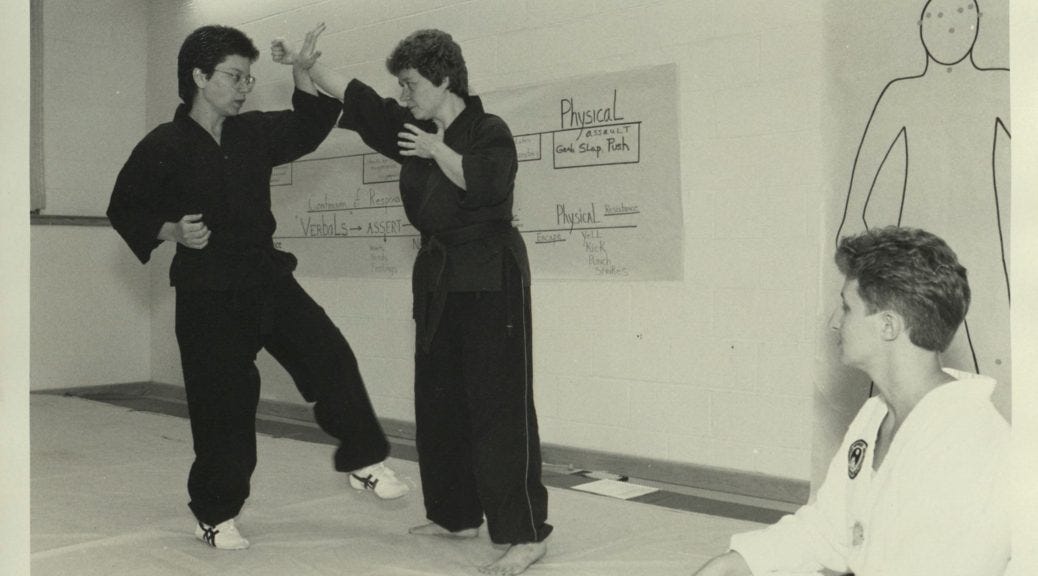
“The right to self-defense is one of the most basic human rights. It is usually one of the first rights denied and oppressed group by their oppressors . . . Each woman who defends herself against attack strikes a blow at the culture that allows men to brutalize women and trains women to submit to men. We will not submit!” — Women’s Martial Arts Union, New York, 1975
I find it interesting to think about this argument in relation to the loss of a physical feminism as time went by. Whether we think of it as Cell 16’s manifesto for a woman’s self-defense in the 70s or the role of Jiu-Jitsu for the suffragettes, the idea of autonomy carried out through a body that could fight, hurt, damage, and frighten, not just nurse, heal, please, and nurture, seems to be a subject of controversy in a feminism that prefers to die repeating epithets like “why educate women about how to defend themselves, we should be educating men not to be violent”. Thus, we’re back to Stiegler’s politics of choice replacing a politics of affirmation of the new. For indeed, without a body that is able to guarantee its own autonomy by force, there is not much that can be created in terms of liberation, other than a buyer’s hope that men will perhaps choose not to be violent.
It should be deeply troubling that feminist sees itself hoping that the same patriarchal institutions that were theorized as part of the problem are now the locus in which hope for a savior is deposited. Education, Law, Courts, Police, and other patriarchal institutions designed to maintain the system of male power, are now seen as the main locus of feminist action, as if, in true liberal fashion, if only we were to teach the right thing, and operate the law properly, and enforce it adequately, we would be able to achieve the much watered drown goal of ‘gender equality’.
It becomes easier to understand, however, when these two factors are put side by side. On one side, with the de-skilling of the population, the relationship women have with their bodies as places of creation (beyond that of reproduction, but productive labor) is replaced by a logic of consumer where one demands better service rather than create its own way (a great way to see this is to compare the 6B4T movement in Korea and China, where it is coupled with a creative and productive logic of female separatism, and how when the movement trended in the US and its satellites, it was instead subsumed into a politics of ‘no dating men until they get better’, much as one would boycott a store until they start offering better service). On the other, we have a production of male power that renders it impossible to imagine power changing hands from men to women, since the very figuration of the problem of male power associates males as a subject that is always-already powerful. The position of victimhood of women is thus not the product of an unnatural configuration of power made to erode women’s power and mask men’s weakness; instead, it becomes the very trait that defines the position of the female subject in history. As much as there was a big uproar against transfeminist Andrea Long Chu’s claim that to be female is to be fucked, much of feminist theory that positions the female subject as a victim of nature is not too far off from claiming the same.
메타데이터
- post_id
- 77d990cacb7e
- slug
- the-failures-of-phallogocentrism-77d990cacb7e
- url
- https://medium.com/@ndebud/the-failures-of-phallogocentrism-77d990cacb7e
- canonical_url
- https://medium.com/@ndebud/the-failures-of-phallogocentrism-77d990cacb7e
- author_url
- https://medium.com/@ndebud
- status
- ok
- fetched_at
- 2026-07-22 17:36:53




