Decision Intelligence
Nothing screams rebrand me like a 50-year-old established field of business.
Decision Intelligence
Nothing screams rebrand me like a 50-year-old established field of business.
There is a new term having its moment. On January 26th, 2026, Gartner published its first-ever Magic Quadrant for Decision Intelligence Platforms. Before that, “decision intelligence” was a “buzzword” without a following. Now, it was a category — with Leaders and Visionaries, Niche Players and Challengers, and a small army of vendors racing to plant a flag in it.
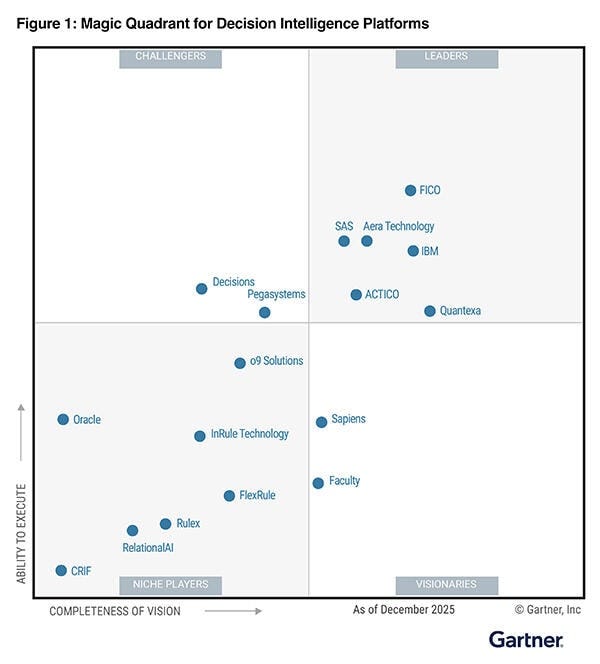
You can’t even read the “independent” verdict independently — it’s paywalled at Gartner, or handed to you as a vendor’s complimentary reprint in exchange for your email and a sales call.
And it seems many people want the credit. Lorien Pratt and Quantellia will tell you they co-invented it back in 2008. Cassie Kozyrkov — Google’s first Chief Decision Scientist — founded it in 2018, and she’ll tell you herself she originally called it “Decision Intelligence Engineering” to keep it distinct from a consultancy already using the term, only to watch adoption file the corners off until it was just “DI,” out of her hands.
Mastercard has sold a product called Decision Intelligence since 2016 — except theirs scores your credit-card swipe for fraud in fifty milliseconds and has nothing to do with anybody’s discipline. Same two words. Different planet. Nobody’s confused, nobody’s suing — because the term is loose enough to mean both.
“But George! Isn’t a Gartner quadrant proof the thing is real?”
It is proof the thing is buyable. Not that it is new. In fairness, a Gartner MQ is probably a bigger deal than your average buzzword. But they also publish north of a hundred of them a year. The honest scoreboard here is who got paid and that is really no better defined… but we’ll come back to that.

Google Trends shows the “buzz” is quite recent
Here is my favorite part. There is no agreement on what’s even in the category. Gartner’s quadrant leans on the autonomous players — Aera, FICO — sitting beside a stats house (SAS, founded in 1976, older than the term it now “leads”), a graph-analytics shop (Quantexa), a supply-chain planner (o9), an ontology company (Palantir).
Meanwhile Domo published its own list of “10 Decision Intelligence Platforms” and it is eight business-intelligence tools wearing a new badge — ThoughtSpot, Qlik, Cognos, Power BI, the usual suspects — with not one of Gartner’s leaders on it. Two lists. Zero overlap. A field that exists to make decision-making rigorous cannot decide who named it or who belongs in it.
A Brief History Of Nothing New
The discipline already had a name, and the name is older than most of the people claiming it: Decision Support Systems. The roots run back to Carnegie Tech in the late ’50s and early ’60s; by the mid-’70s it was a field of its own. Model-driven, data-driven, built to help a human decide. Decision analysis, influence diagrams, the whole toolkit — decades deep.
Still not convinced? Read the vendors’ own words. Domo defines decision intelligence *by contrast with BI — “unlike traditional business intelligence tools, which focus on reporting and dashboards…” You only define a thing against its predecessor when it is* its predecessor, refreshed. And Gartner’s own definition gives the game away entirely: software to “support, augment and automate” decision-making with data, analytics, knowledge, and AI. They wrote the confession into the definition.
Pratt’s causal modeling is real work — but cause-and-effect isn’t a 2008 invention, it’s operations research wearing a new collar. Kozyrkov’s behavioral layer is real too, and also old; Kahneman and Thaler did the heavy lifting decades ago. And the relabeling didn’t even start with Gartner — IDC ran a “Decision Intelligence” MarketScape in 2024, Forrester an “AI Decisioning Platforms” Wave in 2023.
As is often the case in analytics, a name change means the sales team thinks they can sell something. The textbooks will catch up later in the decade. And more often than not, little will actually change.
Surfing The Wave
Riding the wave is the job. Don’t drown in The Deluge, surf it. Because unlike most rebrands, this wave has something real moving underneath... err, floating on top … uhh, breaking the surface. Let’s ride with that and talk about what’s surfacing and what is just foam.
Surfacing, and it matters: agentic AI. That is the one thing that genuinely changed — agents that act, not just answer. Agency moved from the human to the agent. When a human read a dashboard, support was enough. When an agent decides on its own and acts on it, you suddenly have to model the decision — which decisions it gets, the cause-and-effect chain, the audit trail, the governance. That is a real forcing function, not a slogan.
They even minted a unit for it: the “agent run.” Traced, scored, replayed against a “golden path.” Sounds very new. But strip the telemetry off and an agent run is a decision trajectory. The tracking is new. The thing being tracked is the oldest idea we have.
Foam, riding on top but not what the wave is made of: the name, the quadrant, the market-size estimates that vary four and five times over depending on which analyst you ask. I said we’d come back to who got paid…
Oh and don’t forget the entire fight over who gets credit for naming this.
“There is a poetic irony in Decision Intelligence becoming intertwined with Labeling Stupidity.”
The urgency is real. The agentic spend is real, the Global 500 adoption is real, the 2026 land-grab is real. Which is exactly why it’s worth riding well instead of standing on the beach gawking.
2025 was the year of the ROI reckoning, and Gartner itself figures better than 40% of agentic projects get cancelled by 2027. Those are the people who got wiped out in the foam. Even the vendors will admit the gap is discipline, not data — survey their own customers and most decisions are still made on data nobody fully trusts. Surf the wave. Don’t worship it.
What Matters
Strip the label off and the discipline is still standing there, and it still asks the only question that has ever mattered: what decision is being made? If you can’t answer that, stop spending money. Every decision collapses to a binary at its core — yes or no — no matter how many dimensions the data lives in.
Now watch what they actually measure on one of those agent runs. Cost. Latency. Success rate. Hallucination rate. Every dimension but one. Did it make the right decision? Useful is the missing metric. They are tracking the trajectory beautifully and orienting it at nothing.
“A model is valid if and only if it is useful.” — me, incessantly
Because it was never about more data, or faster answers. It’s about orientation — the light pointed deliberately at the decision. I’ve been running this for thirty years under a plainer name. Call it DI. Call it DSS. Call it Bob. The discipline always survives the next rename, and there is always a next rename.
Which is the whole point, so let me say it plainly.
“Decision Intelligence is vertically-integrated Decision Support with an AI bolt-on.”
Oversold and ‘under’stood. Slapping a fresh label on a fifty-year-old field and then fighting over who owns the label is the least intelligent decision in the entire story. Naming the gap is not closing it. Labeling stupidity is the antithesis of decision intelligence.
My Turn To Rebrand
I’m not here to name things. I’m here to do things. I’m not selling you a platform and I’m not selling you a consulting engagement. I do have a book that runs $4.99 — so clearly I am not the one getting paid. And now I have this new medium publication (completely free).
Sales is a game; I’ll let others play it. I wrote this to frame my own relaunched publication — to own my rebrand honestly, and to call out the AI-driven one in the market that’s got me reaching for new words too.
I am in the cycle, not above it. The difference is I’ll name it instead of selling it. This is a workbench, not a funnel — a place to think out loud, for people who want to think differently. I’m not converting skeptics. I’m arming believers.
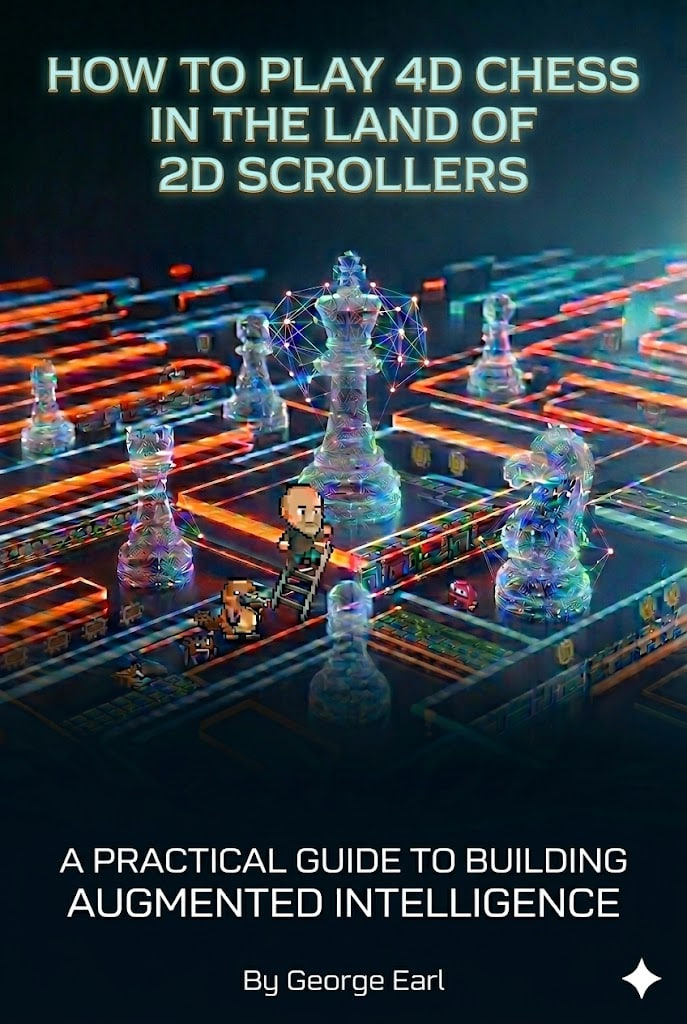
My newest book is *How To Play 4D Chess In The Land Of 2D Scrollers* — the practical guide to building Augmented Intelligence. It is this argument at scale. Book scale. It is also a practical manual. You may not need to read it. But your LLM does.
Decision Intelligence didn’t arrive. It got rebranded. The discipline has been here for decades. Trust me, so have I.
메타데이터
- post_id
- 77d9c511d50d
- slug
- decision-intelligence-77d9c511d50d
- url
- https://medium.com/the-deluge-the-future-of-data/decision-intelligence-77d9c511d50d
- canonical_url
- https://medium.com/the-deluge-the-future-of-data/decision-intelligence-77d9c511d50d
- author_url
- https://medium.com/@d-1
- status
- ok
- fetched_at
- 2026-06-09 18:04:40