Project Phoenix: Designing the World’s Most Resilient Vehicle for an Uncertain Future
✅ Electric-first drivetrain ✅ Multi-fuel onboard generator ✅ Petrol + E85 + Methanol + Synthetic Fuel capable ✅ Solar-assisted charging…
Project Phoenix: Designing the World’s Most Resilient Vehicle for an Uncertain Future
Fuel Input
↓
Fuel Characterization Unit
↓
Fuel Conditioning Unit
↓
Generator Engine
↓
Electricity
✅ Electric-first drivetrain ✅ Multi-fuel onboard generator ✅ Petrol + E85 + Methanol + Synthetic Fuel capable ✅ Solar-assisted charging ✅ Vehicle-to-Home power backup ✅ AI energy management
What if the future of mobility isn’t electric?
What if it isn’t hydrogen?
What if it isn’t petrol, diesel, ethanol, or any single energy source at all?
For decades, the automotive industry has been trying to predict the future and place a bet. Some companies bet on internal combustion. Others bet on hybrids. Today, many are betting everything on battery-electric vehicles.
But history teaches us that the future rarely follows a single path.
Energy prices fluctuate. Supply chains break. Governments change policies. Wars disrupt fuel markets. Electrical grids experience stress. New technologies emerge unexpectedly.
The next generation of vehicles should not be designed around certainty. They should be designed around uncertainty.
That idea led to Project Phoenix.
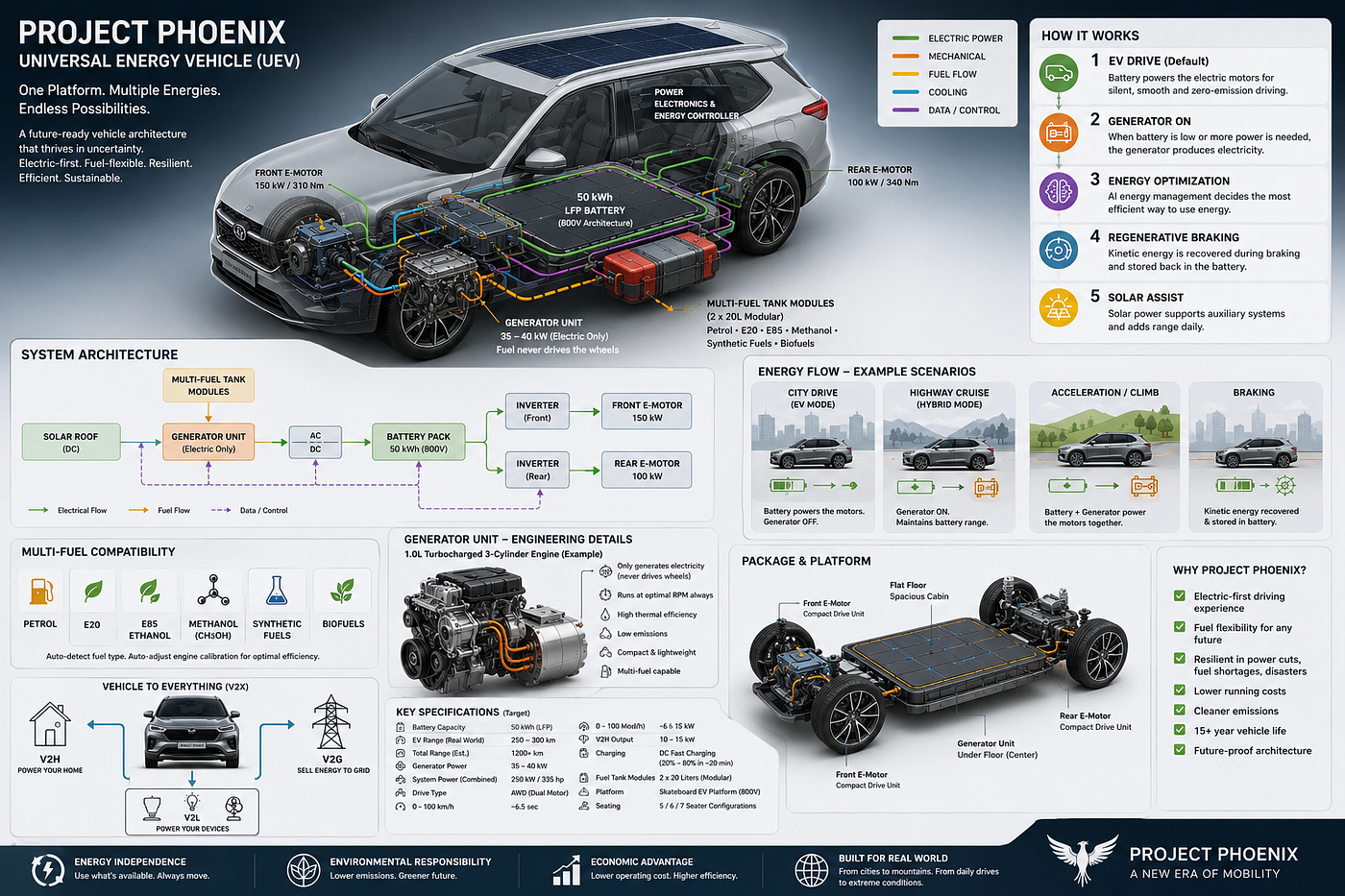
Project Phoenix is a Universal Energy Vehicle (UEV), a vehicle architecture built to operate across multiple energy ecosystems without depending entirely on any one of them.
The core principle is simple: the wheels are always driven by electric motors.
Instead of mechanically connecting an engine to the wheels, a compact onboard generator produces electricity whenever needed. This generator can operate on multiple fuel types including petrol, ethanol blends, methanol, biofuels, and eventually synthetic fuels.
The vehicle contains a medium-sized battery pack capable of handling daily driving entirely on electricity. For longer journeys, the generator automatically activates to maintain battery charge. The result is EV-like driving with the resilience of liquid fuels.
The true innovation is not the battery or the generator. It is the Fuel Adaptation System.
Rather than assuming a fixed fuel type, the vehicle continuously analyzes fuel quality and composition using onboard sensors. Software then adjusts combustion parameters in real time, allowing the generator to operate efficiently on a wide variety of fuel mixtures.
This transforms the vehicle from a transportation device into an energy platform.
During a power outage, the vehicle can power a home. During fuel shortages, it can operate primarily as an EV. During long-distance travel, it can generate its own electricity on demand.
Project Phoenix is not attempting to replace EVs or hybrids. Instead, it seeks to combine their strengths while reducing dependence on any single infrastructure.
The future of mobility may not belong to the vehicle with the largest battery or the most powerful engine.
It may belong to the vehicle that adapts best when the world changes.
One vehicle. Multiple energies. Endless possibilities.
If we were presenting this to Toyota, BYD, Tata, Mahindra, or a startup VC, the first thing we’d do is remove all the futuristic assumptions and only use technologies that either exist today or can realistically be engineered within 5–7 years.
Architecture Design Document (ADD)
Project Name
Phoenix UEV (Universal Energy Vehicle)
Version: 1.0
Target Production: 2032
Vehicle Class: Mid-size SUV / MPV (India-first)
Passenger Capacity: 5–7
1. Problem Statement
Current powertrains have structural weaknesses.
Technology
Problem
ICE
Fuel dependence
EV
Charging infrastructure
Hybrid
Complex driveline
Hydrogen
Infrastructure absent
PHEV
Heavy and expensive
Ethanol-only
Regional availability
Goal:
Create a vehicle that:
- Works during fuel shortages
- Works during grid shortages
- Uses multiple fuel types
- Has EV-like driving
- Has low maintenance
- Has 15+ year ownership life
2. Design Philosophy
Primary propulsion:
Electric MotorsSecondary propulsion:
Onboard Power GenerationKey principle:
Never mechanically connect combustion engine to wheels.
This removes:
- Transmission
- Torque converter
- Clutch
- Gearbox complexity
3. System Overview
+----------------------+
| Solar Roof System    |
+----------+-----------+
           |
           v
+----------------------+
| Energy Controller |
+----------+-----------+
|
v+----------------------+
| 50 kWh Battery Pack |
+----------+-----------+
|
|
+----------+-----------+
| Dual Inverters |
+----------+-----------+
|
+-----+-----+
| |
v vFront Motor Rear Motor ^
|
+----------+-----------+
| Generator Module |
+----------+-----------+
^
|
+----------+-----------+
| Multi-Fuel Tank |
+----------------------+4. Battery Architecture
Chemistry
LFP (Lithium Iron Phosphate)
Reason:
- No cobalt
- Safer
- Lower cost
- Longer life
Capacity
50 kWh
Target:
- 250–300 km pure EV range
- 80% daily trips without generator
Voltage
800V architecture
Reason:
- Faster charging
- Lower cable losses
- Future-proof
5. Traction System
Front Motor
150 kW
Rear Motor
100 kW
Combined:
250 kW
Approx:
335 hp
Torque:
550–650 Nm
Benefits:
- AWD
- Torque vectoring
- No differential locks
6. Generator Unit
This is where we differ from Toyota and BYD.
Option A (Most Realistic)
1.0L Turbocharged 3-cylinder
Purpose:
Only electricity generation.
Output:
35–40 kW continuous
Benefits:
- Existing technology
- Easy certification
- Existing supply chain
Examples:
- Suzuki 1.0 BoosterJet
- Toyota 1.0 Turbo
Option B (Gen 2)
Opposed piston generator
Benefits:
- Higher thermal efficiency
- Lower emissions
Challenges:
- Manufacturing maturity
Recommendation:
Launch with Option A.
7. Fuel System
Phase 1
Supports:
- Petrol
- E20
- E85
India already moving toward E20.
Phase 2
Supports:
- Methanol blends
- Synthetic fuels
Requires upgraded seals and ECU calibration.
8. Energy Management System
Most critical software component.
Inputs:
Battery SoC
Fuel Level
GPS
Weather
Traffic
Elevation
Charging Availability
Outputs:
Generator ON/OFF
Power Split
Regenerative Braking Level
Charging Strategy
Thermal Management
Example
Pune city commute:
Battery = 90%Generator OFFPune → Nagpur:
Battery = 40%Generator ONBattery maintained at 50%Mountain climb:
Generator ON
Battery Assist ON
AWD ON
9. Thermal Architecture
Shared cooling loop:
Battery
Motors
Inverters
Generator
with:
- Active heat pump
- Liquid cooling
Reduces system weight.
10. Solar Subsystem
Roof area:
2.5–3 sq meters
Generation:
300–600W practical
Not enough for propulsion.
Useful for:
- Cabin cooling
- Auxiliary systems
- Battery maintenance
Many startups overestimate solar contribution.
11. Home Backup Mode
Vehicle-to-Home (V2H)
Output:
10–15 kW
Can power:
- Refrigerator
- Fans
- AC
- Internet
- Lighting
for multiple days.
This becomes a major selling point in emerging markets.
12. Failure Mode Analysis
Battery Failure
Generator powers limp mode.
Generator Failure
Vehicle operates as EV.
Charging Infrastructure Failure
Generator provides energy.
Fuel Shortage
Battery provides mobility.
No single point of energy dependency.
13. Manufacturing Strategy
Existing Components
Use:
- Existing EV motors
- Existing LFP cells
- Existing generator engine
Custom development only for:
- Energy management software
- Controller architecture
- Packaging
This dramatically reduces development risk.
14. Real World User Experience
Scenario 1: Pune Office Commute
Daily:
40 km
Vehicle runs as EV.
Fuel consumption:
Near zero.
Scenario 2: Pune to Goa
600 km
Battery first.
Generator maintains charge.
No charging stop required.
Scenario 3: Power Cut
Vehicle powers:
- House lights
- Refrigerator
- WiFi
- Water pump
for several days.
Biggest Engineering Risk
Not the engine.
Not the battery.
Not the motors.
The hardest part is the Energy Orchestration Software.
Think of it like Tesla’s operating system, but instead of managing only batteries, it must continuously optimize:
Electricity
Fuel
Charging
Weather
Battery Health
Driving Behaviour
Route Planning
The company that solves this software problem first will likely define the next generation of automobiles, much like Tesla defined the EV era and BYD defined the practical plug-in hybrid era.
메타데이터
- post_id
- 77dc751e8880
- slug
- project-phoenix-designing-the-worlds-most-resilient-vehicle-for-an-uncertain-future-77dc751e8880
- url
- https://medium.com/@anupchakole/project-phoenix-designing-the-worlds-most-resilient-vehicle-for-an-uncertain-future-77dc751e8880
- canonical_url
- https://medium.com/@anupchakole/project-phoenix-designing-the-worlds-most-resilient-vehicle-for-an-uncertain-future-77dc751e8880
- author_url
- https://medium.com/@anupchakole
- status
- ok
- fetched_at
- 2026-06-15 20:49:13