The Hardest Problem in Databases… Solved by Google
When we talk about databases, most people imagine a simple table storing data, queried whenever needed. But at Google’s scale, databases…
The Hardest Problem in Databases… Solved by Google

When we talk about databases, most people imagine a simple table storing data, queried whenever needed. But at Google’s scale, databases are not simple. They exist across continents, in thousands of servers, serving millions of users. Making sure all these servers agree on the same data is one of the hardest problems in computer science.
In this blog, we will break down how Google solved this problem in a way that feels almost magical. By the end, you will understand the problem, the solution, and why it matters.
The Problem — Time is Harder Than You Think
Imagine two users in two different continents updating the same bank account at the same time. One is in New York, the other in Tokyo. If both try to transfer money simultaneously, how do you know which transaction happened first?
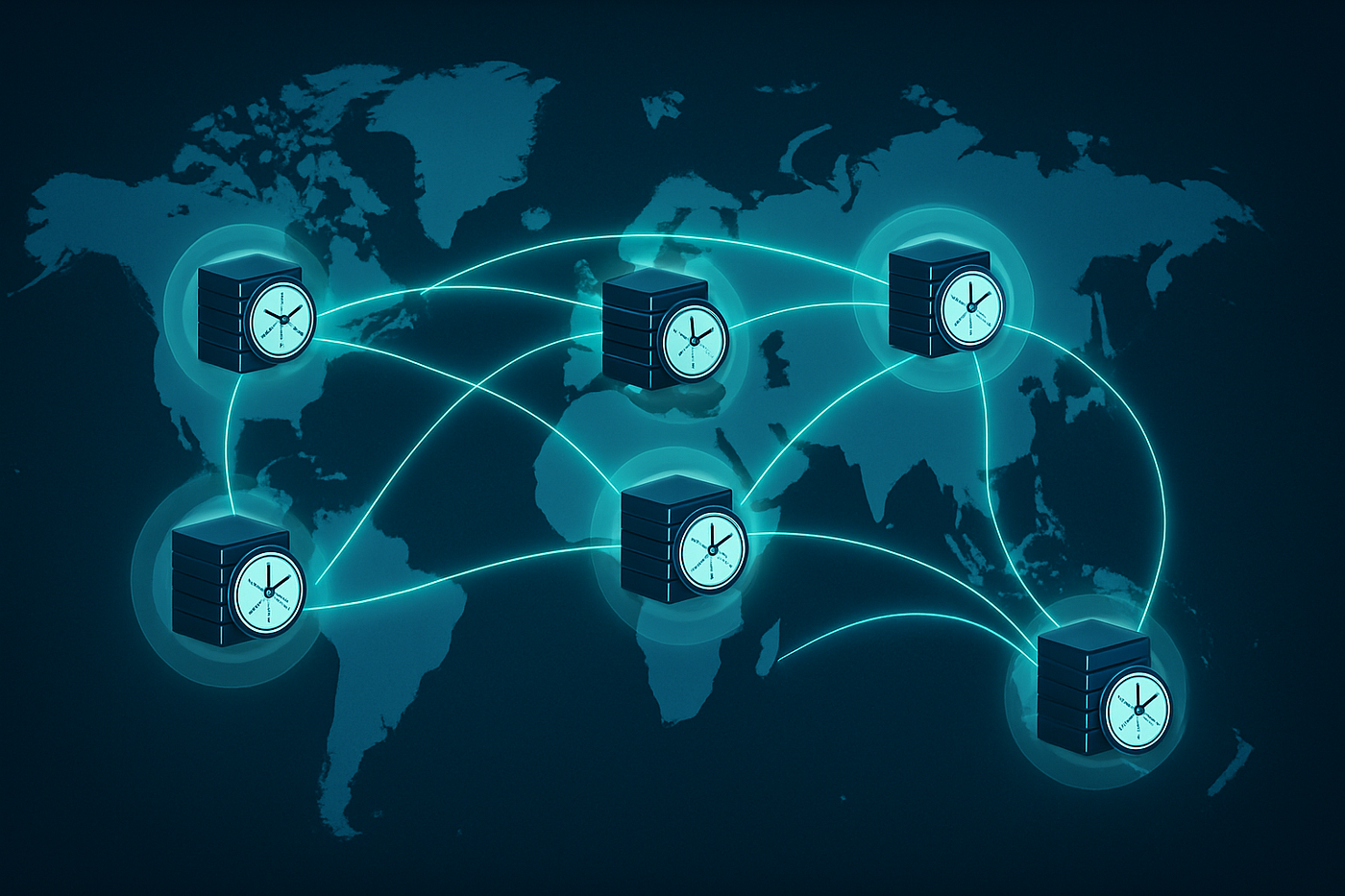
Servers use clocks to timestamp transactions, but here is the catch:
1. Clocks Drift
What it means: Every computer has its own clock. No two clocks are perfectly synchronized. Over time, one clock may be slightly ahead or behind another.
Why it matters: In distributed databases, the order of operations depends on timestamps. Even a millisecond difference can cause problems at Google scale.
Example: Imagine two users updating the same bank account:
- Alice in New York transfers $100 at
10:00:00.001according to her server’s clock. - Bob in Tokyo transfers $200 at
09:59:59.999according to his server’s clock.
Even though Bob clicked after Alice, the database might think Bob’s transaction happened first because of clock drift. This could result in overdrafts, reversed transactions, or lost updates.
2. Network Delays
What it means: Computers communicate over the internet, but messages take time to travel. This is called network latency.
Why it matters: Even if clocks are perfect, the time it takes for one server to tell another about an update can make ordering tricky.
**Example:
- **Alice’s server in New York sends a transaction to Tokyo. It takes 100 milliseconds to arrive
- Meanwhile, Bob in Tokyo updates the same account.
Without knowing the exact delay, the database might misorder the updates, applying Bob’s transaction first even though Alice clicked first.
3. ACID Guarantees
What it means: Businesses rely on ACID properties to trust databases:
- Atomicity: A transaction either happens completely or not at all.
- Consistency: The database always moves from one valid state to another.
- Isolation: Transactions don’t interfere with each other.
- Durability: Once committed, data is never lost.
Why it matters: If timestamps are wrong because of clock drift or network delays, ACID guarantees break. Transactions may be applied in the wrong order, causing data corruption, financial losses, or inconsistent records.
**Example:
- **Bank account balance: $1000
- Alice transfers $100 → new balance should be $900
- Bob transfers $200 → new balance should be $700
If timestamps or network delays misorder transactions:
- Database might apply Bob’s $200 first → $800
- Then apply Alice’s $100 → $700
Even though the final balance looks correct, the history of transactions is wrong, breaking consistency and isolation. In large systems with millions of transactions, this can scale to billions of dollars of errors.
Google’s Solution — TrueTime
The problem we saw earlier was that clocks drift and network delays make it hard to know which transaction happened first. Google’s solution, TrueTime, fixes this using a combination of super-accurate clocks and smart software.
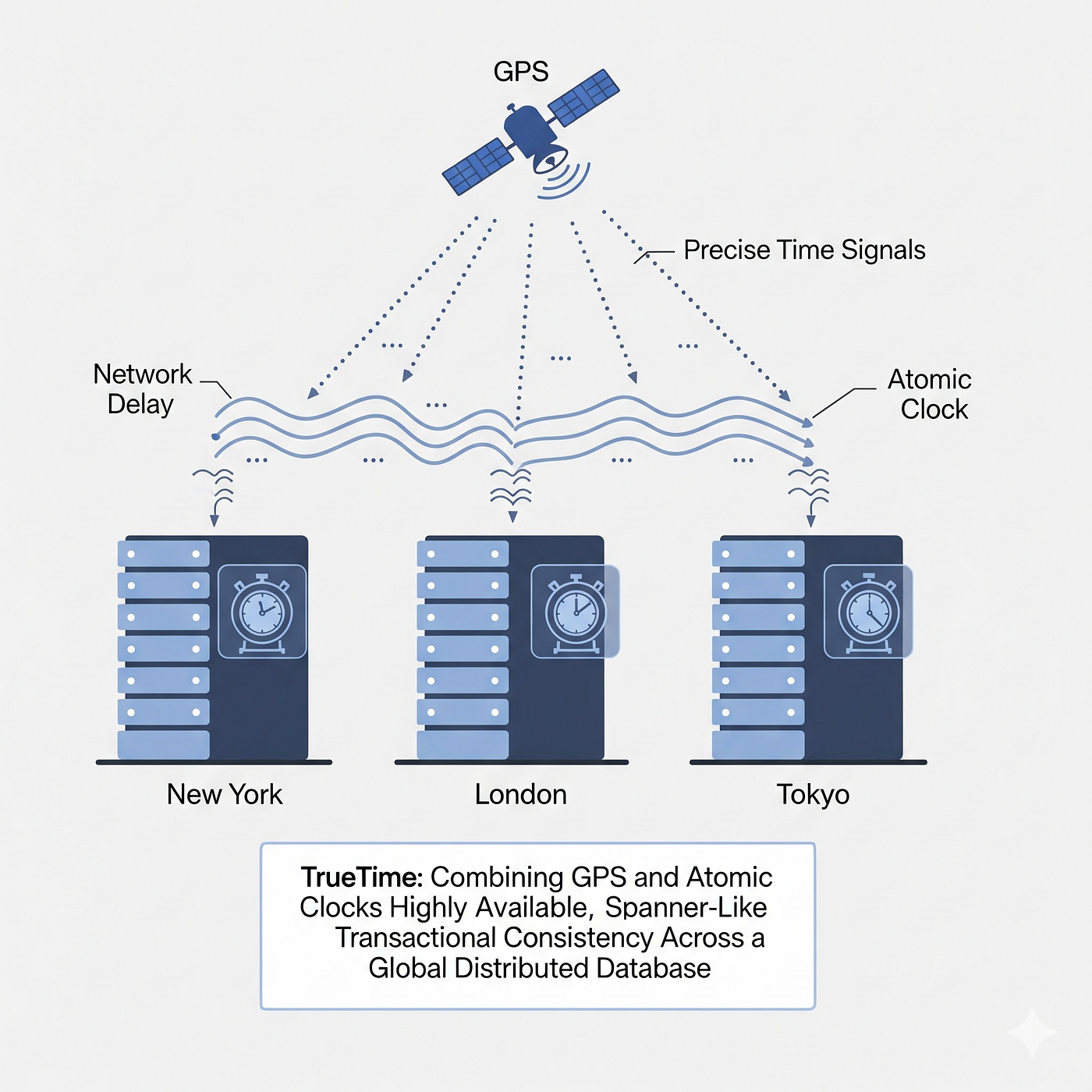
1. Atomic Clocks
What it is: Atomic clocks are extremely precise clocks that almost never drift. They are much more accurate than normal server clocks.
For those interested in the quantum principles behind their remarkable accuracy, please refer to the final section where the underlying science is explained in detail.
Example: Imagine a normal clock that may drift 1 second per day. Atomic clocks might drift 1 second in millions of years. That means Google servers can trust the time much more accurately.
2. GPS Satellites
What it is: Every server can sync its time with GPS satellites, which have extremely accurate clocks in space.
**Example:
- **Server in New York asks a GPS satellite, “What time is it?”
- Server in Tokyo does the same.
- Both servers now know almost exactly the same time.
Even if servers are continents apart, the difference in clocks is tiny.
What about Network delay here: Network delay still impacts time synchronization via GPS, but its effect is minimized by how the system is designed. While the time signal itself is incredibly accurate, the time it takes for that signal to travel from the satellite to a server on Earth must be accounted for.
Why Network Delay Is Minimized While the time it takes for the signal to travel is a form of network delay, it’s a very predictable one. The signal travels at the speed of light. Because the receiver can calculate its precise distance from the satellite, it can subtract the known travel time from the received signal’s timestamp, arriving at an extremely accurate and synchronized time.
3. Error Bounds
What it is: Even with atomic clocks and GPS, there is still a tiny uncertainty. TrueTime keeps track of this and tells the database:
Time = 10:00:00.001 ± 5msThis means: “The real time is somewhere between 10:00:00.001 minus 5 milliseconds and 10:00:00.001 plus 5 milliseconds.”
Why it matters: When committing transactions, Spanner waits until it’s sure of the order. Even if two servers try to update the same data, the database knows which happened first within that tiny margin of error.
Simple Example with Banking Imagine Alice and Bob updating the same bank account: → Alice in New York sends a transaction at 10:00:00.001 ± 5ms → Bob in Tokyo sends a transaction at 10:00:00.002 ± 5ms
The database knows the exact safe order and applies Alice’s transaction first and then Bob’s, even though the servers are continents apart.
Without TrueTime, the database might get it wrong due to clock drift or network delay, possibly leading to lost money or inconsistent balances.
Key Takeaways
- TrueTime is a combination of hardware (atomic clocks + GPS) and software.
- It ensures all servers agree on the order of transactions, even across continents.
- It allows fast, globally consistent updates, without slowing down the database.
Real-World Use Cases
- Financial Systems: Banks like Google Pay or trading platforms need global ACID transactions. Without Spanner, transfers could double-spend money or show out-of-order transactions.
- Multiplayer Online Games: Players attacking the same boss from different continents could get duplicate loot or incorrect stats. Spanner guarantees global event ordering.
- Global SaaS Applications: Apps like Google Docs or cloud storage rely on multi-region servers. TrueTime ensures edits remain consistent worldwide.
A simplified simulation with threads and uncertainty:
import java.util.concurrent.atomic.AtomicInteger;

class TrueTimeSimulator {
    long errorBound = 5; // ±5ms uncertainty
    AtomicInteger globalCounter = new AtomicInteger(0);

    synchronized int commitTransaction(String serverName) {
        long currentTime = System.currentTimeMillis();
        long safeTime = currentTime + errorBound;
        System.out.println(serverName + " committing at safeTime: " + safeTime);
        return globalCounter.incrementAndGet();
    }
}

public class SpannerSimulation {
    public static void main(String[] args) {
        TrueTimeSimulator tt = new TrueTimeSimulator();

        Runnable serverTask = () -> {
            String serverName = Thread.currentThread().getName();
            int txId = tt.commitTransaction(serverName);
            System.out.println(serverName + " applied transaction: " + txId);
        };

        Thread newYork = new Thread(serverTask, "New York");
        Thread tokyo = new Thread(serverTask, "Tokyo");
        Thread london = new Thread(serverTask, "London");

        newYork.start();
        tokyo.start();
        london.start();
    }
}
This simulation shows how uncertainty is handled and transactions are globally ordered.
But wait… how does TrueTime on the server help with a client’s transaction when network latency still exists?
TrueTime doesn’t give a client a single, perfect timestamp. Instead, it provides a time interval with a guaranteed uncertainty bound . This is the
[earliest time, latest time]range. Here's why this is so powerful:
1. Client-Side Delay is Acknowledged: When a client sends a transaction to a Spanner server, the server uses its own local TrueTime clock to timestamp the transaction. The server’s clock, thanks to GPS and atomic clocks, is extremely accurate, with an uncertainty of just a few milliseconds.
2. Transactions are Held Until Safe: When a transaction arrives at the server, Spanner doesn’t commit it immediately. It holds the transaction for a short period of time, essentially waiting until it’s absolutely certain that the transaction’s timestamp is in the past and won’t be in conflict with any other incoming transactions from other servers. This ensures a global, consistent ordering of events.
Think of it this way: A client in New York sends a transaction at 10:00:00.001. A client in Tokyo sends a transaction at 10:00:00.002. Even if the network delay makes the Tokyo transaction arrive first, the Spanner server in Tokyo knows its clock is almost perfectly in sync with the server in New York. When the New York transaction arrives, the server can use its incredibly accurate clock to place it in the correct order, ensuring that Alice’s transfer is processed before Bob’s, regardless of network delays.
Why This Matters
- Global consistency: Spanner maintains ACID guarantees across continents.
- No performance compromise: Older solutions slow down for global writes; Spanner stays fast.
- Hardware + software co-design: Some problems cannot be solved by software alone.
Even a millisecond matters at Google scale. TrueTime is a masterclass in distributed systems engineering.
Key Takeaways
- Global databases face the fundamental challenge of time.
- Google solved it using atomic clocks + GPS + error bounds.
- Spanner guarantees consistent, ordered transactions worldwide.
- This approach is a blueprint for solving extreme distributed systems problems.
Closing Thoughts
Google Spanner is more than a database. It is a solution to a problem you didn’t know existed at this scale. It shows how engineering, physics, and computer science can come together to solve the hardest problems in computing.
Atomic Clocks
Think of a normal clock. It “ticks” by counting some repetitive action, like a swinging pendulum or a vibrating quartz crystal.
Vibrating quartz crystals are indeed used in many modern clocks, especially in watches, wall clocks, and most digital clocks.
How a Quartz Clock Works
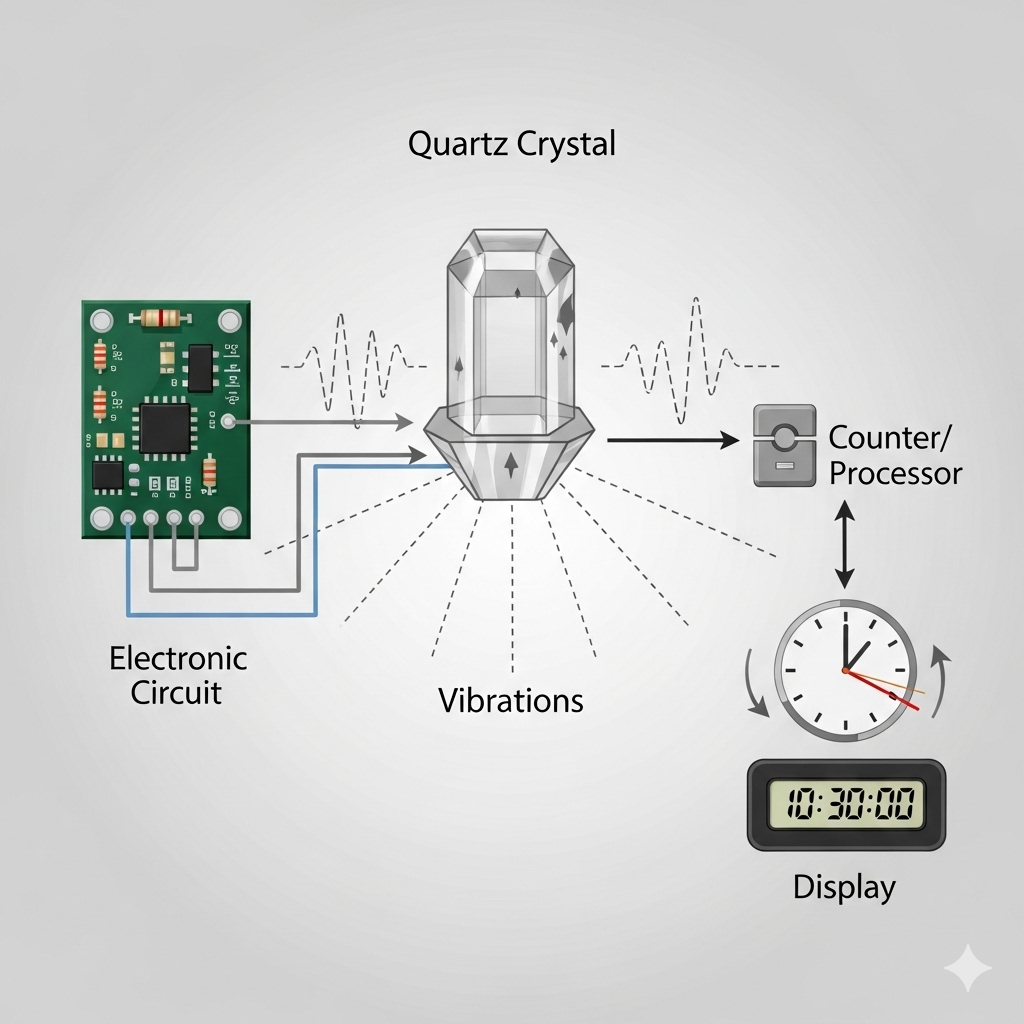
Quartz clocks rely on the piezoelectric effect, which means that certain materials (like quartz crystals) generate a voltage when they are squeezed, and conversely, they change shape when a voltage is applied to them.
- A tiny, precisely cut piece of quartz crystal is placed in an electronic circuit.
- The circuit applies a voltage to the crystal, causing it to vibrate at an incredibly stable frequency.
- The circuit then counts these vibrations. A typical clock crystal is shaped to vibrate at 32,768 times per second.
- Once the circuit counts 32,768 vibrations, it sends a single electrical pulse to a stepper motor, which moves the second hand one tick forward. In a digital clock, this pulse updates the time displayed on the screen.
The problem is, these physical components can be affected by things like temperature, pressure, or just plain old manufacturing flaws. They aren’t perfectly consistent.
Atomic clocks solve this by using something that is fundamentally and universally consistent: the energy transitions of an atom.
Atomic Clocks: How They Keep Perfect Time
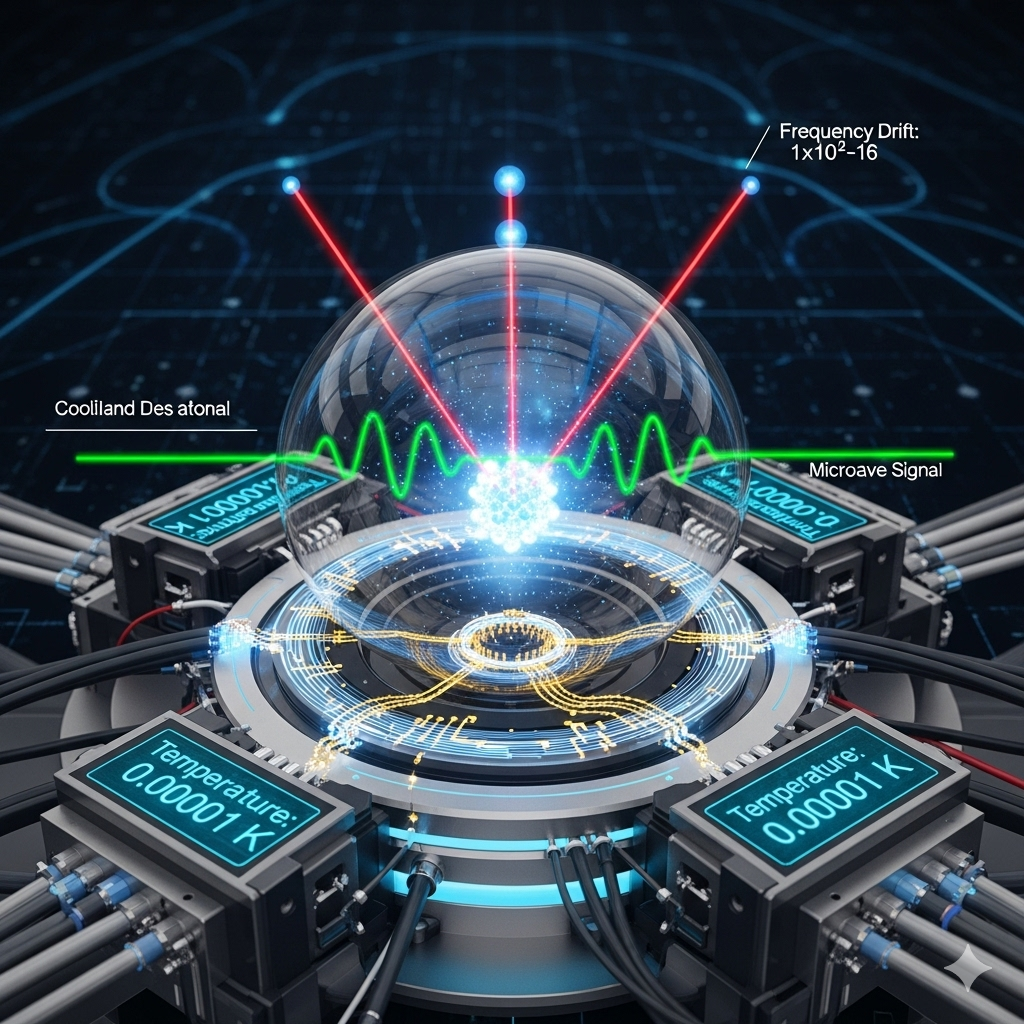
Think of an atom’s electrons like steps on a ladder, or rungs. An electron can only exist on one of these specific energy levels and it can’t be in between them. To jump from a lower rung to a higher one, it needs to absorb a very specific amount of energy. When it drops back down, it releases that exact same energy as a microwave or light wave at a very specific frequency.
This frequency is a constant of nature. Every single cesium-133 atom in the universe, when it makes this specific energy jump, will emit radiation at exactly the same frequency. This perfect, unvarying frequency is what an atomic clock uses as its “tick.”
How It Works, Step-by-Step
- Atom Preparation: First, a cloud of cesium atoms is heated in a vacuum chamber. This vaporizes the atoms and puts them into a specific, low-energy state.
- Microwave Firing: A microwave generator bombards the cesium atoms with waves. The frequency of these microwaves is carefully tuned to match the exact frequency required for the electrons to make that energy jump. This is the core of the clock.
- The “Quantum Jump”: When the microwave frequency is just right, the atoms absorb energy and jump to a higher energy state. If the frequency is even slightly off, far fewer atoms will make the jump.
- Counting the Jumps: A detector is placed at the end of the chamber to count how many atoms successfully made the jump. A feedback loop then adjusts the microwave generator’s frequency until it finds the “sweet spot” where the maximum number of atoms are making the jump.
- Defining the Second: Once the generator is locked onto this perfect frequency, the clock simply counts the cycles of the microwave waves. The international definition of a second is exactly 9,192,631,770 of these cycles from a cesium-133 atom.
- The Counter: A digital counter simply counts these cycles. Once it hits that specific number, it ticks off one second. This process repeats, providing a time base that is astronomically more precise than any other clock.
This video provides a great, simplified explanation of the inner workings of an atomic clock and its use in GPS. How an atomic clock works, and its use in the global positioning system (GPS).
Liked the blog?
If this helped you, leave a clap (or 50!) and share it with your tech circle.
Stay in the loop for more deep dives on Java, performance, and system design:
📌 **Connect on LinkedIn 📌 [Follow me on Medium](https://anmolsehgal.medium.com/) for more engineering write-ups. 📌 [topmate.io/anmolsehgal](https://topmate.io/anmolsehgal): Talk directly with me for personalised advice. 📌 [MyResumentor](https://myresumentor.com/mentor/anmolsehgal492)** if you need help reviewing your resume.
메타데이터
- post_id
- 77ec4916debd
- slug
- the-hardest-problem-in-databases-solved-by-google-77ec4916debd
- url
- https://medium.com/codex/the-hardest-problem-in-databases-solved-by-google-77ec4916debd
- canonical_url
- https://medium.com/codex/the-hardest-problem-in-databases-solved-by-google-77ec4916debd
- author_url
- https://medium.com/@anmolsehgal
- status
- ok
- fetched_at
- 2026-06-26 03:39:16