Why Fluton and Fhenix feel less like products and more like a response to where crypto is going
Lately I’ve been thinking less about individual protocols and more about why certain projects appear exactly when they do. Fluton and…
flutoWhy Fluton and Fhenix feel less like products and more like a response to where crypto is going
Lately I’ve been thinking less about individual protocols and more about why certain projects appear exactly when they do. Fluton and Fhenix are good examples of this. They don’t feel like random experiments or short-term narratives. They feel like a response to a broader shift happening in crypto right now.
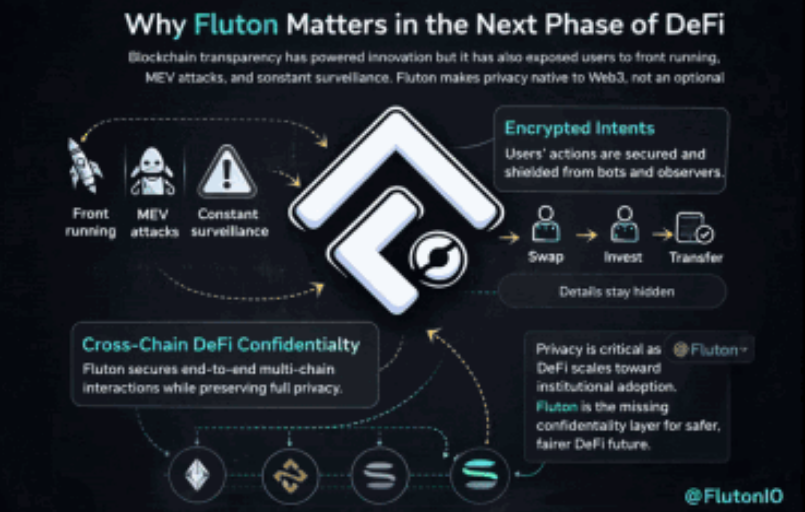
For years, transparency was treated as an unquestionable virtue. Everything on-chain, everything visible, everything traceable. That worked when the ecosystem was small and mostly experimental. But as usage grows, that same transparency starts to work against users. Strategies leak, intent leaks, behavior becomes predictable, and participation starts to favor those who can exploit visibility.
This is where projects like Fhenix become foundational. Confidential computation is not just about hiding numbers, it’s about restoring asymmetry where it actually belongs. Users should not have to expose their intent or internal logic just to interact with a protocol. Fhenix provides the cryptographic layer that makes this possible without breaking composability.
Fluton builds directly on top of that idea, but approaches it from a different angle. Instead of focusing purely on cryptography, it focuses on interaction. How users express intent, how execution happens, and how much information leaks during that process. In that sense, Fluton feels less like a DeFi app and more like an interface layer for private execution.
What makes this combination interesting is timing. Privacy is no longer a niche preference. It’s becoming a practical requirement. As more capital, more institutions, and more complex strategies move on-chain, fully transparent execution starts to look inefficient and even dangerous.
Fluton and Fhenix together suggest a future where privacy is not an add-on or a toggle, but a default assumption baked into execution itself. Not hidden away, not optional, but expected. That’s a big shift in mindset, and it’s why these projects feel more structural than speculative.
메타데이터
- post_id
- 780f63e23a9a
- slug
- why-fluton-and-fhenix-feel-less-like-products-and-more-like-a-response-to-where-crypto-is-going-780f63e23a9a
- url
- https://medium.com/@Theresa58291329/why-fluton-and-fhenix-feel-less-like-products-and-more-like-a-response-to-where-crypto-is-going-780f63e23a9a
- canonical_url
- https://medium.com/@Theresa58291329/why-fluton-and-fhenix-feel-less-like-products-and-more-like-a-response-to-where-crypto-is-going-780f63e23a9a
- author_url
- https://medium.com/@Theresa58291329
- status
- ok
- fetched_at
- 2026-07-13 06:23:13




