How to Reduce AWS Bill: Fix 5 Silent Cloud Cost Leaks | Axalin
Is your AWS bill overspending by 30%? Discover the 5 silent cloud cost leaks draining your budget and learn how Axalin reduced a client’s…
How to Reduce AWS Bill: Fix 5 Silent Cloud Cost Leaks | Axalin
Is your AWS bill overspending by 30%? Discover the 5 silent cloud cost leaks draining your budget and learn how Axalin reduced a client’s bill by 33%.
For many enterprise leaders, the initial migration to the cloud is a triumph of modernization. Workloads are lifted, applications are deployed, and the promised agility of the cloud is realized. But a few months later, a different reality sets in: the monthly AWS bill arrives, and it is significantly higher than projected.
Industry studies consistently show that enterprises overspend on their cloud infrastructure by an average of 30% to 35%. For a mid-market enterprise, this “hidden 30%” can translate to hundreds of thousands of dollars annually — capital that is being silently drained from the IT budget.
As CIOs and enterprise architects, the goal is not just to migrate to the cloud, but to optimize it. Cloud cost management is not a one-time audit; it is a continuous discipline. In this comprehensive guide, we will uncover the five silent cloud cost leaks that inflate AWS bills, explore the strategic challenges of cloud financial management, and detail how Axalin Consultancy Services helps organizations reclaim their cloud ROI through a mature FinOps practice.
What is Cloud FinOps?
*Cloud FinOps is a collaborative business practice and cultural shift that brings together finance, technology, and business teams to manage and optimize cloud spending. It combines the words “Finance” and “DevOps,” focusing on creating a shared responsibility for cloud costs. The core objective of FinOps is to enable organizations to maximize the business value of their cloud investment by ensuring that every dollar spent delivers measurable ROI, without sacrificing speed or innovation.*
The Reality of Cloud Overspending: Key Challenges
Before addressing the technical leaks, it is crucial to understand why cloud overspending happens in the first place. The challenge is rarely malicious; it is usually structural and cultural.
1. The “Lift-and-Shift” Hangover
Many organizations treat cloud migration as a simple data center relocation. They “lift and shift” legacy applications without refactoring them for cloud-native architectures. This results in running oversized, monolithic virtual machines in the cloud, completely negating the elasticity and pay-as-you-go pricing models of AWS.
2. Decentralized Spending and Lack of Visibility
In agile environments, development teams are empowered to provision resources instantly. While this accelerates time-to-market, it often leads to decentralized spending. Without strict tagging policies or budget alerts, engineering teams may spin up resources for testing and forget to terminate them, leading to “shadow cloud spend.”
3. The “Set It and Forget It” Mentality
Cloud environments are highly dynamic. An instance sized perfectly for a production launch in Q1 may be vastly overprovisioned by Q3 as traffic patterns change. Treating cloud infrastructure as static leads to compounding inefficiencies over time.
4. Misaligned Incentives
Often, engineering teams are incentivized on uptime, performance, and speed of delivery, while finance teams are incentivized on cost reduction. Without a unifying framework, these competing priorities result in either over-provisioning (to guarantee performance) or under-provisioning (to cut costs, risking outages).
The 5 Silent Cloud Cost Leaks in AWS
To stop the financial bleed, you must identify where the money is going. Based on our extensive audits across BFSI, healthcare, and manufacturing sectors, Axalin has identified the five most common silent cost leaks in AWS environments.
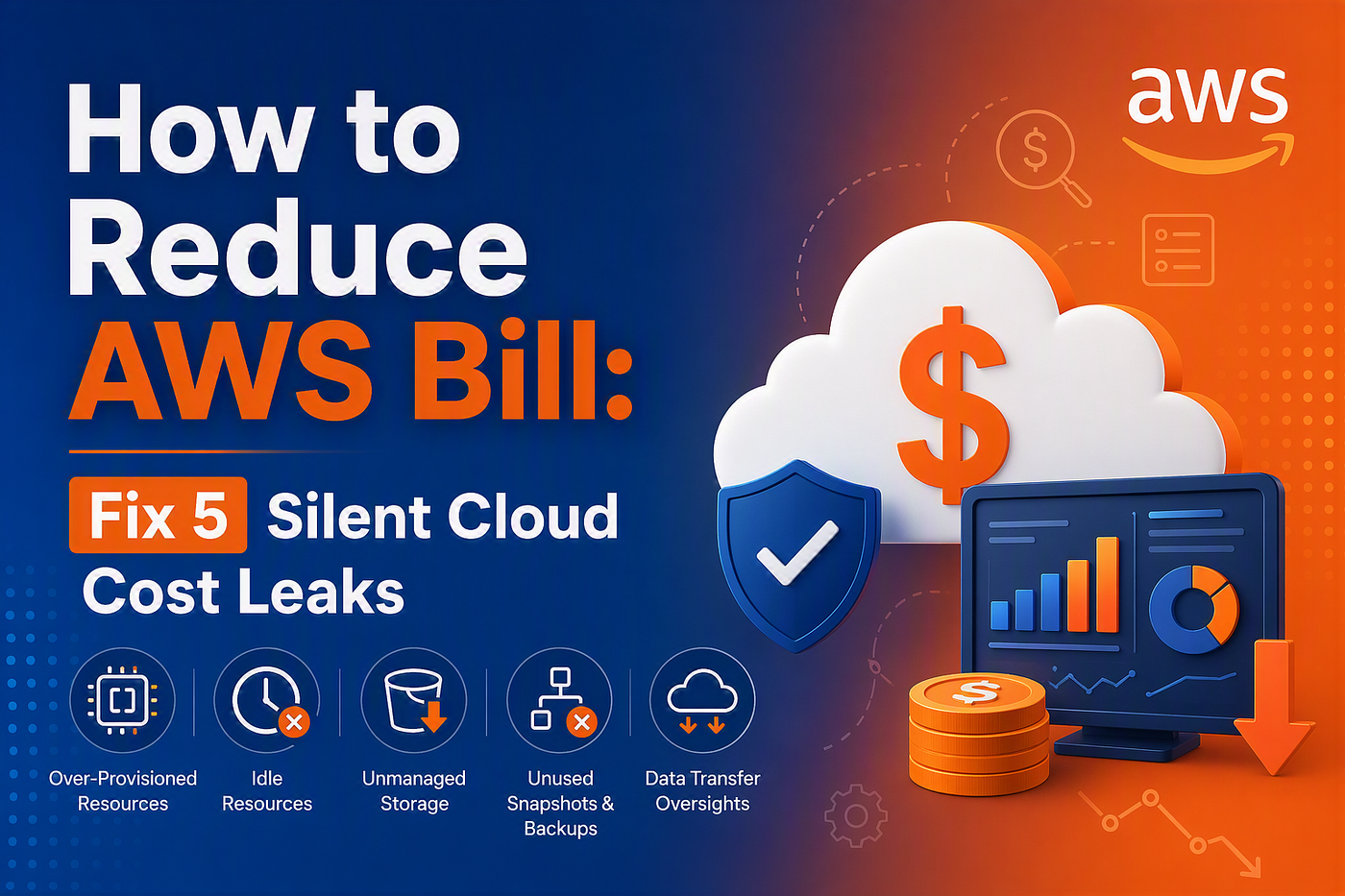
- Orphaned Resources: Unused Elastic IPs, unattached EBS volumes, and idle load balancers that continue to accrue charges.
- Overprovisioned Instances: EC2 instances with consistently low CPU and memory utilization due to a lack of right-sizing.
- Unoptimized Data Transfer: High costs from cross-Availability Zone (AZ) traffic, excessive NAT Gateway data processing, and unmonitored egress.
- Zombie Storage: Accumulated, outdated EBS snapshots and unencrypted, unmanaged S3 buckets that grow indefinitely.
- Inefficient Pricing Models: Relying entirely on On-Demand pricing for predictable, steady-state workloads instead of utilizing Savings Plans or Reserved Instances.
Let’s dive deeper into the mechanics of each leak and how to fix them.
Leak 1: Orphaned Resources
When you terminate an EC2 instance, any associated Elastic Block Store (EBS) volumes set to “Delete on Termination” are removed. However, if that setting was unchecked, or if an Elastic IP was allocated but never attached to a running instance, AWS continues to charge you for these “orphaned” resources.
- The Fix: Implement automated lifecycle policies. Use AWS Config rules or AWS Trusted Advisor to identify unattached EBS volumes and unassociated Elastic IPs. Automate their deletion or snapshot-and-archive process after a 7-day grace period.
Leak 2: Overprovisioned EC2 Instances
Developers often request large instance types (e.g., m5.2xlarge) "just to be safe" during development. Once in production, these instances might be running at 10% CPU utilization. Paying for 100% of the compute while using 10% is a massive waste of capital.
- The Fix: Implement a continuous right-sizing strategy. Utilize AWS Compute Optimizer and Amazon CloudWatch metrics to analyze historical utilization. Downsize instances to match actual workload requirements, and consider transitioning to AWS Graviton processors for an additional 20% price-performance improvement.
Leak 3: Unoptimized Data Transfer and NAT Gateways
Data transfer costs in AWS are notoriously complex and often catch organizations off guard. Cross-Availability Zone (AZ) traffic, data sent out to the internet (egress), and data processed by NAT Gateways can quickly eclipse compute costs. A common architectural flaw is routing all outbound traffic from private subnets through a single, heavily utilized NAT Gateway.
- The Fix: Architect for data locality. Keep traffic within the same AZ whenever possible. For outbound traffic, evaluate if you can use VPC Endpoints (Gateway or Interface) to keep traffic within the AWS network, bypassing NAT Gateway data processing charges entirely. Implement AWS Transfer Family or specialized routing for predictable egress.
Leak 4: Zombie Storage (Snapshots and Unmanaged S3)
EBS snapshots are critical for disaster recovery, but they are rarely cleaned up. Over time, thousands of redundant snapshots accumulate, costing pennies each but adding up to thousands of dollars monthly. Similarly, S3 buckets often contain obsolete logs, temporary files, or duplicate data that are stored in the expensive “Standard” tier rather than cheaper storage classes.
- The Fix: Enforce strict snapshot retention policies (e.g., keeping only the last 7 daily and 4 weekly snapshots). For S3, implement S3 Lifecycle Policies to automatically transition infrequently accessed data to S3 Standard-IA, S3 Glacier, or S3 Glacier Deep Archive. Enable S3 Intelligent-Tiering for unpredictable access patterns.
Leak 5: Inefficient Pricing Models
Many organizations default to On-Demand pricing for all workloads because it requires no upfront commitment. However, for steady-state, predictable workloads (like core databases, baseline web servers, or continuous CI/CD runners), On-Demand pricing is the most expensive option.
- The Fix: Analyze your baseline usage and commit to AWS Compute Savings Plans or Reserved Instances (RIs). Savings Plans offer up to 72% discount compared to On-Demand prices and provide the flexibility to change instance families or regions. For highly predictable database workloads, provisioned capacity or RDS Reserved Instances can yield massive savings.
Axalin’s Approach: A Strategic FinOps Framework
Fixing these leaks requires more than just running a script; it requires a fundamental shift in how your organization manages cloud economics. At Axalin Consultancy Services, we don’t just hand you a report of wasted spend. We implement a comprehensive People + Process + Technology FinOps framework tailored to your enterprise.
1. People: Building a Cloud-Aware Culture
Technology alone cannot solve a cultural problem. We work with your engineering, finance, and business leadership to establish shared KPIs. We train development teams on the financial impact of their architectural decisions, transforming them from “cloud consumers” to “cloud owners.” We help you establish a Cloud Center of Excellence (CCoE) to drive best practices across the enterprise.
2. Process: Establishing Governance and Guardrails
We design and implement robust cloud governance policies. This includes defining mandatory tagging strategies for cost allocation, setting up automated budget alerts, and creating approval workflows for provisioning high-cost resources. We shift cost management from a reactive, end-of-month surprise to a proactive, continuous process integrated into your CI/CD pipelines.
3. Technology: Leveraging the Right Tools
While AWS provides excellent native tools (Cost Explorer, Compute Optimizer, Trusted Advisor), enterprise environments often require a unified view. We help you evaluate, implement, and integrate third-party FinOps platforms (like Cloudability, CloudHealth, or Spot by NetApp) to provide multi-cloud visibility, showback/chargeback capabilities, and automated remediation.
Real-World Use Case: Reducing a Client’s AWS Bill by 33%
The Client: A mid-sized global manufacturing firm transitioning to a smart-factory IoT model.
The Problem: Following a rapid “lift-and-shift” migration of their legacy ERP and IoT data ingestion pipelines to AWS, their monthly cloud spend exceeded their forecast by 40%. The CFO mandated an immediate 20% cost reduction, threatening to halt further digital transformation initiatives. The
Axalin Intervention: Our cloud architects conducted a deep-dive FinOps assessment. We discovered that their IoT data pipeline was routing massive amounts of cross-AZ traffic through expensive NAT Gateways, their EC2 instances were over-provisioned by an average of 60%, and they were paying On-Demand rates for their baseline RDS databases. The Solution & Results:
- Architectural Refactoring: We re-architected the IoT pipeline to utilize VPC Endpoints and optimized AZ placement, reducing data transfer costs by 45%.
- Right-Sizing & Purchasing: We right-sized 150+ EC2 instances and purchased a 1-year Compute Savings Plan for their predictable baseline workloads.
- Storage Optimization: We automated EBS snapshot lifecycle management and moved 80% of their historical IoT telemetry data to S3 Glacier. The Outcome: Axalin successfully reduced the client’s monthly AWS bill by 33%, saving them over $450,000 annually. More importantly, we realigned their cloud governance, ensuring the savings were sustained and allowing them to reinvest the freed capital into their AI-driven predictive maintenance initiatives.
The Business Impact: Benefits of Proactive Cloud Cost Management
Addressing the hidden 30% in your AWS bill is not just an IT cost-cutting exercise; it is a strategic business enabler. When you transition from reactive cloud billing to proactive FinOps, the benefits extend far beyond the balance sheet.
- Maximized ROI and Reinvestment: Every dollar saved in cloud waste is a dollar that can be reinvested into innovation, such as AI/ML initiatives, enhanced cybersecurity, or new product development.
- Predictable Financial Forecasting: By understanding your unit economics (e.g., cost per transaction, cost per active user), finance teams can accurately forecast cloud spend, aligning it directly with business growth and revenue models.
- Accelerated Time-to-Market: Paradoxically, implementing FinOps guardrails speeds up development. When developers have pre-approved, cost-optimized “golden paths” and automated budget alerts, they spend less time waiting for financial approvals and more time building.
- Enhanced Security and Compliance: Cost optimization often goes hand-in-hand with security. Cleaning up orphaned resources, enforcing strict tagging, and managing storage lifecycles inherently reduces your attack surface and improves compliance posture.
Conclusion: Stop Paying for the Cloud You Don’t Use
The cloud was designed to make your business more agile, scalable, and cost-efficient. But without continuous optimization, the very elasticity that makes the cloud powerful can also make it your largest unchecked expense. The hidden 30% in your AWS bill is not an inevitability; it is a solvable engineering and cultural challenge.
By identifying and fixing the five silent cost leaks — orphaned resources, overprovisioned instances, unoptimized data transfer, zombie storage, and inefficient pricing models — you can transform your cloud spend from a financial burden into a strategic advantage.
At Axalin Consultancy Services, we specialize in turning cloud complexity into competitive advantage. Our People + Process + Technology approach ensures that your cloud investment is secure, scalable, and strictly aligned with your business ROI.
Don’t let silent cloud cost leaks drain your digital transformation budget.
👉 Schedule a consultation with our Cloud FinOps experts today and start your journey toward a fully optimized, high-performing AWS environment. Let’s build a cloud strategy that pays for itself.
메타데이터
- post_id
- 781d9f5a1ffc
- slug
- how-to-reduce-aws-bill-fix-5-silent-cloud-cost-leaks-axalin-781d9f5a1ffc
- url
- https://medium.com/@axalin-consultancy-services/how-to-reduce-aws-bill-fix-5-silent-cloud-cost-leaks-axalin-781d9f5a1ffc
- canonical_url
- https://medium.com/@axalin-consultancy-services/how-to-reduce-aws-bill-fix-5-silent-cloud-cost-leaks-axalin-781d9f5a1ffc
- author_url
- https://medium.com/@axalin-consultancy-services
- status
- ok
- fetched_at
- 2026-07-11 18:45:18