THISTLEWOOD: MASTER OF THE PEN
A Dark Historical Novella
THISTLEWOOD: MASTER OF THE PEN
A Dark Historical Novella
By Floyd R. Campbell
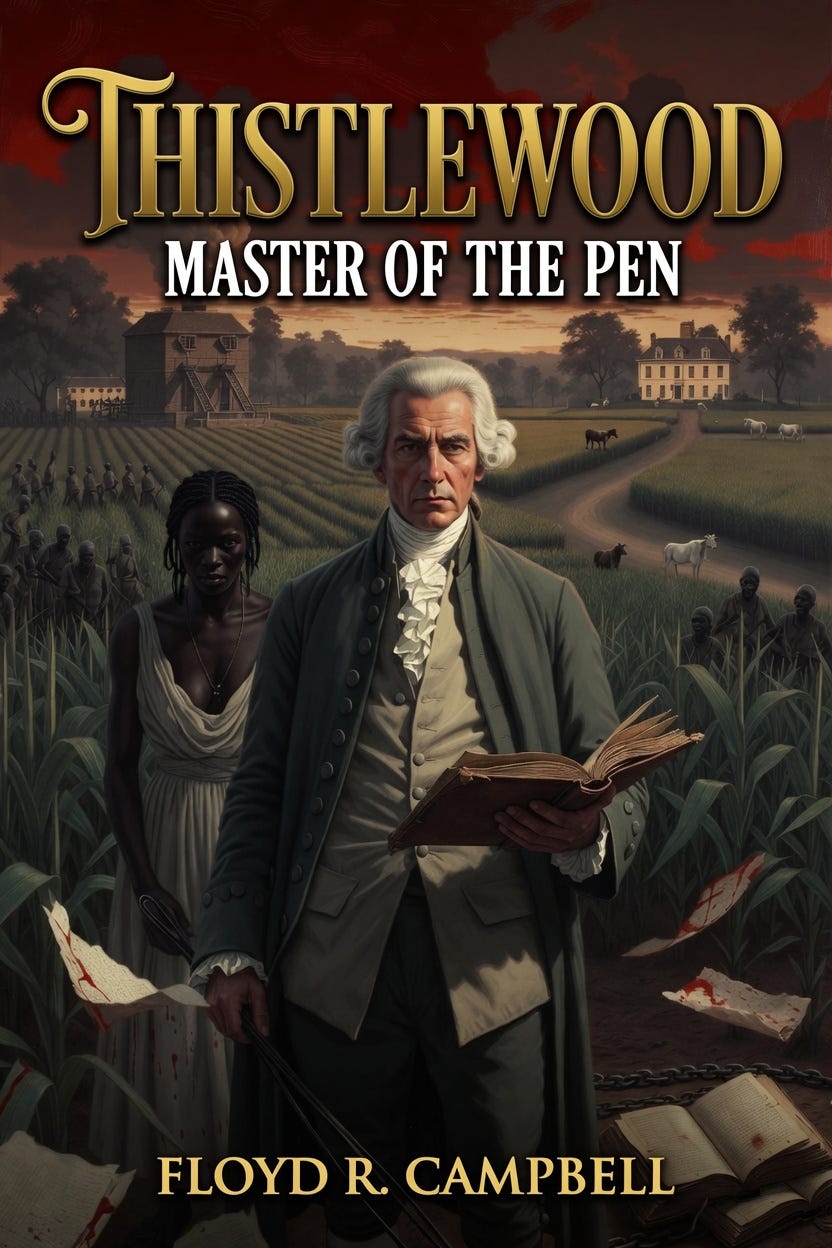
Based on the THISTLEWOOD PAPERS, Thomas Thistlewood (1721–1786)
Thomas Thistlewood (1721–1786) was an English-born plantation overseer and later owner in Jamaica whose extensive diaries provide one of the most detailed firsthand accounts of daily life on a sugar plantation during the height of British colonial slavery in the Caribbean. Spanning roughly 37 volumes and over 10,000–14,000 pages from 1748 to his death. The Thomas Thistlewood Papers (held at Yale’s Beinecke Library, with originals in Lincolnshire Archives) document plantation operations with meticulous, often detached precision.
The Jamaican sun hammered down like a whip as Thomas Thistlewood strode the Savannah-la-Mar wharf in 1760, eyes sharp as a shark’s. He prodded bare flesh with his cane, forcing jaws open, squeezing arms, and slapping thighs. “Twenty-eight pounds for this Coromantee bull,” he growled, slapping the muscular man’s chest. “Strong. Brand him.” The hot iron hissed into skin.
The man clenched his teeth but made no sound. Next, a young woman with full breasts and wide hips. Thistlewood ran his hand over her belly and between her legs, checking breeding potential. “Fifteen pounds. She’ll do. Take her to Phibbah tonight.” By midday he had them back at Egypt Plantation. “First Gang! Hole that forty-two-acre piece!
Two hundred and fifty holes or I’ll skin you alive!” The whip cracked. Bodies glistened with sweat as hoes rose and fell in the brutal heat. Thistlewood watched a slow worker get twenty lashes, blood spraying across green cane leaves. Evening brought the food line.
One herring and a scant pint of corn per person. Starving eyes stared at the meager rations. When an old woman begged, Thistlewood backhanded her. “Grow your own or starve.” Later, in the big house, he took Phibbah hard against the wall, her dress hiked up, grunting with each thrust while she bit her lip in silence. He finished quickly, then wrote in his ledger by candlelight: “Purchased two. Fucked Phibbah. Rations issued. Order maintained.
”Disease never slept. In the wet season, flux tore through the quarters. Thistlewood moved among the dying with clinical detachment, pouring mercury purges down throats while noting mortality rates. A mother wailed over her dead infant. Thistlewood barely glanced. “Seventeen dead this year. Costly.” He treated a woman’s yaws sores, then bent her over a bench and took her roughly from behind—a cold, transactional release—before recording the day’s deaths and expenses. Crop time was hell itself.
Cane leaves sliced skin like razors. First, gang workers bled and sweated as they cut and carried. Thistlewood rode among them, whip ready. When a man collapsed, he ordered twenty lashes “to encourage the others.” At night the mill boiled sugar, fires glowing red while Thistlewood fucked another favored woman in the shadows, her moans mixing with the crack of the whip somewhere in the darkness.
Tacky’s Rebellion exploded like gunpowder. Drums thundered through the night. Fires lit the hills. Thistlewood armed himself and his loyal drivers, pistol in one hand, cock in Phibbah’s mouth as he prepared for war. “Suck harder,” he snarled, finishing fast before striding out to face the uprising. Rebels killed whites. Whites slaughtered rebels in return.
Thistlewood hanged captured men from the silk-cotton tree, their bodies twisting in the breeze as warnings. He lost crops, livestock, and several enslaved people in the chaos, but the ledger would balance. After the rebellion was crushed, he bought replacement bodies cheap and drove them harder than ever.
On Breadnut Island Pen, the focus shifted to livestock.
Thistlewood walked among cattle and mules at dawn, branding, breeding, and slaughtering. A prime steer was killed; blood steamed on the ground while he calculated profit. He watched a young herder girl washing in the river, then took her against a tree—quick, brutal, and wordless—before returning to his books.
Livestock was reliable. People were not. Food remained a weapon. Starving workers begged while he dined on crab, turtle, and wine. Disease culled the weak. He recorded every death with cold precision, then sought release between Phibbah’s thighs or with whichever woman caught his eye that night.
Finances ruled all. At year’s end he tallied every shilling: sugar sales, hiring out labor, meat profits, slave purchases, medicine, burials, and personal pleasures. “The books must balance,” he muttered, ink-stained fingers turning pages filled with suffering.
Epilogue — November 1786 Thomas Thistlewood died in his bed as rain lashed the roof. Phibbah closed his eyes. In his will he freed her and their son but sold the rest like cattle. His thirty-seven volumes of diaries—over fourteen thousand pages of meticulous horror—survived. Purchases. Rapes. Whippings. Yields. Profits. Every brutal detail preserved in perfect handwriting. He thought he was writing an account book. Instead, he wrote his own damnation.
The End.
Guide to the Thomas Thistlewood Papers
Floyd is author of "NIGGER"— The Compendium.
-Every thing you wanted to know about the nigger and were afraid to ask.
메타데이터
- post_id
- 7847dc9bd528
- slug
- thistlewood-master-of-the-pen-7847dc9bd528
- url
- https://medium.com/@floydengland22/thistlewood-master-of-the-pen-7847dc9bd528
- canonical_url
- https://medium.com/@floydengland22/thistlewood-master-of-the-pen-7847dc9bd528
- author_url
- https://medium.com/@floydengland22
- status
- ok
- fetched_at
- 2026-06-09 15:37:30