Energy in immune cells
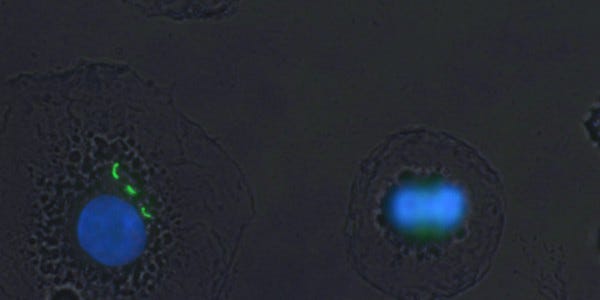
Image of Mycobacterium tuberculosis (green) that has been engulfed by one of the Human monocyte-derived macrophages (nuclei shown in blue). Image credit: Donal Cox (CC BY 4.0)
Energy in immune cells
Macrophages in human airways respond differently to infections compared with macrophages from the blood.
Inside the human body, immune cells known as macrophages are constantly looking for microbes, cell debris and other potential threats to engulf and digest. If a macrophage detects a microbe, it activates and releases molecules called cytokines, which induce further immune responses that help to eliminate the invader.
The macrophages found in the lungs, known as airway macrophages, defend against pollutants and airborne microbes and are therefore key for maintaining respiratory health. Despite this, previous studies have suggested that airway macrophages are not as good at responding to infections as other types of macrophages.
Certain cytokines can cause macrophages to switch how they generate the chemical energy needed to fuel various processes in the cell. However, it remains unclear if it may be possible to develop therapies that boost airway macrophage activity during infection by modifying how they produce chemical energy.
To investigate, Cox et al. compared how human airway macrophages and macrophages that originate in the blood alter their production of chemical energy in response to infection cues. The experiments showed that exposure to a specific cytokine (IFN-γ) caused both macrophage types to produce more chemical energy using a metabolic process known as glycolysis.
Inhibiting glycolysis induced by IFN-γ had a much bigger effect on the ability of the airway macrophages to produce cytokines than it had on blood macrophages. Furthermore, glycolysis controlled the production of a particular cytokine, called TNF, in the airway macrophages but not the blood macrophages.
The findings demonstrate that airway macrophages alter how they produce chemical energy during infections differently than blood macrophages. Since TNF is a crucial cytokine for defending against respiratory infections, understanding how it is regulated in the lung could help researchers develop inhalable therapies to boost its production in patients with respiratory infections that are difficult to treat. The specificity of this approach could ultimately limit side effects compared to therapies that act throughout the body.
Originally published at https://elifesciences.org/digests/98449.
메타데이터
- post_id
- 784e4d623d99
- slug
- energy-in-immune-cells-784e4d623d99
- url
- https://medium.com/health-and-disease/energy-in-immune-cells-784e4d623d99
- canonical_url
- https://medium.com/health-and-disease/energy-in-immune-cells-784e4d623d99
- author_url
- https://medium.com/@elife
- status
- ok
- fetched_at
- 2026-07-15 08:12:24