Modeling-3
Predator–Prey Models: Lotka–Volterra Dynamics in the Deep
Modeling-3
Predator–Prey Models: Lotka–Volterra Dynamics in the Deep

SECTION 01
Introduction & Historical Context
Down in the ocean a big hunt is happening all the time. Sharks are always chasing schools of tuna humpback whales are jumping through krill clouds and barracuda are swimming fast through reefs of anchovies. These hunts do not happen by chance. They follow rules that come from basic math.The Predator Prey model, also called the Lotka Volterra system is an helpful model, in biology. It shows how two species, one that hunts and one that is hunted live together in a cycle. This is explained by two math equations that are connected.


SECTION 02
Biological Background
Before we dive into equations lets understand the interactions being modeled. A predator-prey relationship is a type of interaction where energy and nutrients are transferred between two levels of a food chain. This is also known as an interaction. It happens between two levels, like when one animal eats another. The predator-prey relationship is an example of this kind of interaction.


The Adriatic Sea: Volterra’s Living Laboratory
During World War I, which was from 1914 to 1918 the amount of fish that people caught in the Adriatic Sea went down a lot. A man named Umberto D’Ancona who is a biologist looked at the records of what people caught and found something interesting. He saw that during the war years people caught World War I predatory fish, like sharks and skates and rays compared to the years before World War I or after World War I. This was a big change in the amount of predatory fish, like sharks and skates and rays that people caught in the Adriatic Sea during World War I.


SECTION 03
The Lotka–Volterra Model
The Lotka–Volterra predator–prey model is a way to understand how two groups of living things affect each other. It uses two math equations to show how the Lotka–Volterra predator–prey model works. These equations are. Help us see what happens to the Lotka–Volterra predator–prey model over time. The Lotka–Volterra predator–prey model is based on the idea that the two groups, in the Lotka–Volterra predator–prey model are linked together.
SECTION 04
Model Assumptions
All mathematical models simplify reality

Understanding the assumptions tells us precisely where the model is valid
and where it will fail.


SECTION 04
Model Assumptions

SECTION 05
Mathematical Derivation: First Principles
We get the Lotka–Volterra system from ideas using equations that balance populations and the idea that things react when they meet. We start with things and build up to the Lotka–Volterra system. The Lotka–Volterra system is what we are trying to find. We use population balance equations to do this. The principle of action is also important, for the Lotka–Volterra system.
Step 1: Prey Population Dynamics

For predation, we apply the Law of Mass Action: the number of predation events per unit time is proportional to the frequency of predator–prey encounters, which scales as the product of their densities:


Step 2: Predator Population Dynamics


Step 3: Combined System
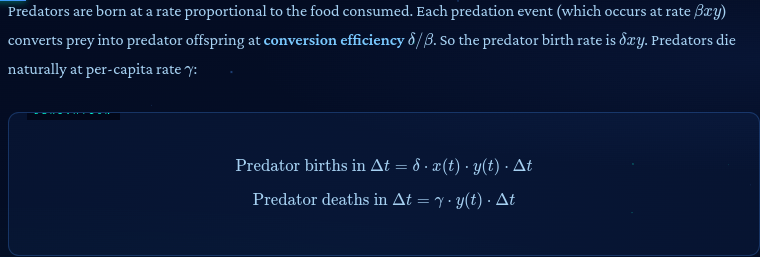
Equations (1) and (2) together form the Lotka–Volterra system. We can factor out population terms:

This form reveals something elegant: the per-capita growth rate of each species depends linearly on the other species’ population:

This form reveals something elegant: the per-capita growth rate of each species depends linearly on the other species’ population:


SECTION 06
Non-Dimensionalization
TBC
메타데이터
- post_id
- 78717599894c
- slug
- modeling-3-78717599894c
- url
- https://medium.com/@rmdi115/modeling-3-78717599894c
- canonical_url
- https://medium.com/@rmdi115/modeling-3-78717599894c
- author_url
- https://medium.com/@rmdi115
- status
- ok
- fetched_at
- 2026-06-15 20:49:13