When AI Becomes the User: Inside the Architectural Shift Where Machines Replace Humans at the Top…
Bots now generate 53% of all web traffic. AI agent requests grew 7,851% in 2025. ChatGPT can buy things for you. Cloudflare…
When AI Becomes the User: Inside the Architectural Shift Where Machines Replace Humans at the Top of the Stack
Bots now generate 53% of all web traffic. AI agent requests grew 7,851% in 2025. ChatGPT can buy things for you. Cloudflare predicts machines exceed humans online by 2027. A deep technical look at MCP, the Agentic Commerce Protocol, agent-to-agent payments, and what the internet looks like when the user is no longer a person.
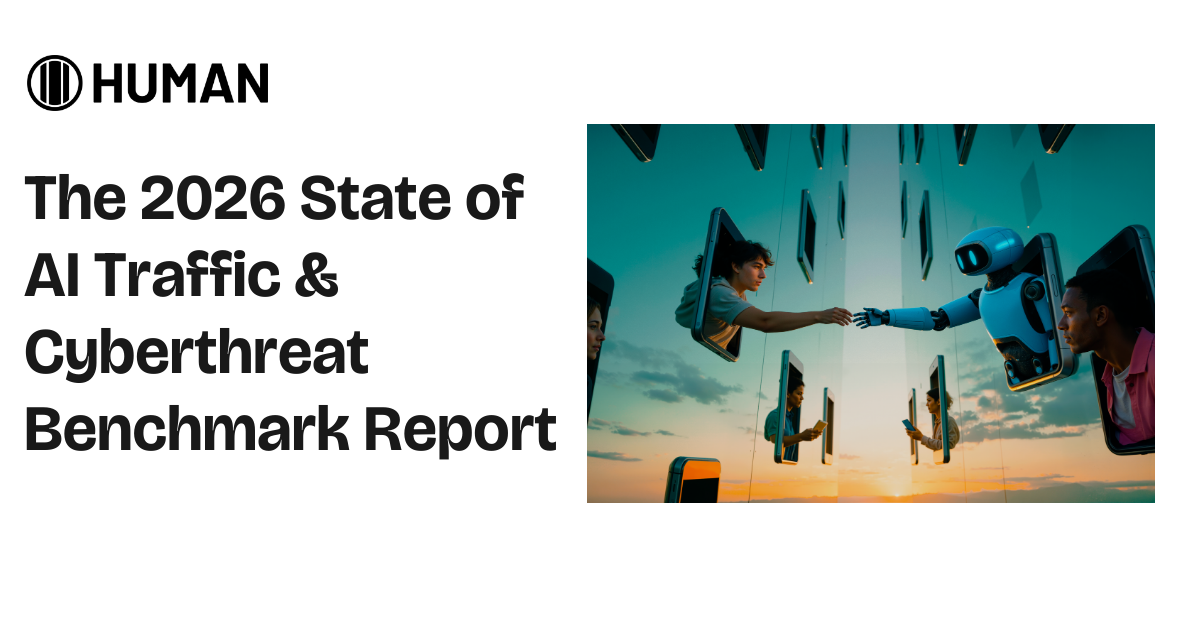
Cover image — Official cover artwork from HUMAN Security’s 2026 State of AI Traffic & Cyberthreat Benchmark Report, published March 26, 2026. Image credits: HUMAN Security, 2026 State of AI Traffic & Cyberthreat Benchmark Report. Source: https://www.humansecurity.com/learn/resources/2026-state-of-ai-traffic-cyberthreat-benchmarks/
The Quadrillion-Interaction Report
In March 2026, HUMAN Security a cybersecurity firm that processes traffic for many of the largest websites on the internet published a benchmark report that should have been the front page of every technology newspaper for a week. The headline finding, drawn from more than one quadrillion analyzed digital interactions across 2025, was deceptively simple. AI agent traffic grew 7,851 percent year-over-year. AI-driven traffic overall surged 187 percent from January to December. Automated traffic was now growing 23.5 percent annually eight times faster than human traffic at 3.1 percent. A week earlier at SXSW in Austin, Cloudflare CEO Matthew Prince, whose company handles traffic for roughly twenty percent of all websites globally, made the same prediction from a different angle. By 2027, bot traffic will exceed human traffic on the internet. He was not speculating. He was extrapolating from a growth curve his company had been tracking since 2024.
The Thales 2026 Bad Bot Report, the thirteenth annual edition, put the current state of affairs even more starkly. Automated traffic accounted for 53 percent of all global web traffic in 2025 the second straight year machines outnumbered humans on the open web, up from 51 percent in 2024. Thales blocked 17.2 trillion bot requests in 2025 alone. AI-driven bot attacks surged twelve and a half times in a single year. Most of the new bot traffic was not malicious. Much of it was AI agents acting on behalf of human users the same agents that the major frontier labs have spent the last twenty-four months turning into general-purpose, tool-wielding, multi-step actors. A person buying a camera online might visit five websites; an AI agent doing the same task for them, Prince observed, might visit five thousand.
This article is about the architectural shift hiding underneath those numbers. We are not just talking about more bots. We are talking about a structural reorientation of the entire internet stack, in which the canonical user the entity that makes requests, fills forms, completes purchases, reads content, and acts on the world is increasingly an AI system rather than a person. The protocols, payment systems, content formats, identity standards, and economic models built for the human-as-user web are being replaced or extended in real time to accommodate the agent-as-user web. The labs building this Anthropic with MCP, OpenAI and Stripe with the Agentic Commerce Protocol, Google with Agent2Agent, Visa with the Trusted Agent Protocol are not adding features. They are laying foundations.
“Machine-based traffic is effectively replacing humans as the dominant form of traffic on the other side of the internet.” - Stu Solomon, CEO of HUMAN Security, on the 2026 State of AI Traffic report, March 26, 2026
The User Has Always Been Implicit
To see why this is a categorical shift rather than a quantitative one, it helps to be precise about an assumption baked into nearly every layer of the internet’s architecture since the late 1990s. That assumption is: the user is a person. The user has eyes. The user reads. The user clicks. The user types. The user has a credit card and physically possesses it. The user has friction, attention limits, opinions, and biases. The user can be served an ad and converted into a customer. The user generates session data that, after the fact, can be modeled, segmented, and resold. Every analytic stack, every authentication flow, every checkout protocol, every captcha, every onboarding funnel, every recommendation system, every advertising auction is built on this assumption. It is so deep in the stack that most of the people working on it have stopped noticing it is there.
What is happening, quietly and quickly, is that this assumption is becoming false for a meaningfully large and growing share of “users.” When ChatGPT’s Agent Mode visits a website to read the page and answer a question for the human who asked, the user at the protocol layer is the AI. The browser identifies itself. The HTTP request goes through. The page is rendered. The content is consumed. The session is logged. Every part of the stack treats the request as it would any other except that the entity on the receiving end of the response is not a person. It is a piece of software whose attention, preferences, and behavioral patterns are different in kind from a human’s. The piece of software does not see ads. It does not get tired. It does not have a credit card; it has a delegated payment token. It does not click; it parses the DOM. It does not browse; it acts.
This article is the technical map of how that shift is unfolding, and what it means for every layer of the stack. We will walk through four primary developments: (1) the empirical traffic reversal, (2) the protocol layer where AI agents are getting standardized capabilities (MCP, Agent2Agent, ACP), (3) the payments layer where machines are being given the ability to spend money, and (4) the structural implications for everything from web design to authentication to content economics. None of this is hypothetical. All of it is shipping now.
The Empirical Reversal: Numbers That Reframe Everything
Before the protocols, the empirical data. Three independent industry datasets, published in the first quarter of 2026, all tell the same story from different angles.
The Thales 2026 Bad Bot Report, based on 17.2 trillion blocked bot requests across the Imperva global network, documented that bots accounted for 53 percent of all global web traffic in 2025, up from 51 percent in 2024. The breakdown matters: 13 percent good bots (legitimate crawlers, monitoring tools, search indexers) and 40 percent bad bots (scrapers, credential stuffers, fraud bots, scalpers). AI-driven bot attacks specifically surged twelve and a half times year-over-year. A third category neither classically “good” nor “bad” is now emerging: AI agents acting on behalf of human users, which behave like bots but are doing legitimate work. The line between legitimate and malicious automation is, in the words of the Thales report, “being erased.”
The HUMAN Security 2026 State of AI Traffic & Cyberthreat Benchmark Report, based on more than one quadrillion interactions analyzed across the HUMAN Defense Platform, drilled into the AI-specific subset. AI-driven traffic surged 187 percent during 2025. AI agent traffic meaning traffic from systems autonomously executing multi-step workflows grew 7,851 percent in a single year. OpenAI’s bots alone, across all identifiers (ChatGPT User, OAI-SearchBot, GPTBot, ChatGPT Agent), accounted for 69 percent of all AI-driven traffic by volume. Meta-ExternalAgent contributed 16 percent. Anthropic’s identifiers (ClaudeBot, Claude-SearchBot) about 11 percent. The remaining dozens of identified AI bots collectively represented less than 5 percent. This concentration is critical: access-policy decisions about a handful of AI companies now have outsized effects on any given website’s overall AI exposure.
Cloudflare’s data, presented by CEO Matthew Prince at SXSW in March 2026, projected that by 2027 bot traffic will exceed human traffic on the open web. The projection was based on the observed growth curve of AI crawler and agent traffic since 2024, combined with what Prince called the “structural multiplication effect of AI agents.” The multiplication effect is the key insight. A human shopper might visit five websites researching a camera purchase. An AI agent doing the same research, processing pages in parallel, comparing specs, reading reviews, validating prices across vendors, can visit a thousand websites. Or five thousand. Or fifty thousand, if the user’s question is broad enough. Each agent request is, from the website’s perspective, a “user.” The multiplier is not gradual. It is structural.
What the three datasets converge on is a picture of an internet whose underlying user composition has fundamentally changed. The mental model of “websites serve content to humans, with some bots for indexing” is wrong now. The accurate model is: “websites serve content to a mixed population of humans and AI agents, where the AI agents are growing eight times faster, generate far more requests per task, and are operating on behalf of humans who are increasingly delegating their attention to them.”
For website operators, the implications cascade through every metric the analytics industry has built. Page views, session duration, bounce rate, conversion rate all designed around human behavior lose meaning when a growing share of visitors are machines. The HUMAN report’s central recommendation was blunt: stop treating “human good, machine bad” as a viable security or business model. Build systems that distinguish, classify, and manage automated traffic at scale. Authentication, pricing, content delivery, fraud detection, and even basic analytics all need to be redesigned for a web where the majority of visitors are not people.
The Protocol Layer: Standardizing the Agent’s Tools
A traffic reversal of this magnitude could not happen without an underlying protocol layer giving AI agents standardized ways to discover, access, and interact with external systems. That layer arrived faster than almost anyone outside the AI labs expected. The most important single piece of it is the Model Context Protocol (MCP), introduced by Anthropic on November 25, 2024, and by December 2025 donated to a Linux Foundation directed fund called the Agentic AI Foundation, co-founded by Anthropic, Block, and OpenAI with support from Google, Microsoft, AWS, Cloudflare, and Bloomberg.
MCP solves a problem that, in retrospect, was the binding constraint on agentic AI. Before MCP, connecting any AI model to any external system Slack, GitHub, Google Drive, an internal database, a customer’s CRM required a custom integration. Every model times every tool times every customer equaled an integration matrix that did not scale. MCP collapses that into a single specification. Tool providers expose their capabilities through an MCP server. AI applications connect as MCP clients. The protocol defines three primitives tools (functions the model can call), resources (data the application provides), and prompts (templates the user can invoke). Once you implement MCP once, you unlock the entire ecosystem.
Figure 1 — The official MCP architecture diagram from the Model Context Protocol specification. AI applications act as MCP clients; tool and data providers expose MCP servers; the protocol mediates between them with a standardized set of primitives. As the documentation describes it, “Think of MCP like a USB-C port for AI applications.” By February 2026, MCP had been adopted by Claude, ChatGPT, Cursor, Copilot, VS Code, and the major enterprise infrastructure providers (AWS, Cloudflare, Google Cloud, Microsoft Azure). The protocol is now governed by the Agentic AI Foundation, a Linux Foundation directed fund. Image credits: Anthropic / Model Context Protocol official documentation, 2024–2025. Source: https://modelcontextprotocol.io/docs/getting-started/intro · Specification: https://github.com/modelcontextprotocol · Anthropic launch post: https://www.anthropic.com/news/model-context-protocol
The adoption curve has been one of the fastest in recent infrastructure history. By February 2026, MCP had been adopted by ChatGPT, Cursor, Gemini, Microsoft Copilot, Visual Studio Code, and most other major AI products. Enterprise-grade MCP deployment infrastructure now exists from AWS, Cloudflare, Google Cloud, and Microsoft Azure. The protocol’s official documentation describes the analogy elegantly: “Think of MCP like a USB-C port for AI applications. Just as USB-C provides a standardized way to connect electronic devices, MCP provides a standardized way to connect AI applications to external systems.”
What MCP does, at the architectural level, is make AI agents capable users of arbitrary software. Before MCP, an AI assistant could chat about your Google Calendar but could not actually read or write to it without a one-off engineering project. After MCP, your agent can have your Google Calendar, your Notion workspace, your GitHub repos, your Slack channels, your PostgreSQL database, your team’s internal documentation, and your custom company tools all accessible through a single interface, with consistent permission and discovery semantics. The agent is no longer a chatbot that knows things. It is a user of your software stack.
Two related protocols are filling in the picture. Google’s Agent2Agent (A2A) protocol, launched in 2025, standardizes how AI agents communicate with other AI agents rather than with tools. This matters because the next generation of agentic workflows involves multiple specialized agents coordinating a research agent feeding findings to a writing agent feeding drafts to a fact-checking agent, all running in parallel. Without a protocol, every multi-agent system would be a bespoke integration. With A2A, agents from different vendors can interoperate. Stripe and Tempo’s Machine Payments Protocol (MPP), with Visa as a design partner, does the same job at the financial layer: it gives agents a standard way to pay other agents for services. When Visa announced its Trusted Agent Protocol in March 2026, with cards integrated into the Visa Acceptance Platform, the major financial rails crossed the threshold from “supporting human payments” to “supporting agent payments” as a first-class capability.
The combined effect of MCP, A2A, and MPP is to give AI agents the same kind of foundational protocol stack that humans have had on the web since the 1990s. HTTP let humans request web pages. HTTPS gave them encryption. HTML, CSS, JavaScript gave them rich documents and applications. OAuth gave them federated identity. Stripe and PayPal gave them payments. Now MCP gives agents the equivalent of HTTP a universal protocol for accessing capabilities. A2A gives them the equivalent of email between humans agent-to-agent communication. MPP and the Agentic Commerce Protocol give them the equivalent of Stripe programmable money. The agent stack is being built out at internet speed, by the same companies that built the human stack, often as direct extensions of it.
When AI Spends Money: The Agentic Commerce Stack
Of all the developments in the agent-as-user transition, the most economically consequential is the moment AI agents got the ability to spend money on a user’s behalf. That moment was September 29, 2025, when OpenAI and Stripe launched Instant Checkout in ChatGPT alongside the Agentic Commerce Protocol (ACP). ChatGPT users in the United States could now buy products directly from US Etsy sellers without ever leaving the chat. Shopify merchants Glossier, Vuori, SKIMS, Spanx followed within months. By early 2026, more than a million Shopify merchants had access to the protocol. McKinsey projected the agentic commerce channel would drive $3 to $5 trillion globally by 2030.
Figure 2 — Official launch artwork from Stripe and OpenAI’s joint announcement of Instant Checkout in ChatGPT, September 29, 2025. The Agentic Commerce Protocol is co-developed by Stripe and OpenAI and is now open-source under Apache 2.0. Salesforce announced support for ACP in October 2025; the Stripe Agentic Commerce Suite generalized the architecture in December 2025; by early 2026, Visa had announced its Trusted Agent Protocol and Stripe-Tempo’s Machine Payments Protocol (MPP) had launched for agent-to-agent transactions. Image credits: Stripe newsroom, “Stripe powers Instant Checkout in ChatGPT and releases Agentic Commerce Protocol co-developed with OpenAI,” September 29, 2025. Source: https://stripe.com/newsroom/news/stripe-openai-instant-checkout · OpenAI announcement: https://openai.com/index/buy-it-in-chatgpt/ · ACP specification: https://www.agenticcommerce.dev/
The technical architecture is worth walking through carefully, because it is the first major non-human-mediated commerce flow in the history of the consumer internet. When a user asks ChatGPT a shopping question “best running shoes under $100” ChatGPT searches and presents products from across the web, ranked organically. If a product supports Instant Checkout, the user taps “Buy,” confirms order, shipping, and payment details, and completes the purchase without ever leaving the conversation. Under the hood, ChatGPT sends order details to the merchant’s backend using the Agentic Commerce Protocol. The merchant accepts or declines, processes payment via their existing provider (Stripe, in the typical case, via the new Shared Payment Token API), and handles fulfillment. ChatGPT acts, in OpenAI’s own framing, “as the user’s AI agent securely passing information between user and merchant, just like a digital personal shopper would.”
The protocol has three foundational principles, each of which is engineered for the specific case where the buyer is not a human. First, users stay in control: every step requires explicit user confirmation before action. Second, payment is secure: encrypted payment tokens are authorized only for specific amounts at specific merchants, scoped tightly so that even if a token is compromised, its exposure is bounded. Third, data sharing is minimal: only the information required to complete the order is shared with the merchant, with explicit user permission. These are not just product-marketing principles. They are the technical answer to the genuine new problem of authorizing a non-human entity to spend a human’s money.
The infrastructure has expanded fast since the initial launch. Stripe announced the broader Agentic Commerce Suite in December 2025, generalizing the ChatGPT integration into a full stack: machine payments for accepting agent transactions, Link’s agent wallet for paying on behalf of users, Issuing for agents (giving agents their own provisioned payment instruments), and Stripe-orchestrated tax, shipping, and inventory handling. By Stripe’s own 2025 annual letter, more than 700 AI agent startups launched on Stripe in 2024, and the company expected that number to be surpassed in 2025. Stripe powers 78 percent of the Forbes AI 50. The agentic commerce category is no longer a forward-looking bet. It is one of Stripe’s primary growth narratives.
What makes the commerce layer architecturally interesting is that it inverts a foundational assumption of e-commerce: that the buyer is the entity whose presence triggers the transaction. In the new model, the buyer is the entity whose delegation triggers the transaction. A human says, in a conversation with ChatGPT three weeks ago, “I usually like running shoes from Hoka, my size is 11, my shipping address is X, my Visa is Y, and I generally don’t spend more than $200.” That sentence, captured as a set of permissions and preferences in the agent’s memory, becomes the authorization for thousands of future agent-initiated purchases. The buyer’s role has shifted from operator of each transaction to configurer of policy. As Meta’s Ginger Baker put it during Stripe Sessions 2025, “payments will move from being a moment to being a policy.”
The most interesting prediction in the agentic commerce literature, from Stripe’s Head of Information and Data Science Emily Glassberg Sands, is that “agents don’t just change who’s at the checkout. They change who’s doing the searching, the deciding, the trusting all of it.” That is the structural prediction. The parts of commerce that have always been UX problems product discovery, comparison, decision, trust, conversion are becoming protocol problems, because the entity making the decisions is no longer constrained by human attention spans or visual interfaces.
What Breaks: The Human-User Assumption Across the Stack
Once you internalize that the user can be an AI, the implications cascade through layers of internet architecture that no one previously thought of as user-dependent. Five of those layers are now visibly under stress.
The first is the analytics layer. Google Analytics, Mixpanel, Amplitude, Segment, and every other product-analytics tool was built to measure human behavior. Session duration, scroll depth, bounce rate, conversion rate, funnel completion all of these metrics depend on the user being a person with finite attention. When a meaningful percentage of “users” are AI agents who read the entire page in 200 milliseconds, scroll only because the agent’s headless browser emulates scrolling, and “convert” by triggering an API call rather than clicking a button, the analytics signal becomes increasingly noisy. JuggerInsight’s analysis of the HUMAN Security data put it cleanly: “Metrics like page views, session duration, and conversion rates all designed around human behavior lose reliability when a growing share of visitors are machines.” Most enterprises are still making strategic decisions on dashboards whose numbers no longer mean what they used to.
The second is the authentication layer. CAPTCHAs, rate limits, behavioral biometrics, device fingerprinting, IP reputation the entire anti-bot defense stack was built on the premise that “bot equals bad.” The Thales report’s central finding was that this binary has collapsed. AI-driven bot attacks grew twelve and a half times in 2025, while legitimate AI agent traffic exploded almost eight thousand percent. The new defense stack has to distinguish not between human and machine, but between authorized and unauthorized machines, which requires identity systems for AI agents themselves. Cloudflare’s recent products around AI Audit, AI bot management, and the AI Agent Marketplace are early entries into this space. The OAuth-equivalent for AI agents a way for an agent to prove it is acting on behalf of a specific authorized user, with specific scoped permissions, against a specific resource is still being built. The protocols (MCP’s OAuth integration, the W3C Verifiable Credentials work) exist. The deployment is uneven.
The third is the content economics layer. We covered this in detail in the previous article on the death of search, but it bears repeating here in the agent-as-user framing. When an AI agent reads your blog post on behalf of a human user, the human never visits your page. They see your content as part of an AI-generated synthesis. Your ad never gets impressed. Your email-capture popup never appears. Your retargeting pixel never fires. The page view happened, but the entire monetization architecture downstream of the page view was assuming a human reader. The publisher antitrust lawsuits, the content-licensing deals between Anthropic and the major publishers, the Cloudflare AI Crawler restrictions all of these are first-generation attempts to reconstruct an economic loop in which content creators are paid for the work that AI agents consume on behalf of humans.
The fourth is the user-interface layer. When the user is an AI, beautiful design becomes secondary. Clean semantic HTML, well-structured data, predictable DOM, fast load times, server-rendered content, and machine-readable metadata all become primary. The websites that load instantly, render cleanly without JavaScript, and structure their content for extraction will be readable and citable by AI agents. The websites optimized for human visual experience with JavaScript-heavy interactive components and anti-bot measures will be invisible. This is not a future trend. It is observable now in the agent traffic data. As Cloudflare’s research has noted, the same content rendered server-side with semantic HTML versus client-side with React-heavy interactivity often shows a ten-fold or larger difference in AI-agent crawl success.
The fifth, and most fundamental, is the trust layer. Humans have spent thirty years learning to evaluate web content to recognize a phishing email, to be suspicious of unusual offers, to verify a domain name before entering credentials. AI agents have none of those instincts by default. They were trained to be helpful and follow instructions, and the instructions can be hidden inside the very content they are reading on the user’s behalf. Prompt injection the technique of embedding adversarial instructions in content that an AI agent will read is now the active research frontier of AI security, with documented exploits against every major frontier model and every major agentic browser. Anthropic’s research on prompt injection mitigation, OpenAI’s parallel work, Google DeepMind’s Constitutional AI extensions, all converge on the same conclusion: the trust assumptions that protect human users do not transfer to agent users. New defenses are needed at every layer.
The Structural Multiplication: One Human, Thousand Agents
The most underappreciated consequence of the agent-as-user transition is what Cloudflare’s Matthew Prince called the “structural multiplication effect.” When AI agents take over tasks that humans used to perform sequentially, the resulting traffic is not one-to-one with human intent. It is one-to-thousands. Every layer of internet infrastructure designed around human-scale request volume is being asked to handle agent-scale request volume.
The clearest example is research. A human researching a topic might read fifteen articles in two hours. An AI agent doing the same task, running in parallel, might fetch and parse 1,500 articles in the same two hours. SUSO Digital’s analysis of agentic traffic patterns in 2025 found that agent traffic in research-heavy categories grew 1,300 percent in the first eight months of the year, with the sharpest acceleration coming after ChatGPT Agent and Perplexity Comet shipped in July and October respectively. The same dynamic is unfolding in commerce comparison shopping, where agents systematically check prices across dozens of merchants for a single purchase decision; in news monitoring, where agents poll hundreds of sources for a single news brief; and in software development, where coding agents make tens of thousands of file reads and API calls for a single user-initiated task.
The economic question this raises is the next decade’s central question for the consumer internet. Who pays for the infrastructure to serve agent-scale traffic? A traditional website’s hosting costs were sized for human request volume. When that volume multiplies by 100x because the requests are coming from agents, the unit economics change. Cloudflare’s response has been to roll out paid AI crawler access tiers letting publishers charge AI companies for crawling rights. OpenAI, Anthropic, and Google have all signed multi-year content licensing deals with major publishers (News Corp, Condé Nast, the Financial Times, the Associated Press, Vox Media) that effectively pay for the right to train on and retrieve from premium content. The economic model being built is one where AI labs pay content creators directly, on a usage or licensing basis, rather than the indirect ad-supported model that used to channel revenue through search-and-click traffic.
For technical readers, the actionable implication is to think clearly about how your own infrastructure interacts with agents. Three concrete points are worth sitting with. First, your bot management strategy needs to evolve from binary blocking to identity-aware allowlisting. Knowing that a request comes from ClaudeBot acting on behalf of a specific Claude user with specific permissions is fundamentally different from knowing it comes from “a bot.” The Cloudflare AI Audit and similar identity-aware bot tools are the early version of this. Second, your content needs to be structured for dual consumption. Human readers and AI agents read differently. The websites that win the next decade will serve both audiences cleanly well-designed for humans, well-structured for machines. Third, your business model needs to think about agent-mediated revenue. If your users start delegating commerce, research, and content consumption to agents, your monetization needs paths that work in that flow. Affiliate partnerships, API-level integrations with the major AI products, structured product feeds (the Amazon Buy For Me model, the OpenAI Instant Checkout model) these are not optional in the new stack.
What Comes Next: The Agent-Native Internet
If the data is right and the protocols are real, the internet that emerges by the late 2020s is going to be architecturally different from the one we have now, in ways that are clarifying once you look at them directly.
It will be agent-native rather than agent-tolerant. Today’s stack accommodates agents grudgingly CAPTCHAs that they have to be allowed to skip, robots.txt files that they may or may not respect, anti-bot tools that they evade or get whitelisted from. The next stack will have agent identity, agent authorization, agent payment, agent reputation, and agent rate limiting as first-class architectural concepts. MCP, A2A, ACP, MPP, and the W3C Verifiable Credentials work are the foundational pieces being laid down now.
It will be policy-driven rather than session-driven. Today’s user makes decisions in real time, transaction by transaction. The next user increasingly an agent acting on a human’s behalf operates under policies set in advance. The human says, in advance, what spending limits, content preferences, communication permissions, and trust thresholds apply. The agent enforces and executes against those policies. Every layer of the stack that today asks the user to decide in the moment will, in five years, ask the agent to decide based on the user’s policy.
It will be multi-agent rather than single-actor. Today, when you do something on the web, you do it yourself. In the agent-native internet, you will increasingly have a suite of agents acting on your behalf a research agent, a shopping agent, a communications agent, a calendar agent, a coding agent, each specialized, each running its own loop, each coordinating with the others through standard protocols like A2A. The user becomes the orchestrator of a fleet rather than the operator of a session.
And, critically, it will be financially actuated. The single most important architectural decision in the agent-native internet is that agents have money. They can pay merchants. They can pay other agents. They can be paid for services. The Machine Payments Protocol, the Agentic Commerce Protocol, Stripe’s Issuing for agents, Visa’s Trusted Agent Protocol all of these are infrastructure for an economy in which value moves not between humans and humans, or even between humans and businesses, but between agents and agents on humans’ behalf. As Stripe’s Will Gaybrick said in late 2025, “agents will spend money faster than people.” That is not a marketing line. It is the consequence of the multiplication effect applied to economic transactions.
What This Means for Technical Readers
For engineers, founders, and product builders, the practical implications cascade through nearly every layer of what you ship.
If you build products, you are now building for two distinct kinds of users humans and agents and the agent population is growing eight times faster. Your information architecture, content structure, API design, authentication flows, and trust model all need to support both. The companies that ship genuinely good agent-readable experiences over the next two years will compound an advantage that takes a long time to catch up to. The pattern of investing in machine-readable interfaces is what made Stripe, Twilio, and the API-first generation of companies dominant in the 2010s; the agent-first generation is being made the same way right now.
If you build infrastructure, the bottlenecks are shifting. Authentication and identity for agents (delegated capability, scoped permissions, attribution back to humans) is the OAuth-equivalent problem of the next five years. Rate limiting and capacity for agent-scale traffic is the CDN problem of the next five years. Trust and reputation for agents is the SSL/PKI problem. The companies that build the core primitives Cloudflare’s AI agent identity work, Stripe’s MPP and Issuing, Anthropic’s MCP server ecosystem, the Linux Foundation’s Agentic AI Foundation will define the standards. The companies that build on top of those standards will be the next wave of unicorns.
If you build content or businesses dependent on human attention, the operating environment is changing under you. Your traffic, your analytics, your conversion funnels, and your monetization all assumed a human-user model that is now eroding measurably. The strategic response is not to fight the change. It is to build agent-native business models alongside the human-native ones. Direct API integrations with the major AI products. Structured product feeds. Content licensing to AI labs. Agent-readable knowledge bases. Affiliate programs that work in agent flows. The publishers and businesses that figure out agent-native monetization first will have years of advantage over the ones that wait.
If you are an individual technical reader trying to understand the trajectory, the highest-leverage thing you can do is to start treating AI agents as serious users of your work, your tools, and your information. Read the MCP specification. Build a small MCP server for something you care about. Subscribe to one of the agentic browsers and use it as your daily driver for two weeks to see how the workflow differs. Read Stripe’s Agentic Commerce Suite documentation even if you do not work in payments. The mental shift from “AI as assistant” to “AI as user” is the conceptual move that, once made, makes a lot of the otherwise confusing developments of 2025–2026 snap into a single coherent story.
The Bottom Line
The internet, for thirty years, was an architecture for human users. That architecture is being extended, and in many places replaced, by an architecture for agent users software systems acting on humans’ behalf, equipped with standardized protocols (MCP, A2A, ACP), financial infrastructure (MPP, Stripe Agentic Commerce, Visa Trusted Agent Protocol), and growth curves that are eight times faster than human web usage. Bots are 53 percent of traffic now. AI agent traffic specifically grew 7,851 percent in 2025. Cloudflare projects machines will exceed humans on the web by 2027. The transition is not coming. It has arrived.
What is left to be decided is who builds the standards, who captures the economics, and who shapes the rules. The labs (Anthropic, OpenAI, Google) are racing to define the protocols. The payment networks (Stripe, Visa, Mastercard) are racing to define the financial rails. The infrastructure companies (Cloudflare, AWS, Cloudflare, the Linux Foundation) are racing to define the trust and identity layer. The publishers, content creators, and platforms are racing to figure out their economics in a world where the visitor is not always a person. The window in which an individual engineer, founder, or technical reader can shape the new layer is open right now and will probably stay open for another two or three years.
The single largest mental shift required to operate in this environment is to stop thinking of AI as a feature of products humans use, and start thinking of AI as a user of products humans build. The protocols, the payments, the data structures, the trust mechanisms, and the business models that come from that mental shift are the ones that will define the next decade.
The user is no longer always a person. Build for that. The internet is being rewritten under our feet, by us, for our agents, in real time. The right move is to be one of the people writing it.
If this piece helped clarify the structural shift for you, share it with the engineer, founder, or strategist on your team who still thinks AI is “just chatbots.” The internet’s primary user is changing. The conversation has to catch up.
References
메타데이터
- post_id
- 7877adeb08a2
- slug
- when-ai-becomes-the-user-inside-the-architectural-shift-where-machines-replace-humans-at-the-top-7877adeb08a2
- url
- https://medium.com/data-science-collective/when-ai-becomes-the-user-inside-the-architectural-shift-where-machines-replace-humans-at-the-top-7877adeb08a2
- canonical_url
- https://medium.com/data-science-collective/when-ai-becomes-the-user-inside-the-architectural-shift-where-machines-replace-humans-at-the-top-7877adeb08a2
- author_url
- https://medium.com/@hayanan
- status
- ok
- fetched_at
- 2026-06-14 11:28:49