Beyond Freeze-Drying: The Rise of Vacuum Microwave Dehydration (VMD)
How a New Generation of Drying Technology Is Redefining Premium Food Preservation
Beyond Freeze-Drying: The Rise of Vacuum Microwave Dehydration (VMD)
How a New Generation of Drying Technology Is Redefining Premium Food Preservation
The Rise of Vacuum Microwave Dehydration
The global food industry is entering a new era of preservation technology. For decades, Freeze-Drying (Lyophilization) has been considered one of the most advanced methods for preserving the nutritional profile, color, aroma, and structure of premium ingredients. From specialty coffee and pharmaceutical products to high-value fruits and functional ingredients, freeze-drying has earned its reputation as a benchmark technology.
However, as global supply chains increasingly demand:
- higher production efficiency,
- reduced energy consumption,
- lower environmental impact,
- scalable premium quality,
the limitations of traditional freeze-drying — including long processing times, high operational costs, and significant energy requirements — have encouraged researchers and manufacturers to explore alternative solutions.
One emerging technology attracting significant attention is:
Vacuum Microwave Dehydration (VMD)
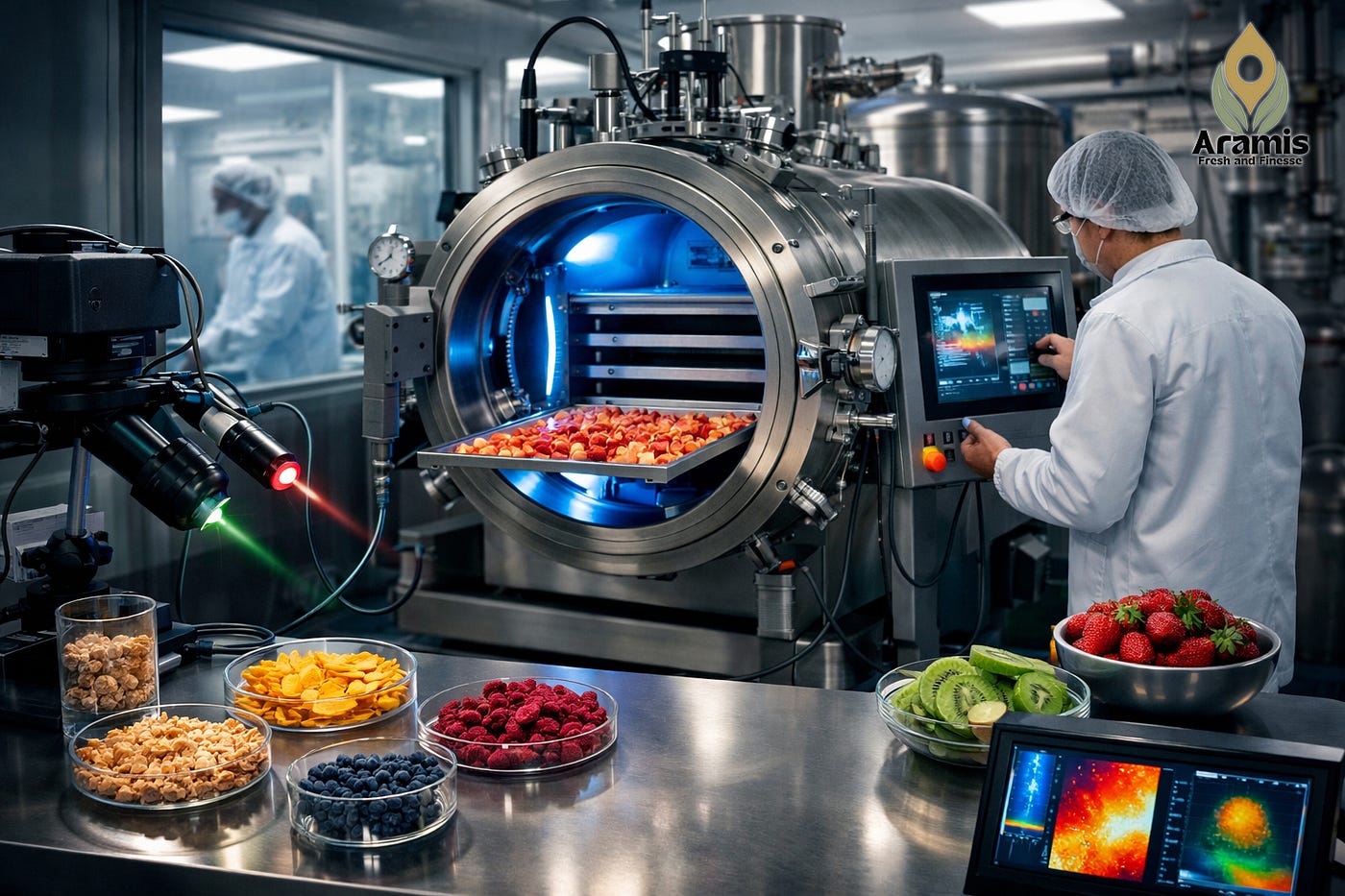
By combining the principles of microwave volumetric heating with a low-pressure vacuum environment, VMD represents a promising approach that aims to balance premium quality preservation with improved processing efficiency.
Rather than replacing freeze-drying in every application, VMD is becoming an important next-generation technology for food manufacturers seeking faster processing, controlled quality, and improved sustainability.
The Physics of VMD: How It Works
Traditional thermal drying methods rely mainly on heat transfer from the surface toward the interior of the product.
This process can create challenges such as:
- surface hardening,
- uneven moisture removal,
- color changes,
- texture degradation.
Freeze-drying solves many of these problems by removing water through sublimation — the direct transition of ice into vapor under vacuum conditions.
However, freeze-drying requires:
- freezing the product,
- maintaining very low temperatures,
- extended processing periods,
- high energy input.
VMD operates through a different physical mechanism:

different physical mechanism
Volumetric Electromagnetic Heating
1. Low-Temperature Evaporation
Inside a VMD chamber, reduced atmospheric pressure lowers the boiling point of water.
This allows moisture removal at significantly lower temperatures than conventional drying methods, helping protect sensitive compounds and maintain product quality.
2. Volumetric Internal Heating
Unlike conventional drying, where heat moves gradually from the outside inward, microwave energy interacts directly with polar molecules — especially water. This creates internal heating, allowing moisture to migrate outward more efficiently.
The result can be:
- shorter drying cycles,
- improved energy efficiency,
- better preservation of product structure.
3. Porosity and Texture Development
Rapid internal vapor formation can create a porous cellular structure.
Under optimized conditions, this may produce:
- lighter texture,
- improved crispness,
- enhanced rehydration characteristics.
This is one reason VMD attracts interest for premium snack applications and high-value ingredients.
Advanced Optical Monitoring: The Future of Process Precision
One historical challenge of microwave-assisted drying has been achieving uniform energy distribution.
Uneven heating can create:
- localized overheating,
- color variation,
- texture inconsistency.
To overcome this challenge, modern VMD systems increasingly integrate advanced monitoring technologies, including:
- optical sensors,
- hyperspectral imaging,
- moisture mapping systems,
- real-time process control.
These technologies create a continuous feedback loop between the product and the drying system.
If certain areas absorb energy differently, process parameters can be adjusted to maintain:
- consistent color,
- controlled moisture removal,
- improved batch uniformity.
For premium food products, visual consistency is not only an aesthetic factor — it is a major component of buyer confidence.
Comparative Analysis: VMD vs. Freeze-Drying
From a food engineering perspective, both technologies offer important advantages.

Comparative Analysis
Important note: Performance depends strongly on the specific product, equipment design, and processing conditions.
The Neuromarketing Behind the Shift: Why Quality Technology Matters
Technology does not only influence production. It also influences buyer perception. In global B2B food markets, purchasing decisions are shaped by both technical specifications and psychological confidence.
1. The Perception of Freshness and Innovation
Historically, faster drying processes were often associated with lower quality. Modern VMD challenges this assumption. When buyers understand that advanced engineering can achieve shorter processing times while protecting product characteristics, the perception changes:
Speed no longer means compromise. Speed becomes a symbol of technological capability.
2. Visual Consistency Builds Trust
Human perception strongly connects visual quality with product reliability.
Uniform:
- color,
- size,
- texture,
- appearance,
creates subconscious confidence. For international buyers managing premium brands, consistent appearance reduces uncertainty and strengthens supplier credibility.
The Sustainable Horizon
As food manufacturers face increasing pressure to reduce energy consumption and improve environmental performance, processing technologies must evolve. Vacuum Microwave Dehydration represents more than a drying method.
It represents a broader movement toward:
- smarter processing,
- energy optimization,
- precision manufacturing,
- premium-quality scalability.
The future of food preservation will likely not depend on one single technology. Instead, it will be shaped by choosing the right process for the right application. Freeze-drying will continue to play a critical role in many high-value sectors. At the same time, technologies such as VMD are opening new possibilities for manufacturers seeking the balance between:
quality, efficiency, and sustainability.
Conclusion
The next generation of dried foods will not simply be defined by removing water. It will be defined by how intelligently that water is removed.
Vacuum Microwave Dehydration demonstrates how food science is moving toward a future where precision engineering meets natural ingredients. Because in premium food manufacturing, excellence is not only about preserving what is inside the product. It is about preserving the trust behind it.
For deeper analysis, visit the full Market Reports section: → My Website Link
Aramis Dried Fruit
B2B Supplier of Premium Dried Fruits
메타데이터
- post_id
- 7882a319c4db
- slug
- beyond-freeze-drying-the-rise-of-vacuum-microwave-dehydration-vmd-7882a319c4db
- url
- https://medium.com/@aramisdriedfruit002/beyond-freeze-drying-the-rise-of-vacuum-microwave-dehydration-vmd-7882a319c4db
- canonical_url
- https://medium.com/@aramisdriedfruit002/beyond-freeze-drying-the-rise-of-vacuum-microwave-dehydration-vmd-7882a319c4db
- author_url
- https://medium.com/@aramisdriedfruit002
- status
- ok
- fetched_at
- 2026-07-15 08:43:05