Wave Picking Under Peak Pressure
Boozt set a new warehouse record as 215,000 items were packed on Black Friday. While the result was visible immediately, the work that made…
Wave Picking Under Peak Pressure
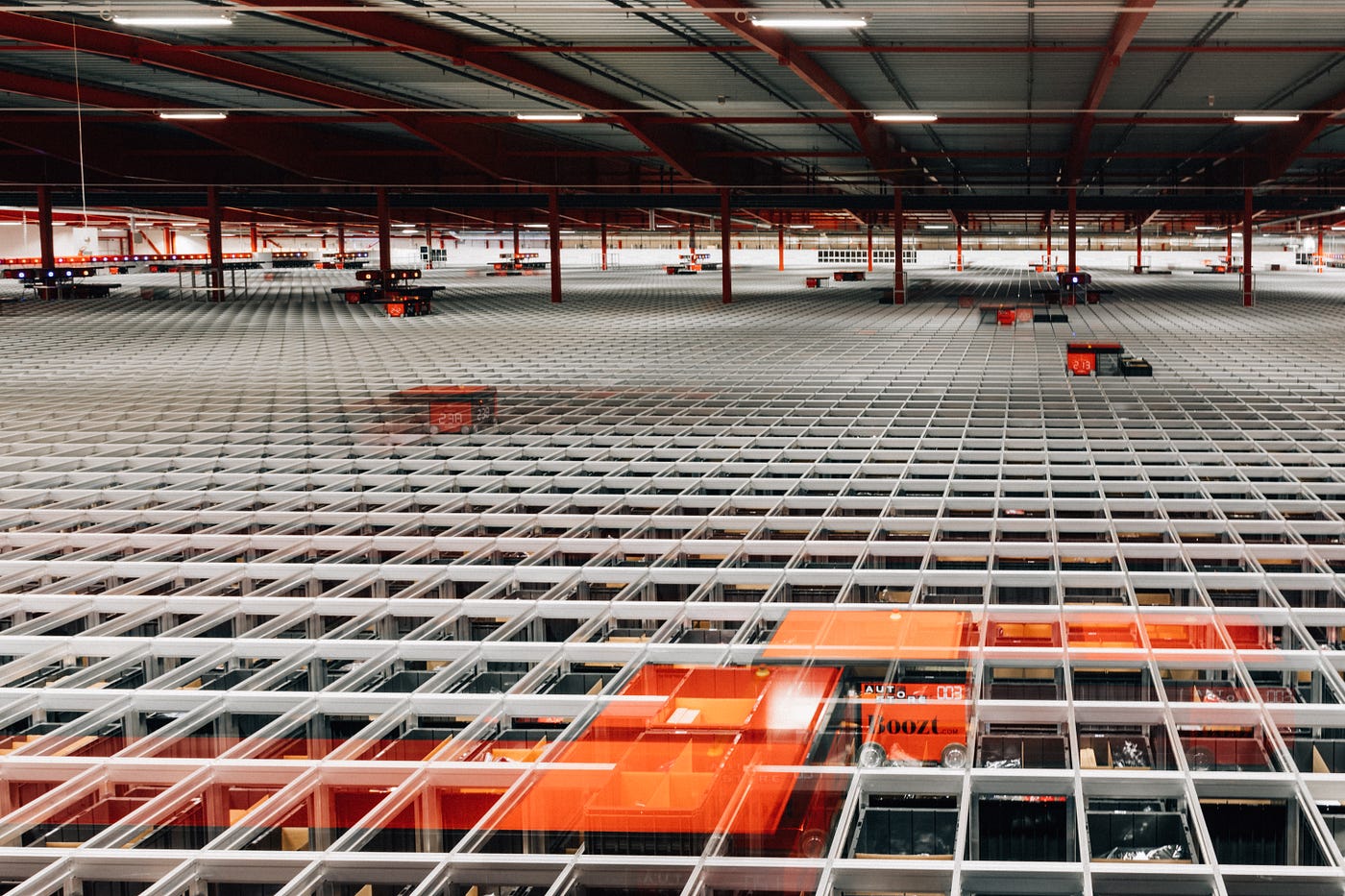
Boozt set a new warehouse record as 215,000 items were packed on Black Friday. While the result was visible immediately, the work that made it possible was not. It lived in numbers, configurations, and decisions made continuously across day and night shifts to keep the system balanced under sustained pressure.
Text by: Jan Naruškevič, Senior Backend Developer
This article is a deep dive into the calculations that were made around the clock during the Black Friday month at Boozt in order to keep the warehouse as effective as possible. A play by play account of the focus on keeping the warehouse system in shape during peak, and how a series of small but deliberate calculations helped turn pressure into flow.
Black Friday as a control problem
During peak, the warehouse is not a static system. It is a living one. Orders arrive constantly, staffing changes across shifts, breaks interrupt flow, and automation must support human work without becoming a bottleneck itself.
The task during Black Friday Week was not to optimise everything at once. It was to keep the system within control limits. To make sure that when people were ready to work, the system was ready to feed them.
That required constant attention and a clear understanding of how numbers in the system translate into physical work on the warehouse floor.

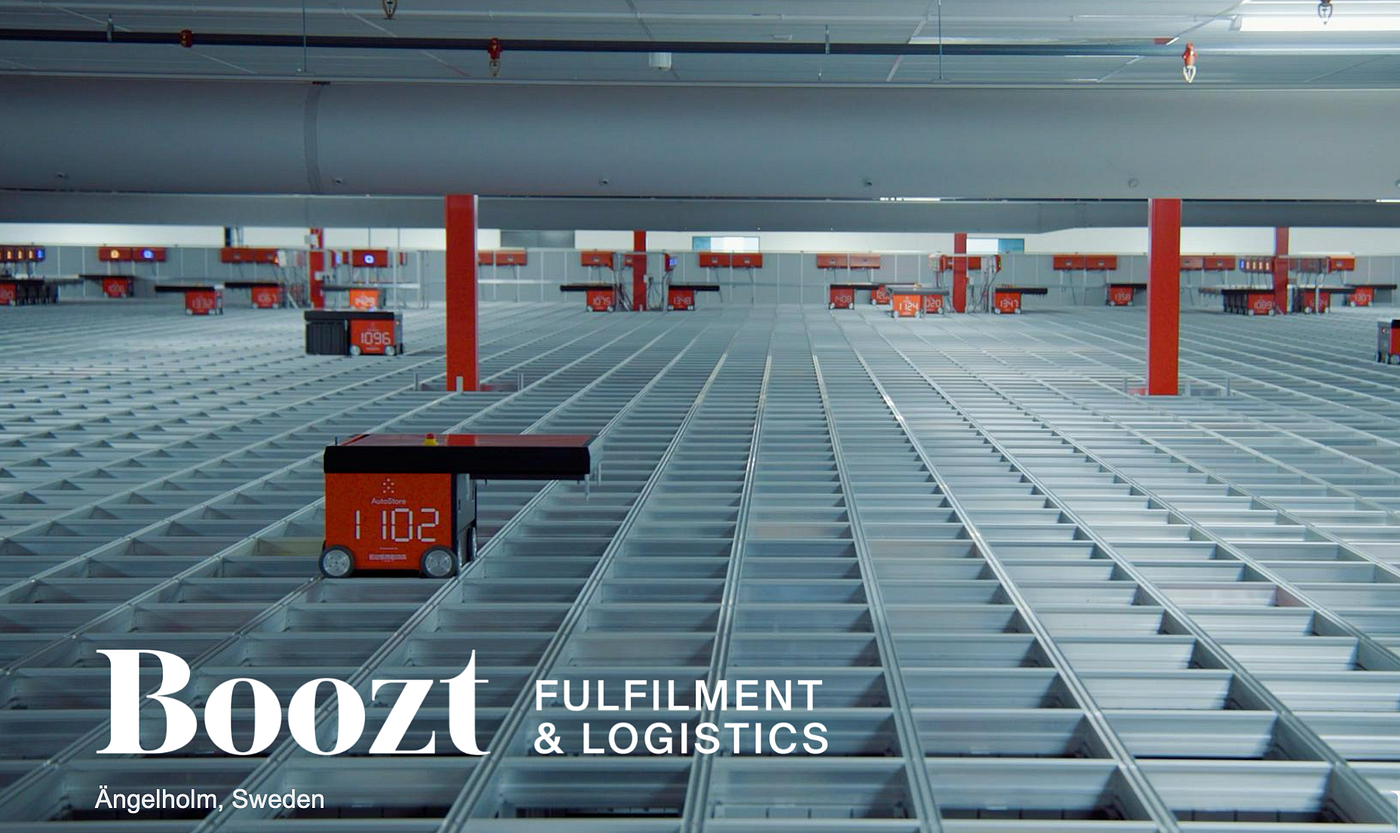
The Boozt Fulfilment Centre
Prepared bins as the core signal
One number became central during Black Friday Week. The share of prepared bins available in the system.
Prepared bins act as a buffer. They separate system capacity from human work and absorb variability caused by breaks, shift changes, and uneven order inflow. The working target during peak was to keep roughly 70 percent of top cells occupied by prepared bins.
Reaching that level consistently required tuning preparation logic, adjusting configurations, and removing competing queues that consumed preparation capacity without contributing to immediate throughput.
Preparing during breaks, not during work
Peak performance depends heavily on what happens during breaks.
At one point during the period, shift patterns included short breaks followed by long working windows. Ten minutes of preparation was not enough to support several hours of picking and packing. Preparation logic had originally been designed for shorter cycles.
Adjustments were made to treat breaks as preparation windows for the next two to three hours of work rather than reacting to immediate demand. This shift reduced pressure once work resumed and helped stabilise output across longer periods.
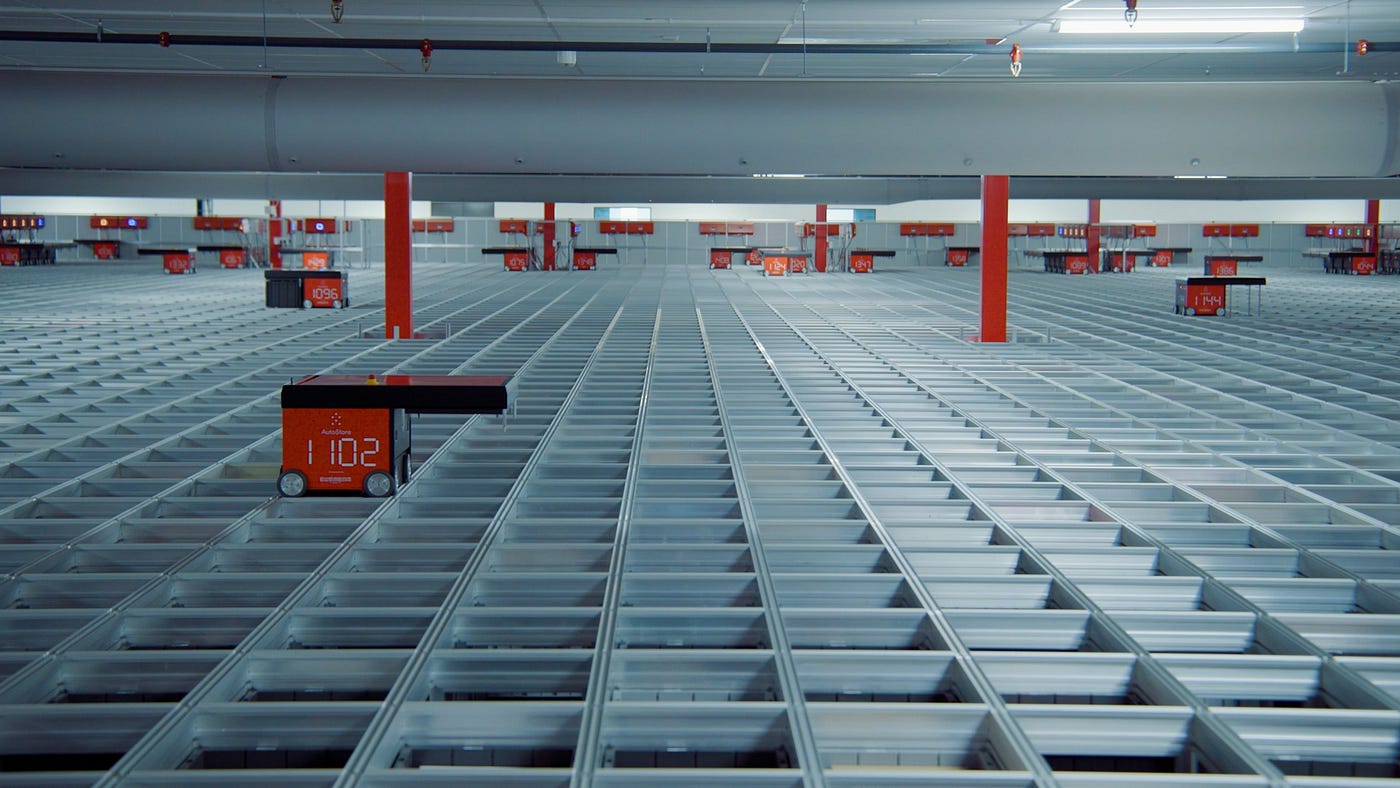
Boozt has around 500 people working at their fulfilment centre with more than 1250 robots helping them.
Balancing competing preparation flows
Another challenge during peak was competition between preparation flows. Pick and pack and consolidation both depend on prepared bins, but large queues in one flow could block the other.
At times, thousands of bins were queued for pick and pack preparation, forcing consolidation bins to wait even when they were time critical.
Preparation logic was updated to distribute work more evenly. Instead of one large queue, preparation was spread across smaller interleaved batches. This allowed both flows to progress in parallel and prevented local optimisation from hurting overall throughput.
Timing beats volume
Some issues during peak were not caused by lack of capacity, but by timing.
Bin transfers occasionally completed too close to carrier pickup times, leaving insufficient time for pick and pack. These transfers consumed system capacity without contributing to shipped orders.
To address this, transfers were limited to shipments with enough remaining processing time. As a rule, transfers were only initiated when there were at least two hours left before pickup. This aligned system behaviour with real operational constraints.

The Boozt Fulfilment Centre takes up around 100.000 km² and is located in Ängelholm.
Wave Picking
This brings us to another set of crucial calculations happening behind the scenes. It’s not enough to simply prepare bins for the peak — we also need to know which exact bins should be prepared and when.
Not so long ago, we processed orders strictly using FIFO (First In, First Out): the older the order, the sooner it was picked and packed. This approach sounds logical, and for a long time it worked very well. However, as our operations scaled, and especially during the BlackFriday FIFO gradually became a bottleneck.
Outbound zone with FIFO shipments waiting to be shipped.
FIFO does not account for carrier pickup schedules. For example, we could pack thousands of shipments for Omniva, even though their truck would arrive only three days later. During that time, fully packed shipments would simply occupy valuable warehouse space. Instead, it would be far more efficient to prioritize shipments scheduled for pickup today or early tomorrow morning.
To solve this problem, FIFO was replaced with a Wave Picking system. In this model, priority is driven by distributor schedules — the sooner a shipment can be picked up, the higher its priority in the picking queue.
Shipments packed during the whole BlackFriday period
Packed non-wave shipments include Wave shipments which were not packed in time and shipments ordered with priority packing service. Priority shipments always bypass wave rules and are packed first. This ensures that high-priority customers receive their orders as quickly as possible, even during peak periods.
Night shifts and hidden bottlenecks
Unexpected behaviour appeared during night shifts. Even with systems active, preparation rates dropped significantly.
Investigation suggested a strong link between preparation throughput and robot availability. When availability dropped to around 15 percent due to charging, preparation slowed dramatically. Once availability increased closer to 19 percent, prepared bin counts rose sharply.
This observation led to closer monitoring of robot availability as a leading indicator during low activity periods and informed further adjustments.

Spoiler: This picture was NOT taken during Black Friday
One system across day and night
Peak does not reset between shifts. Behaviour observed at night affects day-time performance, and decisions made during the day influence night-time preparation.
Throughout Black Friday Week, system behaviour was monitored continuously and discussed across shifts. Small changes were evaluated quickly, reinforced if effective, or rolled back if not.
This created a living feedback loop where the system was constantly nudged back into balance.
Issues we had
The warehouse ecosystem is inherently complex. It consists of many small and large components that must work together in perfect sync. On top of that, the environment this ecosystem operates in differs dramatically during a regular period and during the Black Friday (BF) peak. What works well under normal conditions may fail completely during Black Friday — and vice versa.
Because of this complexity and the coupling between different subsystems, it’s not always possible to predict what will go wrong. When issues do arise, they often need to be fixed on the fly. This Black Friday was no exception.
Preparation Issues
In the past, we manually configured robot charging behavior and the number of robots assigned to each port. Today, these settings are handled automatically by AutoStore. While this reduces operational overhead, it also introduces new constraints that we must take into account.
Our plan was to prepare enough bins during the night, when no operators are working. Bin preparation can’t happen during active packing hours, as robots are mostly busy delivering bins to ports and there’s no spare capacity for preparation.
However, things didn’t go as planned.
During the night, bin transfers were also running — a process that automatically moves entire bins from one AutoStore system to another to handle consolidation. At the same time, around 85% of robots were charging, leaving only 15% available. The system ended up using all of that available capacity to serve bin transfers.
As a result, most of the time no bins were prepared during the night.
Only when robot availability increased to around 19% the number of prepared bins started to grow rapidly. This behavior was unexpected and it is something we’ll need to account for when planning Black Friday 2026.
Because of this, we sometimes failed to prepare enough bins, leaving certain shipments unready for packing when needed. We had to react quickly. One of the emergency solutions was a so-called “Bulldozer” system — a mechanism that forcefully pushed required shipments into the queue, ignoring the usual rules and limits.
Autostore1 did not prepare enough
Item Distribution Issues
Even when all required bins are prepared, unexpected problems can still occur.
One such issue was the emergence of hot bins — bins containing items required by dozens or even hundreds of shipments. Imagine 20 operators at different ports all waiting for the same bin. This creates a bottleneck: operators are forced to wait until the hot bin is released from another port and eventually delivered to theirs.
At one point, we identified 16 hot bins, holding items needed for several thousand shipments.
There was no automatic fix for this. The solution had to be done manually: items were removed from the hot bins and re-indelivered into multiple separate bins to distribute the load.

The cumulative effect
None of these changes were dramatic on their own. There was no single breakthrough or hero fix.
But together, they reduced friction, protected buffers, and kept throughput predictable. They allowed people on the warehouse floor to work at full speed without waiting for the system to catch up.
That is how records are built. Incrementally, quietly, and with discipline.
How we pushed Autostore to its limits
To hit a new packing record, we had to push AutoStore to the very edge of its capabilities.
But what does “pushing AutoStore to its limits” actually mean in practice?
Generally high-speed packing is simple: operators need to receive bins as quickly as possible, with minimal waiting time. For that to happen, bins must already be prepared — meaning they’ve been dug up from deeper layers and placed into top cells, ready to be delivered to ports on demand.
During regular periods, this is fairly easy. We pre-prepare a buffer of bins that we expect to need soon, and the system runs smoothly. Black Friday, however, changes everything.
During BF, we run with the maximum possible number of operators, all packing simultaneously. While this increases throughput, it also creates a new bottleneck: hardware limits of AutoStore itself.
Where the bottleneck comes from
AutoStore ports are served by robots. Those same robots are also responsible for preparing bins. With fewer active ports, fewer robots are needed for port operations, leaving the rest free to focus on bin preparation — digging bins up to the top cells so they can be delivered in a shorter possible time when requested (5 seconds in average).
During Black Friday, the situation is the opposite.
With many active ports:
- More robots are needed for port operations
- Robot traffic on top cells increases significantly
- More prepared bins are needed, which means we occupy more top cells
This combination makes bin preparation for maximum ports challenging. The robots are busy, the traffic is dense, and the space needed to prepare new bins is largely occupied.
And this is where the real challenge begins.
We needed to plan work shifts and operator breaks in a way that allowed us to prepare enough bins for the next 2–3 hours of work — even while running with maximum operators / ports.

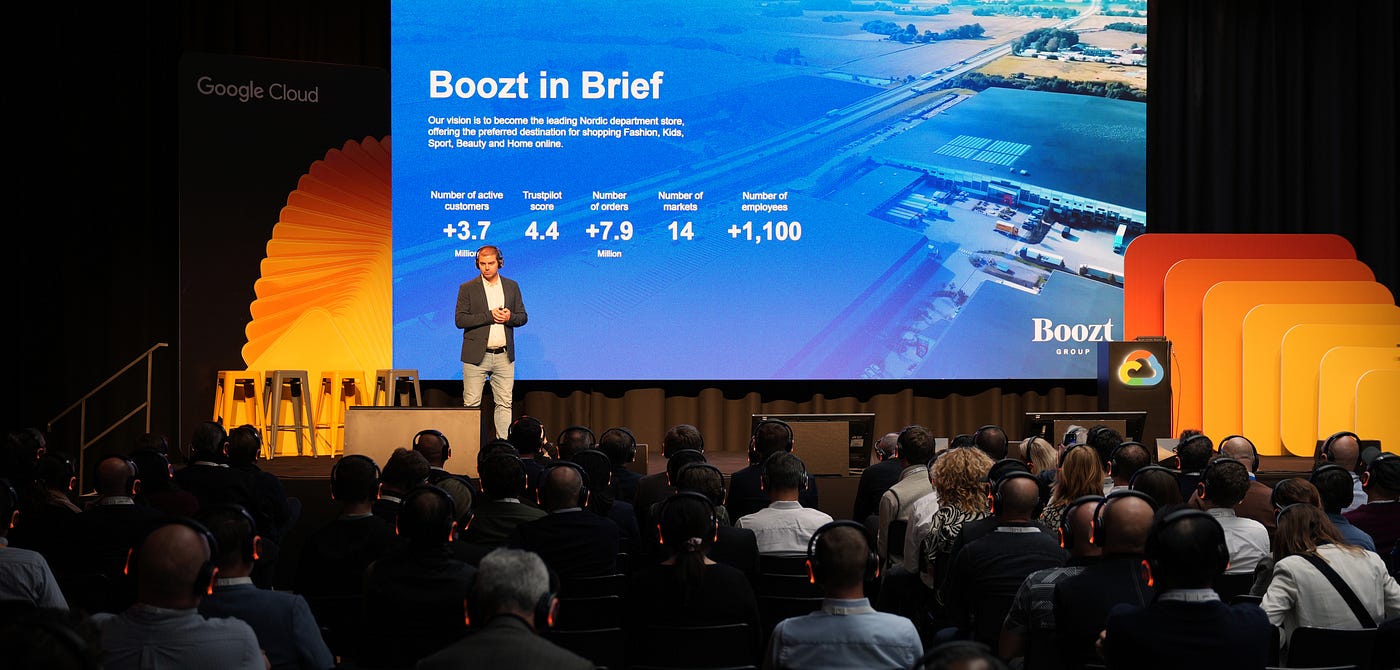
Boozt CSCO, Ronni Funch Olsen
Let’s look at the numbers
We operate three AutoStores, each with a different top-cell capacity:
- AS1: 16,224 top cells, 260 robots
- AS2: 29,708 top cells, 504 robots
- AS3: 33,732 top cells, 533 robots
To simplify the analysis, we can treat them as a single combined system.
That gives us a total of 79,664 top cells.
For AutoStore to remain effective, top cells must serve two purposes:
- Storing prepared bins
- Allowing robots to move freely across the grid
From Autostore experts, we know that at least 30% of top cells must remain free to avoid performance degradation. That means we can safely occupy up to 70% of top cells for prepared bins:
79,664 × 70% = 55,764 prepared bins
This number effectively defines our upper limit for how much work we can buffer ahead of time.
Packing capacity in reality
To translate prepared bins into real throughput, we relied on the average packing speed measured during Black Friday 2024 — approximately 100 packed pieces per hour per operator. This is a low number compared to other periods of time but we had to use this number as the foundation for all further planning. In reality after the dust settled we managed 115 picks per hour and operator for 2025 — a significant increase!
During Black Friday operations, our setup looked like this:
- Two 8-hour shifts, resulting in 16 working hours per day
- An average of 140 operators working simultaneously across all three AutoStores
From this, we can calculate the theoretical maximum daily packing capacity:
16 hours × 140 operators × 100 pcs/hour = 224,000 pieces per day
In reality, during Black Friday 2025, we packed 215,000 pieces in a single day — reaching 95.98% of the theoretical maximum. This already leaves very little margin for errors, delays, or unexpected incidents.
Capacity per shift
Breaking this number down further helps explain why bin preparation became such a critical challenge.
Each 8-hour shift had a theoretical capacity of:
8 hours × 140 operators × 100 pcs/hour = 112,000 pieces per shift
This means that AutoStores had to continuously supply bins at a pace that could support over 100,000 packed pieces every shift, without slowing operators down.
Working sprints and breaks
In practice, operators did not work continuously for 8 hours straight.
To keep operators from getting tired and working effectively, work was organized into 2–3 hour working windows (sprints), followed by 10–20 minute breaks. While these breaks were necessary for people, they also became a crucial operational opportunity for AutoStores.
Let’s look at what this means in numbers.
2-Hour Working Window
- 2 hours × 100 pcs/hour × 140 operators = 28,000 pieces
3-Hour Working Window
- 3 hours × 100 pcs/hour × 140 operators = 42,000 pieces
This means that before each sprint started, AutoStores needed to have prepared bins with 28,000 to 42,000 pieces, depending on sprint length.
Why breaks mattered
During operator breaks, packing was stopped:
- No ports were active (except for some bin transfer ports)
- Robot traffic to ports decreased drastically
- More robots became available for bin preparation
These short 10–20 minute breaks were effectively the only windows where AutoStores could recover, prepare bins, and build up a buffer for the next sprint.
If bin preparation during breaks fell behind, the impact was not immediate, but it was still inevitable.
Operators would usually start the next working sprint with enough prepared bins to keep packing going for a while. However, that buffer was often insufficient for the entire duration of the sprint. Once prepared bins were consumed, AutoStore had no choice but to start assigning non-prepared bins to ports.
This meant that bin preparation began happening during peak packing hours, when robot traffic was already high and top cells were heavily occupied. Preparing bins under these conditions is significantly slower than doing it during breaks, when fewer ports are active and robot load is lower.
As a result, operators didn’t stop working altogether — but they gradually started to feel the slowdown. Waiting times increased, bin delivery became less predictable, and overall throughput suffered compared to a fully prepared sprint.
In short, break-time bin preparation didn’t determine whether a sprint could start — it determined how smoothly it could finish.

Operating near the edge
Looking at the system as a whole, it becomes clear how tightly everything was connected:
- Operator schedules and breaks
- Robot availability and traffic
- Top-cell occupancy
- Bin preparation timing
Running at almost 96% of maximum packing capacity left very little room for recovery. Even small inefficiencies — slightly slower preparation or longer peak periods — could gradually accumulate and turn into noticeable slowdowns later in the shift.
At the same time, this result was not driven by a single factor.
The record-breaking performance was the outcome of many things working well together:
- Efficient bin transfers between AutoStores
- A well-tuned wave picking strategy
- Strong workforce planning and shift design
- Pushing AutoStore’s capabilities as close to their practical limits as possible
What truly defined the success of Black Friday 2025 was the ability to keep all of these elements aligned — continuously, under extreme load.
Conclusion
Black Friday records do not come by themselves. They are the result of work that rarely shows up in dashboards or headlines.
Behind the packed orders were hours of calculations, configuration changes, and decisions made day and night by people who understand how systems behave under pressure and how small adjustments can tilt the odds in their favour.
This invisible work is what turns complexity into flow. And it is what made the Black Friday record of 2025 possible.
[embed]
메타데이터
- post_id
- 7883eb5219f4
- slug
- wave-picking-under-peak-pressure-7883eb5219f4
- url
- https://medium.com/boozt-tech/wave-picking-under-peak-pressure-7883eb5219f4
- canonical_url
- https://medium.com/boozt-tech/wave-picking-under-peak-pressure-7883eb5219f4
- author_url
- https://medium.com/@boozttech
- status
- ok
- fetched_at
- 2026-06-10 22:22:12