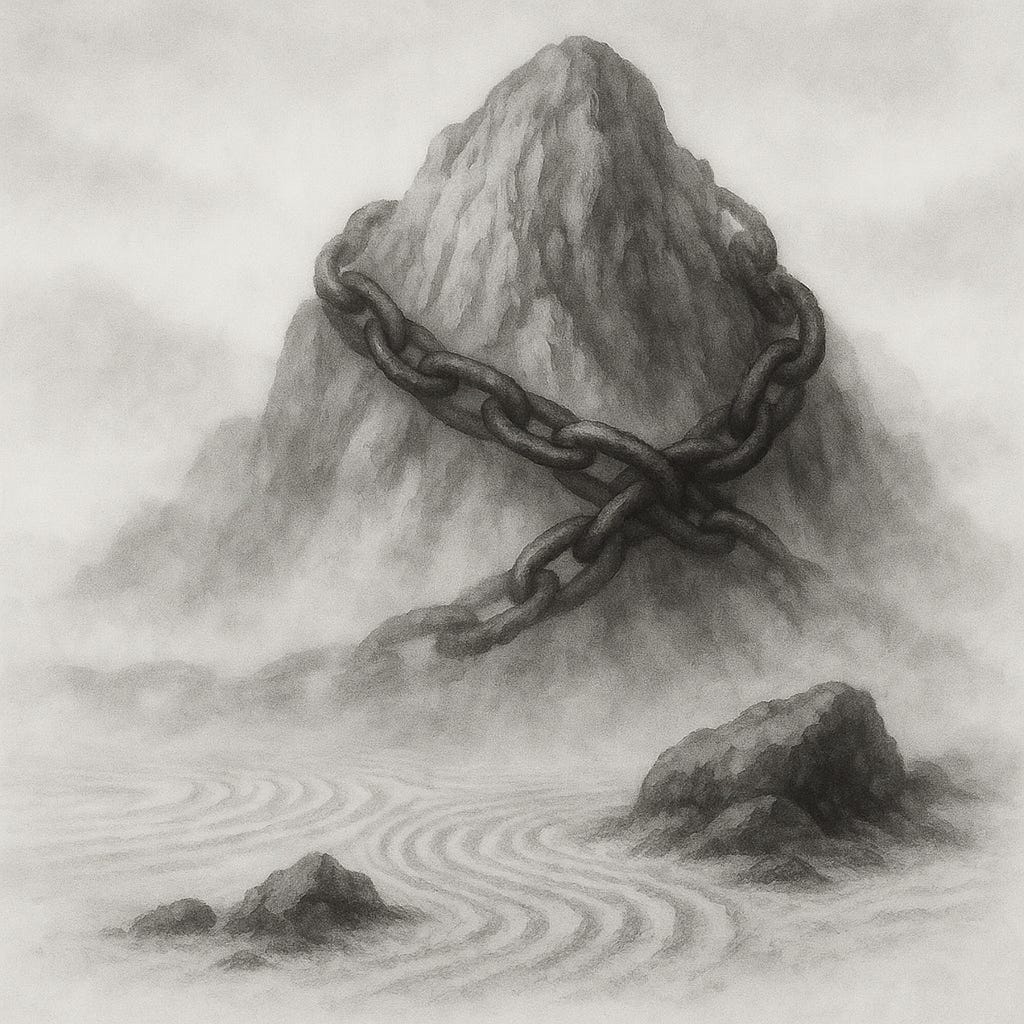
Three Forbidden Treatises Bound Together — Why al-Buni’s Name Is on All of Them
In the world of Arabic manuscripts, books are not always what they appear. A single binding may contain multiple works by different…
Three Forbidden Treatises Bound Together — Why al-Buni’s Name Is on All of Them
In the world of Arabic manuscripts, books are not always what they appear. A single binding may contain multiple works by different authors, assembled by a compiler whose logic may not be immediately apparent. Some compilations are haphazard. Others are deliberate — carefully structured anthologies in which the arrangement of texts tells a story that no individual text could tell alone.
Volume VI of the Al-Buni Manuscripts Collection is the second kind. The Majmu’at Thalath Rasa’il(Collection of Three Treatises) binds together three works by three different authors across 278 pages. The title page names all three: al-Shadhili, Ibn al-Mar’ah, and al-Buni (d. 622 AH / ~1225 CE). The order reveals a curriculum — a deliberate progression from inner purification through communal practice to therapeutic healing.

VOL. VI — AL-BUNI MANUSCRIPTS COLLECTION
Majmu’at Thalath Rasa’il
The Title Page as Declaration
By naming al-Shadhili, Ibn al-Mar’ah, and al-Buni together, the compiler was making a statement. Al-Shadhili is one of the most venerated saints in Sunni Islam, founder of a Sufi order that spans continents. Al-Buni is the most notorious name in Arabic operative magic, whose works have been banned and burned across the Islamic world. Ibn al-Mar’ah occupies a position between them.
Placing all three on a single title page was an argument: these traditions belong together. The saint, the scholar, and the operative magician are colleagues in a single enterprise.
Part I: The Individual Path
The Kitab fi al-Tariqah (Book of the Path), attributed to Abu al-Hasan al-Shadhili, opens the volume with a systematic presentation of the Sufi spiritual journey organized into 60 gates. Each gate represents a stage of spiritual development.
The gates begin with foundational etiquette — the adab required of anyone who would engage with the spiritual world. The middle gates develop the practitioner’s relationship with the spiritual waystations of the Sufi path: repentance, patience, gratitude, trust, love. The Sixtieth Gate — “On Particularity” — addresses the unique relationship between the perfected soul and God.
Part II: The Communal Dimension
Ibn al-Mar’ah’s Commentary on the Spiritual Assemblies shifts from the individual path to the communal. If Part I addresses how the individual seeker travels toward God, Part II addresses what happens when seekers gather. The spiritual assembly (majlis) is not merely a social occasion. It is a technology of amplification — a structure through which individual spiritual work is magnified by collective practice.
Part III: Healing the Obstacles
The Shifa’ al-Sudur (The Healing of Hearts), attributed to al-Buni, completes the curriculum. In Sufi psychology, the heart (qalb) is the seat of spiritual perception, and it can be afflicted by diseases: pride (kibr), envy (hasad), attachment to the world (hub al-dunya), and forgetfulness of God (ghaflah). These diseases obstruct spiritual progress and block the channels through which divine power flows.
The progression is clear: travel the path (Part I), practice in community (Part II), heal what remains broken (Part III). Only then is the practitioner ready for the operative work described in other volumes of the Al-Buni Manuscripts Collection.
The Compiler’s Intelligence
The arrangement of the three treatises is not random. It follows a developmental logic that anyone trained in Sufi pedagogy would recognize: purify the self, strengthen through community, heal what resists purification. The compiler understood that al-Buni’s operative works — the *Shams al-Ma’arif*, the Barhatiyyah commentary, the magic square construction — presuppose a practitioner who has done this inner work.
What the Binding Reveals About Al-Buni
The compilation challenges the popular image of al-Buni as a sorcerer operating outside mainstream Islamic spirituality. Here is al-Buni bound together with the most respected Sufi saint of his era, in a compilation that treats the Sufi path and operative magic as complementary phases. The progression — inner purification, communal practice, therapeutic healing — is the curriculum of a spiritual physician, not a sorcerer.
For al-Buni’s pastoral prayer book that further complicates the “sorcerer” narrative, see Volume V. For the distinction between spiritual science and sorcery, see the companion article.
Majmu’at Thalath Rasa’il (Collection of Three Treatises) is available in its first English translation as Volume VI of the Al-Buni Manuscripts Collection. Available in paperback.
메타데이터
- post_id
- 788e7e4da7f2
- slug
- three-forbidden-treatises-bound-together-why-al-bunis-name-is-on-all-of-them-788e7e4da7f2
- url
- https://medium.com/@johnfriendpublishing/three-forbidden-treatises-bound-together-why-al-bunis-name-is-on-all-of-them-788e7e4da7f2
- canonical_url
- https://medium.com/@johnfriendpublishing/three-forbidden-treatises-bound-together-why-al-bunis-name-is-on-all-of-them-788e7e4da7f2
- author_url
- https://medium.com/@johnfriendpublishing
- status
- ok
- fetched_at
- 2026-06-09 15:37:30