From Colony to Country: Guyana’s Independence Story.
Guyana’s Independence Day and the Shadow of the Wismar Massacre.
From Colony to Country: Guyana’s Independence Story.
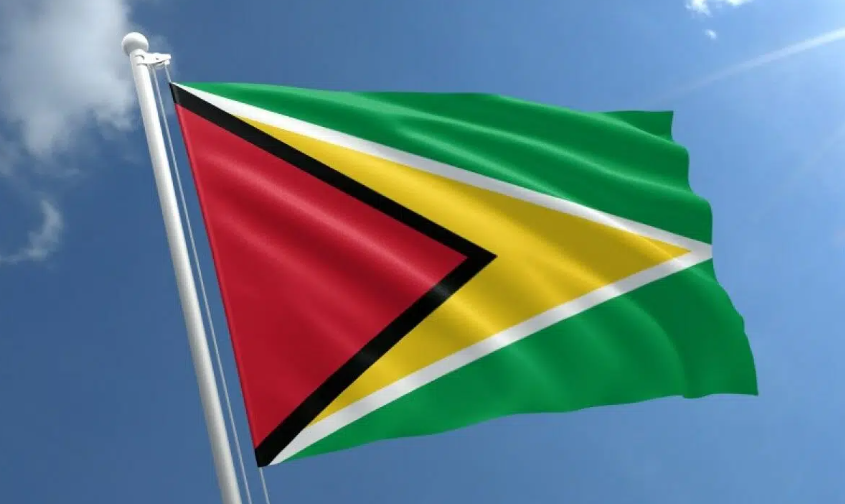
Flag of Guyana. Image: National Today.com
Guyana’s Independence Day and the Shadow of the Wismar Massacre.
Guyana is often remembered for the 1978 Jonestown Massacre, where 909 members of the Peoples Temple, led by Jim Jones, died in a mass murder-suicide in a remote commune. Less known are the racially charged conflicts between Indo-Guyanese (of Indian Hindu and Muslim descent) and Afro-Guyanese (of African descent) that marked the years leading to independence from the United Kingdom on May 26, 1966.
While May 26 is celebrated as Guyana’s Independence Day with vibrant festivals, traditional food, music, dance, fashion shows, fireworks, and lively gatherings, a darker story lies beneath. For many, this date also marks the memory of the 1964 Wismar Massacre, a tragedy some politicians have sought to downplay for over six decades.
Historical Context.
In 1964, Guyana was a British colony, and the People’s Progressive Party (PPP), led by Dr. Cheddi Jagan, an Indo-Guyanese socialist, held power after winning the 1961 elections. Jagan’s ties to Fidel Castro, following Cuba’s revolution, alarmed Western powers. His opponents included the People’s National Congress (PNC), led by Forbes Burnham, and the United Force (UF), led by brewery magnate Peter D’Aguiar, who appealed to indigenous Amerindians and business interests. Both parties were pro-Western, contrasting with Jagan’s socialist agenda.
Burnham and Jagan were once allies. After earning a law degree and studying political science at the London School of Economics, Burnham became the first chairman of Jagan’s PPP. However, in 1953, four months after the PPP’s election victory, the British governor dissolved Parliament, dismissing Jagan but retaining Burnham as education minister.
Seeing an opportunity, Burnham distanced himself from Jagan’s communism, forming the PNC in 1957. He served as Georgetown’s mayor in 1959 and president of the Guyana Labour Union by 1963, positioning himself as a moderate, pro-Western leader.
The Union Conflict.
The Man Power Citizens’ Association (MPCA), a moderate union representing sugar and bauxite workers, held significant influence in the 1960s. It clashed with the Guyana Agricultural Workers Union (GAWU), a PPP-aligned union primarily representing Indo-Guyanese sugar workers.
The MPCA, backed by colonial authorities and sugar companies like Bookers, resisted GAWU’s push for recognition. After Jagan’s 1961 victory, GAWU launched strikes and protests, including cane field burnings, to challenge the MPCA’s dominance.
Despite Jagan’s premiership, his power was limited by colonial oversight. The British governor could veto policies deemed disruptive, preventing Jagan from using state resources to support GAWU or protect strikers.
This left GAWU vulnerable to strikebreakers, often Afro-Guyanese workers aligned with the MPCA and PNC.
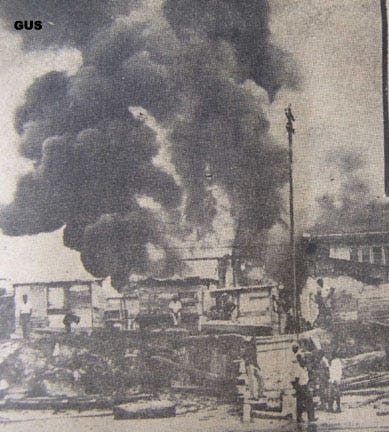
Image: Guyana under seige.
Racial and Political Tensions.
From 1962 to 1964, Guyana saw escalating unrest, with sugar mill lockouts, arson, and retaliatory violence. Racial divisions — Indo-Guyanese in rural sugar areas, Afro-Guyanese in coastal mining and fishing — were exploited by political actors. The PNC and MPCA received clandestine support from the CIA and British government, who viewed Jagan’s socialism as a threat (Rabe, 2005). This culminated in the Wismar Massacre of May 25–26, 1964, in the predominantly Afro-Guyanese Wismar-Christianburg-Mackenzie area.
Over 36 hours, more than 200 Indo-Guyanese homes and businesses were looted and burned, with official reports citing two deaths, though some unverified claims suggest higher casualties. Women and girls faced sexual violence, and British troops evacuated approximately 3,400 Indo-Guyanese to Georgetown, many never returning, despite being taxpayers and free men and women of the British Empire.
The Wismar Report (1964) described the massacre as a “diabolical plot, ingeniously planned and ruthlessly executed,” suggesting premeditation to undermine Jagan’s government by portraying it as incapable of maintaining order. The violence was part of a broader campaign from 1961 to 1964, fueled by foreign interference, to destabilize the PPP.
Independence and Its Legacy.
In December 1964, a new proportional representation system enabled a PNC-UF coalition to oust Jagan. Burnham became prime minister, declaring May 26, 1966, as Independence Day — a date some Indo-Guyanese view as a provocative reminder of the Wismar Massacre. In 1970, as Guyana became a republic, Burnham unified Wismar, Christianburg, and Mackenzie into Linden, (Burnham’s legal first name), a move critics saw as symbolizing his political triumph.
Burnham’s 21-year rule (1964–1985) was marked by authoritarianism and economic decline, prompting an estimated 100,000–150,000 Guyanese, mostly Indo-Guyanese, to migrate to the U.S., UK, and Canada. This was driven by fears of racial violence, and economic hardship under PNC policies, and not solely related to the Wismar events.
The Jonestown Connection.
Burnham’s legacy faced further scrutiny after the 1978 Jonestown Massacre. The Peoples Temple, supported by the PNC for its socialist alignment, amassed wealth in Guyana. On November 20, 1978, Viola Burnham, Forbes’ wife, and Deputy Prime Minister Ptolemy Reid visited the site post-massacre, reportedly returning to Georgetown with over US$1 million in cash, gold, and jewelry (Washington Post, December 23, 1978). The valuables’ fate remains unclear, with a 1979 fire destroying related records, fueling allegations of corruption akin to the political opportunism seen in 1964.

Image:
Conclusion.
While May 26, 1966, is celebrated with the focus on festivities, it is also (for many people), a reminder of the turbulent 1961–1964 period. The destruction, driven by political machinations and foreign interference, tries to leave Guyana’s complex history of racial and political strife in the past. The Jonestown rumor underscored the ongoing distrust in Burnham’s regime, echoing the Wismar era’s legacy of division and loss.
References
- Rabe, S. G. (2005). U.S. Intervention in British Guiana: A Cold War Story.
- Washington Post. (1978, December 23). “Jonestown Aftermath.”
- Wismar Report (1964). Guyana Government Archives.
메타데이터
- post_id
- 7892e5f78fe7
- slug
- from-colony-to-country-guyanas-independence-story-7892e5f78fe7
- url
- https://medium.com/@bravo26au/from-colony-to-country-guyanas-independence-story-7892e5f78fe7
- canonical_url
- https://medium.com/@bravo26au/from-colony-to-country-guyanas-independence-story-7892e5f78fe7
- author_url
- https://medium.com/@bravo26au
- status
- ok
- fetched_at
- 2026-07-19 16:05:00