The Universe May Not Need Fundamental Space-Time After All
For generations, humanity has imagined the universe as a vast cosmic stage made of space and time. Galaxies drift through it. Stars are…
The Universe May Not Need Fundamental Space-Time After All
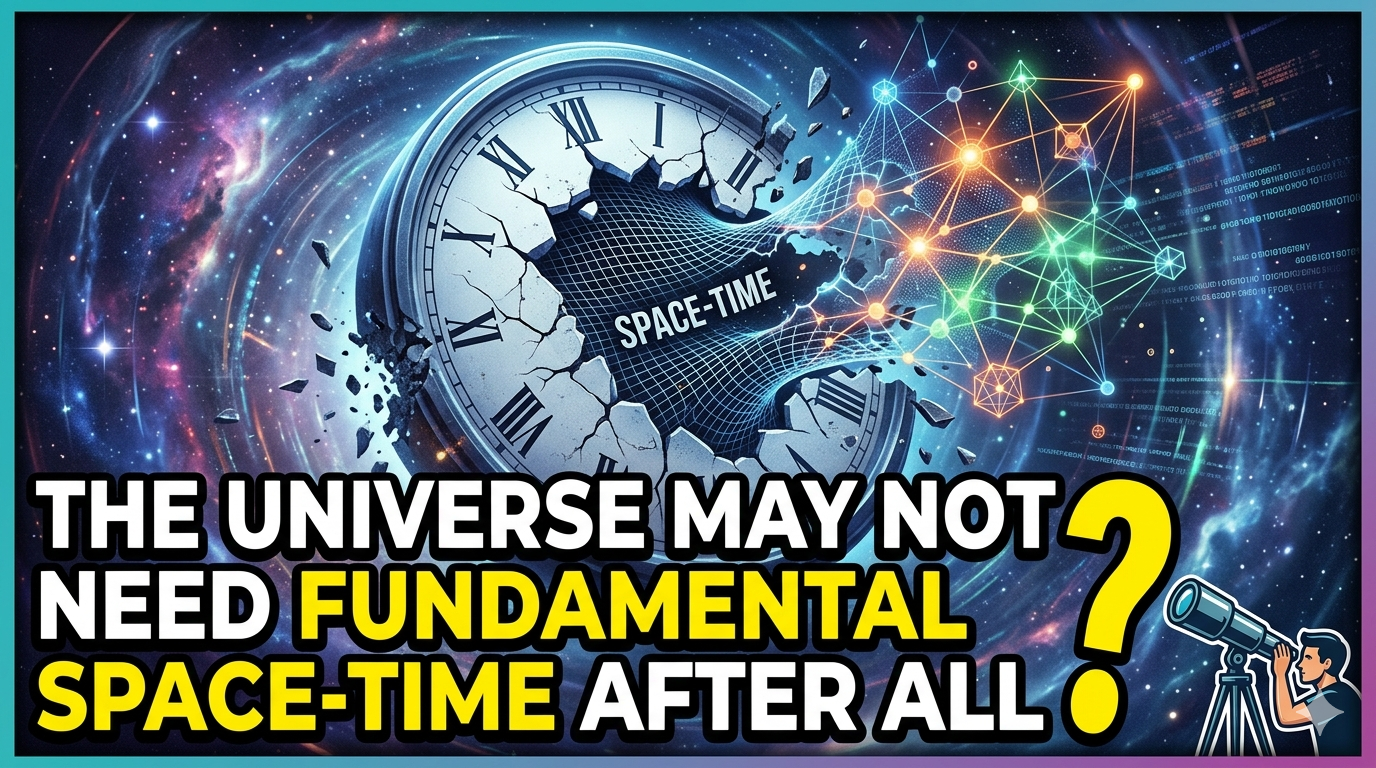
For generations, humanity has imagined the universe as a vast cosmic stage made of space and time. Galaxies drift through it. Stars are born and die within it. Every event in existence appears to happen somewhere and sometime.
But modern physics is beginning to suggest something astonishing:
Space-time itself may not be fundamental reality.
Instead, what we experience as space and time could emerge from deeper invisible structures — patterns of quantum information, entanglement, or unknown pre-geometric laws beneath the surface of the cosmos.
This idea sounds almost philosophical, yet it is rapidly becoming one of the most serious directions in theoretical physics.
And if it is true, our understanding of reality may be approaching another historic transformation.
The Crisis at the Heart of Physics
Physics currently rests on two extraordinary pillars.
Einstein’s General Relativity explains gravity, black holes, and the large-scale structure of the universe with remarkable precision. Meanwhile, Quantum Mechanics governs the microscopic world of particles, uncertainty, and probabilities.
Both theories are incredibly successful.
Yet together, they refuse to fully cooperate.
Relativity treats space-time as smooth and continuous — like a flexible fabric that bends under gravity. Quantum theory, however, describes reality as fundamentally discrete, fluctuating, and uncertain.
When physicists attempt to merge these frameworks under extreme conditions — such as inside black holes or during the birth of the universe — the equations collapse into contradiction.
This conflict has become one of the deepest unsolved problems in science.
And increasingly, some researchers suspect the problem may exist because we are treating space-time as more fundamental than it truly is.
Space May Be Born From Information
One of the most fascinating developments comes from quantum entanglement.
Entangled particles remain mysteriously connected even across enormous distances. Measuring one instantly influences the other, regardless of separation.
For decades, entanglement appeared to be a strange feature of quantum mechanics.
Now many physicists believe it may be something far more profound.
Research in quantum gravity and information theory suggests that the geometry of space itself could emerge from networks of entanglement. In other words, the connections between quantum states may literally create the structure we perceive as space.
Distance may not fundamentally exist.
What we call “near” and “far” could simply reflect how strongly different parts of reality are entangled with one another.
In this view, space is not the container of existence.
It is a consequence of deeper relationships.
The Universe as a Hologram
Another revolutionary concept reshaping modern physics is the holographic principle.
The idea emerged from studies of black holes and later gained support through developments in string theory.
It suggests that all the information inside a region of space can be fully encoded on its boundary — much like a hologram stores a three-dimensional image on a two-dimensional surface.
If correct, our three-dimensional universe may itself emerge from more fundamental lower-dimensional information.
Reality, at its deepest level, could resemble a cosmic projection generated by hidden informational structures.
While this sounds almost surreal, the mathematics behind holographic models has produced powerful insights into gravity, black holes, and quantum systems.
For many physicists, this is no longer science fiction.
It is a serious clue.
Time May Not Fundamentally Exist Either
The implications become even more radical when time enters the discussion.
At everyday scales, time feels undeniable. We experience motion, aging, memory, and change.
But some equations describing the quantum universe contain no preferred direction of time at all.
This has led certain physicists to propose that time itself may be emergent rather than fundament
메타데이터
- post_id
- 78aa52df3fa3
- slug
- the-universe-may-not-need-fundamental-space-time-after-all-78aa52df3fa3
- url
- https://medium.com/@udilip00/the-universe-may-not-need-fundamental-space-time-after-all-78aa52df3fa3
- canonical_url
- https://medium.com/@udilip00/the-universe-may-not-need-fundamental-space-time-after-all-78aa52df3fa3
- author_url
- https://medium.com/@udilip00
- status
- ok
- fetched_at
- 2026-07-10 10:20:21