What the Doorway Remembered
How a forgotten United Fruit building revealed a hidden chapter of New Orleans labor history.
What the Doorway Remembered
How a forgotten United Fruit building revealed a hidden chapter of New Orleans labor history.
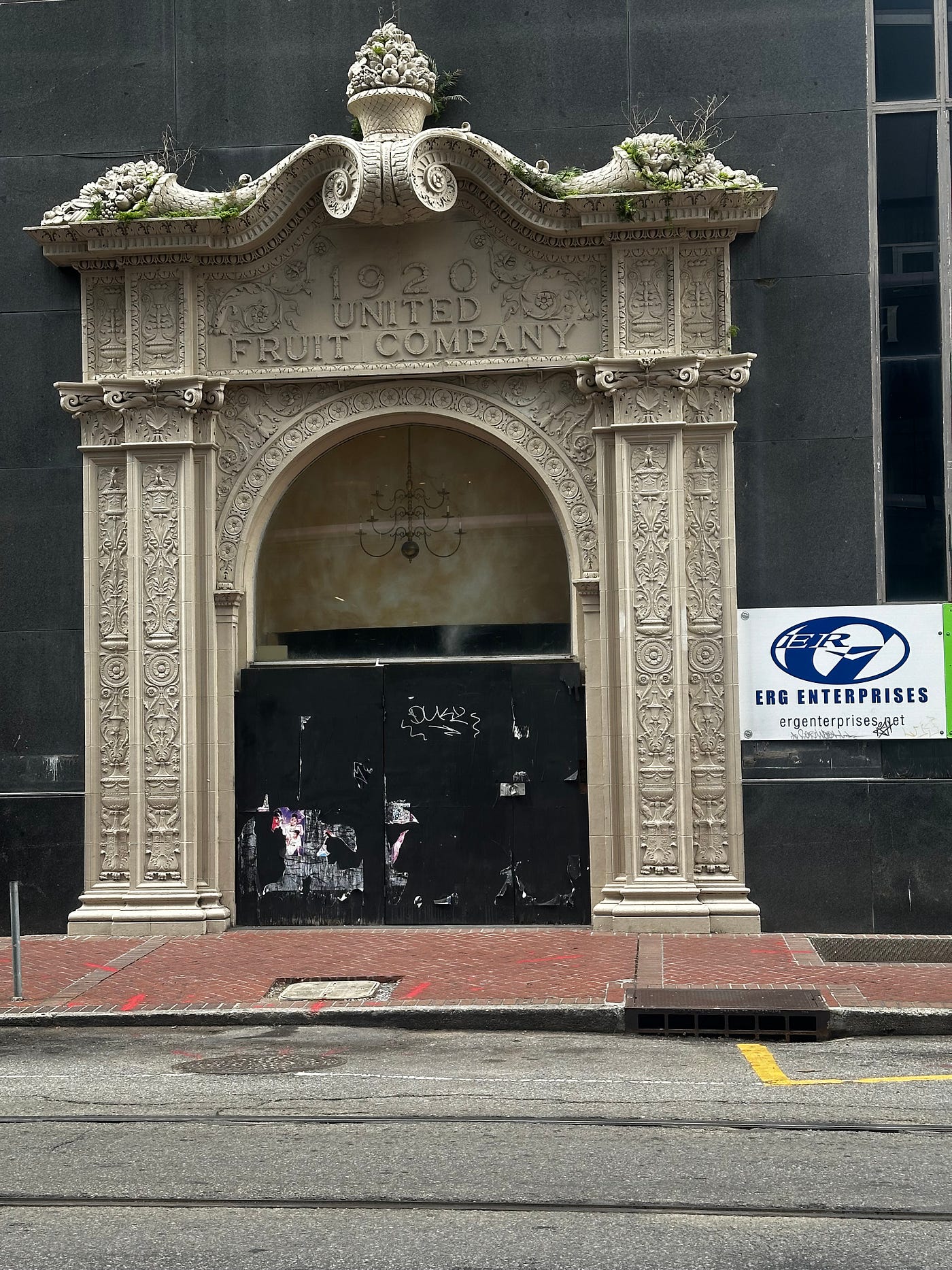
The former United Fruit Company building at St. Charles Avenue and Union Street, New Orleans. Photographed November 2024.
It was a warm November morning as I walked down St. Charles St from the French Quarter into the Central Business District in New Orleans. I still remember the cool wind on my cheeks and the scent of bacon and coffee wafting on the breeze from a nearby cafe. A construction barricade caught my attention. The building was clearly old and was only a shadow of what it once had been. I pulled my phone and snapped a few pictures.
The Photograph
This doorway was unique; an ornate archway carved with various fruits and vegetation growing from cracks in the facade. An inscription announced the building as The United Fruit Company with the year 1920 carved below the company’s name. This clearly historic doorway called to me in a way I still don’t really understand. The massive 10 story building stood empty at the corner of St. Charles, still projecting a kind of quiet strength and power, a seeming relic of a time long past in a city with more haunting spectres than one can easily name. This was, after all, New Orleans, where dark history hides in plain sight and things are rarely everything they seem to be on the surface.
The Ghosts In Plain Sight
I grew up in the Northwest Ohio Rust Belt. Urban decay was always there. The ghosts of what was haunted the present physically. The crumbling remains of former industrial titans rust and crumble in plain sight. Not just abandoned factories and foundries. Entire decaying industrial ecosystems lie dormant in plain view for all to see. . Empty factories sit next to empty warehouses, rusting railyards and the network of supporting business on which a workforce once depended, shuttered bars and restaurants, vacant homes and worker housing much of it still sitting visible command the landscape. In places like Toledo, Cleveland, or Youngstown, the industrial past is still present long after the factories idle and the jobs disappear. Even when the factories are torn down, railroad tracks pulled up, and warehouses turned into boutique coffee shops and cafes the scars on the landscape are a permanent reminder of what was once there and what has been lost. A quick web search reveals thousands of images of the Midwest and Northeast’s industrial past. In some circles the many gratuitous images are known collectively as “ruin porn.” Those of us who call those places intimately, know it as home. I have known for some time that New Orleans is different hiding much behind its many facades.
This is not the story of the 50,000 plus square foot building at 321 St. Charles street, but rather it is the story of a forgotten, but not departed empire, and those who willingly, or unwillingly, served it. It is also the story of how the Crescent City celebrates parts of its long and complicated history while absorbing and largely forgetting others. On that fall morning I was simultaneously standing in the heart of the city’s fashionable Central Business District and in the heart of an antique machine built for the purposes of moving freight and making money, a lot of money for a relatively small number of people.

Following the Thread
The United Fruit Company had been in New Orleans since the early years of the 20th century with its headquarters at the corner of St. Charles Avenue and Union St. It is no exaggeration to say that United Fruit was an empire moving raw materials, people, and goods such as sugar, spices and coffee. The most important good was the banana. The curved yellow fruit was at the center of a massive operation, the scale of which is still hard to fathom today. See, United Fruit not only owned the banana plantations where the fruit was grown and harvested, but the railroads that transported the product from the interior of central and south American countries to the coast where the company’s loading facilities loaded into a fleet of company owned ships, and transited the sweet yellow gold to North American ports and company owned wharves. From there, the fruit was loaded into domestic railcars and shipped across the continent. It was a veritable banana empire.
It’s hard to conceive of the importance and scale of the need for bananas in the latter half of the nineteenth century through the second world war. I like a good banana split as much as the next guy, banana bread, perhaps as a side with lunch are all wonderful uses for the tropical fruit. Bananas were literally a lifesaver for our working class ancestors.
Time is a great equalizer. The names change, language softens, and context is lost to the dusty annals of history the empire prefers we forget. The sharp, jagged edges are sanded away until the violence beneath the words becomes nearly invisible and the pain almost imperceptible to our modern conscience.
On that fall morning in twenty-first century New Orleans the United Fruit building seemed disconnected, oddly placed, another office building surrounded by other office buildings. It’s placement turned out to be anything but accidental. One of the first things I found when I began to research the company was labor uprising lasting about two months in the early summer of 1913.
What the Doorway Remembered
On May 31, 1913 a labor contract between the United Fruit Company and marine workers in New Orleans came to an end. When transportation workers arrived at the wharves on Monday June 2, 1913 they discovered they had been locked out. Worse, in order to go to work each man, as an individual, was required to sign a new contract which included up to a ten percent pay cut. The company explained that wages were being flattened across the company and the payscale in use in New York would now be used in every port where the company operated.Further, the company refused to recognize any union as a bargaining unit. The National Industrial Union on behalf of the transportation workers announced that a general strike that could affect as many as 1,000 workers in New Orleans was underway. In addition to the locked out workers in New Orleans, the union also announced workers at sea would also be quitting when their vessels arrived in port. In response, C.H. Ellis, a senior executive for United Fruit, told local news reporters that the company could replace the strikers with local men and denied there would be any disruption to the company’s service.

As I read the 113 year-old reporting, I tried to visualize the geography. I opened Apple Maps and searched for Julia St. All I found was a similarly named cruise terminal. Clearly my 21st century map would not allow me to find a 20th century wharf. I searched several databases and finally found Sanborn Fire Insurance Maps for the CIty of New Orleans through the Library of Congress. As I stepped back into the New Orleans of June 1913, the city fundamentally changed. The French Quarter I know is party quarter of the city. It is full of bars, iconic restaurants, and raucous music. The shops range from novelty stores to boutiques. People live there, sure, but I don’t consider it to be a true working class enclave any more. Looking at the Sanborn map side by side with Apple Maps, I could see immediately that the riverbank itself has been extended. The Riverwalk area, for example, would be in the river itself in 1913. In a modern and romanticized view it is easy to think that the French Quarter is much as it was hundreds of years ago. This is not the case. The French Quarter I know is part of a carefully constructed image constructed over the past century. In 1913 the French Quarter was home to a working waterfront. The Julia St wharf was but one of many wharves that serviced the industrial machine. I was shocked by the sheer number of rail lines assisting the docks to move cargo. An industrial brewery and large timber operation sat a mere stone’s throw from where Cafe Dumonde sits today. This was a living, breathing neighborhood with all that entails. The map shows saloons, a far more important institution than we understand today, rooming houses, workhouses, and the Charity Hospital: all important fixtures of what would unfold in June and July 1913.
The United Fruit Doorway, like so many doorways in New Orleans, led somewhere wholly unexpected. What started as a simple snapshot had revealed a long forgotten labor strike, the real history of the waterfront, and the realization that I didn’t know the city as well as I thought I did. I had only scratched the surface and the strike was about get stranger still.
About the Author
Charlie Anderson is a chef, Navy veteran, and writer based in Appalachia. His work explores food, working-class culture, labor history, and the stories hiding in plain sight across America.
Read more at The Nomad Chef NC: [thenomadchefnc.substack.com](http://Charlie Anderson is a chef, Navy veteran, and writer based in Appalachia. His work explores food, working-class culture, labor history, and the stories hiding in plain sight across America. Read more at The Nomad Chef NC: thenomadchefnc.substack.com)
메타데이터
- post_id
- 78c84f47a02a
- slug
- what-the-doorway-remembered-78c84f47a02a
- url
- https://medium.com/@thenomadchefnc/what-the-doorway-remembered-78c84f47a02a
- canonical_url
- https://medium.com/@thenomadchefnc/what-the-doorway-remembered-78c84f47a02a
- author_url
- https://medium.com/@thenomadchefnc
- status
- ok
- fetched_at
- 2026-07-17 22:31:47




