Pricing Risk in Africa’s Largest Economy: Why ESG, Oil Volatility, and Capital Markets Collide in…
Read the full article here.
Pricing Risk in Africa’s Largest Economy: Why ESG, Oil Volatility, and Capital Markets Collide in Nigeria
Read the full article here.
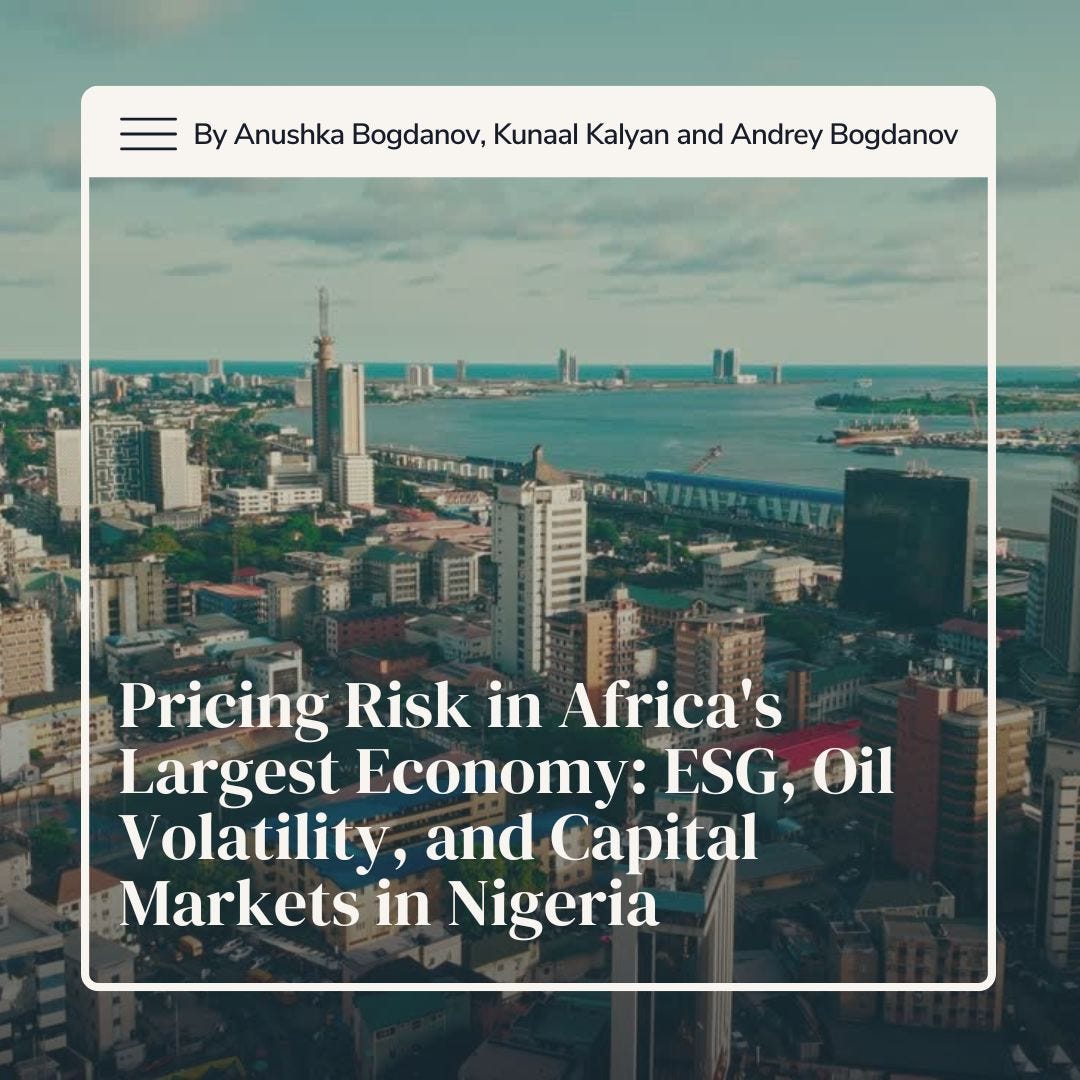
Nigeria is often described in superlatives: Africa’s largest economy, its most populous nation, and one of its most strategically important energy producers. Yet for global investors, lenders, and trade partners, Nigeria is also something else, an ESG stress test.
This is not because Nigeria lacks ambition. Regulatory alignment with global sustainability standards is accelerating, including commitments to International Sustainability Standards Board (ISSB) disclosure frameworks. The challenge lies elsewhere: in whether ESG data is credible enough, governance strong enough, and institutions resilient enough for markets to price Nigerian risk with confidence rather than caution.
This article distils insights from our SSRN-accepted research paper, Pricing Risk in Africa’s Largest Economy: ESG, Oil Volatility, and Capital Markets in Nigeria, and frames ESG not as ideology, but as a market mechanism for pricing risk.

Nigeria as an ESG Stress Test
Nigeria’s capital markets remain shallow relative to the size of its economy, with market capitalisation fluctuating roughly between 20% and 35% of GDP over the past decade. These swings closely mirror oil price cycles, foreign-exchange (FX) stress, and volatile portfolio flows (World Bank, 2023a; IMF, 2023a).
From an ESG perspective, Nigeria embodies a structural paradox: a hydrocarbon-rich economy facing fiscal fragility; a vast youth demographic alongside persistently high unemployment; and ambitious reform signals constrained by governance and institutional capacity gaps (UNDP, 2023; World Bank, 2024). These characteristics make Nigeria an ideal stress test for ESG frameworks in large, heterogeneous emerging markets, where disclosure must operate under macroeconomic and political pressure rather than institutional stability (de Villiers & Maroun, 2018).
Oil, FX Volatility, and the Limits of ESG Disclosure
Nigeria’s ESG risk profile is inseparable from its dependence on hydrocarbons. Oil revenues dominate export earnings and FX inflows, making GDP growth, fiscal capacity, and investor confidence highly sensitive to global oil price cycles (Arezki, Ramey & Sheng, 2017; IMF, 2023a).
Oil price volatility transmits rapidly into FX instability, raising the cost of imported inputs, constraining access to trade finance, and increasing balance-sheet risk for firms with foreign-currency liabilities (Kinda, Mlachila & Ouedraogo, 2016). In such environments, long-term investments in emissions measurement, governance systems, and workforce development are often deferred, even when they would improve resilience.
This dynamic complicates ESG adoption. While sustainability risks are clearly material, forward-looking disclosures may be discounted by markets if investors doubt firms’ ability to execute transition plans under FX and financing constraints (BIS, 2021; ECB, 2022). As a result, ESG reporting risks becoming narrative rather than decision-useful and markets price that uncertainty accordingly.
CBAM: When Trade Policy Becomes a Capital-Markets Filter
The European Union’s Carbon Border Adjustment Mechanism (CBAM) illustrates how ESG risk now travels across borders. Although formally a trade instrument, CBAM has become a capital-allocation mechanism, transmitting climate risk directly into valuation and cost of capital (European Commission, 2023).
For Nigerian exporters, insufficient or unverifiable emissions data can trigger conservative default assumptions at the border, effectively imposing an implicit carbon cost regardless of actual emissions intensity. Empirical evidence shows that markets penalise emissions opacity more heavily than emissions exposure, applying valuation discounts and higher risk premia to firms with weak climate disclosure (Bolton & Kacperczyk, 2021; ECB, 2022).
CBAM therefore reinforces the financial relevance of ISSB IFRS S2 climate-related disclosures, which focus explicitly on risks that affect enterprise value, cash flows, and access to capital (ISSB, 2023). In practice, CBAM accelerates the pricing of transition risk in Nigerian capital markets, even where domestic regulatory enforcement remains uneven.
Social Risk: Demographics, Fragmentation, and Market Confidence
Nigeria’s most significant long-term asset its youth, is also a source of systemic social risk. With a median age below 19 and more than 60% of the population under 25, Nigeria’s growth trajectory depends on whether its labour market can absorb this demographic wave (UN DESA, 2023; World Bank, 2024).
Yet ESG disclosure on workforce composition, youth employment, and retention remains limited. While many firms report high-level social indicators, far fewer disclose data that would allow investors to assess human-capital resilience in a high-pressure labour market (Risk Insights, 2023).
Gender diversity illustrates this imbalance. Although extensive literature links gender-diverse boards to stronger governance and risk oversight (Terjesen, Sealy & Singh, 2009; Post & Byron, 2015), Nigerian firms continue to exhibit under-representation of women across management pipelines. In emerging markets characterised by institutional uncertainty, homogeneous leadership structures are empirically associated with higher governance risk and weaker monitoring (Claessens & Yurtoglu, 2013).
In Nigeria, these social dynamics are not peripheral. They interact directly with productivity, operational continuity, and investor confidence, making social risk financially material rather than reputational.
Governance as the Binding Constraint
Across emerging markets, governance quality consistently explains more variation in valuation and cost of capital than environmental or social factors alone (Claessens & Yurtoglu, 2013; Khan, Serafeim & Yoon, 2016). Nigeria is no exception.
While formal governance disclosure is relatively strong, effective board independence remains constrained by concentrated ownership structures and limited transparency beyond the boardroom, particularly in executive remuneration and procurement practices (Risk Insights, 2023). These gaps weaken the credibility of ESG disclosures and amplify perceived regulatory and earnings risk.
Nigeria’s commitment to adopt ISSB standards is directionally correct. However, early adoption without issuer readiness introduces the risk of adverse repricing rather than value creation. Empirical and supervisory evidence suggests that markets penalise poor-quality or inconsistent disclosure more severely than non-disclosure, as opacity increases uncertainty (BIS, 2021; ECB, 2022).
From a signalling-theory perspective, disclosure frameworks only work when markets believe they are enforced and supported by institutional capacity (Spence, 1973; Suchman, 1995). Sequencing therefore matters more than speed.
ESG as a Credibility Test — Not a Narrative
In Nigeria, ESG is not a branding exercise. It is a discipline of risk recognition, filtered through oil volatility, FX constraints, social stability, and governance enforcement. Where disclosure is credible and supported by data systems and institutional capacity, ESG can reduce information asymmetry and support capital-market re-rating. Where it is not, transparency may amplify perceived risk instead of mitigating it.
Nigeria’s ESG moment will be defined not by the pace of regulatory convergence, but by credibility, the alignment between standards and capacity, disclosure and enforcement, ambition and execution (World Bank, 2023a; ISSB, 2023).
If Nigeria succeeds, ESG can become a pathway to deeper capital markets and more resilient growth. If it does not, exclusion will occur not through regulation alone, but through market repricing in an increasingly ESG-constrained global financial system.
References
-
Arezki, R., Ramey, V.A. and Sheng, L. (2017) ‘News shocks in open economies: Evidence from giant oil discoveries’, Quarterly Journal of Economics, 132(1), pp. 103–155.
-
Bank for International Settlements (BIS) (2021) Climate-related risk drivers and their transmission channels. Basel: Bank for International Settlements.
-
Bolton, P. and Kacperczyk, M. (2021) ‘Do investors care about carbon risk?’, Journal of Financial Economics, 142(2), pp. 517–549. https://doi.org/10.1016/j.jfineco.2021.05.008
-
Claessens, S. and Yurtoglu, B.B. (2013) ‘Corporate governance in emerging markets: A survey’, Emerging Markets Review, 15, pp. 1–33. https://doi.org/10.1016/j.ememar.2012.03.002
-
de Villiers, C. and Maroun, W. (2018) ‘Sustainability accounting and integrated reporting’, in de Villiers, C. and Maroun, W. (eds.) Sustainability Accounting and Integrated Reporting. London: Routledge, pp. 1–18.
-
European Central Bank (ECB) (2022) Climate-related risks and financial stability. Frankfurt: European Central Bank.
-
European Commission (2023) Carbon Border Adjustment Mechanism (CBAM): Questions and Answers. Brussels: European Union.
-
International Monetary Fund (IMF) (2023a) Climate change and trade policy: CBAM and transition risk. Washington, DC: International Monetary Fund.
-
International Sustainability Standards Board (ISSB) (2023) IFRS S2: Climate-related Disclosures. London: IFRS Foundation.
-
Khan, M., Serafeim, G. and Yoon, A. (2016) ‘Corporate sustainability: First evidence on materiality’, The Accounting Review, 91(6), pp. 1697–1724. https://doi.org/10.2308/accr-51383
-
Kinda, T., Mlachila, M. and Ouedraogo, R. (2016) ‘Commodity price shocks and financial sector fragility’, IMF Working Paper WP/16/12. Washington, DC: International Monetary Fund.
-
Post, C. and Byron, K. (2015) Women on boards and firm financial performance: A meta-analysis. Academy of Management Journal, 58(5), pp. 1546–1571. https://doi.org/10.5465/amj.2013.0319
-
Risk Insights (2023) ESG GPS® Nigeria Market Disclosure Analysis. Johannesburg: Risk Insights (Proprietary dataset).
-
Spence, M. (1973) ‘Job market signaling’, Quarterly Journal of Economics, 87(3), pp. 355–374.
-
Suchman, M.C. (1995) ‘Managing legitimacy: Strategic and institutional approaches’, Academy of Management Review, 20(3), pp. 571–610.
-
Terjesen, S., Sealy, R. and Singh, V. (2009) Women directors on corporate boards: A review and research agenda. Corporate Governance: An International Review, 17(3), pp. 320–337. https://doi.org/10.1111/j.1467-8683.2009.00742.x
-
United Nations Department of Economic and Social Affairs (UN DESA) (2023) World Population Prospects 2023. New York: United Nations. Available at: https://population.un.org/wpp/
-
United Nations Development Programme (UNDP) (2023) Nigeria Human Development Report: Social inclusion and governance. Abuja: UNDP.
-
World Bank (2023a) Nigeria Development Update: Seizing the Opportunity. Washington, DC: World Bank Group.
-
World Bank (2024) World Development Indicators: Nigeria. Washington, DC: World Bank Group. Available at: https://data.worldbank.org/country/nigeria
메타데이터
- post_id
- 78e91c11b217
- slug
- pricing-risk-in-africas-largest-economy-why-esg-oil-volatility-and-capital-markets-collide-in-78e91c11b217
- url
- https://medium.com/@esggpssa/pricing-risk-in-africas-largest-economy-why-esg-oil-volatility-and-capital-markets-collide-in-78e91c11b217
- canonical_url
- https://medium.com/@esggpssa/pricing-risk-in-africas-largest-economy-why-esg-oil-volatility-and-capital-markets-collide-in-78e91c11b217
- author_url
- https://medium.com/@esggpssa
- status
- ok
- fetched_at
- 2026-06-20 20:29:01