“Where the good way is”
A Brief Timeline of Southern Baptists: 1600–2000
“Where the good way is”
In Jeremiah 6:16, the prophet implores God’s people to “stand by the roads, and look, and ask for the ancient paths, where the good way is; and walk in it, and find rest for [their] souls.” While this verse specifically speaks to the nation of Israel that had turned away and forgotten the ways of the LORD their God, it beckons to the 21st century Christian as well: to scour redemptive history for the mighty works that God has performed as recorded in the Scriptures, as accomplished in the life, death, resurrection, and ascension of his Son, and those works which he is still bringing about through the power of his Spirit and Word through his Church — so that we might return to him and the life that comes in walking in his wisdom.
Within this drama, Baptists have only inhabited history for roughly the past 400 years, not quite a significant amount of time if we are including the centuries of history recorded in the Old Testament. Regardless of this relative “newness” on the stage of God’s redeeming work, throughout their entire existence Baptists have undeniably played a role as instruments in taking the gospel to the nations. However, just as Israel as God’s covenant people were marked by many ebbs and flows of faithfulness and outright rebellion, so too has the life of Baptists been one of continuous regress and renewal. Hence, the prophet Jeremiah’s call to all of God’s people through all of time and space to seek the Lord and his “good way” even when they choose to defiantly claim, “We will not pay attention!” (Jer. 6:17) Despite our propensity to walk a different path than the “good way,” God invites his people to examine their history so that they might rediscover what is good, identify that which is evil, and walk in humble repentance into the future.
For context: at the time of this work, I am currently a master’s student at The Southern Baptist Theological Seminary and have compiled this short timeline for a class on Southern Baptist Heritage & Mission with Dr. Eric Smith. I did not grow up Southern Baptist nor am I currently a member of an SBC church, but I would still affirm many of those distinctives that make Baptist churches “Baptist.” This timeline is by no means exhaustive of all of Southern Baptist history simply due to course scope and time constraints, however, I have still found its information useful to identify my place within redemptive history and hope it provides the same for any potential reader.
Above all, my hope and prayer is that this greatly-abbreviated timeline might play even a minute role in helping myself, and any pilgrim to this article that finds themself also intrigued by Southern Baptist history, stand at the crossroads of the 21st century and ask for the ancient paths that led us here, that we might find the good way, walk in it (seeking forgiveness for where we have neglected to do so), and find rest for our souls (Ps. 1; Matt. 11:28–30; Jn. 14:6).
1600’s: Across the Atlantic
1608 // John Smyth and Thomas Helwys organize first English-speaking Baptist Church in Amsterdam
1638 // London Baptists organize first Particular Baptist Church
In 1616, Henry Jacob (1563–1624) of the Church of England, returned from his exile in Holland (due to his outspoken calls for reform) and gathered what became known as “The JLJ Church” in Southwark. After a tumultuous two decades that included three different lead pastors, internal theological differences, and multiple church splits, one specific group split from The JLJ Church in 1638 in protest primarily against infant baptism. This group, led by John Spilsbury (1593–c. 1668), launched the first church ever considered Calvinist Baptist. Historically, the new churches espousing these convictions would be known as Particular Baptists.
1639 // First Baptist Church of Providence, Rhode Island organizes first Baptist church in North America
William Screven (1629–1713)
Born in Somerset, England, William Augustine Screven set sail for the American colonies as a teenager in the 1640s. A few decades later, Screven was baptized in Boston, Massachusetts by John Myles, the notable Baptist church planter who founded the first Baptist churches in Wales and Massachusetts. Screven himself was later ordained in 1682 in preparation to plant a church in Kittery, Maine, which was established early that autumn. In 1696, in the midst of congregational turmoil in Kittery, 28 members of the church and Screven left for South Carolina to plant the first Baptist church in the American South: the First Baptist Church of Charleston.
1696 // First Baptist Church of Charleston, South Carolina becomes first Baptist church in the American South
1700’s: Headed South
1707 // Philadelphia Baptist Association established as first Baptist association
1740 // George Whitefield preaches in Baptist church in Charleston at start of First Great Awakening
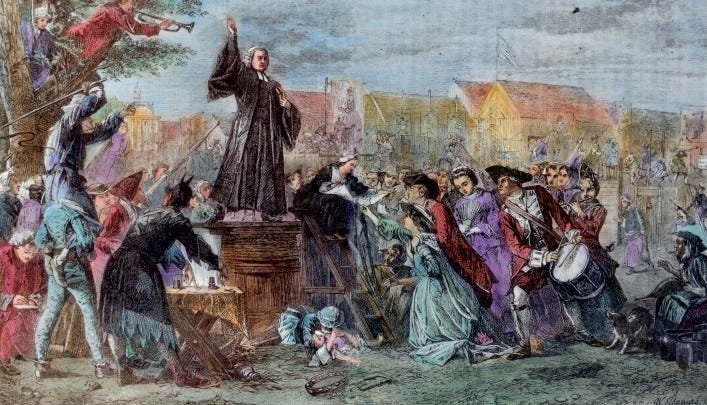
During the second of his seven trips to America, the talented evangelist and Anglican chaplain George Whitefield became entangled in a local pamphlet and sermon war in Charleston, South Carolina with Alexander Garden, the rector of St. Philip’s Church and commissary of the Bishop of London. Though Whitefield’s preaching stirred the fires of the First Great Awakening, seeing numerous adults and children come to faith in Christ, he did not spare criticizing many clergymen in the Church of England for their lack of belief in justification by faith and instantaneous conversion. Local Congregationalist Josiah Smith and Baptist Isaac Chanler both championed and defended Whitefield’s ministry efforts in the town during this time, although the year would ultimately be characterized by its conflict and division rather than its contribution to the larger Great Awakening fruits.
1752 // Charleston Baptist Association organized as first Baptist association in the American South
1758 // Sandy Creek Baptist Association operates as center of Separate Baptist movement
1775–1783 // American Revolutionary War

George Liele (c. 1750–1828)
George Liele was born as a slave in Virginia just over two decades prior to the American Revolution. After being moved to Savannah, Georgia and converting in 1773, he quickly began ministering and preaching to other slaves, occasioning his ordination as a missionary to other slaves just two years later. After the onset of the war, the British loyalist Liele was freed from slavery in 1778 and eventually made passage with his family to Jamaica in order to flee the colonies. Liele spent the remainder of his life preaching and establishing churches in Jamaica, leading to an estimated 8,000 Baptists believers recorded on the island by 1814. Within Baptist lore, Liele is credited with being the first Baptist missionary: though William Carey is often credited with this feat, Liele reached Jamaica in 1783, ten years prior to the former’s leaving for India in 1793.

George Liele (c. 1750–1828)
1796 // John Taylor’s preaching begins Second Great Awakening in Kentucky
After moving to Kentucky in 1785, John Taylor spent the next decade planting new churches in Woodford and Boone County. His preaching and launching of these various churches coincided with other Protestant frontier efforts that proved a significant part of the impetus of the Second Great Awakening. In these early years of the revival, Taylor would help lead the Separate and Regular Baptists to reunify as the “United Baptists” and would see Baptist ranks in Kentucky reach 14,076 members by 1802.
John Taylor (1752–1833)
John Taylor was born in Fauquier County, Virginia to parents who were members of the Church of England. Despite his frontier Anglican upbringing, it wasn’t until he was 17 that Taylor became a Christian after hearing the preaching of William Marshall. Due to Marshall’s influence and a reading of the New Testament, Taylor was baptized two years later as he became a Baptist “from principle.” Taylor eventually moved to Kentucky in 1785, where he would spend much of the remainder of his life planting churches in multiple Kentucky counties, launching various Baptist associations, leading Baptist reunification efforts, as well as being credited with helping kindle the American counterpart of the Second Great Awakening.
1800’s: Cooperation & Conflict
1814 // Triennial Convention formed
1821 // Baptists appoint Lott Cary as first African American missionary
1830 // Baptists disfellowship “Cambellites”
1845 // Organization of Southern Baptist Convention & Foreign and Home Mission Boards
In the climate of Antebellum America, pro-slavery Baptists met in Augusta, Georgia on May 8, 1845 to launch a new missionary organization in defiance of the American Baptist Home Mission Society’s (ABHMS) refusal to take a stance on slavery. At this meeting, former Triennial Convention president William Bullein Johnson was appointed as the first president of the new Southern Baptist Convention (SBC), simultaneously organizing the Foreign Mission Board and Home Mission Board. Because Johnson and the SBC claimed that this new convention was rooted in a desire for faithful global and domestic mission efforts, the SBC would not address their marred history until the release of a “Resolution on Racial Reconciliation on the 150th Anniversary of the Southern Baptist Convention” in 1995.
John L. Dagg (1794–1884)
Born in Middleburg, Virginia, John Leadley Dagg became a Christian in 1809 at the age of 15. At the age of 18, Dagg became convictionally Baptist after an investigation of believer’s baptism and became a member of the local Ebenezer Baptist Church shortly after. Ordained in 1817, Dagg spent eight years pastoring small churches in Virginia before accepting the call to the Fifth Baptist Church of Philadelphia. After stints in leadership at the Haddington Institute and Alabama Female Athenaeum, the pastor-theologian became the president of Mercer University in Georgia in 1844 (a year before the inception of the Southern Baptist Convention), where he also taught theology. Dagg retired from his presidency in 1854 and spent the next decade and a half writing his acclaimed systematic theology and ecclesiology works, before moving back to Alabama prior to his death in 1884. Though renowned for his leadership of Mercer University and for being the first Southern Baptist to write a systematic theology, Dagg also defended the SBC’s stance on slavery in his Elements of Moral Science (1859).

John L. Dagg (1794–1884)
1859 // The Southern Baptist Theological Seminary founded in Greenville, South Carolina
James P. Boyce (1827–1888)
Son of one of the wealthiest families in South Carolina, James Petigru Boyce was born in Charleston in 1827. Though his mother was converted by the preaching of the notable pastor of the First Baptist Church of Charleston, Basil Manly, Sr., Boyce was not converted until his time at Brown University in 1846 when university president Francis Wayland delivered a convicting message at the school’s chapel. After graduation, Boyce attended Princeton Theological Seminary (studying under the likes of Charles Hodges) before serving as the pastor of the First Baptist Church of Columbia, South Carolina for two years. Over the next decade, Boyce would teach briefly at Furman University before founding The Southern Baptist Theological Seminary, serving as a Confederate chaplain during the American Civil War, and even serving in the South Carolina state legislature. Like his contemporaries, Boyce’s legacy is hindered by his complicity with the sin of slavery among the SBC, although he can still be credited for his passionate dedication to building a seminary rooted in openness, excellence, and confessional identity until his death in 1888.

James P. Boyce (1827–1888)
1861–1865 // American Civil War

1879 // President Crawford H. Toy dismissed from SBTS after embracing German theological liberalism
1888 // First Lottie Moon Christmas offering
Annie Armstrong (1850–1938)
Born in Baltimore, Maryland, Annie Walker Armstrong became a Christian at age 19 and subsequently joined Seventh Baptist Church of Baltimore. Two years later, Armstrong and 117 fellow members left Seventh Baptist to plant Eutaw Place Baptist Church (also in Baltimore). Within Southern Baptist history Armstrong is known for her role in drafting the constitution of the Woman’s Missionary Union that connected the organization to the Southern Baptist Convention–she would serve as the corresponding secretary for the body until 1906. Armstrong was distinguished for her continued writing contributions to various missions publications, as well as her fundraising efforts that included the first Christmas offering for Lottie Moon in China.

Annie Armstrong (1850–1938)
1890 // Alberto Diaz sent to Cuba as an SBC missionary
Alberto Diaz (1852–1941)
Alberto Diaz was born to Roman Catholic parents in Guanabacoa, Cuba in 1952, the oldest of twenty-four children. After attending the University of Havana for a portion of his collegiate studies, Diaz served in the Cuban military during the Ten Years’ War against the Spanish government. At one point during the war, Diaz was separated from his unit and swept out to sea, where he was rescued by fishermen and sent to New York City. In New York, Diaz showed an affinity for medical studies and eventually converted to Christianity after a hospital visitor shared the gospel with the young man during a bout with pneumonia. Shortly after, Diaz was baptized and trained by R.B. Montgomery before he returned to Cuba to preach the gospel and establish Baptist churches. Due to ongoing conflicts in Cuba for the remainder of the century, Diaz would have to leave and return to Cuba multiple times, however he did so with great support from the Florida Board of Missions as well as the Home Mission Board of the SBC. Diaz’s efforts led to the establishment of the West Cuba Baptist Convention and the continued presence of Baptist missionaries in Cuba until 1965.
1899 // E.Y. Mullins becomes 4th president of SBTS
E.Y. Mullins (1860–1928)
Dedicated to ministry by his parents at birth, Edgar Young Mullins was born in Franklin County, Mississippi. After joining the inaugural class of Texas A&M University in 1876 with intentions to become a lawyer, Mullins was converted at a revival meeting in Dallas, Texas shortly after graduating. By 1881, Mullins was enrolled at The Southern Baptist Theological Seminary, where he planned on training to become a missionary. Due to health reasons, Mullins did not go overseas, but began to pastor Harrodsburg Baptist Church in Harrodsburg, Kentucky after graduating from SBTS. Over the next two decades, Mullins married Isla May Hawley, pastored Lee Street Baptist Church in Baltimore, Maryland, worked briefly for the Foreign Mission Board, and pastored another church in Massachusetts before making his way back to SBTS–this time as professor of theology and president of the flagship institution. Mullins served in this role until his death in 1928, and left a meditating legacy for navigating multiple theological crises (including the issue of Calvinism, the Landmark interpretation, and the Fundamentalist-Modernist dispute) while also serving in presidencies for the Southern Baptist Convention and the Baptist World Alliance.
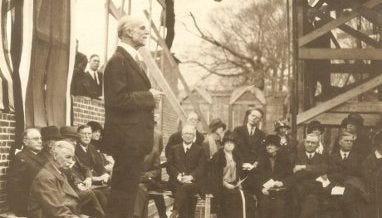
E.Y. Mullins (1860–1928)
1900’s: Revisions & Resurgence
1925 // SBC adopts Cooperative Program and The Baptist Faith and Message (1925)
George Truett (1867–1944)
Born in Hayesville, North Carolina, George Washington Truett was converted in 1886 before joining Hayesville Baptist Church. Three years later, Truett moved with his parents to Whitewright, Texas, where he was ordained by Whitewright Baptist Church in 1890. Shortly after, Truett worked for Baylor University in Waco, Texas for two years as a financial secretary before enrolling as a freshman in 1893. During his time at Baylor, Truett married Jospehine Jenkins and served as a youth pastor at East Waco Baptist Church before assuming the pastorate at First Baptist Church of Dallas, Texas in 1897. Truett would remain at FBC Dallas for the remainder of his life, serving as the president of the SCB from 1927 to 1929 and president of the Baptist World Alliance from 1934 to 1939.
1949 // Billy Graham leads first “crusade” in Los Angeles, California

1952 // Martyrdom of Dr. Bill Wallace in South China
1961 // Ralph Elliott’s The Message of Genesis sparks SBC controversy and Baptist Faith and Message reform
Herschel Hobbs (1907–1995)
Born in Marble Valley, Alabama, Herschel H. Hobbs actually grew up attending a local Methodist church before his mother began taking him and his siblings to a Baptist church after his father’s death when he was two years of age. Nine years later, Hobbs became a Christian at a Baptist revival at Enon Baptist Church. Hobbs felt called to vocational ministry at a young age and enrolled at Howard College shortly after he married Frances Jackson in 1927. After his time at Howard College, Hobbs enrolled at The Southern Baptist Theological Seminary for his Th.M. and Ph.D. programs while he pastored various churches in Indiana and Kentucky. Hobbs eventually made his way to First Baptist Church, Oklahoma City in 1949 and from here would serve in many capacities within Southern Baptist life, most notably as president of the SCB from 1961 to 1963. It was during this tenure when Hobbs chaired the committee that revised The Baptist Faith and Message. Hobbs retired from his pastorate in Oklahoma City in 1972, yet would continue to serve the SBC until his death 23 years later.

Herschel Hobbs (1907–1995)
1963 // Baptist Faith and Message revised into second iteration after Elliott controversy
1969–1971 // Growing controversy over the infallability of Scripture within SBC
1979 // Adrian Rogers elected SBC presidence to initiate “conservative revolution
1985 // Dallas, Texas hosts largest Southern Baptist Convention in history (45,561)

1991 // First meeting of the Cooperative Baptist Fellowship
1993 // R. Albert Mohler, Jr. appointed president at SBTS
Prior to 1993, the Southern Baptist Theological Seminary (SBTS) had reached new peaks of enrollment and endowment, while various faculty began to teach against the inerrancy of the Scriptures. Though a resurgence of conservative theology had already been initiated by previous president, Dr. Roy L. Honeycutt, the appointment of Dr. Albert Mohler, Jr. after the former’s retirement arguably marked the beginning of a renewed commitment to orthodox Baptist belief, practice, and teaching at the school. The following year, President Mohler would launch the Billy Graham School of Evangelism, Missions, and Church Growth.

Billy Graham and R. Albert Mohler, Jr. on October 14th, 1993
1995 // SBC releases Resolution On Racial Reconciliation On The 150th Anniversary Of The Southern Baptist Convention
2000 // Baptist Faith and Message revised to reassert biblical inerrancy
메타데이터
- post_id
- 78ef18bae73b
- slug
- where-the-good-way-is-78ef18bae73b
- url
- https://medium.com/@acowboyandascholar/where-the-good-way-is-78ef18bae73b
- canonical_url
- https://medium.com/@acowboyandascholar/where-the-good-way-is-78ef18bae73b
- author_url
- https://medium.com/@acowboyandascholar
- status
- ok
- fetched_at
- 2026-06-27 18:20:27




