Cloud POS vs Traditional POS: What UAE Businesses Need to Know
The UAE’s retail and hospitality landscape is evolving faster than almost anywhere else in the world. From sprawling malls in Abu Dhabi to…
Cloud POS vs Traditional POS: What UAE Businesses Need to Know
The UAE’s retail and hospitality landscape is evolving faster than almost anywhere else in the world. From sprawling malls in Abu Dhabi to boutique cafés lining Jumeirah’s side streets, business owners face a decision that quietly shapes how their entire operation runs: should they invest in a cloud-based point of sale system, or stick with a traditional, on-premise setup?
This isn’t a trivial choice. The wrong call costs money, creates compliance headaches, and limits growth. The right one streamlines operations, reduces overhead, and positions a business to scale. Here’s what UAE business owners, across retail, F&B, and services, actually need to understand before deciding.
What “Traditional POS” Really Means
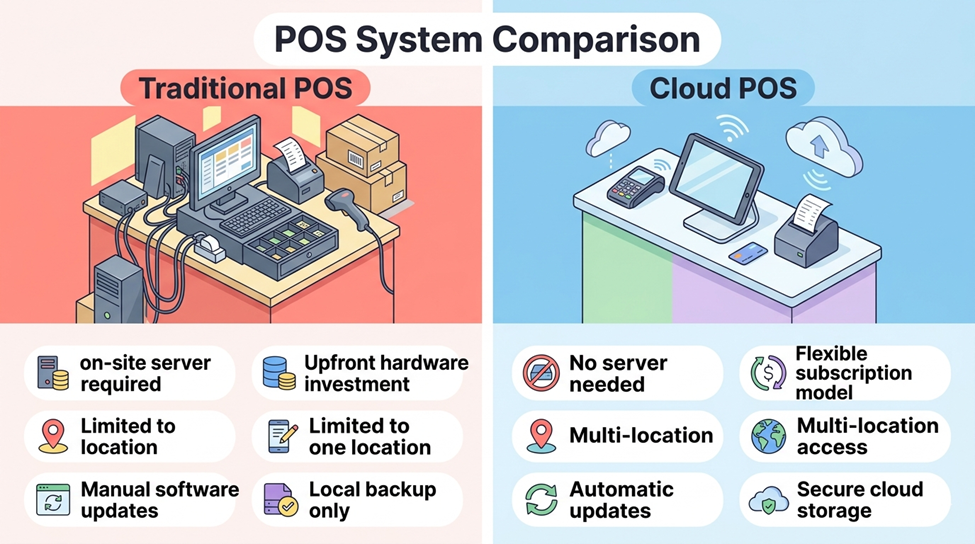
A traditional POS system, sometimes called a legacy or on-premise system, stores all data locally; on a server or hard drive physically located at the business. Transactions are processed through dedicated POS terminals connected to that local infrastructure.
For years, this was the standard. Supermarkets, pharmacies, and department stores across the UAE ran on these systems because they were perceived as reliable and secure. The hardware was owned outright, and the software was a one-time purchase.
The tradeoffs, however, are significant. Upfront costs are high. Maintenance falls on the business. Updating the software often requires a technician on-site. And critically, data lives in one place; which becomes a serious vulnerability if that hardware fails or is damaged.
How Cloud-Based POS Systems Work Differently

A cloud POS system, also referred to as a SaaS POS or web-based point of sale solution, processes and stores data on remote servers accessed via the internet. Business owners can log in from any device, anywhere, and see real-time sales figures, inventory levels, staff performance, and customer data.
Pricing is typically subscription-based, meaning lower upfront costs but ongoing monthly or annual fees. Updates happen automatically. New branches or locations can be added without purchasing new server infrastructure. Multi-outlet retailers in Dubai and across the Emirates have increasingly gravitated toward cloud POS platforms for precisely this reason.
The trade-off that gives many business owners pause is internet dependency. A weak or interrupted connection can disrupt transactions; though most modern cloud POS solutions now offer offline functionality that syncs once connectivity is restored.
The UAE-Specific Factors That Should Drive Your Decision

VAT Compliance and Reporting Requirements
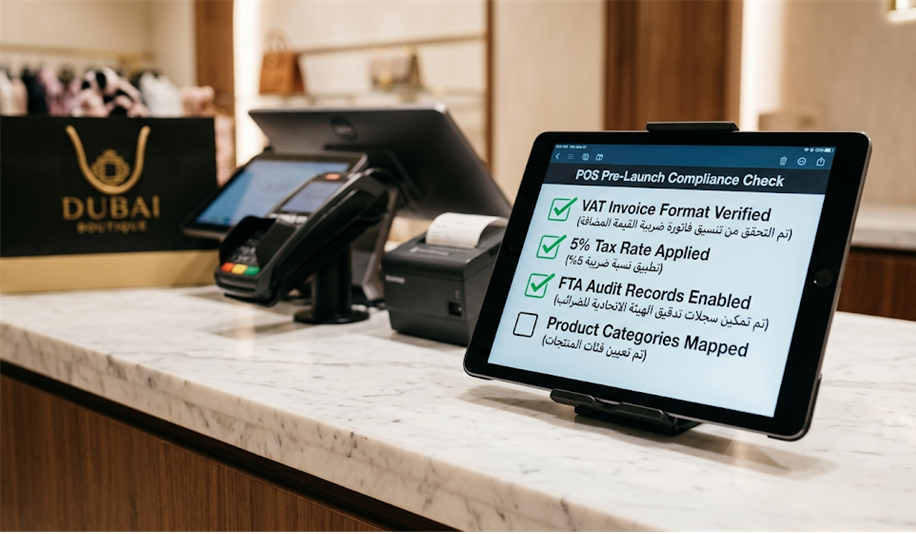
One dimension that often gets overlooked in generic cloud vs. traditional comparisons is regulatory compliance. Since the UAE introduced VAT in 2018, the Federal Tax Authority has clear expectations around how businesses record, report, and audit sales data.
Cloud POS softwares generally have an advantage here. Automatic tax calculation, real-time reporting, and digital audit trails are built-in features on most modern platforms. Traditional systems can be configured for VAT compliance, but updates to tax rules or reporting formats require manual software patches; a slower and more error-prone process.
If you want a deeper understanding of how POS infrastructure intersects with UAE tax obligations, this article on VAT compliant POS systems covers the technical and regulatory requirements in detail.
Arabic Language and Localization Support
A POS solution that can’t communicate fluently with your staff or your customers isn’t truly fit for purpose in the UAE. This means bilingual interfaces, Arabic receipt printing, and right-to-left UI compatibility; none of which are guaranteed regardless of whether a system is cloud-based or on-premise.
Cloud platforms have an edge when it comes to pushing localization updates remotely, but the quality of Arabic support still varies significantly between vendors. For businesses operating in environments where Arabic is the primary language, or where customers expect Arabic receipts and invoices, this needs to be evaluated independently.
Our previous discussion on Arabic support in UAE POS systems breaks down exactly what to look for when assessing a platform’s bilingual capabilities.
Connectivity and Business Continuity
The UAE’s internet infrastructure in commercial districts is generally excellent, but relying entirely on connectivity without a fallback plan is a risk no business should take; particularly in high-transaction retail or busy restaurant environments.
When evaluating any cloud-based point of sale solution, the key question is: what happens during an outage? Does the system continue processing transactions locally and sync later? Or does everything grind to a halt? Vendors handle this differently, and it should be a non-negotiable part of any procurement conversation.
Cost: What the Numbers Actually Look Like

Traditional POS hardware and software can require significant capital expenditure upfront; servers, terminals, installation, and licensing. For a single-outlet operation that doesn’t anticipate rapid scaling, this model can make financial sense.
Cloud POS shifts the cost structure. Subscription fees accumulate over time, but businesses avoid large capital outlays, expensive maintenance contracts, and the cost of hardware replacement cycles. For multi-branch retailers or businesses planning to expand across the Emirates, the cloud model typically becomes more economical within 18 to 36 months.
Scalability and Remote Management
This is where cloud POS systems offer the clearest advantage for growing UAE businesses. Adding a second location to a traditional POS setup means duplicating hardware, configuring local servers, and manually synchronizing inventory data. It’s slow and expensive.
Cloud-based retail management software handles multi-location expansion through a single dashboard. Inventory, staff access, pricing, and promotions can be managed centrally and pushed across all outlets simultaneously. For franchise operators and multi-outlet retail chains, this capability alone justifies the shift.
Which Should UAE Businesses Choose?
There’s no universal answer, but there is a practical framework. If a business operates from a single location, has limited IT support, and values predictable costs, a well-configured traditional POS may still serve adequately. If a business is growing, operates across multiple locations, prioritizes real-time data access, and needs seamless VAT reporting; cloud POS is the more future-proof investment.
What’s clear is that the decision shouldn’t be made on price or familiarity alone. The UAE market has specific demands around compliance, language, and operational scale that make this choice consequential. Evaluating point of sale software against those local requirements, rather than generic global benchmarks, is the difference between a system that works and one that grows with you.
메타데이터
- post_id
- 78f698ff972e
- slug
- cloud-pos-vs-traditional-pos-what-uae-businesses-need-to-know-78f698ff972e
- url
- https://medium.com/@multitechpos.profiles/cloud-pos-vs-traditional-pos-what-uae-businesses-need-to-know-78f698ff972e
- canonical_url
- https://medium.com/@multitechpos.profiles/cloud-pos-vs-traditional-pos-what-uae-businesses-need-to-know-78f698ff972e
- author_url
- https://medium.com/@multitechpos.profiles
- status
- ok
- fetched_at
- 2026-06-09 15:37:30