The Global Water Crisis Could Become Bigger Than the Oil Crisis
For more than a century, oil shaped the global balance of power.
The Global Water Crisis Could Become Bigger Than the Oil Crisis
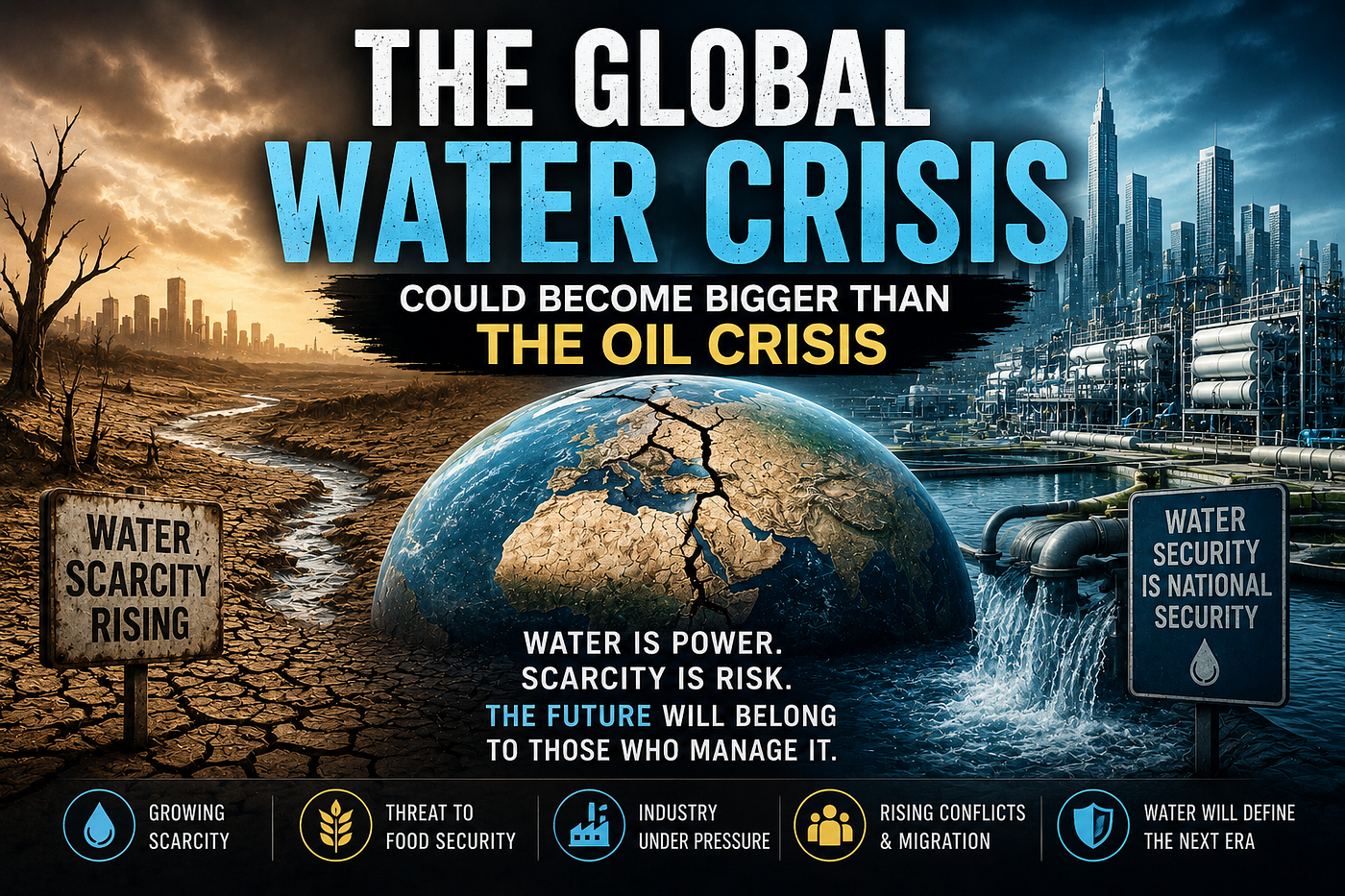
For more than a century, oil shaped the global balance of power.
Wars were influenced by it. Alliances were built around it. Entire economies rose because of it. The countries that controlled energy resources often controlled geopolitical influence as well.
But the next major global crisis may not revolve around oil, semiconductors, or even artificial intelligence.
It may revolve around water.
Not because the world is running out of water entirely, but because access to clean, reliable, and usable freshwater is becoming one of the most unequal and strategically important resources on Earth.
That shift is happening much faster than most people realize.
For decades, water scarcity was treated primarily as an environmental or humanitarian issue. Today, governments increasingly see it as an economic, industrial, agricultural, and national-security challenge.
The consequences could reshape geopolitics in ways similar to the oil shocks of the 20th century.
The reason is simple.
Modern civilization depends on enormous quantities of freshwater.
Agriculture requires it. Manufacturing depends on it. Semiconductor production consumes vast amounts of ultra-pure water. Energy generation relies heavily on cooling systems. Cities cannot function without stable supply networks.
Even the technologies designed to build a cleaner future require water-intensive industrial systems.
As climate change intensifies and populations continue growing, pressure on freshwater systems is accelerating globally.
The world is entering an era where water stress may influence economic stability as much as energy prices once did.
This is no longer a distant threat.
Major rivers are shrinking. Reservoir levels are falling. Groundwater reserves are being depleted faster than they can replenish. Heat waves and droughts are becoming more frequent across multiple continents simultaneously.
Some regions are approaching critical stress levels.
Countries across the Middle East and North Africa already face severe water scarcity. Parts of India are experiencing declining groundwater reserves at alarming speed. Western regions of the United States continue struggling with prolonged drought conditions. Southern Europe is confronting increasing agricultural pressure from rising temperatures.
Even regions historically considered water-secure are becoming vulnerable.
This changes the global economic equation.
For decades, businesses optimized supply chains primarily around labor costs, logistics, taxation, and energy access. Water availability may increasingly become another decisive factor in industrial planning.
That possibility is especially important for advanced manufacturing sectors.
Semiconductor fabrication plants require massive amounts of highly purified water to produce chips. Data centers supporting artificial intelligence expansion consume enormous cooling resources. Battery manufacturing and clean-energy infrastructure development also depend heavily on industrial water systems.
The future digital economy is far more water-dependent than many people understand.
This creates a hidden vulnerability.
The world is simultaneously expanding AI infrastructure, clean-energy systems, industrial production, and urbanization while climate instability increases pressure on freshwater resources.
Those trends are colliding.
And the consequences may redefine geopolitical power in the coming decades.
Countries with stable freshwater access could gain enormous strategic advantages. Nations facing severe scarcity may encounter economic instability, agricultural disruption, migration pressure, and political tensions.
This is why water is increasingly being discussed in national-security circles.
Control over water infrastructure can influence entire populations and economies. Rivers crossing international borders already generate geopolitical friction in several regions. Climate stress could intensify these disputes dramatically.
The Nile River remains central to tensions between Egypt and Ethiopia. Water-sharing disputes continue between India and Pakistan. Central Asian countries face growing concerns over river access and hydropower systems. China’s upstream control of major rivers has also raised regional anxieties.
These tensions may grow as water scarcity worsens.
Unlike oil, however, water has no easy substitute.
Energy systems can eventually diversify into renewables, nuclear, or alternative technologies. Freshwater is fundamentally irreplaceable for human survival and industrial civilization.
That makes the challenge uniquely dangerous.
At the same time, water scarcity is deeply connected to food security.
Agriculture accounts for the majority of global freshwater consumption. As drought conditions intensify, crop yields become increasingly vulnerable. Rising temperatures also increase evaporation rates and irrigation demand.
This creates a dangerous cycle.
Lower water availability can reduce agricultural productivity, increase food prices, destabilize economies, and intensify migration pressures. Political instability often follows prolonged food and water insecurity.
History repeatedly demonstrates this pattern.
Several researchers have argued that environmental stress contributed to instability before conflicts in regions such as Syria. While no crisis emerges from a single factor alone, water scarcity can amplify existing economic and political vulnerabilities.
The economic consequences are already visible.
Insurance costs are rising in climate-vulnerable regions. Agricultural volatility is increasing food-market uncertainty. Industrial facilities are facing operational disruptions due to water shortages and heat stress.
Even global financial institutions are beginning to treat water risk as a serious investment variable.
Investors increasingly recognize that companies dependent on water-intensive operations may face long-term exposure to climate-related disruption. Businesses operating in high-risk regions could encounter rising operational costs and supply instability.
This is pushing governments and corporations toward new strategies.
Desalination projects are expanding rapidly, especially in the Middle East. Water recycling technologies are receiving greater investment. Smart irrigation systems are improving agricultural efficiency. Infrastructure modernization is becoming more urgent worldwide.
Technology may partially reduce future pressure.
Artificial intelligence is already being used to optimize water management systems, predict drought conditions, detect infrastructure leaks, and improve irrigation efficiency. Advanced sensors and data analytics are helping utilities manage consumption more intelligently.
But technology alone may not solve the underlying imbalance.
Global water demand continues rising while climate instability disrupts traditional weather patterns and freshwater replenishment cycles.
The challenge is structural.
Some analysts believe water could eventually become one of the defining geopolitical resources of the 21st century.
That possibility changes how nations think about resilience.
For decades, economic strategy focused heavily on globalization and efficiency. Countries assumed essential resources could always move across borders through stable international markets.
Recent crises shattered that assumption.
The pandemic exposed supply-chain vulnerabilities. Energy shocks revealed dependence risks. Semiconductor shortages demonstrated the fragility of advanced manufacturing ecosystems.
Water scarcity may create another layer of systemic vulnerability.
Governments are increasingly prioritizing resource security alongside economic growth.
This is leading to a broader transformation in industrial policy.
Countries are investing more aggressively in climate adaptation infrastructure, reservoir systems, desalination capacity, water recycling technologies, and agricultural resilience.
The nations that adapt fastest may gain substantial long-term advantages.
This could reshape migration patterns as well.
Regions experiencing severe water stress may become less economically viable over time, increasing population movement toward more stable environments. Urban centers already struggling with infrastructure pressure may face additional strain.
The geopolitical implications are enormous.
Access to freshwater could influence industrial competitiveness, food production, energy systems, and social stability simultaneously. Nations capable of securing resilient water systems may strengthen economic influence in an increasingly climate-stressed world.
The private sector is also beginning to respond.
Large corporations are evaluating water availability more carefully when selecting locations for manufacturing and data-center expansion. Sustainability reporting increasingly includes water-risk exposure. Investors are pressuring companies to disclose climate vulnerabilities tied to resource consumption.
Water is becoming financially material.
That shift mirrors what happened with carbon emissions over the last decade.
Issues once viewed primarily as environmental concerns are now entering the core of economic strategy. Climate adaptation is no longer separate from business planning or national policy.
It is becoming central to both.
The most important point is that water scarcity is not a future problem waiting for future generations.
It is already influencing agriculture, infrastructure, industrial planning, migration, and geopolitical tensions today.
And unlike many technological disruptions, this challenge operates according to physical limits.
Freshwater systems cannot expand infinitely. Groundwater depletion cannot continue forever without consequences. Climate instability cannot intensify indefinitely without reshaping economic systems.
The world is approaching a period where resource management may become one of the defining tests of global leadership.
Countries capable of balancing industrial growth, technological advancement, and climate resilience may emerge stronger. Nations unable to adapt could face rising instability.
This is why water may ultimately become more geopolitically significant than many current headlines suggest.
Artificial intelligence may transform economies. Climate policy may reshape trade. Semiconductors may define technological power.
But without stable access to freshwater, none of those systems can function sustainably at scale.
That reality is beginning to reshape how governments, corporations, and investors think about the future.
The next great global competition may not simply be about energy, technology, or military strength.
It may be about securing the most essential resource civilization has always depended on.
Water.
Subscribe to Genecapsule for more deep dives into AI, geopolitics, business, climate policy, and the future shaping the global economy. Stay ahead of the curve and join the community today.
메타데이터
- post_id
- 79016a34c32c
- slug
- the-global-water-crisis-could-become-bigger-than-the-oil-crisis-79016a34c32c
- url
- https://medium.com/@anandv_62921/the-global-water-crisis-could-become-bigger-than-the-oil-crisis-79016a34c32c
- canonical_url
- https://medium.com/@anandv_62921/the-global-water-crisis-could-become-bigger-than-the-oil-crisis-79016a34c32c
- author_url
- https://medium.com/@anandv_62921
- status
- ok
- fetched_at
- 2026-06-09 15:37:30