Introduction to Spiking Neural Networks: Neuronal Dynamics
In the previous article we introduced SNNs and Neuromorphic computing. Now let’s dive deeper into neuronal dynamics within the human brain!
Introduction to Spiking Neural Networks: Neuronal Dynamics
In the previous article we introduced SNNs and Neuromorphic computing. Now let’s dive deeper into neuronal dynamics within the human brain!
Let us suppose that a neuron sends a signal across a synapse. It’s common to refer to the sending neuron as the presynaptic cell and to the receiving neuron as the postsynaptic cell. In biological systems, electric charge is carried by ions, and nerve cells are separated from the outside world by a lipid membrane (a barrier normally impermeable to ions).
The inside of a cell is more negatively charged than the outside. This charge imbalance results in electric potential. When an action potential arrives at a synapse, it triggers a complex chain of biochemical processes that lead to a release of neurotransmitter from the presynaptic terminal to the postsynaptic terminal.
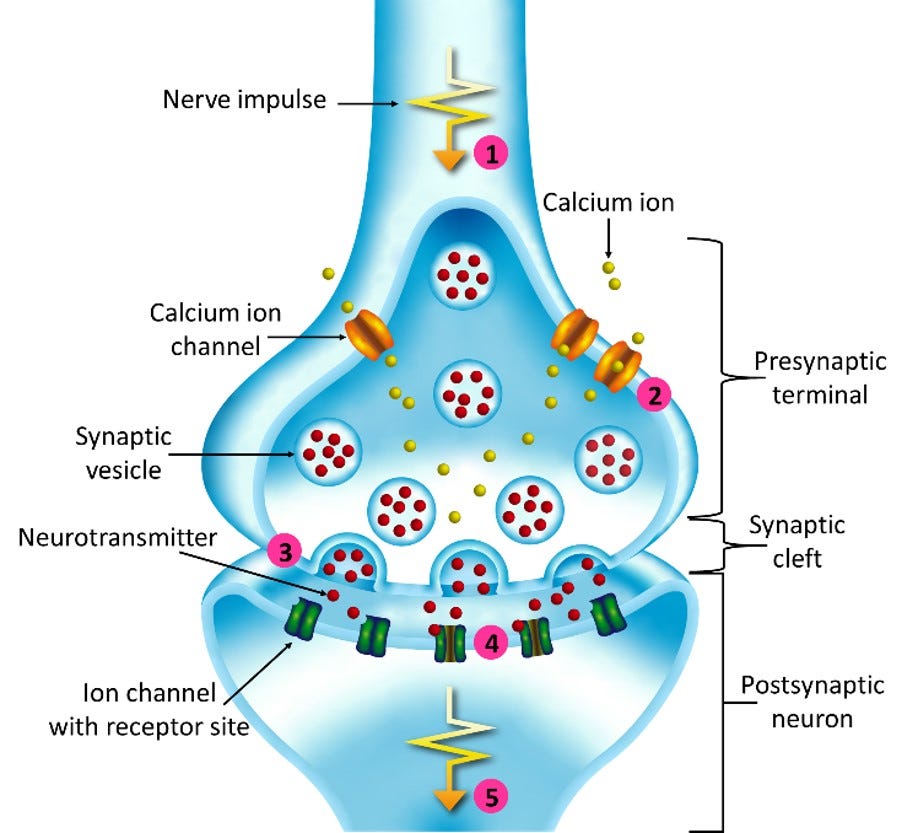
Source: OIST
As soon as transmitter molecules have reached the postsynaptic side, they will be detected by specialized receptors in the postsynaptic cell membrane and lead to an opening of specific channels causing extracellular ions to flow into the cell.
The ion influx, in turn, changes the potential difference uᵢ(t) between the interior of the cell and its surroundings so that, in the end, the chemical signal is translated into an electrical response. This is called the membrane potential.
Without any input, the neuron is at rest corresponding to a constant membrane potential (uᵣₑₛₜ). After the arrival of a spike, the potential changes and finally decays back to the resting potential. Let’s say at t = 0, the presynaptic neuron j fires its spike. For t > 0, we see a response of neuron i:

εᵢⱼ(t) defines the postsynaptic potential (PSP). If the voltage difference uᵢ(t) − uᵣₑₛₜ is positive we have an excitatory postsynaptic potential (EPSP). Similarly, if uᵢ(t) − uᵣₑₛₜ is negative, we have inhibitory postsynaptic potential (IPSP). The following figure shows the EPSP caused by the arrival of a spike from neuron j at an excitatory synapse of neuron i:

Consider two presynaptic neurons j = 1, 2, which both send spikes to the postsynaptic neuron i. Neuron j = 1 fires spikes at t₁(1), t₁(2), . . . , similarly neuron j = 2 fires at t₂(1), t₂(2), . . . . Each spike evokes a postsynaptic potential εi1 or εi2 , respectively. As long as there are only few input spikes, the total change of the potential is approximately the sum of the individual PSPs:

i.e., the membrane potential responds linearly to input spikes:

On the other hand, linearity breaks down if too many input spikes arrive during a short interval. As soon as the membrane potential reaches a critical value ϑ , the membrane potential exhibits a pulse-like excursion. This short voltage pulse will propagate along the axon of neuron i to the synapses with other neurons.
After the pulse, the membrane potential does not directly return to the resting potential, but passes through a phase of hyperpolarization (increases the negative polarization of the membrane) below the resting value. This hyperpolarization is called “spike-afterpotential.”
In most neurons, four spikes — as shown below, are thus not sufficient to trigger an action potential. Instead, about 20–50 presynaptic spikes have to arrive within a short time window to trigger a postsynaptic action potential:

Now we know that neuronal dynamics can be roughly conceived as a summation (integration) process, combined with a mechanism that triggers action potentials above some critical voltage. Now we have to come up with a way to model the neuron using these characteristics.
That’s it for this article! Thanks for reading 🎉
메타데이터
- post_id
- 7908ca7b5f00
- slug
- introduction-to-spiking-neural-networks-neuronal-dynamics-7908ca7b5f00
- url
- https://medium.com/@ckekula/introduction-to-spiking-neural-networks-neuronal-dynamics-7908ca7b5f00
- canonical_url
- https://medium.com/@ckekula/introduction-to-spiking-neural-networks-neuronal-dynamics-7908ca7b5f00
- author_url
- https://medium.com/@ckekula
- status
- ok
- fetched_at
- 2026-06-17 16:37:43