That USDT Payment Might Be Frozen Tomorrow: How to Check a TRC20 Wallet Before You Accept It
Selling crypto P2P or getting paid in USDT? Check any TRC20 wallet for scams and freezes before you hit send. A free instant tool sits here.
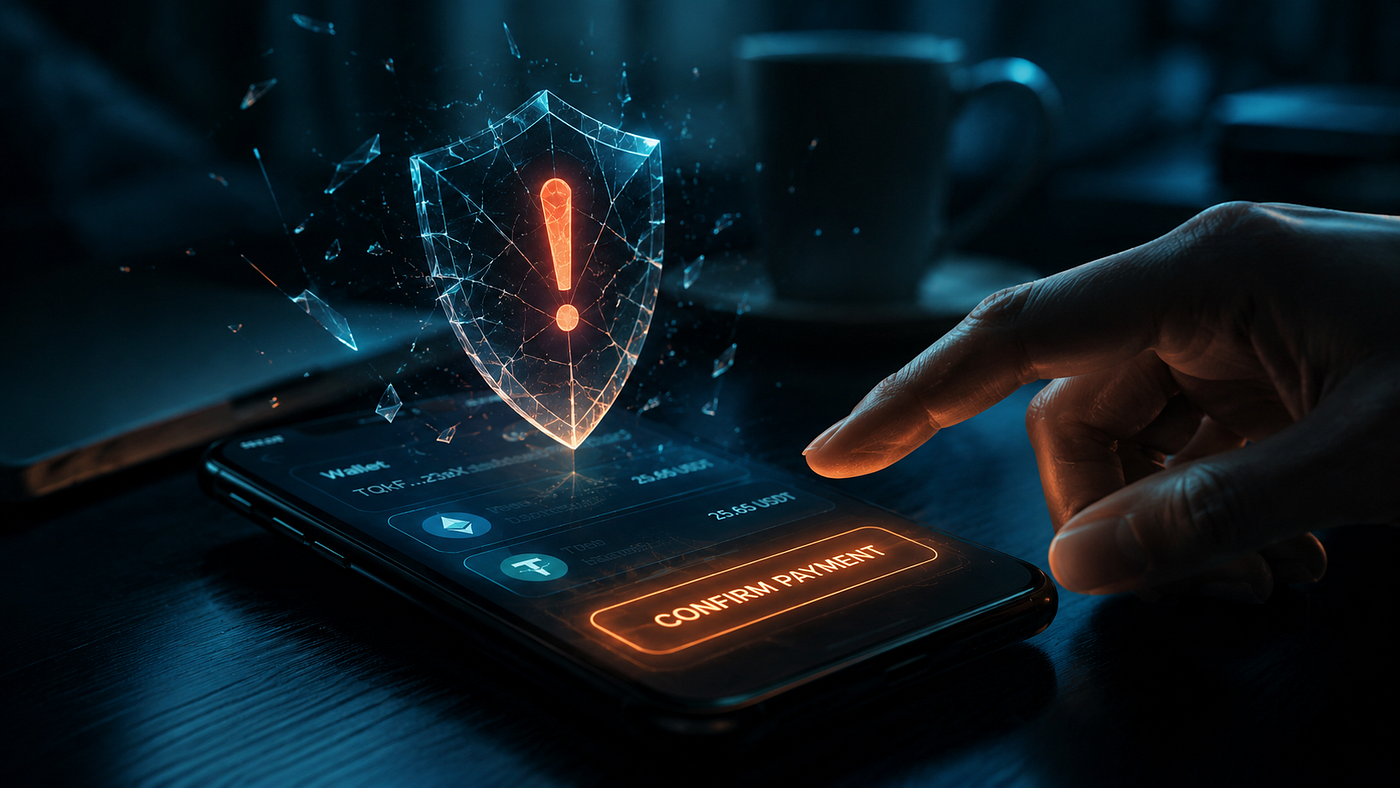
That USDT Payment Might Be Frozen Tomorrow: A P2P Trader’s Guide to Checking a TRC20 Wallet Before You Accept It
A freelance designer in Manila closed a $4,000 project in February 2026 and got paid in USDT TRC20, same as always. Three weeks later, half of it wouldn’t move. No warning, no email, just a wallet that suddenly refused to send. It turned out the client’s payment had passed through an address connected to a Ponzi scheme that collapsed that same month — and once Tether’s compliance team traced the flow, every wallet downstream got caught in the blacklist, including hers. She hadn’t done anything wrong. She just never checked where the money had actually been before it reached her.
Stories like this are becoming routine. Crypto scams and fraud drained an estimated $17 billion globally in 2025 alone, and P2P trading — where buyers and sellers deal directly, often with no intermediary vetting either side — is one of the fastest-growing entry points for both scammers and, increasingly, for accidental exposure to tainted funds. The FBI’s most recent fraud data puts total cryptocurrency-related losses at $11.3 billion, with investment scams alone accounting for $7.2 billion of that. None of this requires you to be careless. It just requires the other side of a transaction to be dirty — and TRON’s USDT TRC20 rail, cheap and fast as it is, has become the preferred highway for moving that dirty money quickly. **Run a free check on any wallet before you accept a payment →**
This guide is written for the people who actually live with this risk every day: P2P sellers, freelancers getting paid in stablecoins, OTC traders, and anyone who’s ever hesitated for a second before hitting “release” on a crypto trade. Here’s exactly what to look for, what the scams look like in practice, and how to check a TRC20 address in the time it takes to read this sentence.
Why P2P and Freelance Payments Are the Riskiest Way to Receive USDT
Unlike an exchange trade, a P2P or freelance payment usually has no intermediary confirming that the sender’s funds are clean. You’re trusting a stranger’s wallet history sight unseen. Scammers know this, and they’ve built entire playbooks around it.
The Triangle Scam
One of the most common patterns documented by P2P safety researchers works like this: a scammer buys crypto from a seller, then uses screenshots of that same payment as fake “proof” to defraud a second seller in a separate trade — pressuring both to release funds before either has actually confirmed receipt. The fix is unglamorous but effective: never release funds until the money is visibly and irreversibly sitting in your own account, and never trust a payment screenshot as proof on its own.
The “Frozen Funds” Advance-Fee Scam
A newer twist plays on the fact that Tether freezes really do happen. Victims are told their incoming USDT is “temporarily blocked” and that a small fee will unlock it — a modern reskin of the decades-old advance-fee fraud playbook, now wearing a crypto compliance costume. If someone claiming to be “Tether support” asks for a fee to release your funds, that’s not how real freezes work; legitimate unblocking goes through law enforcement or legal channels, never a stranger’s payment request.
Pig-Butchering and Romance-Investment Scams
Some of the largest enforcement actions this year — including a single seizure north of $580 million tied to transnational scam networks — trace back to long-con “pig-butchering” schemes where victims are groomed over weeks before being pushed to send USDT to wallets that later turn out to be part of massive laundering operations based out of scam compounds in Southeast Asia. If you’re ever asked to send USDT to “test” a platform or “unlock” a bigger payout, stop.
What a “Frozen Wallet” Actually Means — And Why It Isn’t Random
When Tether blacklists an address, it’s rarely arbitrary. On May 4, 2026, the company froze $38.4 million across 19 Tron addresses after an on-chain investigator traced the funds to a collapsed exchange and an investment scheme worth well over $150 million — proof that freezes often ripple outward from one bad actor to every wallet that touched the money afterward, sometimes several hops removed from the original fraud. That’s exactly why “I got this from a normal-looking client” isn’t a defense against ending up in the same blacklist.
The uncomfortable truth: your wallet doesn’t have to belong to a criminal to get frozen. It just has to have received money that, several transactions back, did.
How to Actually Check a TRC20 Wallet Before You Accept a Payment
Here’s the workflow — it takes less time than confirming a payment screenshot.
1. Copy the sender’s TRON address. Before you release goods, services, or crypto in a trade, get the exact wallet address (starts with “T”) the payment is coming from.
2. Paste it into a scanner and hit go. **Head to AML Crystal and paste the address into the free scan box** — no account, no card, no waiting. In under a second you get a 0–100 risk score built from sanctions data, transaction history, and behavioral clustering.
3. Look at the tier, not just the number. A score under 25 means the wallet has a clean history with no exposure to sanctioned or illicit sources. 26–50 means indirect exposure to shakier counterparties — proceed, but maybe not for a five-figure trade. Above 50, slow down. Above 75, walk away from the trade entirely.
4. Check the fund source breakdown. The full report shows what percentage of the wallet’s history traces back to known exchanges versus unknown or high-risk sources, plus any flags for mixer or darknet exposure — the exact patterns behind the freezes described above.
5. Save the report. If a dispute ever comes up — with a P2P platform, a client, or your own bank — having a timestamped risk report from before you accepted the payment is exactly the kind of documentation that protects you.
Red Flags Worth Memorizing
- A counterparty who refuses to let you scan their wallet before a large trade, or gets defensive when you ask.
- Payment “proof” that’s just a screenshot, with no way to independently verify the transaction hash.
- Any request to pay a fee to “unlock” or “release” your own frozen funds — a real freeze is resolved through law enforcement or legal counsel, never a stranger’s invoice.
- Urgency: pressure to release funds “right now” before you’ve had time to check anything.
- A wallet whose transaction history shows dozens of same-day, similarly sized transfers — a classic structuring pattern used to dodge detection thresholds.
Conclusion
Nobody plans to end up holding frozen USDT. It happens quietly, downstream of someone else’s fraud, to people who did everything else right. The freelancers, P2P sellers, and small OTC traders getting caught in these freezes usually share one thing in common: they never checked the wallet on the other side of the trade before hitting send or release. That check now takes under a second and costs nothing.
Frequently Asked Questions
Can I really check a wallet before accepting a P2P trade for free? Yes. A basic TRC20 risk scan requires no account or payment for casual use — paste the address, get a score, and decide before you commit to the trade.
What should I do if a wallet comes back high-risk mid-trade? Don’t release funds, goods, or services. Ask the counterparty for an alternative wallet, or walk away from the trade — a high-risk score is a strong signal, not a formality.
Is it normal for a client to get upset if I ask to scan their wallet? No. A legitimate counterparty has nothing to hide from a quick, free risk check. Reluctance or defensiveness is itself a red flag worth noting.
How do I know if “frozen funds unlock fee” requests are scams? They almost always are. Genuine freezes are resolved through law enforcement, court orders, or the issuer’s own compliance process — never by paying a stranger a release fee.
Does a high risk score mean the sender is definitely a criminal? Not necessarily — it can also mean the wallet received funds several hops downstream from an illicit source without the current holder’s knowledge. Either way, it’s a reason to pause and dig deeper before transacting further.
Can freelancers protect themselves the same way exchanges do? Yes. The same risk-scoring technology exchanges use for compliance is available as a free, no-registration tool for individual payments — the barrier to using it professionally is gone.
What’s the fastest way to check a transaction that already happened? Paste the transaction hash instead of the wallet address — this analyzes both the sending and receiving side of that specific transfer.
Don’t Find Out the Hard Way
The next USDT payment you’re about to accept could be perfectly clean — or it could be sitting three hops downstream from the next big freeze. Don’t guess. **Scan it free right now at AML Crystal — paste the address, get your score, and know before you release anything.**
메타데이터
- post_id
- 79226e94ec68
- slug
- that-usdt-payment-might-be-frozen-tomorrow-how-to-check-a-trc20-wallet-before-you-accept-it-79226e94ec68
- url
- https://medium.com/@burberryhermes131/that-usdt-payment-might-be-frozen-tomorrow-how-to-check-a-trc20-wallet-before-you-accept-it-79226e94ec68
- canonical_url
- https://medium.com/@burberryhermes131/that-usdt-payment-might-be-frozen-tomorrow-how-to-check-a-trc20-wallet-before-you-accept-it-79226e94ec68
- author_url
- https://medium.com/@burberryhermes131
- status
- ok
- fetched_at
- 2026-07-15 15:25:19