Apple Just Put Ads in Maps and Nobody Is Talking About It
Apple released iOS 26.5 this morning. The release notes call it three new features. One of them is a wallpaper.
Apple Just Put Ads in Maps and Nobody Is Talking About It
Apple released iOS 26.5 this morning. The release notes call it three new features. One of them is a wallpaper.
The release notes for iOS 26.5 are 142 words long. I read them this morning, before my shift, with the second coffee of the day and the radiator clicking the way it does when the heating has been off overnight, and the house is taking its time to warm up.
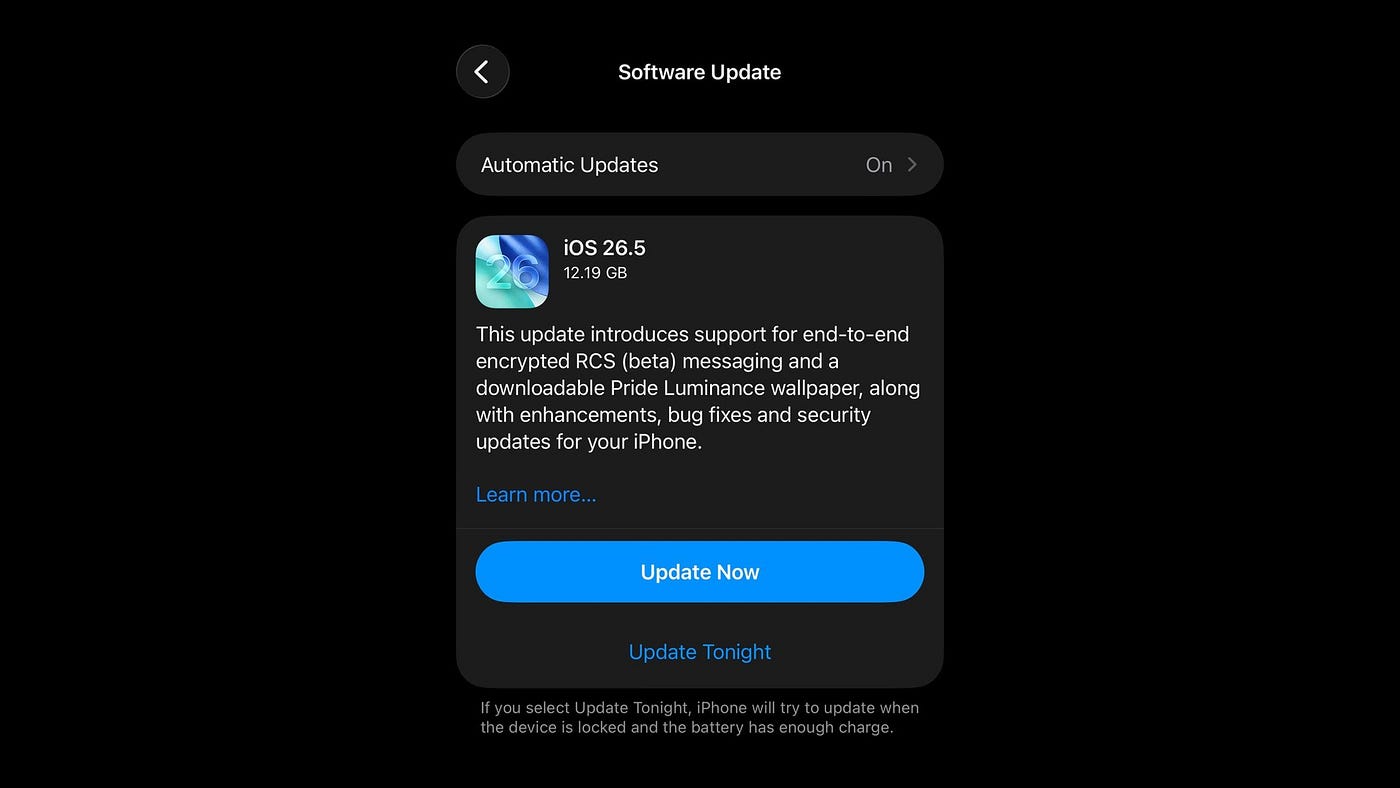
Image from my mobile
Three features, Apple said. Encrypted RCS messaging. A Pride wallpaper. Suggested Places in Maps.
I want to take those in the wrong order, because the order Apple put them in is doing some work I do not think is accidental.
Start with the wallpaper, which is a wallpaper. It refracts colours. It celebrates Pride. It is, by any reasonable reading of the word feature, not one. It is an art asset, the kind of thing that in a sane version notes would sit in a line at the bottom that said “also, new wallpaper.” Putting it at feature-level in a three-item list is the kind of thing you do when you need the list to be three items long. Which makes you wonder what the other two are doing in the list, and whether they were chosen to share the stage with a wallpaper for reasons other than their own merits.
The encryption one is real, and it is good, and I want to be clear about that before I get to the part where I am annoyed. End-to-end encryption for RCS between iPhone and Android, where the carrier supports it, closes a privacy gap that has been a small embarrassment for Apple for about three years. I think of my friend Sai Kumar, who has been the lone green bubble in our group chat for years. Watching his videos come through as pixelated, unencrypted messes has been a constant 2020s headache. The reason this is shipping now and not in the next major version is almost certainly that the EU and the UK have been making noises about messaging interoperability and Apple has decided to get ahead of the regulator rather than be dragged by one, but the result is that the encryption is here and the encryption is good, and I am turning it on today, and so should you.
That is one of three.
The third one, the Maps one, is where the piece I actually wanted to write lives.
Apple’s release notes, verbatim, describe Suggested Places as displaying recommendations based on what is trending nearby and your recent searches. That sentence is fine. The sentence that comes a few lines later, also in Apple’s own documentation, is the one I had to read twice. Ads on Maps will appear when users search in Maps, and can appear at the top of a user’s search results, as well as at the top of the new Suggested Places experience.
Read that sentence with the word “ads” replaced by “paid placements.” Read it again with the phrase “at the top of a user’s search results” sitting in the front of your mind. That is what the feature is. The Suggested Places surface is the room. The ad slot is the furniture. Apple has built a new room in Maps, and the first thing they have put in it is somewhere to sell space.
Last month, I was driving back from a late shift when my friend Sai Kumar rang to say he had run out of paracetamol and his head was splitting, and I ended up looping through Linthorpe trying to find a pharmacy that was still open. In that moment, you are not browsing or exploring. You are solving a small crisis. Having a paid placement, a shop that paid to be there rather than the one that is actually open or nearest, be the first result in that moment is a small breach of what the app is for.
Maps is not the App Store. People know what the App Store is. They open it expecting commerce, the way you open Amazon expecting commerce, and the ads in App Store search have been there since 2016, and nobody has built a piece around them since about 2017 because the surface has always been transactional. Maps has not. Maps is the app you open when something has gone slightly wrong with your day and you need a fact about the world. Where the nearest petrol station is, whether the place you are trying to get to is still open, how long the A19 will take you on a Tuesday at half past four. The contract between the user and the app, up to and including iOS 26.4, has been that the answer Maps gives you is the answer to the question you asked. Suggested Places quietly rewrites that contract.
The rewrite is small. That is the part that makes it work. If the change were larger, it would be a story. Because it is small, it is a footnote in a release notes page that leads with a wallpaper.
Now I want to come back to something I skipped, because there is a second change in iOS 26.5 that is not in the three-feature list at all, and it is the one I have been turning over the longest.
Starting with this update, the App Store supports a new subscription model. Monthly payments, twelve-month commitment. The framing, in Apple’s own developer documentation, is that this gives users the price of an annual subscription without the upfront cost. Spread the pain. Easier on the monthly budget.
Run the sentence with the word “contract” instead of “subscription,” the way I did with the ads paragraph, and the shape of it changes.
A twelve-month contract for an app. Paid monthly, so the line item on the statement stays small enough to slide past you. Long enough that by the time you remember you have not opened the app in four months, you are eight payments in, and the cancellation flow is going to fight you for the last four. We all know what cancellation flows are like. Every one of them is built by a team whose job it is to make you not cancel. I saw this pop up on a pro-level photo editing app last week, a “special offer” that looked like a bargain until I realised I could not opt out until 2027.
Annual subscriptions are honest, in their way. You pay the big number, you feel it, you remember it next year. Monthly subscriptions are honest in the other direction. You see the charge every month, small ones get cancelled when they stop earning their place, the market does its small Darwinian work and the apps that survive are the ones still being used. The twelve-month-committed monthly subscription is the worst of both. Small enough to be invisible. Long enough to lock you in. Designed, and I do mean designed, for the friction of cancellation to do the work the product itself cannot.
Developers will love it because predictable subscription revenue is the most valuable kind of revenue there is, and a twelve-month locked floor is a forecasting gift. Apple will love it because Apple takes its cut on every one of those twelve payments. The user is the only party in the transaction with no structural upside, which is also, not coincidentally, the only party Apple has to convince with the marketing copy on the announcement page.
So that is iOS 26.5. One genuine privacy upgrade that should have shipped two years ago and is shipping now because the regulators got loud. One change to Maps that turns a utility into a small advertising surface. One change to the App Store subscription rails that makes it materially harder to leave an app you have stopped using. And a wallpaper, which got to be feature number two on the list, because the list needed three items and the other two were not the kind of thing Apple wanted at the top of the page.
I am installing the update today. I always do. I usually hit the Update Tonight button and leave the phone face down on the nightstand, hoping the security patches do not mess with my alarm.
But I am going to remember which of the three features was a wallpaper.
And when Maps shows me a sponsored result the next time I am trying to find something I actually need, I am going to remember that too.
I write about Apple, native workflows, and why you probably don’t need half the apps on your phone.
Subscribe: substack.com/@anilkumarbakkashetti
메타데이터
- post_id
- 7932099986fa
- slug
- apple-just-put-ads-in-maps-and-nobody-is-talking-about-it-7932099986fa
- url
- https://medium.com/miles-metrics/apple-just-put-ads-in-maps-and-nobody-is-talking-about-it-7932099986fa
- canonical_url
- https://medium.com/miles-metrics/apple-just-put-ads-in-maps-and-nobody-is-talking-about-it-7932099986fa
- author_url
- https://medium.com/@Anilkumarbakkashetti
- status
- ok
- fetched_at
- 2026-06-12 07:40:50